Cooked Before Drying
In the documented Aksakal method, much of the tarhana mixture is cooked before it is formed and dried.






Manav Tarhanası is one of the characteristic traditional foods of Balıkesir and a fascinating example of just how different one tarhana can be from another. Rather than describing a single universal Turkish recipe, the name points to a regional food tradition shaped by local ingredients, household knowledge and the culinary culture of Balıkesir's long-established Manav communities.
A particularly detailed modern record comes from Aksakal in Bandırma, where Manav and Muhacir families living in the same settlement preserve strikingly different tarhana traditions. In the documented Manav version, milk and yoghurt are heated before tomato, pepper, göce, chickpeas and wheat flour are incorporated into a thick cooked dough.
Once cooled, the dough is pushed and crumbled through a traditional sieve known as a gözer, spread over clean cloth and dried. When it is time to make soup, the dried tarhana can be cooked with tomato, water and a little oil, producing a savoury, gently tangy bowl whose flavour is quite different from heavily spiced or strongly fermented tarhanas found elsewhere in Türkiye.
The documented Aksakal method cooks the dairy, vegetables, grain and flour before the tarhana is dried.
Wheat-based göce and pre-cooked chickpeas give the tarhana additional body and regional character.
The cooled dough is traditionally crumbled through a gözer before the small pieces are dried.
Manav Tarhanası is recognised among the traditional dishes that help define Balıkesir's diverse cuisine.
Essential information about one of Balıkesir's distinctive traditional tarhana preparations.
Balıkesir Province in north-western Türkiye, with particularly useful modern documentation from Aksakal in Bandırma.
A dried tarhana preparation that is later reconstituted and cooked as a traditional soup.
Documented versions can combine wheat flour, göce, chickpeas, yoghurt, milk, tomato and pepper.
The cooked and cooled tarhana dough can be crumbled through a gözer before being dried for storage.
To understand Manav Tarhanası, it helps to understand Balıkesir as a meeting place of different culinary communities.
Tarhana is found across Türkiye, but the word does not describe one fixed formula. Flour, yoghurt, grains, vegetables, herbs, fermentation, cooking and drying can all change dramatically from one province—or even one village—to another.
Balıkesir provides an especially revealing example. The province's food culture has been shaped by long-established local communities as well as Yörük traditions and successive migrant populations. As a result, several forms of tarhana can exist within the same geographical area.
Manav Tarhanası is one of those expressions. Balıkesir's provincial culture authority lists it among the region's notable traditional foods alongside tirit, sura, saçaklı mantı, keşkek, düğün çorbası, zerde and other characteristic dishes.
A remarkable example survives in Aksakal, a neighbourhood of Bandırma. There, researchers have documented both Manav and Muhacir Tarhanası, showing how two communities living side by side can transform the same basic idea—tarhana—into preparations with different ingredients, processing methods, aromas and flavours.
The identity of Manav Tarhanası comes from much more than flour and yoghurt: cooked vegetables, grains, chickpeas, drying and the method of crumbling all contribute.
In the documented Aksakal method, much of the tarhana mixture is cooked before it is formed and dried.
The Aksakal recipe combines both dairy ingredients before the vegetables and grain are added.
Fresh vegetables add colour, aroma and savoury character to the tarhana mixture.
A wheat product known locally as göce contributes grain texture and helps distinguish this preparation from simpler flour-based tarhanas.
Pre-cooked chickpeas add another layer of substance to the traditional mixture.
Flour is gradually worked into the cooked ingredients until a firm tarhana dough develops.
The cooled dough is traditionally pushed through a coarse sieve or screen to create small pieces suitable for drying.
The granulated tarhana is spread over cloth and dried thoroughly before being stored for later soup making.
Balıkesir Manav Tarhanası is a regional tarhana tradition associated with Balıkesir's local Manav food culture. It is prepared as a preserved dry ingredient and later cooked with liquid to make a warming soup.
One of the clearest contemporary descriptions comes from Aksakal in Bandırma. In that recipe, milk and yoghurt are heated, tomato and pepper are added, göce is cooked until tender, and chickpeas and salt follow. Wheat flour is then introduced gradually until the mixture becomes a substantial dough.
After cooling, the dough is broken into smaller particles using a gözer. These particles are dried thoroughly and stored. The result is therefore quite different in production from simply mixing raw flour and yoghurt and leaving the dough to ferment for an extended period.
The ingredients are transformed into a firm cooked tarhana base before drying.
The cooled dough is reduced to small pieces so that it can dry efficiently.
Thorough drying allows the tarhana to be stored and used when soup is needed.
The dried preparation is returned to the pot with liquid and cooked until smooth and ready to serve.
In this regional culinary context, Manav is a cultural designation connected with long-established local communities of north-western Anatolia. The name therefore identifies the tradition associated with the people making the tarhana rather than describing a particular vegetable or ingredient.
This becomes especially clear in settlements such as Aksakal, where researchers distinguish between the tarhana prepared by the local Manav community and a separate Muhacir Tarhanası associated with migrant culinary traditions.
The two preparations demonstrate an important principle of Turkish regional food: people can live in the same village, shop in the same landscape and use some overlapping ingredients while still preserving clearly different culinary identities.
“Manav” identifies the regional food tradition in which this form of tarhana has been preserved.
Recipes survive through households and communities rather than through one nationwide formula.
Different food traditions can coexist within the same Balıkesir settlement.
Manav and Muhacir preparations provide a particularly vivid example of culinary diversity.
Balıkesir lies between Marmara and the northern Aegean, and its cuisine reflects an unusually broad range of landscapes and communities. Grain agriculture, livestock, dairy production, olive cultivation, coastal foods and village cooking all contribute to the provincial table.
Within this food culture, Manav Tarhanası is listed alongside foods such as tirit, sura, saçaklı mantı, keşkek, düğün çorbası, zerde and höşmerim. That company is revealing: many of Balıkesir's most distinctive dishes are strongly connected with home cooking, seasonal preparation, communal meals or traditional preservation.
Tarhana is particularly suited to a household economy built around preparing food when ingredients are abundant and preserving it for later use. Summer vegetables, dairy, grain and legumes can be transformed into a dry product ready to become soup during cooler months.
Wheat flour and göce connect the tarhana to Balıkesir's agricultural interior.
Yoghurt—and in some documented versions milk—adds richness and acidity.
Tomatoes and peppers bring the flavours and colours of the warm growing season into a preserved food.
Drying transforms the cooked mixture into a practical ingredient for later meals.
Recipes vary from household to household, so there is no reason to expect every bowl of Manav Tarhanası to contain an identical ingredient list. Nevertheless, the carefully documented Aksakal recipe provides an excellent reference for understanding the tradition.
That preparation combines milk, yoghurt, tomato, pepper, göce, pre-cooked chickpeas, salt and wheat flour. Together they create a far more layered base than a tarhana made only from flour and yoghurt.
Other Balıkesir descriptions demonstrate that variations exist. Some local preparations emphasise tomato, pepper, yoghurt, chickpeas and flour and may also include mint. These differences should be understood as part of the living household tradition rather than as contradictions.
A 2026 academic study recorded the following ingredients in the Manav Tarhanası prepared for its research in Aksakal, Bandırma.
Yoghurt is one of the ingredients most strongly associated with tarhana across Türkiye, but the Aksakal Manav recipe is notable for combining both yoghurt and milk.
The two are heated together at the beginning of the preparation. This creates the liquid foundation into which the tomato, pepper, göce and other ingredients are introduced.
Because regional tarhanas can be radically different, the presence of milk should not be treated as a rule for every Balıkesir household. It is best understood as an important feature of this well-documented local preparation.
Contributes acidity, dairy flavour and richness to the tarhana base.
Softens and enriches the mixture in the documented Aksakal preparation.
The dairy mixture is brought to the heat before the vegetables are incorporated.
Other household versions may use a somewhat different dairy balance.
Tomato and pepper give many forms of western Anatolian tarhana their warm colour and recognisable savoury aroma. In the Aksakal recipe, both are prepared before being added to the heated milk-and-yoghurt mixture.
The vegetables are not simply a garnish added when the final soup is served. They become part of the tarhana itself, meaning their flavour is preserved inside the dried preparation.
Tomato also returns when the documented tarhana is made into soup: grated tomato is cooked briefly in oil before water and the dried tarhana are added.
Brings acidity, colour and savoury depth to both the dry tarhana and the finished soup.
Adds vegetal sweetness and aromatic character without requiring a heavily spiced formula.
The vegetables become fully incorporated rather than remaining as separate pieces.
Drying provides a way of carrying summer produce into later months.
Two ingredients help make the documented Manav Tarhanası especially interesting: göce and chickpeas.
Göce is a wheat-based grain preparation used in regional Anatolian cooking. In the Aksakal method it is washed, added to the boiling mixture and cooked gently until it becomes soft before the chickpeas and flour are incorporated.
The chickpeas are cooked in advance. Together with the göce they give the tarhana additional substance and demonstrate why regional tarhanas cannot always be understood simply as fermented flour-and-yoghurt mixtures.
A traditional wheat component that adds grain character to the mixture.
The göce needs enough cooking time to become tender before flour is added.
The legumes are prepared beforehand and then mixed into the tarhana base.
Grain and chickpeas contribute to the substantial character of the final preparation.
Wheat flour is added only after the dairy, vegetables, göce and chickpeas have already been brought together. The heat is reduced and the flour is introduced gradually rather than dumped into the pot all at once.
As the flour absorbs the moisture, the mixture becomes increasingly thick. The goal at this stage is to produce a dough substantial enough to cool, handle and eventually pass through the gözer.
This cooked-dough stage is one of the most useful clues for recognising the particular method documented in Aksakal. It gives the preparation a different production logic from tarhanas built around prolonged fermentation of a raw dough.
Working the flour in little by little makes it easier to distribute evenly.
The flour must become properly incorporated into the hot mixture.
The mixture needs enough structure to be handled after cooling.
The dough is left for several hours before the crumbling stage begins.
One of the most distinctive details in the Aksakal preparation is the use of a gözer, a coarse sieve or screen through which the cooled tarhana dough is worked by hand.
The dough is placed over the gözer and rubbed or pushed through its openings. This separates the large mass into much smaller pieces, increasing the surface area exposed to air and making the later drying stage more effective.
Not every fragment necessarily passes through perfectly on the first attempt. Larger pieces can be dried separately or worked again until they reach a suitable size.
The large cooked mass becomes manageable granules and small pieces.
Smaller particles expose more surface to moving air.
The traditional process is tactile and depends on judging the dough's consistency.
The tool gives the production process a strong connection with household food craftsmanship.
After the tarhana has been crumbled into smaller pieces, it is spread over a clean cloth and allowed to dry.
The documented Aksakal method notes that indoor drying can take several days. Drying can also take place in a suitable clean outdoor environment, provided the tarhana is protected from dust and contamination.
During this period the pieces are gently moved from time to time. This helps air reach the surfaces between the granules so that moisture can escape more evenly.
A broad layer provides better air circulation than a deep pile.
Drying surfaces and surroundings should be protected from dust and contamination.
Occasional turning helps expose different surfaces to the air.
Proper drying is essential before the tarhana is moved into storage.
The Aksakal method can be understood as a sequence: heat milk and yoghurt, add tomato and pepper, cook göce until soft, add chickpeas and salt, work in the wheat flour, cool the dough, crumble it through a gözer and dry the resulting pieces thoroughly.
Although the ingredient list is straightforward, the process requires practical judgement. The cook must recognise when the göce has softened, when enough flour has been incorporated and when the dough has cooled enough to handle without becoming difficult to crumble.
Milk and yoghurt form the starting liquid for the documented preparation.
Tomato and pepper are incorporated and brought back to the heat.
The grain is cooked gently until sufficiently tender.
Pre-cooked chickpeas and salt are mixed into the base.
Wheat flour is gradually added until a thick dough develops.
The mixture rests before it is handled and crumbled.
The dough is reduced to smaller pieces by hand.
The tarhana is spread over clean cloth and dried for storage.
Making the final soup is considerably quicker than producing the dried tarhana itself. In the Aksakal preparation recorded for the 2026 study, a little sunflower oil is heated before grated tomato is added and cooked.
Hot water is then introduced. Once the liquid has boiled, the dried Manav Tarhanası is crumbled gradually into the pot, helping prevent large lumps from forming.
The soup is cooked until the tarhana has dispersed and reached the desired consistency. Salt can be adjusted at the end, and the documented serving method notes that yoghurt or cheese may be added according to preference.
A small amount provides the base for the tomato.
Fresh or preserved grated tomato develops flavour before the water is added.
The liquid creates the soup base into which the dry tarhana will dissolve.
Adding it gradually makes it easier to achieve an even consistency.
Taste near the end because the dried tarhana is already seasoned.
Cheese or yoghurt can accompany the soup according to local or household preference.
Manav Tarhanası can combine several flavour families at once. Yoghurt supplies gentle acidity, tomato and pepper add vegetable sweetness and savoury depth, wheat and flour create body, and chickpeas contribute a mellow legume character.
A 2026 sensory study of the Aksakal preparations found that the tested Manav Tarhanası was perceived particularly through salty and umami qualities, with sourness also contributing to its profile.
The study involved a relatively small specialist panel, so those results should not be treated as a universal description of every household version. They are nevertheless useful evidence of how one carefully documented Balıkesir Manav Tarhanası was experienced when compared under controlled conditions with the local Muhacir preparation.
Tomato, grain, yoghurt and chickpeas combine into a substantial soup flavour.
Yoghurt contributes acidity without necessarily making the soup sharply sour.
Flour and göce create a fuller body than a thin broth-based soup.
Fresh vegetables and the dried tarhana base give the finished bowl a layered aroma.
In 2026, researchers Sedanur Akkoç and Osman Güldemir published a comparative study of Manav and Muhacir Tarhanası from Aksakal in Bandırma. The research documented ingredients and production methods before comparing the soups through sensory evaluation.
Thirteen gastronomy-related panelists evaluated five basic taste dimensions as well as aroma and descriptive characteristics. For the Manav Tarhanası sample, salty and umami perceptions were prominent, while descriptive terms including savoury, aromatic and sour also appeared.
The importance of the study goes beyond deciding which soup individual tasters preferred. Its real value is that it records, in unusual detail, how two different culinary communities living in the same Balıkesir neighbourhood preserve different versions of tarhana.
The research appeared in the Balıkesir University Social Sciences Institute Journal.
The study focused on two tarhana traditions prepared in the same neighbourhood.
Ingredients, dough preparation, soup preparation and storage methods were recorded.
The finished Manav and Muhacir soups were evaluated for taste, aroma and descriptive qualities.
Aksakal provides one of the best examples of why travellers should never assume that all Turkish tarhana is the same. Manav and Muhacir Tarhanası are made in the same neighbourhood yet follow clearly different culinary paths.
The documented Manav Tarhanası contains fresh tomato and pepper, a milk-and-yoghurt combination, göce and chickpeas and follows a cooked-dough process before the mixture is worked through a gözer and dried.
The Muhacir Tarhanası recorded in the same study uses a different formulation involving yoghurt, sourdough starter, tomato and pepper pastes and a substantial group of aromatic spices. Its production includes a more intensive fermentation stage.
These differences reveal how migration, family tradition and cultural identity can survive in something as everyday as a bowl of soup.
Fresh vegetables, dairy, göce, chickpeas, flour and a cooked-and-dried preparation.
A differently seasoned preparation with sourdough and a stronger fermentation component.
Both traditions have been documented within Bandırma's Aksakal neighbourhood.
The comparison demonstrates how recipes can preserve community histories within one landscape.
No. Like many traditional foods transmitted through households rather than industrial specifications, Manav Tarhanası can change from family to family and from district to district.
The Aksakal recipe is exceptionally useful because its ingredients and process have been documented in detail. However, other Balıkesir descriptions show somewhat different combinations. A local recipe, for example, describes tomato and pepper cooked down before yoghurt and chickpeas are added, followed by flour, salt and mint.
Such variation is normal. The most useful approach is therefore to describe exactly which local version is being discussed rather than turning one recipe into a rigid rule for the entire province.
Ingredient proportions and seasonings can change according to family tradition.
Balıkesir is a large province with many distinct local food cultures.
Drying, crumbling and the length of resting can vary between preparations.
The variations are part of what makes regional tarhana worth exploring.
Drying is what transforms freshly cooked tarhana dough into a practical pantry ingredient. Moisture is gradually removed from the small pieces, allowing the product to be stored and later reconstituted with water.
The process also changes how the food is used. Instead of preparing yoghurt, vegetables, grain, chickpeas and flour from the beginning every time soup is wanted, the household does the more time-consuming work in advance.
This relationship between seasonal production and later convenience is one of the great strengths of traditional tarhana. The finished dry product represents both preserved ingredients and preserved labour.
Drying creates a shelf-stable form suitable for longer storage when handled correctly.
The most labour-intensive stages are completed before the soup is needed.
A portion of dry tarhana can be taken from storage while the remainder stays preserved.
Abundant summer ingredients can become part of meals served in cooler seasons.
Manav Tarhanası is most naturally served hot, after the dried preparation has fully dispersed into the cooking liquid and the soup has reached a smooth, satisfying consistency.
In the documented Aksakal recipe, tomato forms part of the cooking base and cheese or yoghurt may accompany the finished soup according to preference.
As with most traditional soups, thickness is partly a matter of household taste. More water produces a lighter consistency, while a greater proportion of tarhana creates a thicker and more substantial bowl.
The aroma and soft texture are most expressive straight from the pot.
The liquid-to-tarhana ratio determines how light or substantial the soup becomes.
A little yoghurt can reinforce the dairy character already present in the tarhana.
The Aksakal documentation also records cheese as a possible accompaniment.
Tarhana's preserved form makes it especially well suited to cooler weather, when a stored dry mixture can quickly become a warm and filling soup.
Balıkesir sources also place Manav Tarhanası within the province's wider traditional food culture, which includes foods prepared for homes, gatherings, weddings and charitable communal meals.
The exact role of the soup varies between households. For some families tarhana is an everyday winter food; for others its strongest associations may be with older village cooking, family preparation or the annual rhythm of making provisions for the colder months.
Dried tarhana is particularly practical when warm soup becomes part of the daily table.
Its preserved form makes it easy to prepare in smaller household quantities.
Manav Tarhanası belongs to the wider repertoire of Balıkesir's regional cooking.
The making of tarhana connects summer ingredients with meals eaten later in the year.
Manav Tarhanası is deeply connected with home cooking, so it should not be expected on every restaurant menu. Travellers interested in trying it should look beyond generic tourist restaurants and seek places that specialise in regional Balıkesir cuisine.
Traditional esnaf lokantaları, village restaurants, local food events and establishments serving home-style dishes can be promising places to ask. Bandırma and the surrounding countryside are especially relevant because Aksakal's Manav Tarhanası tradition has now been documented academically.
When buying dried tarhana, ask about the ingredients and the place of production. The word “tarhana” alone does not tell you whether the product follows a Manav, Muhacir, Yörük or another regional style.
Use the name “Manav Tarhanası” rather than simply asking for tarhana.
Home-style kitchens are more likely to preserve local soup traditions.
The Aksakal tradition provides a particularly strong connection with this part of Balıkesir.
Homemade or small-scale dried tarhana may reveal varieties rarely seen in standard supermarkets.
The most rewarding way to taste Manav Tarhanası is to treat it as a regional food rather than simply another version of “tarhana soup.” Ask how it was made, which grains were used and whether the recipe belongs to a particular village or family.
Pay attention to the texture as well as the flavour. Göce, chickpeas and flour can create a substantial body, while yoghurt and vegetables add layers that may become easier to recognise as the soup cools slightly.
Homemade tarhana often carries a family or village-specific recipe.
Its presence can tell you more about the structure of the traditional mixture.
Yoghurt contributes tang, but the balance varies between recipes.
The soup can feel more substantial than tarhanas made mainly from finely milled flour.
If you encounter both Manav and Muhacir Tarhanası, tasting them side by side can be particularly revealing.
Properly prepared local tarhana makes an unusual regional food souvenir.
Local producers can explain the liquid ratio and finishing method they use at home.
Pair the experience with Balıkesir's tirit, cheeses, lamb dishes, höşmerim and other regional foods.
Manav Tarhanası tells several stories at the same time. It shows the importance of wheat and dairy, the seasonal use of tomatoes and peppers and the role of preservation in traditional household cooking.
More importantly, it demonstrates how culture can survive through technique. The ingredients matter, but so do the sequence of cooking, the way the flour is incorporated, the use of the gözer and the knowledge required to judge when the tarhana is dry enough for storage.
Aksakal adds another layer to that story. Manav and Muhacir families have preserved different approaches to tarhana within the same neighbourhood, making one humble soup an unusually clear example of Balıkesir's cultural diversity.
Summer produce is transformed into food that can be enjoyed months later.
Texture and drying depend on experience that is difficult to capture completely in a written recipe.
Recipes can preserve community identity even when different groups live side by side.
Balıkesir's cuisine is strongest when its many local traditions are allowed to remain distinct.
For travellers interested in regional Turkish food, Manav Tarhanası offers much more than a bowl of soup. It connects grain, dairy, vegetables, preservation and community history in a preparation that changes meaningfully from one local tradition to another.
It is especially interesting for anyone who has already tasted conventional red tarhana elsewhere in Türkiye. The presence of göce and chickpeas, together with the cooked-dough and gözer method documented in Aksakal, makes comparison worthwhile.
And because Manav and Muhacir Tarhanası can coexist within the same Balıkesir community, the dish provides a perfect example of why travelling for food is often about how people cook, not simply what a dish is called.
The cooked, crumbled and dried process is fascinating in its own right.
Göce adds another dimension to a food many travellers expect to be based only on flour.
The Manav–Muhacir comparison reveals the cultural depth behind Balıkesir's food.
A homemade or village preparation offers the strongest connection with the tradition.
Manav Tarhanası is only one doorway into Balıkesir's enormous culinary landscape. Continue from preserved soup traditions into ceremonial dishes, lamb, handmade dough foods, regional dairy products and famous desserts.
Explore another grain-based dish whose traditional preparation is deeply connected with community and ceremony.
Discover one of the province's classic combinations of bread, broth and meat.
Continue with another soup closely connected with Balıkesir's ceremonial food culture.
Discover the lamb tradition behind many of the province's best-known savoury dishes.
Move from savoury regional food to Balıkesir's famous cheese-based dessert.
Discover one of Balıkesir's most recognisable traditional dairy drinks.
There is no single “standard” tarhana against which every regional version can be measured. Across Türkiye, tarhana may contain different grains, vegetables, dairy products, herbs and seasonings, and its fermentation and drying methods can vary considerably.
What makes the documented Balıkesir Manav version particularly useful is its clearly recorded combination of milk, yoghurt, fresh tomato and pepper, göce, chickpeas and wheat flour, followed by cooking, cooling, gözer crumbling and drying.
The best way to compare tarhanas is therefore not to ask which one is the “real” tarhana. Ask instead which community made it, what grain and dairy were used, whether the mixture was cooked or fermented, how it was dried and how the resulting soup is traditionally served.
A documented cooked preparation incorporating fresh vegetables, dairy, göce, chickpeas and flour.
May depend more heavily on fermentation, different grains, herbs, sourdough, spice or alternative drying techniques.
Many tarhanas transform seasonal ingredients into a preserved base for later soup making.
The community and production method tell you more than the word “tarhana” alone.
Traditional tarhana making involves both cooking and drying, so cleanliness and moisture control matter throughout the process. Use clean utensils, clean cloths and properly prepared ingredients.
When adding flour to the hot mixture, work gradually. Adding too much at once makes even distribution more difficult and can leave pockets of dry flour inside the dough.
The dried tarhana should not be packed away while residual moisture remains. When making the final soup, add the tarhana gradually and stir well so that it disperses evenly instead of forming large lumps.
Allow the grain to soften before building the final dough with flour.
Gradual incorporation makes the thick mixture easier to control.
The dough should be safe and manageable before it is worked through the gözer.
Drying surfaces should be clean, dry and protected from contamination.
Gentle turning helps air reach the spaces between the tarhana pieces.
Residual moisture can compromise the quality of a preserved food.
It is a regional Balıkesir tarhana tradition in which a prepared dough is dried and later cooked with liquid to make soup.
It is associated with Balıkesir's regional food culture. A particularly detailed contemporary recipe has been documented in Aksakal, Bandırma.
“Manav” is used here as a regional cultural designation connected with the local community preserving the food tradition.
No single recipe represents all Turkish tarhana. Manav Tarhanası has its own local ingredients and preparation methods.
The Aksakal recipe documented in 2026 uses milk, yoghurt, tomato, pepper, göce, pre-cooked chickpeas, salt and wheat flour.
Yes. Yoghurt is an important ingredient in documented Balıkesir preparations.
The documented Aksakal version does. Other household recipes can vary.
Yes in the Aksakal recipe and in other recorded Balıkesir versions. The chickpeas are cooked before being added.
Göce is a traditional wheat-based grain preparation used in regional Anatolian cooking and forms part of the documented Aksakal Manav Tarhanası recipe.
Yes in the detailed Aksakal recipe, where fresh tomato and pepper are incorporated into the cooked tarhana mixture.
Tarhana methods vary widely. The documented Aksakal Manav method emphasises cooking, cooling, crumbling and drying rather than the more intensive fermentation recorded for the local Muhacir Tarhanası.
It is a coarse sieve or screen traditionally used to break the cooled tarhana dough into smaller pieces before drying.
Drying removes moisture and transforms the prepared dough into a preserved ingredient that can later be cooked as soup.
The exact time depends on particle size, temperature, humidity and drying conditions. The Aksakal documentation notes that indoor drying can continue for several days.
One documented method cooks grated tomato in oil, adds hot water and then gradually crumbles the dried tarhana into the boiling liquid.
It is savoury and gently tangy, with dairy, tomato, pepper, grain and chickpea flavours. A 2026 sensory study found salty and umami characteristics particularly noticeable in its Aksakal sample.
Not necessarily. The documented Aksakal formula is considerably less spice-driven than the Muhacir Tarhanası examined alongside it.
The Aksakal versions differ in ingredients and technique. The Manav recipe includes fresh vegetables, milk, yoghurt, göce and chickpeas, while the documented Muhacir recipe uses sourdough, pastes and several aromatic spices and undergoes a stronger fermentation process.
No. Household and district variations exist, so individual recipes may use different proportions, seasonings or processing details.
Yes. Tarhana is traditionally dried precisely so that it can be stored and cooked later, although availability depends on local producers and markets.
Look for regional restaurants, esnaf lokantaları, village food events and local producers, especially in areas where traditional Balıkesir cooking remains strong.
Its importance lies in the combination of regional ingredients, preservation techniques and community knowledge—and in the way it illustrates Balıkesir's remarkable culinary diversity.
The strongest images should go beyond a simple bowl of soup. Manav Tarhanası offers an entire visual sequence: fresh tomato and pepper, grains and chickpeas, the thick cooked dough, the gözer process, drying over cloth and finally the steaming finished soup.
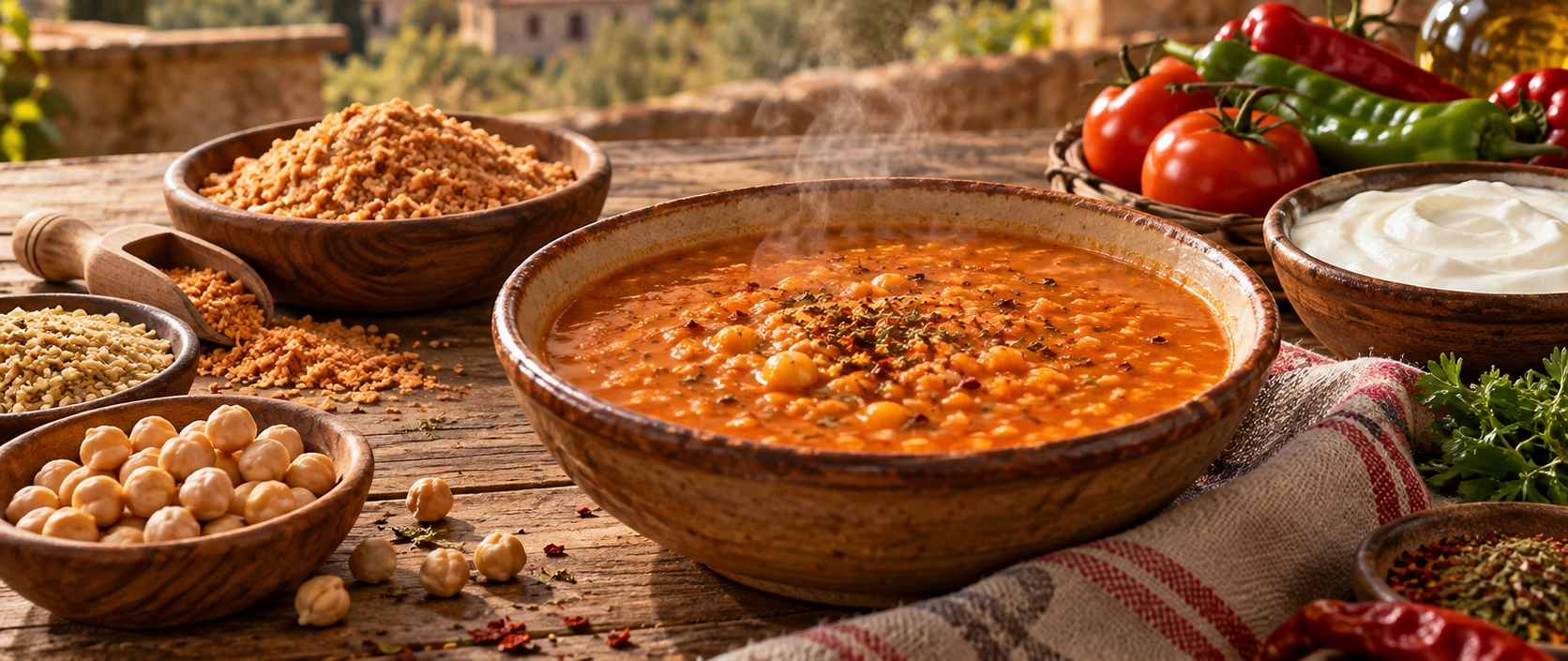
Photograph the finished soup in rustic ceramic tableware with its warm orange-red colour clearly visible.
A close-up of the granulated dried product helps visitors understand what tarhana looks like before cooking.
Hands pushing the cooled dough through a traditional sieve would tell the production story immediately.
Show tomato, pepper, yoghurt, chickpeas, flour and wheat together before preparation begins.
Tarhana granules spread over clean fabric create a strong image of traditional seasonal preservation.
A traditional kitchen or family preparation scene gives the food the cultural context it deserves.
Discover Manav Tarhanası together with local markets, village foods, traditional cheeses, lamb dishes, olive country and the many culinary communities that have shaped Balıkesir.
Custom-designed private programs can combine Balıkesir's traditional dishes, local producers, markets, village landscapes and regional food stories according to your dates and interests.
Explore Balıkesir through traditional tarhana, regional markets, cheeses, lamb, village foods and the culinary communities that give the province its remarkable diversity.
Request This Experience
Combine Manav Tarhanası with Balıkesir's olive oil, cheeses, lamb, desserts, village cooking and northern Aegean landscapes.
Request This Tour