Wheat-Based
Keşkeklik wheat forms the body of the dish and is cooked until the grains lose much of their original structure.






Keşkek is one of the great ceremonial dishes of Turkish cuisine, and Balıkesir has a clearly documented local version. The provincial recipe begins with keşkeklik wheat and meaty lamb bones, cooked slowly together until the grain breaks down and the meat becomes extremely tender.
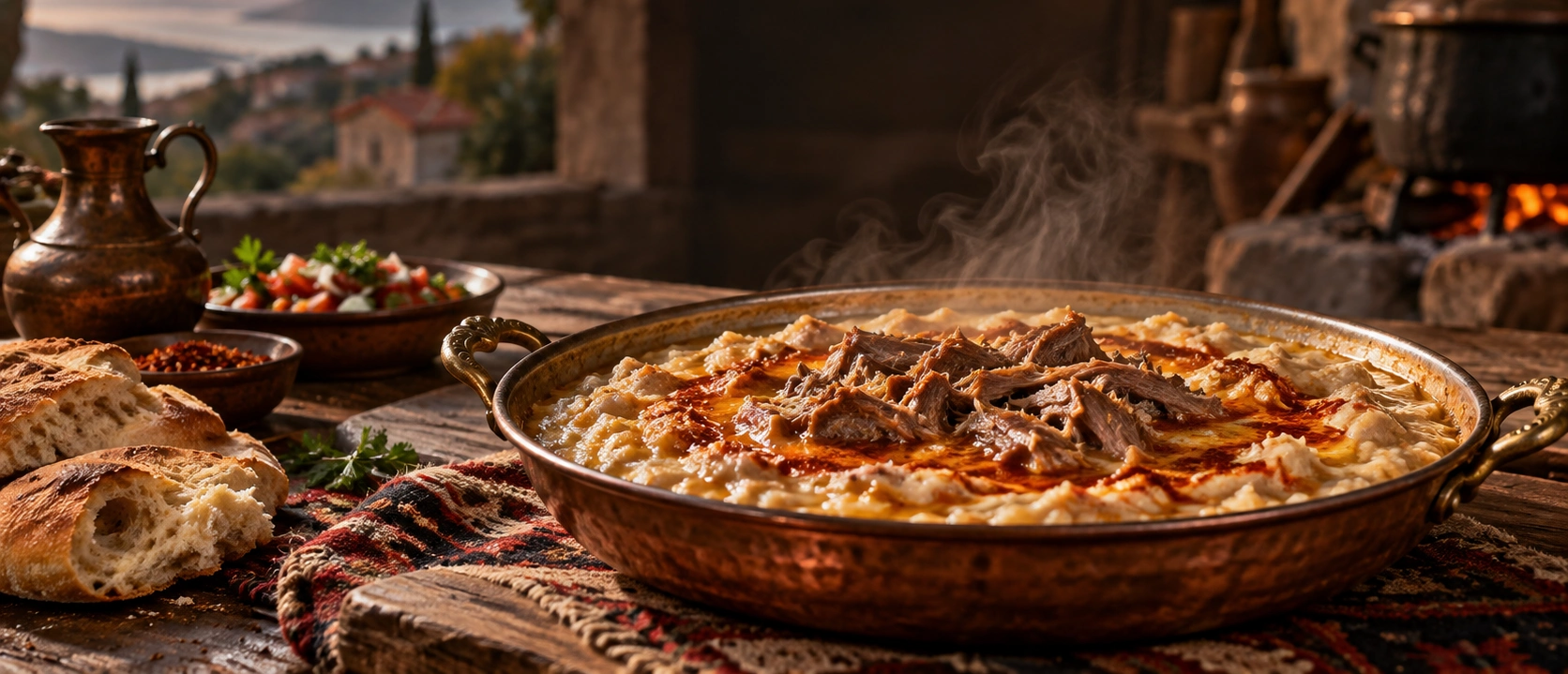
The defining stage comes after cooking. The bones are removed, the meat is returned to the pot, and the wheat-and-meat mixture is beaten with a wooden spoon until it becomes smooth and unified. In the Balıkesir description, the meat should be worked so thoroughly into the wheat that it is no longer separately visible.
Hot melted butter, black pepper, red pepper and tomato paste complete the dish. Beyond the recipe itself, keşkek also belongs to a much larger ceremonial tradition associated with weddings, circumcisions, religious holidays and communal gatherings across Türkiye—a tradition inscribed on UNESCO's Representative List of the Intangible Cultural Heritage of Humanity in 2011.
Wheat is prepared in advance, then cooked for a long time until the grains soften and lose their separate structure.
Balıkesir's official local recipe uses meaty lamb ribs or breast bones beneath the wheat.
The cooked wheat and meat are worked together until the mixture becomes smooth, dense and almost paste-like.
Hot butter, black pepper, red pepper and tomato paste give the finished keşkek its final richness and colour.
Essential information about one of Balıkesir's most important slow-cooked wheat and meat dishes.
Balıkesir Province in north-western Türkiye, with especially strong village and wedding traditions.
Open Balıkesir on Google MapsKeşkeklik wheat is cooked until very soft and then beaten into the finished texture.
The provincial Balıkesir recipe uses meaty lamb ribs or breast bones.
The cooked wheat and meat are beaten together until the meat disappears into the creamy mixture.
Keşkek is both a food and a method: wheat and meat are cooked slowly, then worked together until they become one.
Keşkek belongs to a very old family of Anatolian and Turkish ceremonial foods based on wheat, meat and long cooking. Its importance comes not only from its ingredients, but also from the work required to prepare it and the communal occasions on which it is traditionally served.
Balıkesir's provincial cultural description gives the local dish a precise culinary form. Keşkeklik wheat is washed and boiled the day before. Meaty lamb bones are placed at the bottom of the cooking vessel, the wheat is added above them, and hot water is poured in before the dish is cooked slowly.
As the wheat softens, more hot water may be added and the mixture is stirred from time to time. Once the lamb is cooked, the bones are removed, the meat is separated from them and returned to the pot. The mixture is then beaten with a wooden spoon until it becomes smooth and cohesive.
This beating stage explains why good keşkek looks so different from a simple wheat-and-meat stew. The goal is not to keep every ingredient visibly separate. In the Balıkesir description, one of the defining characteristics is that the meat is beaten so thoroughly into the wheat that it is no longer obvious as separate pieces.
Long cooking, soft wheat, tender lamb and vigorous beating create a dish whose identity comes as much from texture as from flavour.
Keşkeklik wheat forms the body of the dish and is cooked until the grains lose much of their original structure.
Balıkesir's documented preparation specifically uses meaty lamb ribs or breast bones.
The wheat and lamb need enough time for the grain to soften completely and the meat to become tender.
The cooked mixture is beaten until wheat and meat merge into a smooth, cohesive texture.
A defining local detail is that the lamb should be incorporated so thoroughly that separate pieces are no longer obvious.
Melted hot butter adds richness and aroma immediately before serving.
Black pepper, red pepper and tomato paste provide the finishing colour and savoury depth.
In Balıkesir villages, keşkek is strongly connected with weddings, celebrations and communal food traditions.
Balıkesir Keşkek is a traditional slow-cooked dish made from keşkeklik wheat and lamb. The ingredients are cooked until extremely soft, after which the meat is removed from the bones and beaten back into the wheat until the mixture becomes dense, creamy and unified.
The consistency is central to the identity of the dish. Keşkek should not feel like boiled wheat with chunks of meat scattered through it. Instead, the repeated stirring and beating transform the grain and meat into a single, cohesive preparation.
Balıkesir's recorded method finishes the keşkek with hot melted butter, black pepper, red pepper and tomato paste. The result is rich and deeply savoury, with the grain providing body and the lamb almost disappearing into the texture.
The wheat is cooked far beyond the separate-grain texture expected in pilaf.
The ingredients are intentionally beaten together rather than kept visibly distinct.
Proper keşkek is thick, creamy, cohesive and spoonable.
Freshly added butter and pepper are most aromatic while the dish is warm.
Balıkesir's cuisine reflects the province's remarkable geographical range: inland farming districts, livestock country, Marmara settlements and the olive-growing northern Aegean coast all contribute different ingredients and cooking traditions.
Within that broad food culture, keşkek is repeatedly presented alongside tirit, sura, saçaklı mantı, düğün çorbası, zerde, höşmerim and other characteristic regional foods. It belongs especially naturally beside dishes connected with village gatherings and ceremonial tables.
The ingredients also fit Balıkesir's inland agricultural world. Wheat provides the foundation, lamb brings richness, and butter and peppers complete a dish that can be prepared in large quantities for families or entire communities.
Wheat and dough-based foods are deeply rooted in Balıkesir's inland culinary landscape.
Sheep and lamb are central to many of the province's best-known meat dishes.
Keşkek scales naturally from home cooking to large communal preparation.
The dish has a particularly strong connection with weddings and village celebrations.
Across Türkiye, keşkek is more than the name of one fixed recipe. It describes a wider culinary and ceremonial tradition in which wheat and meat are slowly cooked and then worked into a thick, unified dish.
Different regions use different meats, fats, seasonings and preparation details. What remains recognisable is the long transformation of wheat through cooking and beating, often accompanied by collective labour and ceremonial serving.
That wider significance was internationally recognised when the Ceremonial Keşkek tradition of Türkiye was inscribed on UNESCO's Representative List of the Intangible Cultural Heritage of Humanity in 2011. The inscription concerns the living tradition—its preparation, communal work, ceremonies, music and transmission—not one single provincial recipe.
The grain that gives keşkek its body and characteristic texture.
Lamb is used in Balıkesir's documented version, while other regional traditions may differ.
The physical working of the cooked mixture is one of the defining techniques.
Keşkek is closely associated with collective preparation and shared ceremonial meals.
The clearest starting point is the recipe preserved by Balıkesir's provincial culture and tourism authority. Its ingredient list is remarkably concise: meaty lamb ribs or breast bones, keşkeklik wheat, butter, tomato paste and salt.
The method also calls for black pepper and red pepper when the dish is finished. Water is added during cooking as needed so that the wheat can continue softening without drying out before the beating stage.
This simplicity is important. Keşkek does not depend on a long list of flavourings. Much of its depth comes from the lamb, the wheat, the long cooking process and the hot butter poured over the finished dish.
Balıkesir's provincial cultural recipe describes the dish through the following essential ingredients and techniques.
Keşkek begins with wheat, but the goal is almost the opposite of cooking a grain so that every kernel stays separate. The wheat must absorb water, swell and soften until it can be beaten into a thick, creamy mass.
Balıkesir's documented method starts preparation the day before by washing and boiling the keşkeklik wheat. This advance preparation shortens the final cooking process and helps the grain reach the soft structure needed for pounding.
Traditional ceremonial practice in different parts of Türkiye may also involve hulling or pounding wheat before cooking. In Balıkesir, living village traditions include communal preparation of wheat in a dibek, a large stone or wooden mortar used to hull or crush grain.
Balıkesir's local recipe begins by washing and boiling the wheat the previous day.
The grains need to soften enough that they no longer behave like separate kernels.
Extra hot water can be introduced during cooking as the wheat absorbs liquid.
The final texture develops only after fully cooked wheat is worked vigorously.
The official Balıkesir recipe uses meaty lamb ribs or breast bones. Cooking the meat on the bone allows flavour to pass gradually into the wheat and cooking liquid while the lamb becomes tender enough to separate easily.
Once cooking is complete, the bones are removed and the meat is picked from them. The meat is then returned to the pot before the mixture is beaten.
This is an important point because the lamb is not intended to remain as a topping of obvious chunks. Instead, it becomes part of the keşkek itself, contributing flavour and richness while disappearing into the final texture.
Bone-in lamb enriches the cooking liquid and helps create a deeper savoury base.
The meat should separate easily before it is returned to the wheat.
The finished keşkek should be smooth and easy to eat.
The lamb becomes integrated rather than sitting visibly on top.
Keşkek cannot reach its characteristic texture if the wheat is only briefly boiled. The grain needs enough time to absorb liquid and soften so thoroughly that its natural structure begins to break down.
The Balıkesir recipe instructs the cook to add hot water from time to time while the mixture continues cooking. This keeps the wheat hydrated and prevents the pot from becoming dry before the grain has softened sufficiently.
The lamb is cooking during the same process, so the long simmer performs two jobs at once: tenderising the meat and transforming the wheat into the base that will later be beaten smooth.
Rushing the cooking stage leaves the grain too firm for authentic keşkek texture.
Add hot water when necessary rather than allowing the wheat to catch or dry out.
Occasional stirring helps the wheat cook evenly as it thickens.
The lamb flavours the wheat throughout the long simmer.
The most recognisable stage of keşkek preparation is the beating. Once the wheat is extremely soft and the cooked lamb has been returned to the pot, the mixture is worked vigorously until the ingredients merge.
Balıkesir's official description says the keşkek is beaten with a wooden spoon until it reaches a smooth, ointment-like consistency. The important visual sign is that the meat should no longer be separately identifiable.
In larger ceremonial traditions elsewhere in Türkiye, wooden mallets or paddles may be used, especially when keşkek is cooked in huge cauldrons for crowds. The scale changes, but the culinary principle is the same: beating transforms soft wheat and meat into one unified dish.
Beating releases the softened grain's starch and removes the last sense of separate kernels.
The lamb is worked into the wheat until it becomes part of the overall texture.
Repeated working creates the thick, cohesive body associated with good keşkek.
The final consistency matters more than a fixed number of strokes.
After the wheat and lamb have been cooked and beaten into the proper consistency, Balıkesir keşkek receives a rich finishing layer. The local description uses hot melted butter, black pepper, red pepper and tomato paste.
This finishing stage adds more than decoration. Butter carries the aromas of the peppers and gives the surface a glossy richness, while the tomato paste contributes savoury depth and warm colour.
Because the keşkek itself is mild and grain-focused, the contrast between the creamy base and the intensely aromatic butter-and-pepper finish is an important part of the eating experience.
Add it at the end so the aroma remains vivid when the dish reaches the table.
Provides warm, fragrant seasoning without changing the basic character of the wheat.
Brings colour and another layer of gentle heat.
Deepens the savoury finish and gives the topping a reddish appearance.
The provincial method can be understood as a sequence: prepare the wheat the day before, place meaty lamb bones in the vessel, add the wheat and hot water, cook slowly until both wheat and lamb are very tender, remove the bones, return the meat, beat the mixture until smooth, then finish with hot butter, peppers and tomato paste.
The technique is simple in terms of ingredients, but it asks for judgement at every stage. The cook must decide when the wheat needs more hot water, when the lamb is tender enough, and when the beaten mixture has reached the desired consistency.
For large ceremonial quantities, preparation becomes a collective activity and may involve oversized cauldrons, long paddles, wooden mallets and multiple people working together. At home, the same culinary logic can be reproduced on a much smaller scale.
Wash and pre-cook the keşkeklik wheat in advance.
Layer the lamb and wheat, add hot water and simmer until very soft.
Separate the cooked meat and return it safely to the wheat.
Work the meat and wheat together until the mixture becomes cohesive.
Add the hot butter, peppers and tomato paste close to serving.
Keşkek is not limited to one province, and travellers should expect the dish to change as they move through Türkiye. Different regions may use lamb, beef, chicken or other meat, and the exact grain preparation, fat, seasonings and finishing sauce can vary.
Some versions keep more visible pieces of meat, while others beat the mixture until it becomes almost completely homogeneous. Some are pale and butter-forward; others receive red pepper, tomato paste or a stronger coloured sauce.
Balıkesir's documented version is useful precisely because it gives us a clear local reference point: keşkeklik wheat, bone-in lamb, butter, tomato paste, black pepper and red pepper, with the meat beaten into the grain until it is no longer separately visible.
Regional versions may use lamb, beef, poultry or other local choices.
Butter, pepper, tomato-based sauces and other toppings vary from place to place.
Some kitchens beat the mixture more aggressively than others.
Long-cooked wheat and meat remain the central idea behind the tradition.
The word “keşkek” does not automatically identify one exact ingredient list. What it tells you is that you are dealing with a tradition built around slowly cooked wheat and meat, usually transformed through vigorous stirring or beating.
Balıkesir's local recipe stands out through its specific use of meaty lamb ribs or breast bones, its advance preparation of the wheat, and the instruction to beat the cooked meat so thoroughly into the grain that the meat is no longer visibly separate.
The most useful way to compare regional versions is to ask four questions: Which wheat is used? Which meat is cooked with it? How intensely is the mixture beaten? And what fat or sauce is added at the end?
Documented with lamb on the bone, keşkeklik wheat, butter, tomato paste and peppers.
May use different meats, fats, spices, sauces and preparation rituals.
Wheat and meat are cooked until very soft and then worked into a cohesive dish.
The region and community tell you more than the name “keşkek” alone.
Keşkek has a particularly strong connection with weddings in Balıkesir. Rural traditions in districts such as Sındırgı and Burhaniye have preserved communal preparation, large cauldrons and the physical act of beating the wheat as part of the celebration.
In some villages, the preparation itself becomes a social event. Wheat may be processed collectively, cooks take responsibility for large quantities, and the beating of keşkek can be accompanied by local music and watched by guests.
This helps explain why keşkek carries a significance beyond flavour. It is a dish that can embody hospitality, shared labour and the public feeding of a community during an important family event.
Large cauldrons allow keşkek to feed many wedding guests efficiently.
Preparation can involve several people working together over many hours.
Some local traditions connect the beating of keşkek with drums, wind instruments and wedding festivities.
Rural communities continue to preserve methods handed down between generations.
In 2011, Türkiye's Ceremonial Keşkek tradition was inscribed on UNESCO's Representative List of the Intangible Cultural Heritage of Humanity.
UNESCO describes keşkek as a ceremonial wheat-and-meat dish prepared for occasions such as weddings, circumcisions and religious holidays. The tradition includes not only cooking, but also selecting and preparing the wheat, communal labour, blessings, music, beating the keşkek and serving the resulting feast to guests.
This inscription should be understood carefully. UNESCO recognises a national living tradition, not “Balıkesir Keşkek” as a separate UNESCO product. Balıkesir is one of the places where the wider ceremonial culture remains visible through local wedding and village practices.
The Ceremonial Keşkek tradition of Türkiye entered UNESCO's Representative List.
The recognition covers knowledge, rituals, preparation and community participation.
Weddings, circumcisions and religious holidays are central ceremonial contexts.
Traditional knowledge survives through practical transmission from experienced cooks to younger participants.
Balıkesir keşkek is rich, savoury and comforting rather than sharply spiced. The wheat creates a soft, mellow base while lamb contributes depth throughout the dish.
Because the meat is beaten into the wheat, you experience its flavour more than its shape. Hot butter brings aroma and richness, while black pepper and red pepper provide warmth and tomato paste adds a darker savoury note.
The texture should be thick and cohesive, with the wheat completely softened. Depending on how intensely it has been beaten, keşkek can range from visibly fibrous and rustic to remarkably smooth and almost creamy.
Lamb flavours the wheat throughout the long cooking process.
Hot butter enriches the surface and carries the finishing spices.
The wheat should be fully broken down rather than firm or grainy.
Black and red pepper lift the mild wheat-and-meat base.
Keşkek is best served hot or warm, soon after the final beating and seasoning. At large gatherings it may be portioned directly from a large pot or cauldron, while home versions can be transferred to a broad serving dish.
The butter-and-pepper finish is especially effective when added close to serving, because the heat releases the aroma of the fat and spices. The topping may sit visibly over the pale wheat base, creating an appetising contrast.
At a wedding or village event, keşkek is often one dish within a much larger communal menu. Depending on the local custom, it may appear alongside rice or bulgur pilaf, meat dishes, soup, ayran, desserts or other ceremonial foods.
The texture and butter aroma are most appealing before the dish cools.
Add the butter and pepper topping close to service.
Keşkek is substantial and traditionally suited to shared, filling meals.
Wedding menus and village tables vary according to district and family tradition.
Keşkek can be made as a home-cooked dish, but its strongest cultural identity is ceremonial. In Balıkesir, it is widely associated with weddings, circumcision celebrations, village festivals and other large communal gatherings.
This connection makes practical sense. Wheat and meat can be cooked in large vessels, the food is filling, and the preparation itself allows many people to contribute.
Balıkesir is a large province, so the exact occasions and side dishes vary by district. What remains consistent is the idea that keşkek belongs naturally to moments when many people gather and eat together.
The best-known ceremonial setting for keşkek in many Balıkesir villages.
Part of the wider Turkish ceremonial tradition recognised by UNESCO.
Large-batch keşkek suits events where the community eats together.
Smaller quantities can be prepared at home for guests and special meals.
One of the most compelling parts of keşkek culture is the work that happens before the dish reaches the table. In some Balıkesir villages, especially in the Sındırgı area, women have preserved the practice of preparing wheat collectively in a dibek.
A dibek is a large mortar, traditionally made from stone or wood, used for hulling or pounding grain. Rather than treating wheat preparation as an invisible kitchen task, the work becomes a shared activity carried out through imece—community cooperation.
The same spirit continues in large-scale cooking. Someone prepares the wheat, someone tends the fire, someone checks the water, others beat the finished keşkek and still others organise serving. The dish is therefore a practical expression of collective effort.
Traditional mortars can be used to hull or pound the wheat before cooking.
Neighbours and relatives may share the work instead of leaving preparation to one person.
Technique is learned by watching experienced cooks and joining the preparation.
The social process is part of what gives ceremonial keşkek its cultural meaning.
Keşkek is a traditional regional dish, but it may not appear on every restaurant menu every day. Look for establishments specialising in Balıkesir cuisine, home-style esnaf lokantaları, village restaurants and places that serve traditional meat and grain dishes.
For the strongest cultural context, rural districts can be especially interesting. Sındırgı, Burhaniye, Bigadiç and other parts of Balıkesir continue to associate keşkek with weddings, village gatherings and local celebrations.
If you see keşkek on a menu, ask which meat is used and whether the mixture is prepared in the local Balıkesir style. Restaurant versions may differ from large ceremonial keşkek made for a wedding.
The regional name helps signal that you are interested in the local interpretation.
Home-style restaurants are often a better bet than generic international menus.
Village and district traditions can offer a stronger connection with ceremonial keşkek culture.
A wedding-style preparation may differ from a daily restaurant serving.
The best way to appreciate keşkek is to think about texture first. Notice whether the wheat has broken down fully, whether the lamb has become part of the mixture, and whether the final result feels cohesive rather than simply boiled.
Also pay attention to the finishing butter. In Balıkesir's documented version, peppers and tomato paste give the topping an important aromatic and visual role against the mild wheat base.
Keşkek is most expressive soon after beating and finishing.
The wheat should be deeply softened and integrated with the meat.
The meat may not be visibly obvious even though its flavour runs through the dish.
Hot fat, pepper and tomato paste provide much of the surface aroma.
Local cooks may have family or village-specific methods worth hearing about.
A communal event can reveal the social side of the dish that a restaurant plate cannot.
Keşkek changes across Türkiye, making comparisons especially rewarding for food travellers.
Continue with tirit, lamb dishes, local cheeses, ayran or höşmerim.
Keşkek shows how Balıkesir's traditional cuisine can create extraordinary depth from a small number of ingredients. Wheat, lamb, butter, peppers and tomato paste become memorable through time and technique rather than complexity.
The dish also demonstrates the importance of texture as culinary knowledge. Knowing how long to cook the wheat, when to add water and how much beating is needed cannot be reduced completely to a written recipe; experience matters.
Finally, keşkek demonstrates the connection between food and community. The traditional dish is not simply cooked for people—it can be prepared by people together, making the process itself part of the celebration.
A short ingredient list is transformed by patience and technique.
The cook must recognise when wheat and meat have reached the right consistency.
Large-batch preparation makes the dish ideal for shared feasts.
Local methods survive because people continue to practise and teach them.
For travellers interested in regional Turkish cuisine, keşkek is one of the most meaningful dishes to seek out because it connects flavour, agricultural ingredients, labour and ceremony in a single plate.
It is also an excellent example of how texture can define a dish. Wheat begins as firm grain, becomes completely soft through long cooking and is then beaten with lamb until the two are almost inseparable.
Trying keşkek in Balıkesir also provides a natural bridge to the province's other communal and meat-focused foods, including tirit, düğün çorbası, sura and Balıkesir lamb.
Few grain dishes are transformed as completely through cooking and beating.
The meat becomes part of the dish rather than remaining a separate topping.
Keşkek belongs to one of Türkiye's internationally recognised ceremonial food traditions.
A village celebration or regional food event can make the experience especially memorable.
Keşkek is one doorway into Balıkesir's enormous culinary landscape. Continue from slow-cooked wheat and lamb into bread-and-broth dishes, ceremonial soups, protected lamb, handmade mantı, regional dairy products and famous desserts.
Compare keşkek with another traditional dish built around meat, broth and communal serving.
Discover another food closely connected with wedding and ceremonial tables.
Explore the lamb tradition that gives many inland Balıkesir dishes their character.
Continue with one of the province's distinctive dough-and-chicken dishes.
Finish with one of Balıkesir's signature cheese-based desserts.
Discover one of the province's best-known traditional drinks.
These two ideas are related, but they should not be presented as identical. The Balıkesir recipe tells us how the province documents its own keşkek: lamb ribs or breast bones, keşkeklik wheat, butter, tomato paste, salt, black pepper and red pepper.
The UNESCO inscription describes a broader ceremonial tradition across Türkiye. It focuses on the communal process—wheat preparation, large cauldrons, meat, beating, prayers, music, celebration and transmission of knowledge—rather than prescribing Balıkesir's exact ingredients.
Keeping that distinction clear makes the story stronger. Balıkesir keşkek is a regional expression of a much wider Turkish ceremonial food heritage.
Specific local ingredients and a documented preparation method.
A national living-heritage practice centred on communal ceremonial preparation.
Wheat, meat, long cooking and beating connect the two.
One describes a local recipe; the other recognises a broad cultural tradition.
The biggest challenge is reaching the proper texture without scorching the wheat. Use a heavy pot, monitor the moisture carefully and add hot water gradually as the grain continues to absorb liquid.
The wheat must be very soft before serious beating begins. Trying to force undercooked grains into a creamy consistency will make the work harder and leave the final texture coarse.
Because the traditional recipe uses lamb on the bone, normal food-safety care matters. Cook the meat thoroughly, remove bones carefully, keep the dish hot during service and cool leftovers promptly before refrigeration.
Following the Balıkesir method, wash and pre-cook the wheat the day before.
Thick wheat mixtures can catch on the bottom during long cooking.
Maintain enough moisture for the grain to soften completely.
Fully softened wheat and meat integrate far more effectively.
Check the lamb carefully before beginning the final beating stage.
Hot butter and pepper are most fragrant when freshly added.
It is a traditional Balıkesir dish made by cooking keşkeklik wheat with lamb until very soft, then beating the meat and wheat together into a thick, cohesive mixture.
The provincial cultural recipe specifies meaty lamb ribs or breast bones.
The local recipe refers to keşkeklik wheat—wheat prepared for the long cooking and beating required by keşkek.
Yes. Balıkesir's documented method says the wheat is washed and boiled the day before.
The wheat needs to become extremely soft and the lamb needs to become tender enough to integrate into the grain during beating.
Beating breaks down the softened wheat and incorporates the meat until the mixture becomes smooth and cohesive.
In Balıkesir's provincial description, one defining characteristic is that the meat is beaten so thoroughly that it is no longer separately visible.
Yes. Hot melted butter is part of the traditional finishing stage.
Yes. Tomato paste is included in the provincial ingredient list and is used in the finishing stage.
The documented Balıkesir preparation uses black pepper and red pepper.
It is usually savoury and peppery rather than aggressively hot. The exact strength depends on the type and amount of red pepper used.
No. Keşkek is made in many parts of Türkiye. Balıkesir has its own documented regional version and strong local ceremonial traditions.
The UNESCO inscription is for Türkiye's broader Ceremonial Keşkek tradition, not for Balıkesir Keşkek as a separate regional product.
It was inscribed on the Representative List of the Intangible Cultural Heritage of Humanity in 2011.
Yes. Weddings are among the most important traditional settings for keşkek in Balıkesir and in the wider Turkish ceremonial tradition.
A dibek is a large stone or wooden mortar traditionally used to hull, crush or pound grain. Some Balıkesir communities preserve communal wheat preparation in a dibek.
It should be thick, soft and cohesive, with fully cooked wheat and meat integrated into the same texture.
It is savoury, lamb-rich and buttery, with a mild wheat base lifted by black pepper, red pepper and tomato paste.
Look for regional restaurants, esnaf lokantaları, village food establishments and local festivals. Availability may be especially strong around traditional events and wedding seasons.
Yes. Home quantities are practical, but the wheat still needs long cooking and enough beating to achieve the proper texture.
Yes, but it thickens as it cools. Reheat gently and add a small amount of hot water if needed to restore a soft consistency.
Its character comes from the documented combination of keşkeklik wheat, lamb on the bone, long cooking, vigorous beating and a hot butter, pepper and tomato-paste finish.
The strongest images should show both the finished dish and the labour behind it: wheat softening in a heavy pot, lamb cooking beneath it, the mixture being beaten, hot butter being added and communal cauldrons at a village celebration.
Photograph the finished keşkek at a slight angle so its creamy texture and butter topping are visible.
A wooden spoon or paddle moving through the thick mixture instantly communicates the defining technique.
Show the keşkeklik wheat before and after cooking to illustrate the transformation.
Capture the traditional combination of meat, grain and long cooking.
A close-up of hot red-pepper butter or tomato-paste butter being spooned over the surface adds movement and colour.
A communal cauldron or village keşkek-beating scene reveals the cultural story beyond the finished plate.
Discover keşkek together with village food traditions, regional markets, protected lamb, local cheeses, olive country and the diverse culinary heritage of Balıkesir.
Custom-designed private programs can combine Balıkesir's traditional foods, local producers, markets, village landscapes and regional cooking according to your dates and interests.
Explore Balıkesir through traditional keşkek, regional markets, protected lamb, cheeses, village dishes and the food stories that define the province.
Request This Experience
Combine keşkek with Balıkesir's olive oil, cheeses, protected lamb, desserts, village foods and northern Aegean landscapes.
Request This Tour