Karacabey Merino Heritage
Merino genetics contribute characteristics associated with early development, body weight and reproductive capacity.






Balıkesir Kuzu Eti, or Balıkesir Lamb, is one of the most recognised meat traditions of north-western Türkiye. Its identity is connected with sheep raised throughout Balıkesir Province, particularly Karacabey Merino, Kıvırcık and crosses between these sheep types.
The regional sheep population combines characteristics that have been selected over generations: the early development and reproductive qualities associated with Merino sheep and the meat quality traditionally associated with Kıvırcık sheep. Their relatively fine-tailed structure is also linked in the geographical-indication specification with a balanced distribution of fat within and around the muscles.
Balıkesir Kuzu Eti received Turkish geographical-indication protection in 2018 as a Menşe Adı, or designation of origin. Registration No. 314 protects lamb produced according to defined regional characteristics within Balıkesir Province.
Balıkesir Kuzu Eti is registered by TÜRKPATENT under registration No. 314.
The registered geographical boundary covers Balıkesir Province.
The protected tradition is based on Karacabey Merino, Kıvırcık and their regional crosses.
The registered production specification describes lambs reaching slaughter age at approximately 125–135 days.
Essential information about one of Balıkesir's most important protected meat traditions.
Balıkesir Province in north-western Türkiye.
Open Balıkesir on Google MapsKaracabey Merino, Kıvırcık and recognised crosses between these regional sheep populations.
Fresh lamb protected for its regional origin, production method and characteristic meat qualities.
TÜRKPATENT Menşe Adı registration No. 314, registered in 2018.
The reputation of Balıkesir lamb developed through a long regional history of sheep breeding and adaptation.
The official geographical-indication specification traces the development of the sheep type associated with Balıkesir Kuzu Eti back to breeding work begun during the Ottoman period and continued during the early decades of the Turkish Republic.
Over time, producers in Balıkesir developed a population in which characteristics of Merino and Kıvırcık sheep were brought together. These sheep became well adapted to regional production while also providing lambs capable of relatively rapid development.
Merino influence contributed characteristics such as early growth and the possibility of reproduction throughout different periods of the year. Kıvırcık heritage contributed qualities associated with meat flavour and quality.
The resulting lamb became increasingly recognised beyond Balıkesir itself. Over the years, the expression “Balıkesir Kuzusu” developed into a recognised name in Türkiye's meat trade and restaurant culture.
Formal geographical-indication registration in 2018 transformed that longstanding reputation into a protected product definition covering its geographical origin, sheep types and production characteristics.
Breed heritage, growth pattern, fat distribution and regional husbandry all contribute to its protected identity.
Merino genetics contribute characteristics associated with early development, body weight and reproductive capacity.
Kıvırcık sheep contribute characteristics traditionally associated with meat quality and flavour.
F1, G1, G2 and other recognised crosses between Karacabey Merino and Kıvırcık form part of the Balıkesir sheep population.
The regional sheep type is valued by producers for its relatively rapid growth.
A comparatively fine tail is associated with a balanced distribution of fat around and within the muscles.
The Menşe Adı geographical indication connects the product directly with Balıkesir Province.
The protected production method describes lambs reaching slaughter age at approximately 125–135 days.
Registration and monitoring systems are designed to distinguish authentic Balıkesir lamb from meat originating elsewhere.
Balıkesir Kuzu Eti is the protected name for lamb produced in Balıkesir according to a geographical-indication specification connected with the province's established sheep population and husbandry traditions.
It is not simply a restaurant description for any lamb purchased or prepared in Balıkesir. The protected identity is connected with animals belonging to defined regional sheep types and with production taking place within the registered geographical area.
Balıkesir Kuzu Eti refers to the lamb itself rather than one particular recipe or cooking method.
The designation is geographically connected with Balıkesir Province.
Karacabey Merino, Kıvırcık and their recognised crosses form the genetic foundation of the protected product.
Raising, feeding, slaughter age, carcass handling and control procedures are described in the registered specification.
Balıkesir Kuzu Eti is registered by the Turkish Patent and Trademark Office as a Menşe Adı. This is the Turkish geographical-indication category used where a product's defining qualities are closely connected with a specific geographical area.
Balıkesir Kuzu Eti
The geographical-indication registration number is 314.
The application number is C2017/002.
The application was filed on 28 December 2016.
Balıkesir Kuzu Eti was registered on 2 January 2018.
The registration holder is Balıkesir Commodity Exchange — Balıkesir Ticaret Borsası.
The registered geographical boundary is Balıkesir Province. Unlike some Balıkesir geographical indications that apply only to one town or district, Balıkesir Kuzu Eti is associated with the province as a whole.
The geographical indication is registered as a Menşe Adı, often translated as a designation of origin. This gives geographical origin a particularly important role in the identity of the protected product.
For travellers and food enthusiasts, the practical point is straightforward: authentic geographically indicated Balıkesir Kuzu Eti is connected not only with a style of lamb production but with Balıkesir itself.
The geographical boundary is Balıkesir Province.
The specification identifies Karacabey Merino, Kıvırcık and their regional crosses.
Husbandry and slaughter procedures form part of the protected production system.
The registration helps prevent meat from unrelated origins being marketed improperly under the Balıkesir name.
The distinctive sheep population behind Balıkesir Kuzu Eti developed through Karacabey Merino, Kıvırcık and their crosses. The geographical-indication specification describes the combination as important to the product's identity.
Associated with relatively early development, body weight and reproductive characteristics.
A western Anatolian sheep traditionally valued for meat quality and flavour.
First-generation crosses between the recognised regional sheep types form part of the breeding population.
G1, G2 and other blood levels produced through regional breeding are also described in the registration.
The story of Balıkesir lamb is closely connected with livestock improvement. According to the official registration, sheep-breeding work in the region began during the Ottoman period and continued during the early Turkish Republic.
Rather than representing a single recent commercial brand, Balıkesir lamb developed from generations of local production and selection. Farmers increasingly preferred sheep that combined good growth with desirable meat characteristics and adaptation to the regional production environment.
The registered historical description traces breeding work back to the Ottoman period.
Improvement work continued during the first years of the Turkish Republic.
The emerging sheep type was accepted by regional farmers because of its production qualities.
Over time, “Balıkesir Kuzusu” became a recognised name in Türkiye's lamb market.
The geographical-indication document describes a structured production cycle beginning with the breeding of the ewes and continuing through lambing, nursing, weaning and finishing.
The registered production method combines maternal milk with supplementary forage and formulated lamb feed. This is important because Balıkesir Kuzu Eti should not automatically be described as exclusively grass-fed or pasture-fed.
Lambs continue suckling their mothers until the normal weaning period at approximately 80–90 days.
Quality alfalfa is one of the forage materials described in the registered feeding method.
Vetch is another quality roughage used during the lamb-rearing and finishing period.
Specialised starter, grower and finishing feeds supplement milk and roughage during development.
The geographical-indication specification gives particularly useful information about the stage at which Balıkesir lamb enters the meat market.
Lambs are described as reaching slaughter age at approximately 125–135 days, with the production method referring to live weights of around 40–45 kg at this stage.
This is the approximate slaughter-age range described in the protected production specification.
The production method describes lambs reaching approximately this live-weight range by slaughter time.
Lambs normally remain with their mothers until approximately this age.
The post-weaning feeding stage lasts approximately a further month and a half.
The geographical-indication registration includes measurements taken from Balıkesir lamb carcasses. These figures describe the samples examined for registration rather than guaranteeing that every individual lamb will have identical values.
The recorded average hot carcass weight in the registration data was approximately 19.87 kg.
The recorded average cold carcass weight was approximately 19.57 kg.
The average carcass length recorded in the official study was approximately 62.7 cm.
The fine-tailed sheep type is associated with moderate distribution of fat around and within the muscle.
Once lambs reach the appropriate age and weight, animals presented for slaughter are checked against the characteristics required for Balıkesir lamb.
One of the characteristics emphasised in the official registration is the sheep's fine-tailed structure. Unlike heavily fat-tailed sheep populations, the Balıkesir type is described as having fat distributed at reasonable levels between and within the muscles.
Fat is important to lamb because it influences flavour, juiciness and cooking behaviour. The relevant point with Balıkesir lamb is therefore not that the meat contains no fat, but that the registered description identifies its distribution as one of the distinguishing characteristics of the regional sheep type.
The regional type is characterised by a comparatively fine tail rather than a large fat deposit in the tail.
Fat within the muscle contributes to the eating quality of lamb.
The specification also refers to fat located between muscle groups.
Traditional lamb quality depends partly on fat; the protected description concerns its distribution rather than its absence.
Balıkesir lamb is historically valued for the eating quality associated with its Kıvırcık heritage and the balanced fat distribution of the regional sheep type.
During the geographical-indication work, meat samples were assessed using an ISO 4121 sensory scale in which taste and aroma were considered together. The samples recorded an average sensory score of 6.84 on a nine-point scale.
That number should be understood as a result from the samples used in the registration study rather than as a score guaranteed for every individual piece of Balıkesir lamb. Age, cut, storage and cooking technique will all influence the final eating experience.
The meat retains the distinct savoury character expected from young lamb.
Fat distribution contributes richness without defining the product as a heavily fat-tailed style of lamb.
A delicate chop, a slowly cooked shoulder and a roasted leg naturally produce very different textures and flavour intensity.
Correct chilling, storage and preparation remain important even with a protected regional product.
The geographical-indication file also includes chemical analysis of the meat samples examined during registration. These values are useful for understanding the tested product but should not be treated as fixed nutritional values for every cut or every individual animal.
The analysed samples averaged approximately 17.14 g of protein per 100 g.
The analysed samples averaged approximately 26.12 g of fat per 100 g.
Average measured energy was approximately 299.8 kcal per 100 g in the registration samples.
The analysed samples averaged approximately 80.02 mg cholesterol per 100 g.
Actual nutritional composition varies substantially according to the cut, the amount of visible fat, preparation and cooking method. A trimmed lamb leg therefore should not be assumed to have the same composition as a fattier rib or shoulder portion.
Balıkesir Kuzu Eti is a protected meat rather than a single prepared dish. Once the carcass enters the butcher, restaurant or kitchen, different cuts can be selected for very different styles of cooking.
Tender rib or loin chops are well suited to quick grilling or pan cooking.
A versatile larger cut commonly used for roasting, portioning or slow cooking.
Rich connective tissue makes shoulder particularly suitable for longer, slower cooking.
Shank benefits from moist, slow cooking that gradually softens the meat.
Rib cuts combine meat and fat and can be grilled or cooked slowly depending on thickness.
Different parts of the lamb also appear in traditional Turkish preparations, including regional kokoreç traditions.
Because Balıkesir Kuzu Eti refers to the raw regional product rather than one protected recipe, it can appear in many different preparations. The most suitable method depends primarily on the cut.
Chops and small tender pieces can be cooked quickly over high heat.
Larger cuts such as leg can be roasted whole or in large portions.
Shoulder, shank and other connective-tissue-rich cuts become tender with longer cooking.
Lamb works naturally in Turkish-style vegetable and meat dishes cooked gradually in their own juices.
Appropriate cuts can be prepared over charcoal, allowing rendered lamb fat to contribute additional aroma.
Balıkesir's broader meat culture includes preparations using different lamb cuts and offal.
Protecting the name requires more than defining the sheep type. The registration also establishes monitoring intended to identify producers, animals and slaughter operations associated with authentic Balıkesir Kuzu Eti.
Balıkesir Commodity Exchange has additionally developed traceability initiatives designed to connect animal identification information with slaughterhouses and points of sale.
Producer and breeding information can be recorded as part of the control system.
Individual lamb identification supports the ability to follow animals through the production chain.
Slaughter operations form an important part of maintaining the protected product's identity.
Labels and digital traceability tools can help connect meat sold at retail with its registered origin.
It is difficult to establish geographical origin simply by looking at a piece of raw lamb. Authenticity therefore depends much more on traceability, labelling and trusted supply chains than on visual appearance alone.
Balıkesir Kuzu Eti should be identified clearly rather than sold only under a generic “lamb” description.
The protected product must be connected with Balıkesir Province.
Registered-product labelling and geographical-indication presentation can help verify authenticity.
A knowledgeable butcher should be able to explain the source and supply chain of meat sold as Balıkesir lamb.
If a menu specifically advertises Balıkesir lamb, asking about its supplier is entirely reasonable.
Meat colour changes with storage, oxygen exposure, cut and handling and cannot independently prove origin.
Balıkesir's geography supports an unusually broad food culture combining livestock farming, dairy products, olives, vegetables and coastal ingredients. Sheep raising is one of the important pastoral traditions within that wider landscape.
Balıkesir Kuzu Eti represents the meat-producing side of the province's livestock heritage, while cheeses, kaymak and other dairy specialities show how the same agricultural environment has shaped completely different branches of local cuisine.
Explore one of Balıkesir's distinctive traditions built around lamb offal and charcoal cooking.
Move from the province's lamb heritage to its celebrated cheese-based dessert.
Discover another side of Balıkesir's livestock and dairy heritage.
Continue through Balıkesir's geographically protected dairy traditions.
If a restaurant advertises Balıkesir Kuzu Eti, ask whether the meat is genuinely sourced from Balıkesir.
Decide whether you want delicate grilled chops, slow-cooked shoulder, shank or another style before ordering.
A certain amount of fat contributes substantially to the flavour and texture of good lamb.
Good lamb does not always require complicated sauces; straightforward grilling or roasting can reveal the meat itself.
The protected geographical boundary covers the province rather than only Balıkesir city centre.
Combine lamb with the province's cheeses, ayran, olive products and traditional desserts for a broader picture of Balıkesir cuisine.
When authenticity is important, geographical-indication labels and reliable sourcing are stronger evidence than appearance alone.
Cooking time and method can completely change the texture of different lamb cuts.
For travellers interested in Turkish regional food culture, Balıkesir Kuzu Eti offers more than a good meat dish. It connects the restaurant table directly with the province's history of animal husbandry, sheep breeding and protected agricultural products.
Its story is particularly interesting because the geographical indication protects a raw agricultural food rather than one finished recipe. What is being protected is the relationship between the lamb, its regional sheep population, production method and Balıkesir itself.
The product provides a direct link with generations of sheep breeding in Balıkesir.
Its reputation developed around the combination of lamb flavour, growth characteristics and fat distribution.
The designation offers an excellent example of how Türkiye protects regional agricultural products.
Balıkesir becomes even more interesting when its lamb is experienced beside its cheeses, dairy products and olive traditions.
Balıkesir's culinary identity extends far beyond lamb, from geographically protected dairy products to distinctive road foods, olive traditions and local desserts.
Continue directly into another distinctive Balıkesir lamb tradition.
Finish a savoury lamb meal with one of Balıkesir's best-known traditional sweets.
Discover the rich manda kaymağı tradition behind another side of Balıkesir's livestock heritage.
Explore a geographically indicated cheese from another part of Balıkesir Province.
Continue through Balıkesir's pastoral traditions with a distinctive mature cheese.
Try Balıkesir's famous intensely foamy ayran tradition.
Discover one of the province's most famous roadside food classics.
Move from Balıkesir's pastoral interior to the olive-growing landscapes of the Edremit Gulf.
The main difference is not that lamb from elsewhere cannot be excellent. The distinction is that Balıkesir Kuzu Eti has a formally defined geographical identity.
The protected geographical boundary is Balıkesir Province.
Karacabey Merino, Kıvırcık and their regional crosses form part of the registration.
The geographical-indication file describes breeding, feeding, age, slaughter and carcass handling.
Lamb produced elsewhere may be excellent but does not automatically qualify for the protected Balıkesir Kuzu Eti name.
Travellers exploring Balıkesir's lamb traditions should distinguish between Balıkesir Kuzu Eti and Göbel Lamb Kokoreç. The first is a geographically indicated meat product; the second is a specific regional preparation.
Together they demonstrate two different levels of food heritage: the agricultural product itself and the culinary traditions that transform different parts of the animal into local dishes.
A protected lamb product defined by origin, sheep population and production characteristics.
A regional preparation centred on lamb offal and the culinary traditions of Göbel.
One protects the agricultural product; the other expresses how lamb enters local cuisine.
Read our complete guide to this distinctive Balıkesir meat speciality.
Balıkesir Kuzu Eti is geographically indicated lamb associated with sheep raised and produced within Balıkesir Province according to a registered production specification.
The name means Balıkesir Lamb Meat, although “Balıkesir Lamb” is a more natural English expression.
Yes. Balıkesir Kuzu Eti is a registered Turkish geographical indication.
It is registered as a Menşe Adı, or designation of origin.
The TÜRKPATENT registration number is 314.
It was registered on 2 January 2018.
The geographical-indication application was filed on 28 December 2016.
The application number is C2017/002.
The registration holder is Balıkesir Ticaret Borsası, the Balıkesir Commodity Exchange.
The geographical boundary is Balıkesir Province.
The specification refers to Karacabey Merino, Kıvırcık and crosses between these sheep types.
The protected tradition is based on a regional sheep population developed from Karacabey Merino, Kıvırcık and their crosses rather than being described simply as one unrelated modern breed.
Merino heritage is associated with early growth, body weight and reproductive characteristics in the registered description.
Kıvırcık heritage is particularly associated with desirable meat quality and flavour.
The regional sheep type has a relatively fine tail, a characteristic linked in the registration with balanced intermuscular and intramuscular fat distribution.
The registered production method describes slaughter age at approximately 125–135 days.
The production method describes lambs reaching approximately 40–45 kg live weight by the normal slaughter stage.
The geographical-indication specification places the normal weaning period at approximately 80–90 days.
Yes. They generally remain with their mothers until the weaning period while also receiving supplementary feed.
The registered method describes mother's milk together with quality forage such as alfalfa and formulated lamb starter or grower feed.
No such requirement appears in the registered production method. The specification describes both forage and supplementary prepared feeds.
After weaning, lambs undergo approximately 45 days of additional feeding before reaching slaughter stage.
The registration study recorded an average hot carcass weight of approximately 19.87 kg and an average cold carcass weight of approximately 19.57 kg.
No. The official data represent ranges and averages, and individual animals naturally vary.
It is valued for characteristic lamb flavour and meat quality associated with the regional sheep population and its Kıvırcık heritage.
The registration study used an ISO 4121 sensory scale and recorded an average combined taste-and-aroma score of 6.84 out of nine for the tested samples.
The registered process describes chilling fresh carcasses at approximately -1°C to +1°C and resting them for at least one day.
Yes. The specification states that carcasses intended for longer storage can be kept frozen at approximately -18°C.
Look for reliable provenance, geographical-indication labelling and traceability rather than attempting to identify origin by appearance alone.
Not reliably. Colour is influenced by storage, oxygen exposure and handling, so provenance and labelling are much stronger indicators.
No. Balıkesir Kuzu Eti is a protected lamb product, while Göbel Lamb Kokoreç is a specific regional food preparation.
Depending on the butcher or restaurant, lamb can be offered as chops, ribs, leg, shoulder, shank and many other cuts.
There is no single protected cooking method. Tender cuts work well with fast cooking, while shoulder and shank generally benefit from slower preparation.
Restaurants and butchers across Balıkesir Province are natural places to seek it, but always ask about provenance if geographical-indication authenticity is important to you.
The reputation developed from the province's longstanding sheep-breeding tradition and a regional population combining desirable Merino and Kıvırcık characteristics.
The registered description associates Merino heritage with reproductive characteristics that help support lamb production during different periods of the year.
Its protected identity combines regional origin, generations of sheep breeding, defined husbandry practices, characteristic meat quality and a traceable connection with Balıkesir Province.
The most meaningful images of Balıkesir Kuzu Eti are not limited to plated meat. The complete story includes sheep, pastures, butchers, traditional preparation and the finished dishes.
Photograph sheep in the open Balıkesir countryside to establish the connection between product and geography.
Images showing the relatively fine-tailed sheep type help explain one of the product's distinguishing characteristics.
Well-presented lamb cuts communicate the transition from protected agricultural product to food.
Chops or ribs cooking over glowing charcoal create strong visual texture without overcomplicating the story.
A carved leg or shoulder communicates the generous, communal side of lamb cooking.
Keep the styling regional and natural, using bread, vegetables, ayran or simple accompaniments rather than overly elaborate presentation.
Discover Balıkesir Kuzu Eti together with the province's pastoral landscapes, traditional foods, protected regional products and broader culinary heritage.
Custom-designed private programs can combine Balıkesir's lamb traditions with local markets, traditional restaurants, regional cheeses, olive products and other culinary stops according to your route and travel dates.
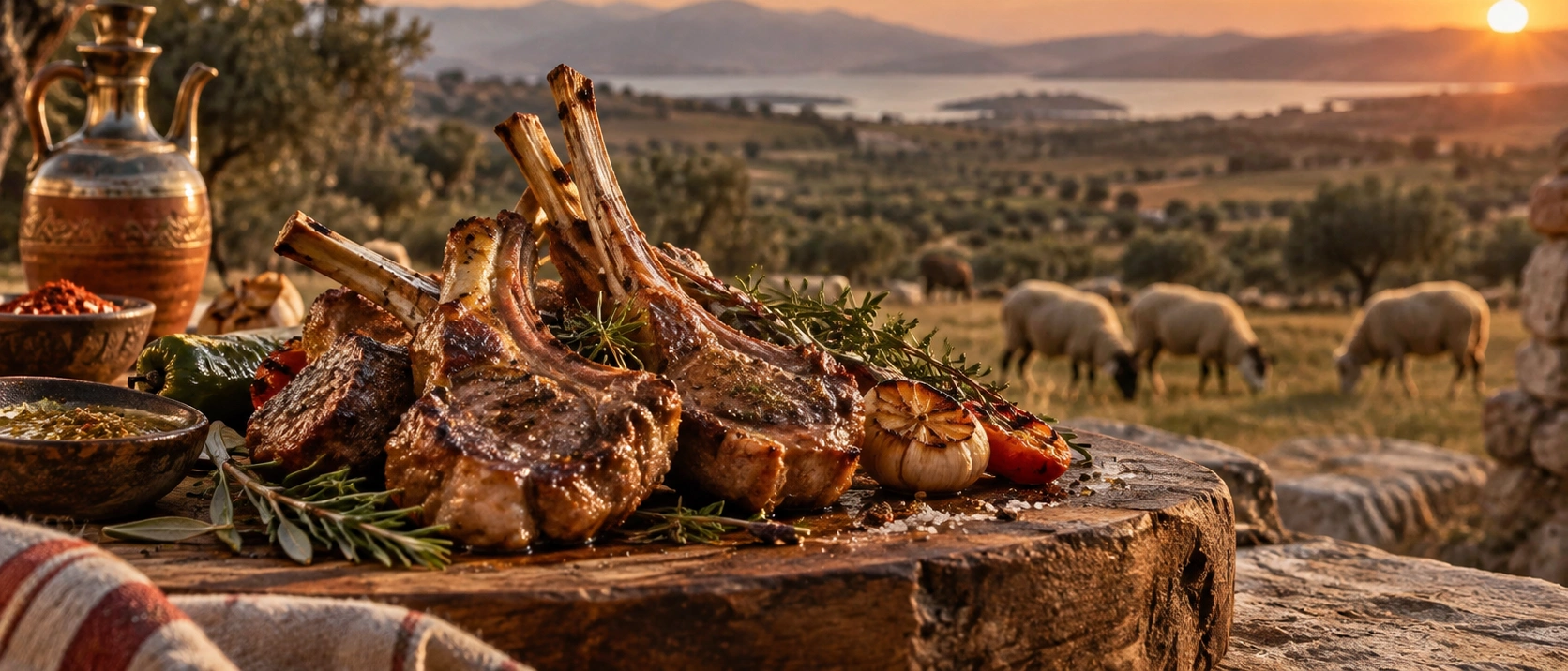
Explore Balıkesir through its protected lamb, pastoral traditions, local markets, cheeses, dairy specialities and regional culinary stories.
Request This Experience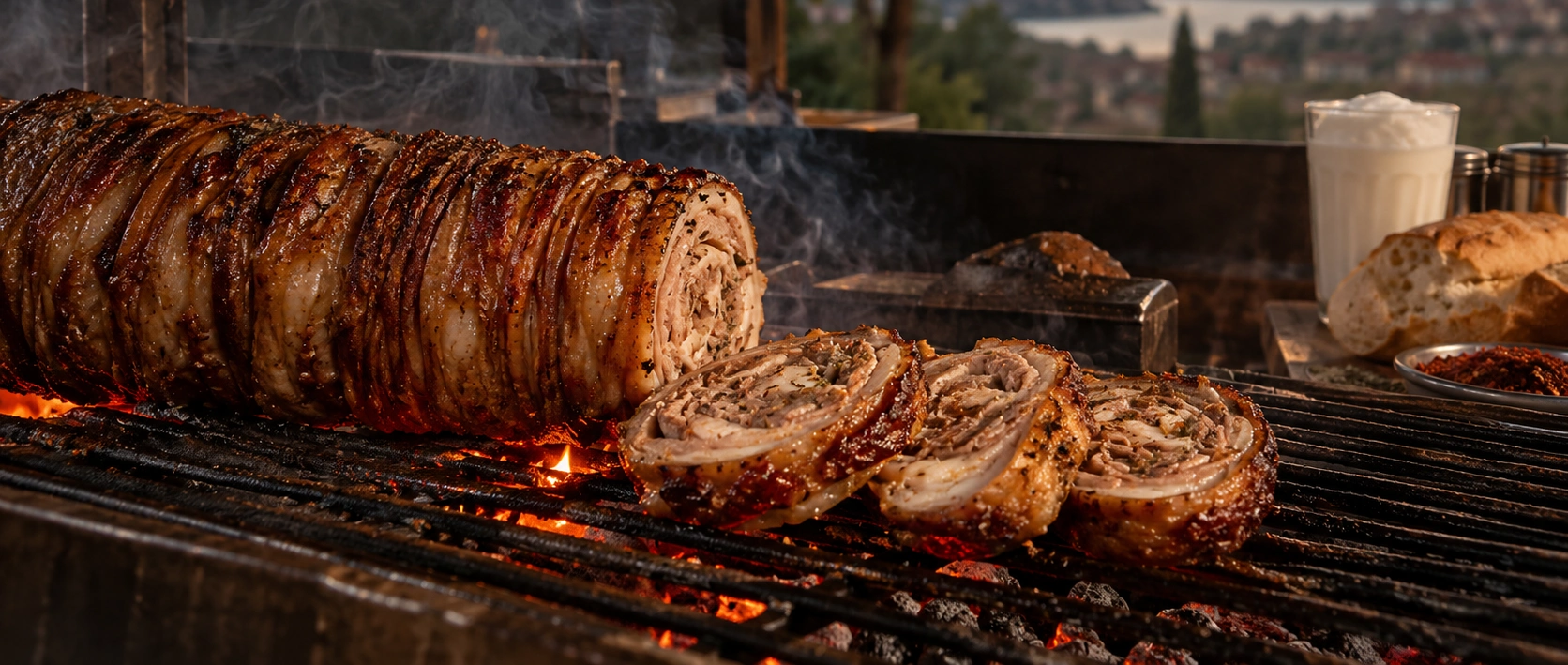
Follow Balıkesir's lamb story from its protected agricultural heritage to local cooking traditions, then continue with the province's dairy, olive and dessert specialities.
Request This Tour