Bread-Based
Tirit begins with bread rather than rice, bulgur or pasta.






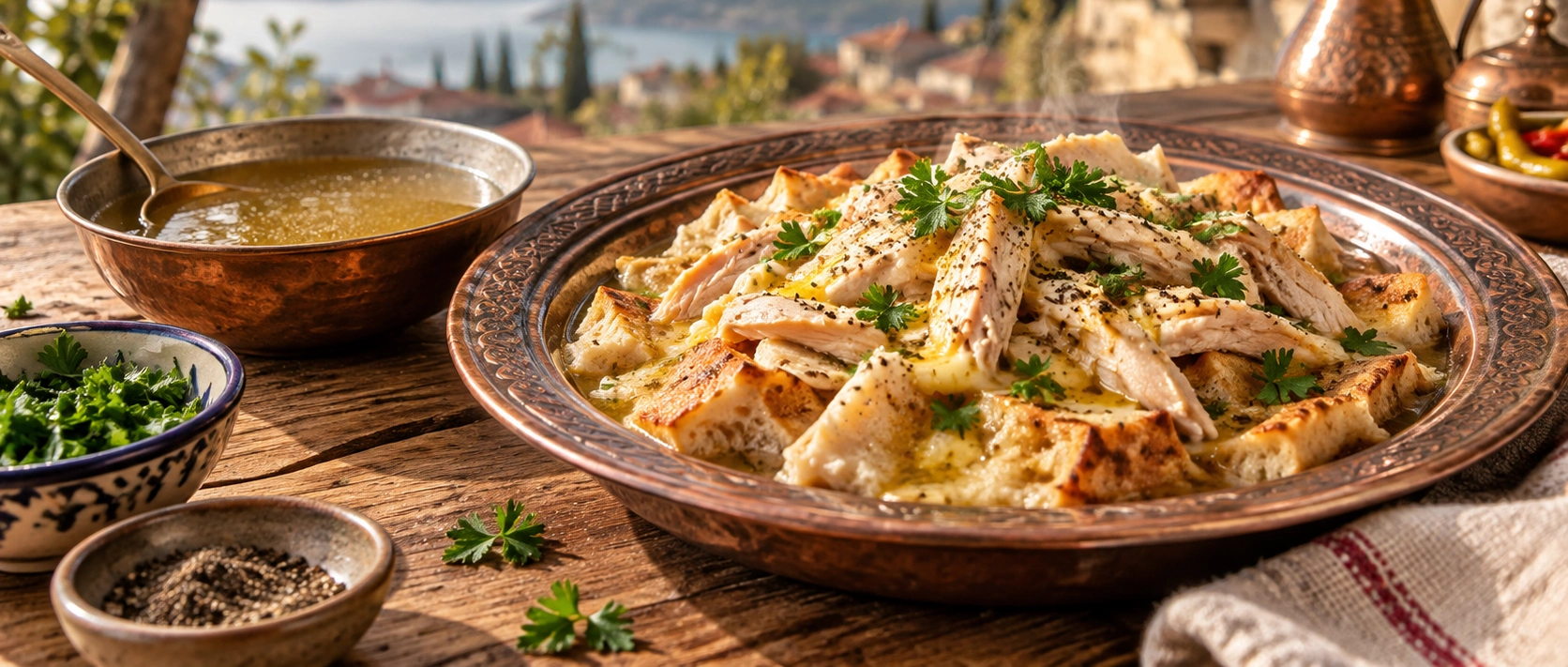
Tirit is one of the traditional dishes repeatedly listed among the characteristic foods of Balıkesir. Its basic idea is wonderfully direct: pieces of bread made for tirit—or, in another local version, yufka—are arranged in a tray and softened with hot chicken broth. Tender chicken is added on top, followed by hot butter, black pepper and parsley.
The dish belongs to a much wider Turkish family of bread-and-broth preparations, yet Balıkesir gives it a recognisable local form. Provincial cultural material describes the chicken version in particular and even notes that tomato can be cooked with the chicken so the broth develops a little colour.
Travel around Balıkesir, however, and you may encounter different expressions of the same idea. Some contemporary restaurant and wedding-style versions use lamb or other meat, meat broth, pide, chickpeas or tomato-based seasoning. These should be understood as local branches of the tradition rather than ingredients required in every Balıkesir tirit.
The foundation is bread cut into pieces, with yufka also documented as a Balıkesir variation.
Hot poultry stock softens the bread and carries the main flavour through the dish.
The official provincial description finishes the soaked bread with cooked chicken meat.
Hot butter and black pepper give the simple bread-and-broth base its final richness and aroma.
Essential information about one of Balıkesir's best-known traditional bread-and-broth dishes.
Balıkesir Province in north-western Türkiye, with district and household variations.
Open Balıkesir on Google MapsTirit bread or yufka cut into pieces and arranged in a tray.
Chicken broth and chicken meat form the core of the provincial cultural description.
Hot butter, black pepper and parsley complete the traditional serving.
Tirit transforms bread and cooking broth into a complete dish—an idea found across Türkiye but expressed differently from region to region.
At its most fundamental, tirit belongs to the old culinary practice of combining bread with hot broth. The Turkish dictionary definition describes tirit as a dish made by adding fried or stale bread to meat broth, which captures the wider family rather than one single regional recipe.
Balıkesir's local description narrows that broad idea into a specific plate. Tiritlik ekmek is cut into small pieces and arranged in a tray. Chicken broth is poured over the bread, chicken meat is added, and the dish is finished with heated butter, black pepper and parsley.
The provincial account also records a small but important detail: tomato may be cooked with the chicken so that the broth takes on some colour. It also states that a version made with yufka exists, showing that the bread base is not completely fixed.
Balıkesir's food culture is highly localised, so today's traveller may meet a different tirit in a village, wedding kitchen or restaurant. Lamb-based versions, pide, chickpeas and meat broth all appear in contemporary Balıkesir cooking. The safest way to understand the dish is therefore to separate its documented provincial core from the many local variations built around the same bread-and-broth principle.
Bread, broth, tender meat and a buttery finish create a dish whose strength comes from absorption rather than complicated technique.
Tirit begins with bread rather than rice, bulgur or pasta.
The bread becomes the flavour carrier by absorbing hot chicken or meat stock.
The components are commonly layered or distributed across a serving tray.
Balıkesir's provincial cultural account specifically describes chicken meat and chicken broth.
The same cultural record notes that tirit can also be prepared with yufka.
Heated butter enriches the soaked bread just before serving.
Black pepper and fresh parsley provide the classic final seasoning and garnish.
Lamb, pide, chickpeas and tomato-based sauces appear in other Balıkesir versions.
Balıkesir Tirit is a traditional bread-and-broth dish in which pieces of tirit bread or yufka are softened with hot stock and served with cooked meat. In the official Balıkesir culinary description, the stock and meat are chicken-based.
What looks like a simple plate is really a controlled exercise in texture. The bread must absorb enough broth to become tender and flavourful without completely collapsing. The meat should remain moist, while butter and seasoning need to enrich the dish without overwhelming the broth.
The result sits somewhere between a bread dish, a meat dish and a broth-based preparation. It is normally eaten with a fork or spoon rather than approached like soup, because the liquid is intended to be absorbed into the bread.
The broth is absorbed by the bread rather than served as a large quantity of free liquid.
Good tirit balances broth quantity, bread structure, meat, fat and seasoning.
Bread forms the base, broth softens it, and meat and butter complete the dish.
Temperature keeps the broth, butter and meat aromatic and integrated.
Balıkesir's cuisine reflects a province positioned between the Marmara and northern Aegean worlds. Grain, livestock, dairy products, olive oil, vegetables and seafood all contribute to a food culture that changes noticeably between inland districts, coastal towns and rural communities.
Official tourism material repeatedly places tirit alongside keşkek, sura, saçaklı mantı, düğün çorbası, zerde, höşmerim and other characteristic Balıkesir foods. That matters because it shows tirit is not simply a generic Turkish dish that happens to be eaten locally; it belongs to the province's recognised culinary identity.
Its bread-and-broth structure also makes practical sense within a household food tradition. Bread is transformed rather than wasted, while the liquid produced by cooking chicken or meat becomes a central ingredient rather than a disposable by-product.
Bread and dough dishes are an important part of Balıkesir's inland food culture.
Animal products contribute meat, broth and butter to the dish.
Tirit adapts naturally to family meals and larger communal tables.
The exact bread, meat and garnish can change from district to district.
In contemporary Turkish, tirit refers broadly to a dish in which bread is combined with meat broth. That definition is useful because it explains why dishes with the same name can look quite different across Türkiye.
Some tirits use lamb or beef, some poultry, some crisp or stale bread, some pide, and some thin flatbread. The shared principle is more important than a universal ingredient list: bread is given new life by absorbing a rich cooking liquid and is then served with meat and regional seasonings.
Balıkesir follows that larger culinary logic while preserving its own chicken-based official description and several local meat-based variations.
The absorbent base that gives the dish its structure.
The main carrier of savoury flavour.
Chicken is central to the documented Balıkesir version, while other meats appear locally.
The same name can represent different local techniques across Türkiye.
The most reliable starting point is the ingredient structure recorded by Balıkesir's provincial culture and tourism authorities: tirit bread, chicken broth, chicken meat, butter, black pepper and parsley. Tomato is used while boiling the chicken in the documented method so the broth develops a little colour.
The same source notes a yufka version. That means the exact bread base may change while the essential technique—soaking bread with flavourful broth and finishing it with meat—remains intact.
Modern local versions may add lamb, beef, chickpeas, tomato paste, red pepper, yoghurt or other garnishes. Those additions can be part of genuine local practice, but they should be presented as variations rather than inserted into every definition of Balıkesir tirit.
Balıkesir's provincial tourism authority describes the dish through the following essential components and steps.
Bread is not simply a filler in tirit; it is the ingredient that absorbs and carries the broth. Its thickness, dryness and structure affect how quickly the dish softens and whether it remains pleasantly textured or becomes overly soggy.
Traditional references use the expression tiritlik ekmek, meaning bread intended or suitable for tirit. Other Balıkesir descriptions use pide, while the provincial source also records yufka as an alternative.
Slightly dry bread can work especially well because it is able to take up broth without disintegrating immediately. Very soft fresh bread generally requires more careful handling and less liquid.
Similar-sized pieces absorb broth at a more consistent rate.
Bread with enough body holds its shape better after soaking.
Thin flatbread creates a softer, more layered style of tirit.
The bread should absorb the broth rather than float in it.
In the documented Balıkesir version, the broth is produced while cooking the chicken. This gives the dish an efficient culinary structure: the same preparation provides both the meat served on top and the liquid used to flavour the bread beneath it.
Because the broth penetrates every piece of bread, its seasoning matters enormously. A weak broth produces a flat tirit, while an excessively salty or greasy broth can dominate the entire tray.
The provincial recipe description notes that tomato is added while the chicken cooks so the stock develops a little colour. This is different from covering the finished dish in a heavy tomato sauce; the idea is to tint and flavour the cooking liquid itself.
The chicken broth is a primary ingredient, not a side product.
Once absorbed, the broth determines the flavour of the whole bread layer.
Warm broth softens the bread efficiently and keeps the dish ready for serving.
Controlled pouring helps preserve texture.
The chicken should be cooked until tender enough to separate easily from the bone. It can then be divided into bite-sized pieces or shredded before being spread over the soaked bread.
This style allows every serving to contain both bread and meat. Unlike dishes where meat is cooked separately and added as an independent garnish, the chicken in tirit is closely connected with the broth because both come from the same cooking process.
Skin, bone and richer pieces can contribute flavour while the chicken cooks, but the finished serving should be easy to eat. Bones are removed before the meat is distributed over the tray.
The meat should pull apart without becoming dry.
Do not discard the liquid that carries the chicken flavour.
The finished tray should be easy to serve and eat.
Distribute the chicken so every portion includes meat.
Preparation begins by cutting the bread into small pieces and arranging it across a tray or serving dish. Hot broth is then distributed over the bread so that the pieces soften and absorb the savoury liquid.
Cooked chicken is placed over the top. Heated butter is poured across the dish, followed by black pepper and fresh parsley. The best result is moist and richly flavoured but still recognisably bread-based rather than completely liquid.
Timing is important because the bread continues to absorb stock after assembly. Tirit is therefore best brought to the table soon after the final broth and butter stages.
Create small, manageable pieces for even soaking.
Moisten the bread throughout without turning the tray soupy.
Distribute the tender meat across the softened bread.
Add hot butter, pepper and parsley and bring the dish to the table warm.
The provincial method can be understood as a short sequence: cook the chicken and prepare its broth, cut the tirit bread, arrange it in a tray, soak it with hot broth, add chicken, pour over heated butter, season with black pepper and garnish with parsley.
Tomato may be cooked with the chicken so the stock gains some colour. A yufka version follows the same general philosophy but produces a different final texture because the thinner bread softens more quickly.
The technique is simple enough for home cooking, yet the final quality depends on judgement. The cook needs to know how much broth the chosen bread can absorb and when to stop adding liquid.
Cook the chicken gently and keep the flavourful liquid.
Cut and arrange the bread before adding moisture.
Add enough broth to soften without destroying structure.
Chicken, butter, pepper and parsley complete the classic serving.
Balıkesir tirit is not frozen into one completely uniform recipe. The provincial cultural description uses chicken and tirit bread, while also acknowledging yufka. Contemporary Balıkesir restaurants and recipe sources demonstrate that meat-based versions are also part of today's regional food landscape.
One common modern interpretation uses lamb cooked until very tender, with pide soaked in meat broth. Some versions add chickpeas, tomato paste, red pepper or a richer sauce. Wedding and village-style preparations may also be described locally as tirit or, in some districts, connected with the idea of kapama.
These differences are not a reason to declare one version false. They show how a practical bread-and-broth technique changes according to district, occasion, available meat and household preference.
The version most clearly documented by Balıkesir's provincial cultural authority.
A richer meat-based form encountered in contemporary local cooking.
A thinner-bread variation specifically acknowledged in the official local description.
Pide is used in many modern and restaurant-style preparations.
Nohut appears in some contemporary Balıkesir recipes and restaurant plates.
Some versions use tomato paste or sauce more visibly than the simple provincial description.
Travellers should not expect every dish called tirit in Türkiye to look the same. The name is used for a family of preparations linked by bread and broth, while the choice of meat, bread, toppings and serving style can change dramatically.
In some regions, lamb or beef dominates. Elsewhere, goose, minced meat or different flatbreads may be used. Balıkesir's official description is especially useful because it identifies a clear local pattern based on chicken broth, chicken meat, bread or yufka, butter, black pepper and parsley.
The best way to compare regional tirits is therefore to ask four questions: What bread is used? What broth soaks it? Which meat goes on top? And what sauce or fat completes the dish?
Officially documented with chicken broth, chicken, bread or yufka, butter and pepper.
May use lamb, beef, goose, different breads, yoghurt or different seasonings.
Bread absorbs broth and becomes the foundation of the meal.
The region and household are more informative than the word “tirit” alone.
Tirit is strongly associated in contemporary Balıkesir food writing with weddings, village gatherings and other communal meals. Large-format preparation suits such occasions because bread, broth and meat can be assembled in trays and served efficiently to many guests.
The exact wedding version may differ from the simpler chicken tirit recorded by the provincial tourism authority. Some current Balıkesir descriptions of wedding tirit use lamb, pide, meat broth, tomato paste or chickpeas.
This distinction is important for visitors. A wedding-style tirit can be genuinely Balıkesirli without matching the provincial chicken recipe ingredient for ingredient. Regional food traditions often have both a documented standard description and living ceremonial versions.
Tray service makes tirit practical for communal tables.
Large-batch versions depend on flavourful stock to season the bread.
Wedding-style versions may use lamb or other meat instead of chicken.
Preparation reflects district and family customs rather than one rigid formula.
Tirit is warm, savoury and deeply shaped by its broth. The bread carries the flavour of the cooking liquid, while chicken or meat adds tenderness and substance.
Butter gives the dish richness and aroma. Black pepper adds warmth without necessarily making it hot, while parsley brings a fresh note to an otherwise soft and comforting combination.
The texture depends heavily on timing. Properly soaked bread should be tender and moist, but a well-made tirit still has enough structure that the components can be recognised. If it sits too long under excessive broth, the bread can become heavy and indistinct.
Broth seasons the bread all the way through.
Hot butter adds richness just before serving.
Both the soaked bread and cooked meat should be easy to eat.
Black pepper and parsley lift the rich base.
Traditional Balıkesir tirit is assembled in a tray or broad serving dish and eaten warm. The chicken is distributed over the bread so portions can be taken with both components together.
Butter is best added hot, and pepper and parsley are applied close to serving. The dish does not need elaborate presentation; its appeal comes from the contrast between richly soaked bread, tender meat and aromatic finishing ingredients.
Modern restaurant versions may be individually plated and can include chickpeas or other accompaniments. When trying tirit for the first time, ask what meat and bread the kitchen uses so you know which regional interpretation is being served.
The bread continues to soften after broth is added.
Broth, butter and meat are most expressive when served hot or warm.
Every portion should carry both the soaked base and the topping.
Pepper and parsley are freshest when added just before the table.
Tirit works naturally as a family meal because it turns a pot of cooked chicken or meat and a supply of bread into a substantial shared dish. Its tray format also adapts easily to larger gatherings.
Contemporary local descriptions connect Balıkesir tirit with weddings, village events and communal food traditions. That association is especially strong in richer meat-based versions prepared for crowds.
Because Balıkesir is a large province with many local food cultures, there is no reason to assume that every district serves tirit for exactly the same occasions. The stronger general point is that the dish comfortably belongs both to home cooking and to collective tables.
Simple ingredients make tirit suitable for comforting home cooking.
A generous tray can be shared easily at the table.
Richer meat-based tirits are strongly associated with contemporary wedding food culture.
Large trays and broth-based preparation suit communal service.
The broader Turkish definition of tirit specifically allows for fried or stale bread, and the technique naturally works well with bread that is no longer at its freshest. Drier bread absorbs broth effectively and can regain tenderness without immediately dissolving.
That does not mean every Balıkesir tirit must be made from leftovers. Special tirit bread, pide or yufka can also be prepared or chosen specifically for the dish.
The larger lesson is one found across traditional food cultures: bread that would be less appealing on its own can become the centre of a new meal when paired with a strong broth and carefully cooked meat.
A little dryness can help the bread take in broth while holding its shape.
Use less broth and handle it more gently.
“Tiritlik ekmek” refers to bread selected or intended for this style of dish.
The method turns simple bread and cooking liquid into a substantial plate.
Tirit is a traditional regional dish, but it is not guaranteed to appear on every restaurant menu every day. Look for restaurants that specialise in Balıkesir cuisine, home-style esnaf lokantaları, village food establishments and places known for regional meat dishes.
Balıkesir city centre is a natural place to search, while inland districts and villages may offer more ceremonial or meat-heavy interpretations. Restaurants that present a modern Balıkesir menu may use lamb, pide and chickpeas rather than the simpler chicken format recorded in the provincial cultural description.
If the menu only says “tirit,” ask what meat is used and whether the bread is pide, yufka or another local bread. That single question can tell you a great deal about the version you are about to taste.
The regional name helps distinguish it from other Turkish tirit styles.
Traditional home-style restaurants are often the best places for local dishes.
Chicken and lamb versions can produce very different experiences.
Tirit bread, pide and yufka each create a different texture.
The easiest way to understand tirit is to focus on the relationship between bread and broth. Look for bread that is fully flavoured but not completely destroyed by liquid, and notice how the meat and butter contribute without masking the stock.
If you have the opportunity, compare a simple chicken version with a richer lamb or wedding-style tirit. The contrast reveals how a single culinary idea can move between home cooking, restaurant cooking and ceremonial food.
Chicken is the documented provincial style, but lamb versions are also common today.
It should taste rich enough to season the bread on its own.
Good tirit is moist and tender without feeling like bread dissolved in liquid.
If available, compare its softer layers with thicker bread or pide.
The butter and broth are at their best before they cool.
Local ceremonial versions can differ significantly from everyday recipes.
Continue with Balıkesir cheeses, lamb dishes, ayran or höşmerim.
District and household traditions are part of the story.
Tirit shows how traditional cooking can create depth from ingredients that appear ordinary on paper. Bread, broth, chicken and butter become memorable not because they are rare, but because each ingredient is used efficiently and in the correct order.
The dish also demonstrates whole-meal thinking. Cooking the chicken produces both meat and stock; the bread gives body to that stock; butter adds richness; and simple seasonings finish the plate. Each part supports the others.
Finally, the variation within Balıkesir is a reminder that provincial cuisine is not one recipe book. Coastal and inland communities, villages, wedding kitchens and restaurants can all interpret a recognised regional dish differently while preserving its essential logic.
Bread and cooking liquid are transformed into the core of the meal.
The quality of a simple stock can define the entire dish.
Tray-based service suits generous shared tables.
The dish changes while keeping its bread-and-broth identity.
For travellers interested in regional Turkish cuisine, tirit is valuable precisely because it is not designed as a showpiece. It represents the kind of food that explains how households turn bread, stock and meat into something deeply satisfying.
Its textures also make it more interesting than the ingredient list suggests. The bread changes completely as it absorbs broth, while chicken or lamb provides substance and hot butter carries aroma through the dish.
Tasting tirit also creates a useful bridge to other Balıkesir foods. It sits naturally beside keşkek, düğün çorbası, sura and saçaklı mantı in the province's world of filling, communal and often ceremonial dishes.
The dish shows how stock can become the main seasoning.
Bread transforms from dry or firm into tender and savoury.
Tirit belongs to Balıkesir's recognised regional food heritage.
Chicken and lamb interpretations can feel like different dishes built on the same idea.
Tirit is one doorway into Balıkesir's enormous culinary landscape. Continue from broth-soaked bread into ceremonial soups, protected lamb, handmade mantı, cheeses, olive oil, ayran and the province's famous cheese-based desserts.
Discover another dish closely connected with communal and ceremonial tables.
Explore the province's geographically protected lamb tradition.
Compare tirit with Balıkesir's distinctive chicken-broth mantı tradition.
Finish with one of Balıkesir's signature cheese-based desserts.
Continue into the dairy heritage of the Manyas area.
Discover one of the province's best-known traditional drinks.
Both styles can belong to today's Balıkesir food culture, but they should not be silently merged into one supposedly fixed recipe. The provincial cultural description is based on bread or yufka, chicken broth, chicken meat, butter, black pepper and parsley.
A modern restaurant or wedding-style version may instead use lamb, meat broth, pide, chickpeas, tomato paste and red pepper. That version is richer and often more meat-forward, while the documented chicken version is comparatively simple.
For culinary accuracy, the best approach is to name which version is being described rather than using one ingredient list to represent every Balıkesir tirit.
Bread or yufka, chicken broth, chicken, butter, pepper and parsley.
May use lamb or beef with meat broth.
Chickpeas, tomato paste and red pepper appear in some current preparations.
Bread absorbs a rich broth and is served with meat.
The biggest technical challenge is controlling the broth. Different breads absorb liquid at different rates, so fixed quantities are less useful than watching the texture as you pour.
Chicken and meat also require normal food-safety care. Cook poultry thoroughly, keep hot broth hot during assembly, cool leftovers promptly and refrigerate them safely.
If the tirit has already been assembled, reheating can make the bread softer than it was originally. For the best texture, store meat, broth and bread separately when preparing components ahead.
Stop when the bread is tender but still structurally recognisable.
Correct the seasoning before the bread absorbs it.
For make-ahead cooking, combine bread and broth close to serving time.
Follow current food-safety guidance for cooking, cooling and storage.
It is a traditional Balıkesir bread-and-broth dish. In the provincial cultural description, tirit bread is softened with chicken broth and served with chicken, butter, black pepper and parsley.
Tirit is a much wider Turkish dish family rather than something unique to one province. Balıkesir has its own recognised local version and includes tirit among its characteristic foods.
The official local description refers to tiritlik ekmek and also notes that a version made with yufka exists. Modern recipes may use pide.
The provincial cultural description is chicken-based. Lamb and other meat versions also appear in contemporary Balıkesir restaurants, recipes and wedding-style cooking.
It is cut into pieces, arranged in a tray and moistened with hot broth until tender.
The bread absorbs the broth, so the stock becomes the main source of flavour throughout the dish.
The provincial description notes that tomato can be cooked with the chicken so the broth gains some colour. Some modern versions use tomato paste more prominently.
Chickpeas are not required by the simple provincial chicken description, but they appear in some contemporary restaurant and meat-based versions.
Yoghurt can accompany some regional or modern tirit styles, but it is not part of the core Balıkesir description used by the provincial tourism authority.
Not usually. Broth is poured over the bread to be absorbed rather than remaining as a large quantity of free liquid.
Yes. The broader Turkish definition of tirit includes stale or fried bread, and slightly dry bread often absorbs broth very effectively.
It simply means bread intended or suitable for making tirit—a bread that can be cut and soaked with broth.
Yes. The official provincial description explicitly states that a yufka version exists.
Black pepper is specifically mentioned in the local cultural description, with parsley used as a garnish and butter poured over the dish.
Contemporary Balıkesir food writing strongly associates richer tirit preparations with weddings and communal gatherings, although customs vary by district.
It is savoury, buttery and broth-rich, with tender bread and meat plus aromatic black pepper and fresh parsley.
Look for regional restaurants, esnaf lokantaları and establishments specialising in Balıkesir cuisine. Availability can vary by day and season.
The bread should be thoroughly flavoured and tender but not completely dissolved into the broth.
The chicken or meat and broth can be made ahead, but the bread is best soaked close to serving so it does not become overly soft.
Its appeal comes from a simple but effective regional combination: bread or yufka absorbs rich broth and is finished with tender meat, butter and restrained seasoning.
The strongest images should explain the dish visually: show the bread before soaking, hot broth being poured, tender chicken or lamb on top, melted butter and the finished tray with parsley and pepper.
Photograph the finished tirit at a slight angle so the bread and meat are both visible.
An action shot instantly communicates the defining tirit technique.
Capture the cut bread or yufka before liquid is added.
Show tender pieces of chicken against the broth-soaked bread.
A close-up of hot butter being spooned or poured adds movement and richness.
A second image featuring lamb, pide or chickpeas can illustrate modern variations.
Discover tirit together with local markets, regional cheeses, protected lamb, olive country, village foods and the diverse culinary traditions of Balıkesir.
Custom-designed private programs can combine Balıkesir's traditional foods, local producers, markets, village landscapes and regional cooking according to your dates and interests.
Explore Balıkesir through traditional tirit, regional markets, cheeses, lamb, village dishes and the food stories that define the province.
Request This Experience
Combine tirit with Balıkesir's olive oil, cheeses, protected lamb, desserts, village foods and northern Aegean landscapes.
Request This Tour