Private İğneada & Limanköy Experience
Ask us about a tailor-made journey combining Limanköy Lighthouse, İğneada, Black Sea coastal landscapes and the remarkable forests and wetlands of northern Kırklareli.
Request a Custom Tour





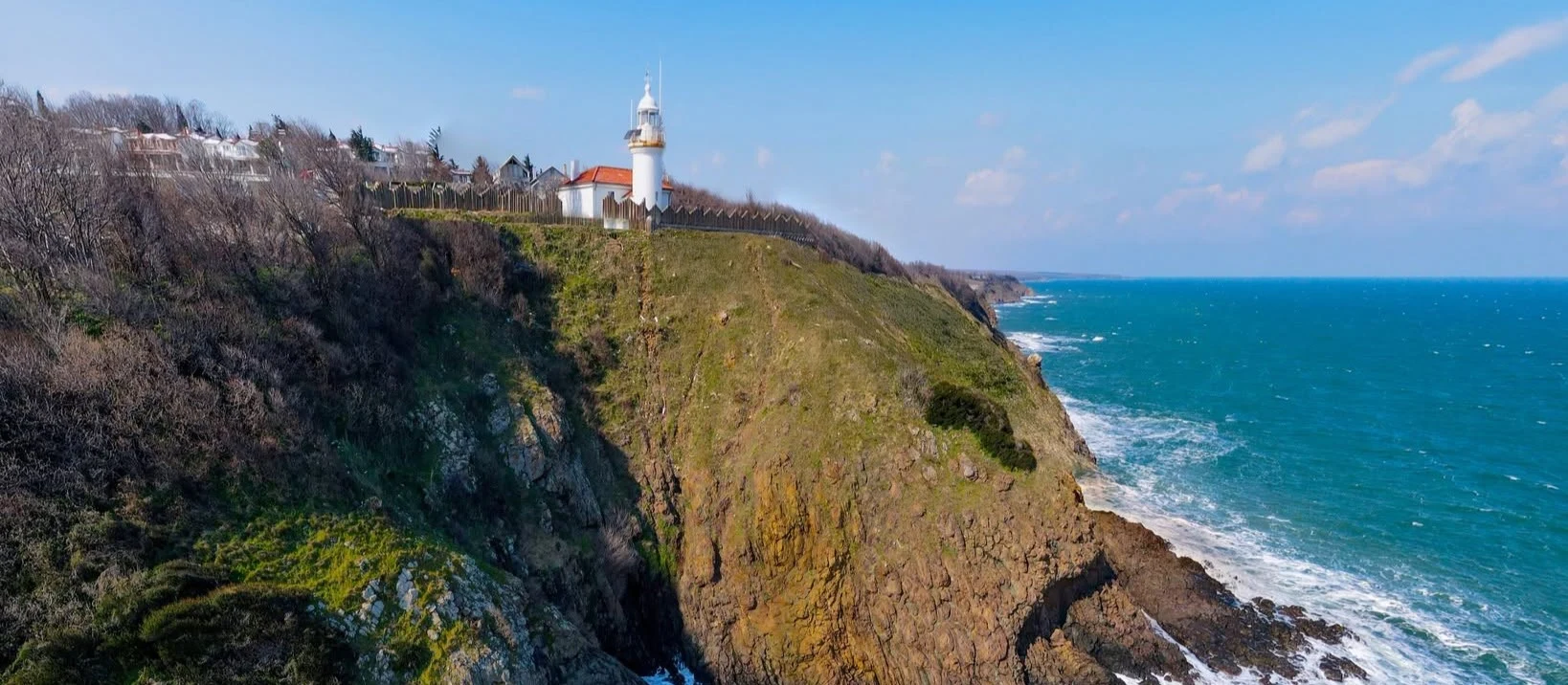
On a windswept headland overlooking the Black Sea, a few kilometers north of İğneada, stands one of the most distinctive maritime landmarks in Turkish Thrace: Limanköy Lighthouse – Limanköy Feneri.
Built in 1866 with the involvement of French builders, the lighthouse is still commonly known locally as the French Lighthouse – Fransız Feneri. For generations its light has helped vessels navigate this remote section of Türkiye's Black Sea coast.
The lighthouse is modest in height compared with many monumental coastal towers, but its elevated position above the sea gives it a commanding presence. The cylindrical white tower rises beside the former lighthouse keeper's building, with the open Black Sea stretching toward the horizon.
Its setting is what makes Limanköy particularly memorable. Here, maritime history meets the landscapes of northern Kırklareli: forests, fishing villages, wild coastline and the wetlands around İğneada.
Today the lighthouse remains part of Türkiye's navigational heritage and is protected under the responsibility of the Directorate General of Coastal Safety. Even when interior access is unavailable, the surrounding landscape and exterior views make it one of the most atmospheric stops around İğneada.
Discover a surviving lighthouse from the great age of 19th-century Black Sea navigation.
French involvement in its construction gave the lighthouse the local name Fransız Feneri.
Enjoy sweeping coastal views from the windswept landscape around Limanköy.
Learn how generations of lighthouse keepers helped guide vessels travelling along the Black Sea coast.
Essential information about one of Kırklareli Province's most distinctive maritime landmarks.
Limanköy, near İğneada in the Demirköy district of Kırklareli Province.
Open on Google Maps1866, during the Ottoman period.
Often called Fransız Feneri – the French Lighthouse – because of French involvement in its construction.
Approximately 8 meters from ground level.
The lighthouse light stands approximately 44 meters above sea level.
Official navigational information gives a visibility range of approximately 20 miles.
A highly exposed and often windy headland overlooking the Black Sea.
Allow around 30–45 minutes for the lighthouse exterior, coastline and photography.
For more than a century and a half, the lighthouse has watched over one of the most remote stretches of Türkiye's European Black Sea coast.
The Black Sea was one of the Ottoman Empire's most important maritime regions. By the 19th century, growing commercial shipping and increasingly regular steamship routes created a greater need for reliable navigational lights along dangerous coastal passages.
It was within this wider period of maritime modernization that Limanköy Lighthouse was constructed in 1866. French builders and technical expertise were involved in the project, which explains why local people came to know it as the Fransız Feneri – French Lighthouse.
Its position was carefully chosen. The lighthouse stands on elevated ground overlooking the open sea close to İğneada, where ships travelling along the western Black Sea coastline needed a dependable navigational reference.
The lighthouse consisted not only of its cylindrical tower, but also an adjoining building used by the personnel responsible for maintaining the light. In an age before automation, operating a lighthouse required constant human attention.
Generations of lighthouse keepers therefore lived and worked in this isolated coastal environment, maintaining the mechanism, fuel and optical equipment while watching the sea in all seasons.
The technology changed dramatically over time, but the fundamental purpose remained the same: to make this section of coastline visible to mariners after darkness fell.
Limanköy Lighthouse is significant not because of enormous architectural scale, but because it preserves an important part of the maritime history of the Black Sea.
For generations, coastal communities depended on ships, fishing and maritime connections. Lighthouses belonged to the infrastructure that made those connections safer.
The lighthouse preserves an important example of Ottoman-period maritime infrastructure dating from 1866.
Its elevated location helped vessels identify and navigate the exposed western Black Sea coastline.
French involvement in its construction created the enduring local name Fransız Feneri.
The adjoining quarters recall a time when maintaining a lighthouse required people to live permanently beside the tower.
The lighthouse and keeper's building are protected as part of Türkiye's maritime heritage.
Its white tower overlooking the Black Sea has become one of the most recognizable historic landmarks around İğneada.
Visitors will often encounter two names for the same monument: Limanköy Feneri and Fransız Feneri.
The second name comes from the role of French builders and technical specialists in the construction of the lighthouse in 1866.
This international connection was not unusual during the 19th century. Lighthouse construction depended on specialized engineering, optical systems and navigational technology, and European expertise played an important role in the modernization of lighthouse networks throughout Ottoman waters.
More than 150 years later, the nickname survives as part of local memory and has become inseparable from the identity of the landmark.
Limanköy Lighthouse follows the practical architectural language associated with traditional lighthouse complexes.
Its most recognizable feature is the white cylindrical masonry tower, which rises from the lighthouse compound and supports the lantern structure above.
Attached to the tower is a rectangular single-story service and keeper's building. Together, these structures formed both a navigational installation and a working home.
Although the tower itself is approximately 8 meters high, its position on elevated coastal ground places the light about 44 meters above sea level.
The white circular tower is the dominant architectural element of the lighthouse complex.
The upper section contains the light and optical equipment responsible for the lighthouse's navigational signal.
The adjoining rectangular building provided working and living space for lighthouse personnel.
Solid masonry construction helped the lighthouse survive its exposed Black Sea environment.
The natural height of the headland gives the relatively modest tower an excellent maritime viewpoint.
Every part of the complex was designed primarily around navigation, maintenance and the lives of lighthouse keepers.
A 19th-century lighthouse required far more work than simply switching on an electric lamp. Before electrical systems reached remote coastal stations, the Limanköy light relied on fuel-burning illumination and mechanical equipment.
Historical descriptions record that lighthouse keepers operated a mechanism that had to be wound manually and used kerosene to produce the light.
The lighthouse later passed through several stages of modernization as navigational technology improved. Modern lighting and reflector systems eventually replaced the older fuel-based methods.
According to official navigational information, the modern light has a stated range of approximately 20 miles.
Earlier keepers had to wind the lighthouse mechanism by hand to keep the system operating correctly.
Kerosene provided the illumination before modern electrical equipment became available.
Lamps, lenses, mechanisms and fuel systems required regular attention from lighthouse personnel.
Improved lamps and reflectors greatly reduced the manual work required to maintain the navigational signal.
The official navigational range allows the light to be detected far offshore under suitable conditions.
The lighthouse should be understood as working navigational heritage rather than simply a historic monument.
Before lighthouse automation, keeping the light operating was a demanding occupation.
A lighthouse keeper had to maintain the lamp, watch the mechanism, clean optical equipment, manage fuel supplies and ensure that the light functioned correctly throughout the night.
At remote locations such as Limanköy, the lighthouse was therefore not simply a workplace. The adjoining building formed part of the keeper's daily life, and families could spend years living beside the sea.
Regional accounts remember Limanköy especially for the continuity of its lighthouse-keeping tradition, with responsibility for the light associated with the same family across several generations.
Automation eventually transformed this way of life. What survives today is therefore also a monument to the people who once maintained Türkiye's coastal navigation system by hand.
The light had to remain dependable regardless of darkness, winter storms or poor weather.
Early lighthouse systems required regular winding, inspection and adjustment.
Keepers were responsible for ensuring that sufficient fuel was always available.
Keeper's quarters turned remote lighthouse stations into homes as well as workplaces.
Limanköy's lighthouse tradition became part of the cultural memory of the surrounding community.
Modern navigational systems gradually reduced the need for permanently resident lighthouse keepers.
The history of Limanköy Lighthouse was not entirely peaceful. Historical research concerning Black Sea lighthouses records a serious interruption during regional unrest in the early years of the 20th century.
Accounts from 1903 describe attacks in the wider İğneada region, during which the lighthouse installation was damaged and the keeper's residence was affected. The lighthouse personnel were forced to leave their isolated station.
The navigational importance of the light meant that the interruption could not be allowed to continue indefinitely. Reconstruction was subsequently authorized, with repair work carried out under protection.
By the end of 1904, the lighthouse was again functioning, restoring an important navigational marker on this part of the Black Sea coast.
Few historic monuments in Kırklareli have a setting as dramatic as Limanköy Lighthouse.
The tower occupies a windswept landscape above the western Black Sea, surrounded by open ground, agricultural land and coastal vegetation. Behind this maritime landscape rise the forests of the Yıldız – Istranca Mountains.
The nearby İğneada region is famous for a completely different natural environment: its rare floodplain – longoz – forests, lagoons, wetlands and extensive sandy coastline.
This combination makes the lighthouse especially valuable for travelers. A visit can move easily from maritime heritage to beaches, wetlands, forests and fishing communities within a relatively compact area.
The lighthouse faces one of the most exposed sections of Kırklareli's Black Sea coastline.
Strong winds are common, especially outside the warmer summer months.
The nearby Istranca landscape creates a striking contrast between dense forest and open sea.
Fishing remains an important part of traditional life along the Black Sea settlements of northern Kırklareli.
This is a much quieter and less intensely developed coastal landscape than many of Türkiye's major resort regions.
Limanköy is especially rewarding when maritime heritage is combined with the natural landscapes around İğneada.
The lighthouse is not a large museum complex. Its appeal comes instead from observing the surviving architecture and understanding how the structure relates to the surrounding sea.
Study the compact cylindrical form of the white masonry tower and its prominent lantern level.
The attached low building recalls the human side of lighthouse operation before automation.
From the exterior, look at the upper gallery and lantern structure that hold the lighthouse's navigational equipment.
The open horizon explains immediately why this elevated site was chosen for a navigational beacon.
The lighthouse is especially photogenic when included together with the surrounding fields, vegetation and sea.
Spend a little additional time exploring the quiet village and understanding its relationship with the Black Sea.
Limanköy Lighthouse is an important historic landmark, but visitors should remember that it is not operated in the same way as a conventional archaeological museum or historic house.
The lighthouse remains protected maritime infrastructure. Public access to the immediate compound or interior can therefore vary, and visitors should not assume that climbing the tower or entering the keeper's building will be possible.
For most travelers, the principal experience is seeing the lighthouse from the accessible exterior areas, enjoying the coastal setting and photographing the Black Sea panorama.
The lighthouse can be atmospheric in every season, but conditions along the Black Sea coast change considerably throughout the year.
Green landscapes, wildflowers and moderate temperatures create beautiful conditions for coastal photography.
The most convenient season for combining the lighthouse with İğneada's beaches, forests and other outdoor attractions.
Excellent for combining coastal scenery with the changing colors of the Istranca forests.
Storm clouds, strong winds and rough seas can create dramatic views, although conditions may be cold and exposed.
Quieter conditions and softer light can work well for architecture and landscape photography.
Lower light often gives the white lighthouse greater texture and adds atmosphere to the surrounding landscape.
Enough for a quick exterior look and several photographs if passing through Limanköy.
Ideal for most visitors who want to appreciate both the architecture and Black Sea landscape.
Allow more time if you enjoy landscape photography or want to explore the immediate surroundings slowly.
Combine the lighthouse with Limanköy village, İğneada and nearby coastal scenery.
Add one or more of İğneada's lagoon, beach and longoz forest landscapes.
Use the lighthouse as one stop within a complete İğneada nature and heritage itinerary.
Limanköy Lighthouse is one of the most photogenic historic structures on the Kırklareli Black Sea coast.
Its simple white tower contrasts beautifully with the blue sea, changing skies and green coastal landscape.
Frame the complete tower and keeper's building together to show the full historic complex.
Position the Black Sea behind the tower to emphasize its maritime function.
A wider composition can include fields, vegetation, lighthouse and sea in one image.
Dramatic Black Sea clouds can create extremely atmospheric lighthouse photographs.
Look for the lantern room, gallery railing, tower profile, windows and connection with the keeper's building.
Never approach unsafe cliff edges or enter restricted areas merely to obtain a photograph.
The lighthouse occupies an exposed Black Sea headland and conditions can be considerably windier than inland Kırklareli.
Treat interior entry as unavailable unless official access is specifically being offered during your visit.
The lighthouse is part of Türkiye's navigational infrastructure as well as a historic landmark.
Even on otherwise pleasant days, coastal wind can make Limanköy feel considerably cooler.
Ground around coastal viewpoints can be uneven, wet or muddy depending on weather conditions.
The lighthouse works best as part of a wider day exploring the coast, forests and lagoons around İğneada.
Take all litter with you and avoid damaging coastal vegetation.
Strong wind, rain or Black Sea storms can significantly change conditions around the lighthouse.
Limanköy Lighthouse is situated in Limanköy village near İğneada, in the Demirköy district of Kırklareli Province.
The village is approximately 4 kilometers from İğneada, making the lighthouse easy to combine with other attractions around the coastal town.
A private car, taxi or organized vehicle is generally the easiest way to reach the area and continue onward to the natural attractions surrounding İğneada.
Limanköy lies only a short drive away, making the lighthouse one of the easiest historical additions to an İğneada itinerary.
Travel east toward İğneada and continue to Limanköy as part of a combined nature and heritage excursion.
Plan the lighthouse as part of a full-day road journey through the Istranca Mountains toward the Black Sea.
A private vehicle provides the greatest flexibility for combining the lighthouse with forests, beaches and lagoons.
Use “Limanköy Feneri” or “İğneada Feneri” as your navigation destination and follow current local road information.
A private vehicle is especially useful if you want to combine Limanköy, İğneada, Demirköy and other northern Kırklareli attractions in one day.
The lighthouse is best experienced as part of a wider journey through the remarkable natural and cultural landscapes of northern Kırklareli.
Explore the relaxed Black Sea town, extensive sandy coastline and fishing traditions only a few kilometers from Limanköy.
Discover one of Türkiye's rare floodplain forest ecosystems, where forests, wetlands, streams and lagoons meet near the Black Sea.
Visit one of the best-known lagoon landscapes around İğneada, separated from the Black Sea by a narrow coastal barrier.
Continue inland toward the forested district center and discover the historic landscapes of the Istranca Mountains.
Explore one of the region's most fascinating industrial-archaeology sites associated with Ottoman iron production.
Travel deeper into the Istranca Mountains to explore Kırklareli Province's best-known cave system.
Continue along the Black Sea region to a historic coastal town known for its cliffs, fishing harbor and ancient rock-cut heritage.
Discover prehistoric settlements, Ottoman monuments, forests, caves, traditional towns and the wider heritage of the province.
Travelers with a full day can combine the lighthouse with several of northern Kırklareli's most memorable natural landscapes.
Begin with the wetlands and floodplain forests while the air is cooler and the natural environment is particularly peaceful.
Continue toward one of İğneada's characteristic lagoon landscapes and the nearby Black Sea shoreline.
Stop in town and look for local dishes, including seasonal Black Sea fish when available.
Drive north toward Limanköy and spend time exploring the village's coastal setting.
Finish the historical part of the journey at the 1866 lighthouse overlooking the Black Sea.
Allow additional time for photography and quiet views before returning toward İğneada or Demirköy.
Limanköy Lighthouse is located in Limanköy near İğneada, in the Demirköy district of Kırklareli Province in northwestern Türkiye.
Limanköy is approximately 4 kilometers from İğneada, so the lighthouse is very easy to include in an İğneada itinerary.
The lighthouse was built in 1866 and has served as a navigational landmark on the Black Sea coast for more than 150 years.
French builders were involved in the construction of the lighthouse, which led local residents to call it Fransız Feneri – the French Lighthouse.
Yes. The historic lighthouse near İğneada is commonly described using names including Limanköy Lighthouse, İğneada Lighthouse and Fransız Feneri.
The lighthouse tower rises approximately 8 meters above ground level. Its elevated coastal position places the navigational light about 44 meters above sea level.
Official navigational information gives the lighthouse a visibility range of approximately 20 miles under suitable conditions.
Visitors should not assume that tower access is available. The structure remains protected navigational heritage rather than a conventional observation tower, and access to operational or interior areas can be restricted.
The lighthouse should not be treated as a conventional museum with guaranteed daily public interior opening hours. Access conditions can vary, so travelers making a special journey should check locally before expecting interior entry.
Yes. The lighthouse and associated keeper's building are protected as part of Türkiye's maritime heritage under the responsibility of the Directorate General of Coastal Safety.
Before modern electrical systems, the lighthouse used kerosene illumination and a manually wound mechanism. Its equipment was modernized over subsequent generations.
Yes. The building attached to the tower formed part of the working lighthouse complex, and Limanköy has a long tradition associated with resident lighthouse keepers and their families.
Yes. The lighthouse overlooks the Black Sea coast of Kırklareli Province close to Türkiye's border region with Bulgaria.
Yes, especially for travelers interested in lighthouses, maritime history, photography and Black Sea landscapes. Its appeal is strongest when combined with İğneada and the surrounding longoz forests.
Approximately 30–45 minutes is suitable for most visitors, although photographers may want to stay longer.
Combine the lighthouse with İğneada, the Longoz Forests, Mert Lake, Demirköy, Dupnisa Cave and other attractions throughout northern Kırklareli.
Spring through autumn generally provides the easiest conditions, while winter can be extremely atmospheric but considerably colder, windier and wetter.
Yes. The white lighthouse, open Black Sea horizon, coastal vegetation and rapidly changing skies make it one of the most photogenic historic landmarks around İğneada.
Historic lighthouses are both cultural monuments and pieces of maritime infrastructure. Visitors can help protect Limanköy by respecting the building, the operational compound and the fragile surrounding coastline.
Never cross locked gates, fences or signs indicating restricted lighthouse areas.
Do not climb walls, roofs, railings or other parts of the lighthouse complex.
Remain on appropriate paths and avoid damaging grassland or coastal plants while taking photographs.
Strong winds and unstable coastal ground can make exposed viewpoints dangerous.
Take all waste with you and help preserve the quiet landscape around Limanköy.
Limanköy is a living village, so respect private property and the daily life of local residents.
Combine Limanköy Lighthouse with İğneada's extraordinary natural landscapes, the Istranca Mountains and the cultural heritage of northern Kırklareli.
Discover one of the least-explored corners of European Türkiye with a private itinerary combining maritime history, forests, wetlands, traditional settlements and Black Sea scenery.
Ask us about a tailor-made journey combining Limanköy Lighthouse, İğneada, Black Sea coastal landscapes and the remarkable forests and wetlands of northern Kırklareli.
Request a Custom Tour
Discover more of Kırklareli, from prehistoric settlements and Ottoman monuments to Black Sea villages, caves, forests and traditional regional culture.
View Kırklareli Guide