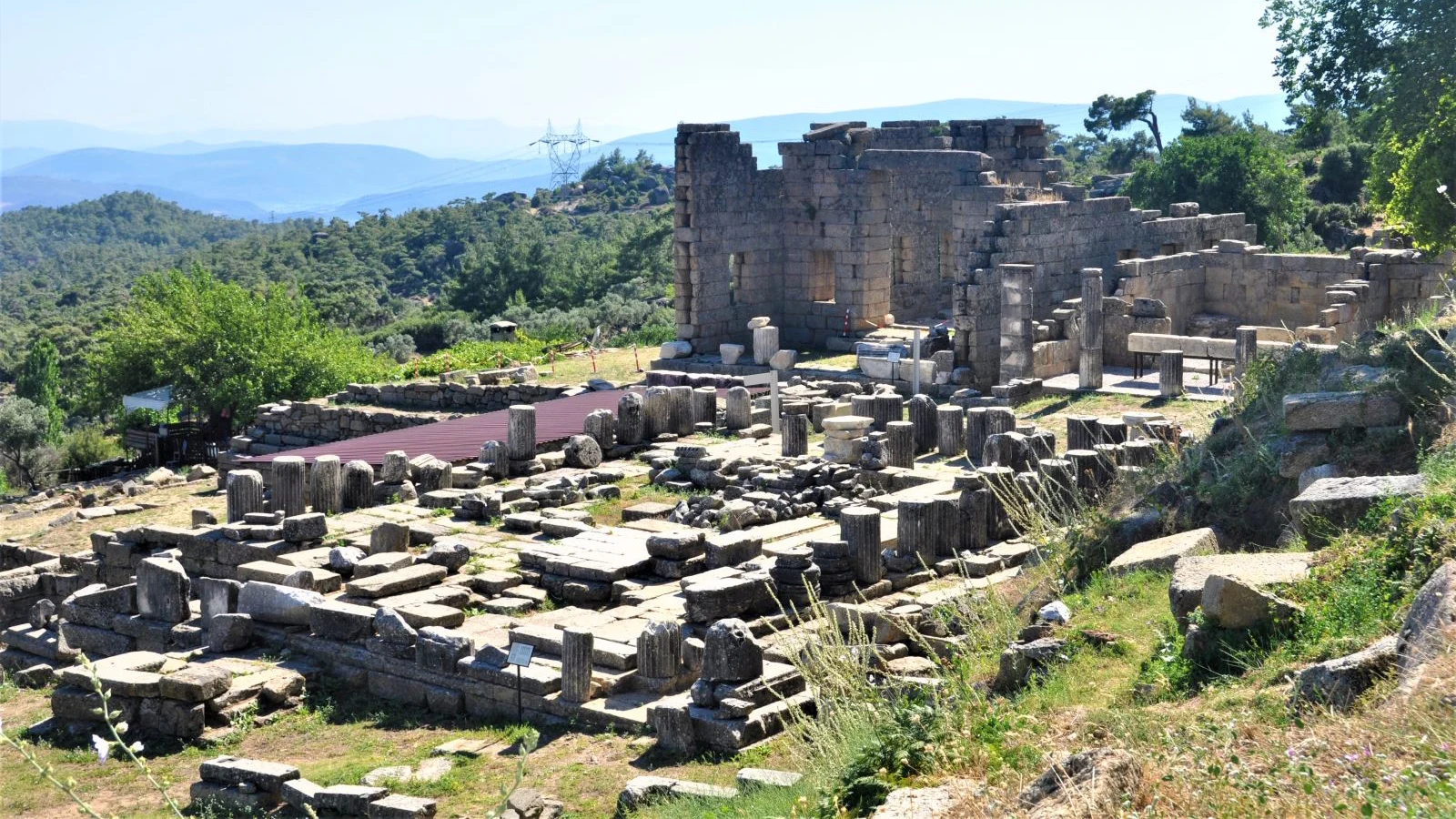
Private Labraunda Ancient Sanctuary Programme
Share your dates and interests; we will check practical arrangements and create a route suited to your group.
Request Your Private Programme





Labraunda lies in the mountains northeast of Milas, ancient Mylasa. The sanctuary was dedicated to Zeus Labraundos, a regional form of Zeus closely associated with the double axe, or labrys.
The setting is fundamental to its character. Terraces, stairs and monumental buildings were constructed among rocks and trees, creating a ceremonial landscape rather than a conventional city centre.
The sanctuary flourished under Mausolus and Idrieus in the 4th century BC. Their projects used religious festivals and architecture to strengthen the public image of the Hecatomnid dynasty.
The principal cult building anchors the sanctuary’s religious identity.
Banquet halls sponsored by the dynasty reveal the social and ceremonial importance of feasting.
Large steps and terraces organised movement through the steep sacred landscape.
The historic connection with Mylasa explains how people approached the mountain sanctuary during festivals.
An at-a-glance introduction to this part of Muğla’s heritage and travel landscape.
Milas, Muğla, Türkiye
Open on Google MapsArchaic origins; major 4th-century BC building
Temple of Zeus, terraces, androns and monumental stairs
Hecatomnid dynasty and ancient Mylasa
Allow 1.5–2.5 hours including hillside walking
Ancient Sanctuary
A meaningful visit begins with the people, landscape and ideas behind the site.
Labraunda Ancient Sanctuary brings together archaic origins; major 4th-century bc building and temple of zeus, terraces, androns and monumental stairs. Its importance is easier to appreciate when the physical setting is considered alongside hecatomnid dynasty and ancient mylasa.
Start by asking what made this particular location useful or meaningful to the people who shaped it. The answer may involve defence, ritual, trade, cultural expression or everyday work, depending on the period.
For a broader route, compare this place with the other destinations in our Muğla travel guide. The region’s coastal and inland sites are linked by centuries of movement, trade and cultural exchange.
The site was a place of worship before the Hecatomnids. Early finds indicate activity from the Archaic period, while the 4th century BC brought the most ambitious transformation.
Mausolus sponsored terraces, a sacred approach and banquet facilities; Idrieus added further buildings including a temple and monumental entrances. The complex served ritual and political purposes.
The sanctuary was connected with Mylasa by a sacred road used for processions and festival gatherings. The route underlines the relationship between city and countryside in Carian religion.
Archaic origins; major 4th-century BC building
Hecatomnid dynasty and ancient Mylasa
Temple of Zeus, terraces, androns and monumental stairs
Different periods can overlap; interpret visible remains and later reuse with care.
Labraunda is not a city like Euromos or Iasos. Its purpose centred on worship, processions and elite patronage.
The double-axe imagery of Zeus Labraundos links local religious traditions with the public symbolism of Carian rulers.
The location in Milas is an essential part of the experience. Pay attention to the relationship between the built environment, approaches and wider landscape rather than viewing the principal landmark in isolation.
The principal cult building anchors the sanctuary’s religious identity.
At Labraunda Ancient Sanctuary, temple of zeus labraundos should be considered within the larger setting rather than as a separate photo opportunity. Observe the scale, materials and placement; these clues often explain how the feature was used.
Which parts of temple of zeus labraundos are original, repaired or reconstructed? Interpretive panels may help distinguish them.
Consider how this element relates to androns elsewhere in the visit.
Banquet halls sponsored by the dynasty reveal the social and ceremonial importance of feasting.
At Labraunda Ancient Sanctuary, androns should be considered within the larger setting rather than as a separate photo opportunity. Observe the scale, materials and placement; these clues often explain how the feature was used.
Which parts of androns are original, repaired or reconstructed? Interpretive panels may help distinguish them.
Consider how this element relates to monumental staircases elsewhere in the visit.
Large steps and terraces organised movement through the steep sacred landscape.
At Labraunda Ancient Sanctuary, monumental staircases should be considered within the larger setting rather than as a separate photo opportunity. Observe the scale, materials and placement; these clues often explain how the feature was used.
Which parts of monumental staircases are original, repaired or reconstructed? Interpretive panels may help distinguish them.
Consider how this element relates to sacred road elsewhere in the visit.
The historic connection with Mylasa explains how people approached the mountain sanctuary during festivals.
At Labraunda Ancient Sanctuary, sacred road should be considered within the larger setting rather than as a separate photo opportunity. Observe the scale, materials and placement; these clues often explain how the feature was used.
Which parts of sacred road are original, repaired or reconstructed? Interpretive panels may help distinguish them.
Consider how this element relates to temple of zeus labraundos elsewhere in the visit.
Labraunda Ancient Sanctuary belongs to a network of places connected by the geography of Milas. Its story intersects with hecatomnid dynasty and ancient mylasa, a useful starting point for understanding why this location matters beyond its own boundaries.
A day in this part of Muğla can contrast temple of zeus labraundos with monumental staircases, then continue toward another regional destination. That contrast helps visitors see different kinds of historical evidence rather than treating every monument as the same kind of attraction.
The best regional itineraries give each place enough time to reveal its own history. Nearby monuments may be related through geography or dynastic patronage, but their periods and purposes are not interchangeable.
To interpret Labraunda Ancient Sanctuary, begin with the surviving evidence: temple of zeus, terraces, androns and monumental stairs. Then ask which activities or beliefs the structures supported, and how much of the original setting is still visible.
Compare the evidence of androns with sacred road. The two may reveal different aspects of the same place, or different phases of its history.
Where an archaeological identification is uncertain, avoid treating a proposed reconstruction as an established fact. Interpretation changes as research and conservation continue.
Start with the defining feature, then widen your view to the details that explain how the place functioned.
The principal cult building anchors the sanctuary’s religious identity.
Banquet halls sponsored by the dynasty reveal the social and ceremonial importance of feasting.
Large steps and terraces organised movement through the steep sacred landscape.
The historic connection with Mylasa explains how people approached the mountain sanctuary during festivals.
The approach road and mountain weather require planning. Verify road conditions and site access, particularly outside the main season or after rain.
Paths and terraces can be uneven and steep. Wear sturdy shoes, carry water and avoid climbing on ancient walls.
Verify the current schedule directly before travel; seasonal hours and closures can change.
Confirm admission and accepted passes with the responsible operator.
Check toilets, drinking water, shade and any on-site services.
Allow 1.5–2.5 hours including hillside walking
The following sequence is an interpretive suggestion rather than a guarantee that every section is open.
Begin with temple of zeus labraundos and take time to orient yourself in the surrounding landscape.
Continue to androns, comparing it with monumental staircases.
Finish with sacred road and consider a nearby stop if time and access permit.
Allow 1.5–2.5 hours including hillside walking
For outdoor ruins, spring and autumn generally offer more comfortable walking temperatures than the height of summer.
Summer afternoons can be hot in Muğla, while rain and wind can make outdoor stone surfaces slippery. Choose the time of day around comfort, visibility and the site’s confirmed opening schedule.
A shoulder-season itinerary often allows more relaxed travel between nearby sites. Check weather conditions and any seasonal transport arrangements before setting out.
Photograph architectural detail without crossing barriers, and use the surrounding landscape to give the subject scale.
A useful set of images includes an establishing view of Milas, a closer study of temple of zeus, terraces, androns and monumental stairs, and a detail that illustrates the site’s material or craft tradition.
Do not touch objects, stand on archaeological walls or enter unsafe areas for a photograph. Respect the privacy of residents and other visitors.
Ask the responsible site or museum about the current accessible route before travelling with a wheelchair, stroller or limited mobility. Historic structures may contain steps, uneven paving or steep gradients.
Expect some uneven surfaces or thresholds; request details of the specific route.
Confirm the authorised parking and closest practical arrival point.
Ask about seating, toilets, shade and rest opportunities.
A shorter circuit or museum-focused stop may be more suitable for some visitors.
Labraunda Ancient Sanctuary is in the Milas area of Muğla Province, southwestern Türkiye. Use the map as an orientation aid, but confirm the correct public entrance, parking and local access rules before departure.
Plan the journey around the official entrance and allow for local road conditions.
Agree on the exact drop-off and return arrangements in advance.
Combine nearby places selectively rather than assuming that every stop can be visited quickly.
Check road closures, restricted archaeological areas and seasonal transport changes.
Use the Muğla travel guide for a wider overview. These nearby ideas are not necessarily within walking distance and should be chosen according to travel time.
Consider this related stop as part of a carefully paced Milas itinerary; check access separately.
Consider this related stop as part of a carefully paced Milas itinerary; check access separately.
Consider this related stop as part of a carefully paced Milas itinerary; check access separately.
Consider this related stop as part of a carefully paced Milas itinerary; check access separately.
In the hills northeast of Milas in Muğla Province.
Zeus Labraundos, associated with the double axe.
Mausolus and Idrieus sponsored much of the 4th-century BC building programme.
It is primarily a sanctuary, historically connected with Mylasa.
As an initial planning estimate, allow 1.5–2.5 hours including hillside walking. Add time for transport, weather and any guided interpretation.
No. Schedules, fees, closures and available sections may change. Check the responsible authority or operator close to your visit.
Yes. A tailored route can combine this stop with nearby heritage and landscape sites, subject to confirmed access and travel times.
Respect barriers, conservation zones and the instructions of local staff.
Do not climb walls, remove fragments or touch fragile surfaces.
Avoid blocking paths or photographing people without permission.
Carry away rubbish and avoid disturbing vegetation or wildlife.
Ask Wow Cappadocia / Venere Travel to design a private, tailor-made regional itinerary with a licensed guide and comfortable vehicle, subject to confirmed site access, without compulsory shopping stops.
Choose archaeology, village culture, coastal landscapes and local food at a pace that suits you.
Share your dates and interests; we will check practical arrangements and create a route suited to your group.
Request Your Private Programme
Continue your Muğla journey with a related historical or coastal destination.
Read the Nearby Guide