Private Kula Food Experience
Share your travel date, interests and group size. We can propose a sensible local route and check any producer access.
Request Your Private Programme





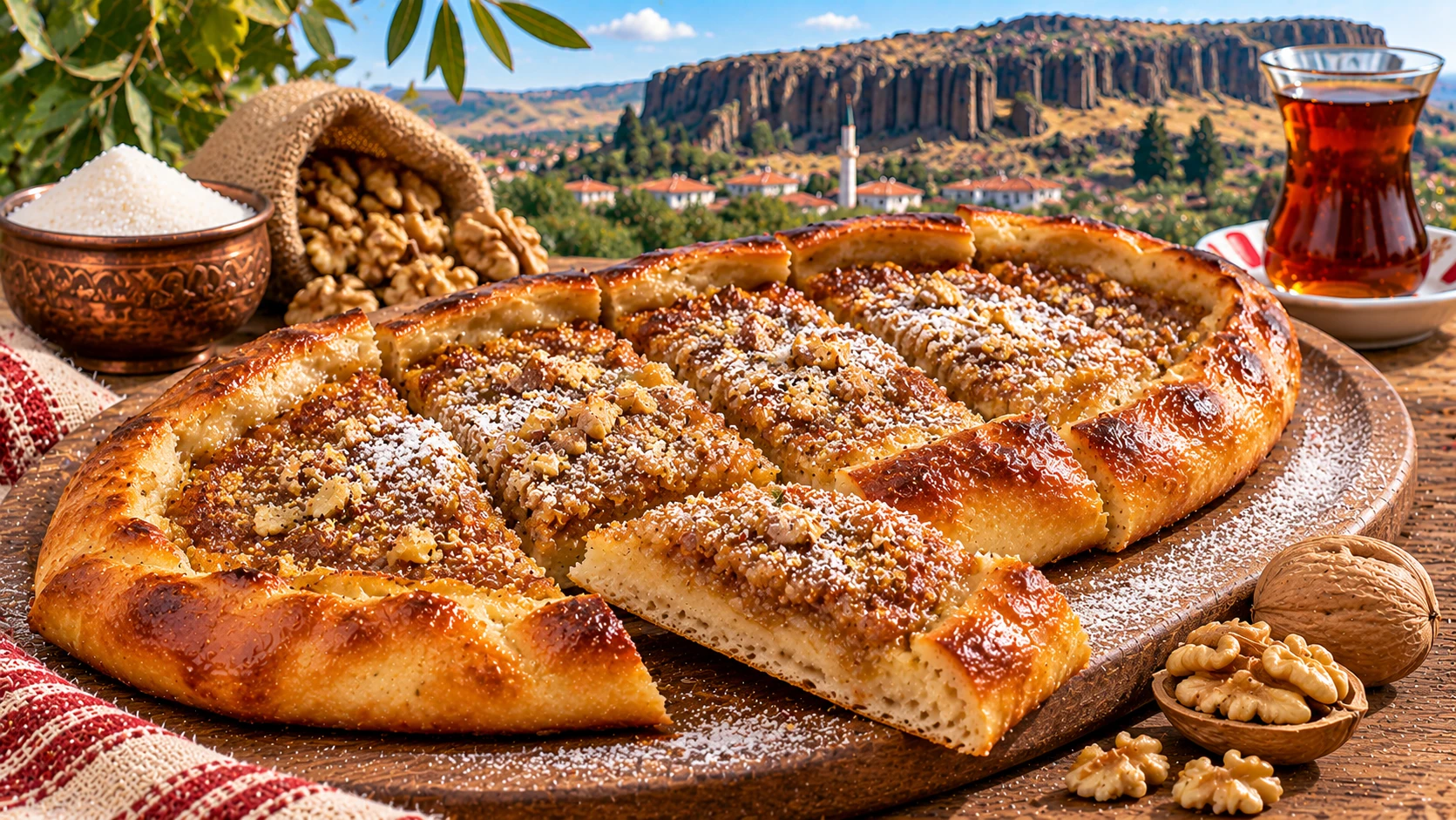
Kula şekerli pide is a sweet bakery speciality made by spreading tahini and sugar over thin dough, rolling and coiling it, and flattening it again before baking. The spiral shaping creates its characteristic layered texture.
Rolling and coiling distribute the tahini-sugar filling through the pastry. Look at the layers in a cut slice and compare them with a flatter, single-layer sweet bread.
Double-roasted tahini and sugar.
Roll, coil, flatten and coat with more tahini.
Layered interior with a browned exterior.
Unsweetened tea to balance the sweetness.
Essential context for a meaningful food experience.
Kula, Manisa
Sweet layered pide
Core flavours
Shaping
Ask locally about availability and season
No specific registration asserted
The Turkish Ministry of Culture’s food portal documents şekerli pide from Manisa and identifies the pictured example as Kula Şekerli Pidesi. Its method uses double-roasted tahini, sugar and dough, without requiring the dish to be described as an officially registered geographical indication.
Kula’s food heritage includes savoury güveç and a strong tradition of roasted chickpeas. Sweet pide provides another reason to stop at a local bakery while exploring the town’s historic houses.
This guide does not assert a specific geographical-indication registration for this item; local reputation and official registration are different things.
The pastry combines the toasted aroma of sesame with caramelised sugar and a slightly crisp exterior. Its interior can remain tender and layered if it has not been overbaked.
Kula’s version is often round and intended for slicing. The visible swirl or folded layers are a clue to how it was formed.
Double-roasted tahini and sugar.
Roll, coil, flatten and coat with more tahini.
Layered interior with a browned exterior.
Unsweetened tea to balance the sweetness.
Kula’s old houses and volcanic landscapes attract many visitors, but its bakeries are a good way to encounter living local craftsmanship.
The dough is rolled out to a thin sheet, spread with tahini and sprinkled with granulated sugar. It is rolled into a cylinder, coiled into a circle and flattened again.
A second coating of tahini is applied to the top before the pastry enters the oven. The official heritage description allows a short rest after baking before serving. The folding process distributes sweetness and sesame flavour through the layers rather than leaving all of it on the surface.
Double-roasted tahini and sugar.
Roll, coil, flatten and coat with more tahini.
Layered interior with a browned exterior.
Unsweetened tea to balance the sweetness.
Ask whether a bakery prepares the traditional rolled-and-coiled version and whether it is baked fresh that day.
Reference for the regional method or designation: Regional food documentation. The linked record is provided for checking the details; opening hours and producer availability must be confirmed separately.
Share it warm with unsweetened Turkish tea. Because the filling is rich, a few slices are usually enough to appreciate the flavour.
Try a bite without extra syrup or toppings. The sugar and tahini already provide the central contrast, and additional sweeteners can mask the roasted-sesame aroma.
Start by asking for the simplest or most characteristic preparation. Give yourself time to observe the texture, aroma and serving method, then compare it with one of the related Manisa foods linked below. A short conversation with a producer can be more revealing than collecting several rushed tastings.
The standard preparation includes wheat and sesame. It is not necessarily dairy-free: individual bakers may enrich the dough or finish it differently, so check if that matters.
For a special trip, verify the producer or bakery is open and that the item is available. Seasonal harvests, working-kitchen schedules and festival dates can change; this guide deliberately avoids inventing fixed opening hours or prices.
Photograph the product in its actual context: the market stall, bakery counter, plate or orchard, with the maker’s permission. Do not enter production spaces without approval, and avoid disrupting food handling to stage a picture.
The hero path in this page is a website image reference, not a photograph included in this HTML package. Supply a properly licensed image of the specific food or product before publishing.
Food markets and historic town centres may have steps, narrow pavements or limited seating. If you need a step-free tasting location, confirm the venue’s access arrangements before travelling.
Ingredient and allergen information should come from the actual producer or kitchen. A traditional description cannot guarantee the absence of cross-contact or accommodate individual dietary needs.
Compare şekerli pide with Alaşehir tahinli pide on a wider Manisa trip: both use tahini, yet Alaşehir’s registered version uses a two-stage bake with a different shape and finish.
The local starting point is Kula in Manisa Province. Use an up-to-date map for the exact shop, producer or market and confirm access before making a special journey.
Continue with this related Manisa guide for a different food tradition or nearby heritage stop. Check actual travel time and opening conditions.
Continue with this related Manisa guide for a different food tradition or nearby heritage stop. Check actual travel time and opening conditions.
Continue with this related Manisa guide for a different food tradition or nearby heritage stop. Check actual travel time and opening conditions.
A sweet, rolled-and-coiled tahini pastry associated with Kula.
Tahini and sugar are spread on thin dough, which is rolled, coiled and flattened before baking.
No. They share tahini but use different shaping and finishing methods.
Yes. Tahini is ground sesame and is essential to the flavour.
The documented Kula preparation relies on tahini and granulated sugar rather than a required poured syrup.
Ask bakeries and pide shops in Kula for a freshly made şekerli pide.
Buy from identifiable producers and ask respectfully about their methods.
Read labels and ask about allergens, preparation and storage.
Do not enter farms, mills, kitchens or workshops without permission.
Order manageable portions and use practical packaging for purchases.
Ask Wow Cappadocia / Venere Travel to plan a private route with licensed guiding where appropriate, realistic travel times and no compulsory shopping stops. Producer visits are subject to availability and permission.
Combine food, culture and history at your own pace.
Share your travel date, interests and group size. We can propose a sensible local route and check any producer access.
Request Your Private Programme
Discover a complementary local food or cultural destination.
Read the Related Guide