Ayvalık Travel Guide
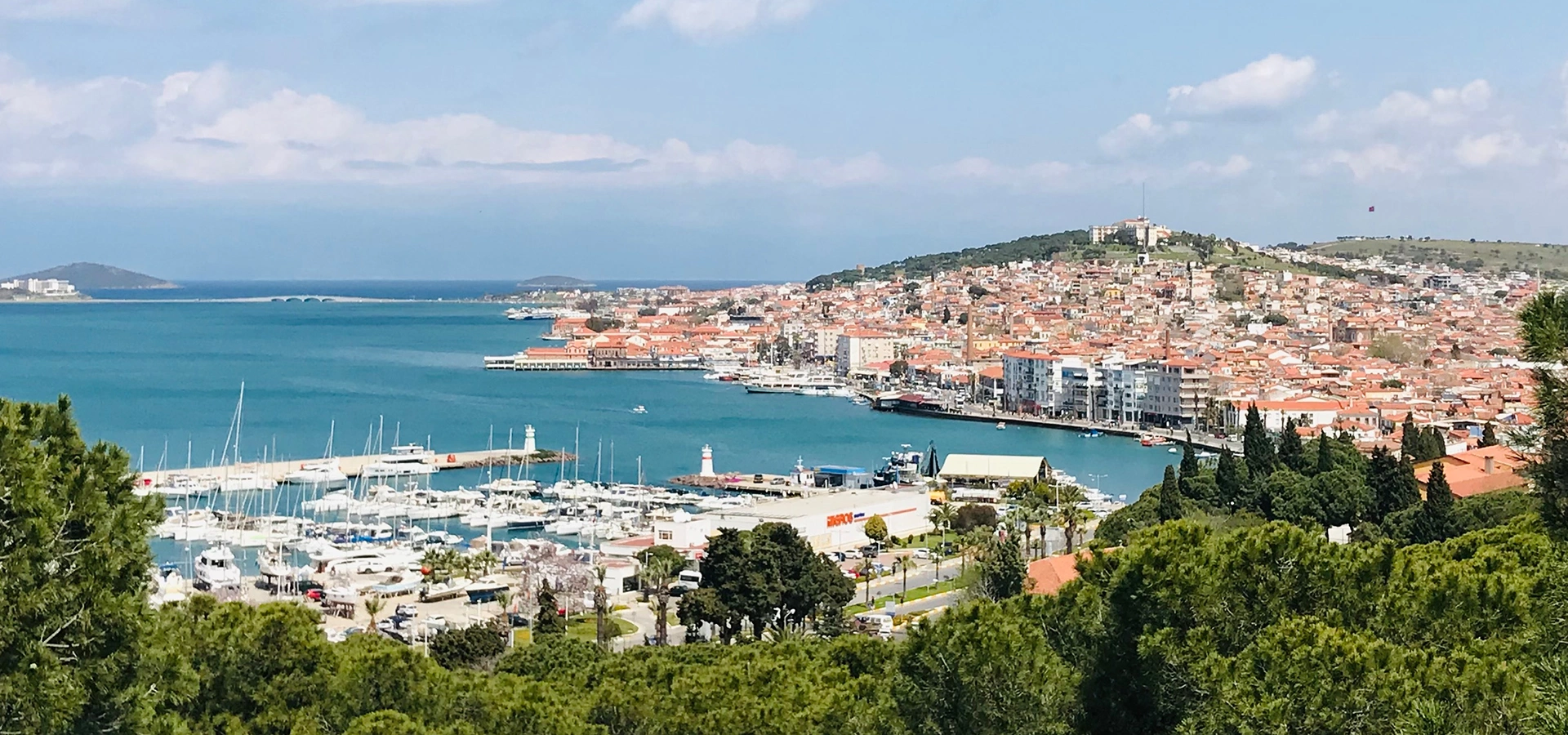
Explore Ayvalık's stone neighbourhoods, waterfront, former churches, mosques, markets, local food and island-filled coastal landscape.
View Ayvalık Guide





In the historic centre of Ayvalık, Çınarlı Mosque is one of the clearest places to understand how the town's architectural landscape changed between the late Ottoman period and the early years of the Turkish Republic. The building was originally constructed for the local Greek Orthodox community as the Hagios Georgios — Agios Georgios / Aya Yorgi — Church and was later adapted for Muslim worship.
Official Turkish cultural sources date the church broadly to the second half of the 19th century, while Ayvalık's heritage documentation identifies it specifically with the major building phase of 1880–1881 and attributes the design to the Ayvalık-born architect Emmanuel Kounas. Kounas is also associated with other important late-19th-century churches in Ayvalık and Cunda.
The building is impressive even before you enter. Its monumental western façade is composed in a strongly Neoclassical architectural language, with projecting entrance elements, paired columns, arched openings, decorative stonework and the warm local stone traditionally associated with Ayvalık. Inside, the character changes: the church-derived spatial arrangement survives beneath a central dome and vaults, while later Islamic elements coexist with elaborate Baroque-influenced decoration and surviving gilded details from the building's earlier use.
That combination makes Çınarlı Mosque more than a beautiful religious building. It is a physical record of Ayvalık's layered urban history: the prosperity of the late Ottoman Greek Orthodox community, the architectural transformation of the town in the 19th century, the population exchange, the conversion of several churches into mosques and the continuing use of historic monuments by a different community.
Today Çınarlı Mosque remains an active place of worship. Visitors are normally welcome when religious activities allow, but the experience should be approached differently from a museum. Dress respectfully, remove shoes before entering the prayer hall, avoid disturbing worshippers and plan sightseeing outside the main prayer periods whenever possible.
The mosque began as one of late-19th-century Ayvalık's most monumental Greek Orthodox churches.
Ayvalık heritage documentation associates the present building with the 1880–1881 period and architect Emmanuel Kounas.
A monumental Neoclassical exterior gives way to a richly decorated interior with Baroque-influenced details.
Unlike a museum church, Çınarlı Mosque continues to function as an active mosque in central Ayvalık.
Essential information for understanding and respectfully visiting one of central Ayvalık's most important historic religious buildings.
Hamdibey neighbourhood, central Ayvalık, within the historic urban fabric and easy to combine with an old-town walk.
The building was constructed as the Greek Orthodox Hagios Georgios / Agios Georgios / Aya Yorgi Church.
Official sources place it in the second half of the 19th century; local heritage research identifies the major building phase as 1880–1881.
Ayvalık heritage documentation attributes the church to local architect Emmanuel Kounas.
A monumental Greek Orthodox church serving Ayvalık's pre-exchange Christian community.
An active mosque, adapted for Muslim worship during the early Republican period.
A cross-plan composition with a central dome, vaulted arms and a three-nave interior arrangement.
Built using rubble and cut stone, with a particularly impressive stone façade associated with Ayvalık's local masonry tradition.
Known for Baroque-influenced ornament, composite capitals and surviving gilded decoration from the church period.
Remove shoes, dress modestly, speak quietly and avoid entering the prayer area during congregational worship.
As an active mosque, there is normally no museum-style entrance ticket; access depends on worship and local arrangements.
Allow around 20–40 minutes for the exterior, interior and architectural details; longer if exploring the surrounding old town.
Çınarlı Mosque is one of the best places in Ayvalık to see how the town's late Ottoman Greek heritage and later Muslim history occupy the same architectural space. Its importance lies not in one decorative detail, but in the whole building and the story it tells.
Ayvalık's historic centre contains several former churches that acquired new functions after the population exchange. Çınarlı is especially striking because of its scale and architectural ambition. It belongs to a period when prosperous local communities commissioned large stone churches whose façades expressed the changing architectural tastes of the late 19th century.
The building also helps visitors read Ayvalık as a city rather than simply as a picturesque holiday destination. The narrow streets, stone houses, former churches, olive-oil industrial buildings and waterfront all belong to the same wider urban history. Çınarlı Mosque stands within that fabric as one of its largest surviving monuments.
Inside, the adaptation from church to mosque remains legible without turning the space into a historical display. The original Christian spatial organisation, columns, dome and ornamental framework survive, while a mihrab, minbar, prayer carpets, calligraphic elements and a minaret express the building's present religious function.
For travellers interested in architecture, religious history or the social transformations of the Aegean, this is therefore one of Ayvalık's essential stops — particularly when paired with Taksiyarhis Monument Museum, Saatli Mosque and Hayrettin Paşa Mosque to compare different fates of the town's former churches.
During the 19th century, Ayvalık — historically known in Greek as Kydonies — developed into an important Aegean town with a substantial Greek Orthodox population, commercial prosperity and a distinctive architectural culture. Churches were among the most visible expressions of that urban growth.
The building now known as Çınarlı Mosque was created as the Hagios Georgios Church. Official Culture Portal information dates it broadly to the second half of the 19th century. More detailed Ayvalık heritage research places the current monumental church in 1880–1881, during a period when the town's ecclesiastical architecture was shifting from earlier basilical arrangements toward more centralised cross-plan forms with domes and increasingly Neoclassical façades.
The church is attributed to Emmanuel Kounas, an Ayvalık architect connected in local research with several important buildings of the period, including Hagios Ioannis — today's Saatli Mosque — and the Taksiyarhis Church on Cunda.
The decisive social transformation came after the Greco-Turkish population exchange. Ayvalık's Orthodox community departed, Muslim communities arrived from Greece and many religious buildings were reassigned. Local heritage chronology places the conversion of Hagios Georgios into Çınarlı Mosque in 1928; some other official summaries use slightly different early-Republic dates, so it is safest to understand the conversion as part of the town's post-exchange transformation during the 1920s.
The new use introduced Islamic liturgical elements without erasing the building's overall architectural identity. The result is not a purpose-built Ottoman mosque disguised as a church, nor simply an abandoned church with a minaret attached. It is a long-used, adapted monument whose successive layers remain visibly intertwined.
The historic Christian dedication was to Hagios Georgios — Saint George, whose name appears in Turkish sources in forms such as Agia İorgi, Aya Yorgi or Ayo Yorgos. After the building became a mosque, the Christian dedication was no longer its everyday public name.
The mosque became known as Çınarlı Camii, literally the “Mosque with the Plane Tree” or “Plane-Tree Mosque.” Turkish place names frequently use çınar for the Oriental plane tree, a species strongly associated with shade, gathering places and long-lived urban landmarks.
Visitors may also encounter the alternative name Alibey Mosque in some older tourism material. However, Çınarlı Mosque is the most widely used modern name in local heritage and visitor information.
The multiple names are useful rather than confusing. They reveal the building's successive cultural identities: Hagios Georgios points to its Orthodox church history, while Çınarlı Mosque belongs to its continuing life as a Muslim place of worship.
Ayvalık heritage research attributes Hagios Georgios to Emmanuel Kounas, an architect associated with a group of important churches constructed in Ayvalık and Cunda during the second half of the 19th century.
This period marked a significant architectural shift. Earlier Orthodox churches in the region commonly followed basilical arrangements, while later buildings increasingly explored cross plans, central domes and more monumental façade compositions. Hagios Ioannis — now Saatli Mosque — and Hagios Georgios — now Çınarlı Mosque — are among the clearest central-Ayvalık examples.
The façades also reflect the broader popularity of Neoclassicism in the eastern Mediterranean during the 19th century. Classical columns, pediments, carefully ordered window groups, moulded cornices and symmetrical compositions offered a visual language associated with urban sophistication and institutional prestige.
Çınarlı Mosque is especially valuable because those architectural ideas survive at monumental scale. You do not need specialist knowledge to notice them: simply stand back from the western façade and compare the balance of its columns, arches, window groups and central pediment before entering.
The exterior is one of the most impressive surviving 19th-century façades in Ayvalık. Official cultural sources describe a building of rubble and cut stone with elegant columns, paired windows and a façade using the warm-toned local stone commonly associated with the town's historic architecture.
The western entrance is the natural place to begin. A projecting central composition rises above a stairway and gives the façade a ceremonial quality. Classical architectural references — columns, capitals, cornices, arches and pediment-like forms — organise the wall into clearly defined horizontal and vertical sections.
The elevated western entrance creates a formal transition from street and courtyard into the former church interior.
Columns and pilasters organise the façade into symmetrical bays and reinforce its late-19th-century Neoclassical character.
Grouped arched openings illuminate the upper interior and give the central façade a strong vertical emphasis.
Small multi-lobed openings and decorative window forms add another layer of visual complexity above the principal windows.
The warm masonry harmonises with Ayvalık's surrounding historic streets and distinguishes the building from modern concrete construction.
The minaret belongs to the mosque phase and makes the building's adapted religious history immediately visible from outside.
The façade rewards slow observation. Rather than photographing only the whole building, look closely at capital forms, stone mouldings, window surrounds, decorative grilles and the points where later mosque elements meet the earlier church fabric.
Official cultural inventories describe Çınarlı Mosque as a cross-plan structure whose central crossing is covered by a dome and whose arms are covered by vaults. The interior also preserves a three-nave organisation, showing how several spatial systems are combined within the building.
This is important for understanding why the mosque feels different from a purpose-built Ottoman mosque. Rather than being organised from the beginning around a single wall facing Mecca, the space developed from an Orthodox church whose primary liturgical orientation was east–west.
The central dome draws the eye upward while the vaults establish the arms of the cross. Thick columns positioned in front of the vaults support gallery levels, and their composite capitals create one of the most distinctive architectural rhythms inside.
When the building was converted to mosque use, Islamic worship had to be accommodated within this inherited geometry. The result allows visitors to read two systems simultaneously: the original church axis and the later Muslim prayer orientation.
The interior is where the building's layered history becomes most powerful. Official tourism sources specifically note that gilded decoration surviving from the church period can still be seen, while the broader ornamental character is described as Baroque.
Visitors should first look upward rather than immediately toward one wall. The dome, vaults, columns and galleries explain the original architectural structure far better than any single decorative feature. From there, examine how painted and gilded surfaces articulate arches, capitals and upper wall zones.
The substantial columns supporting the galleries are topped by elaborate composite capitals, among the interior's most recognisable classical details.
Curving forms, layered decorative framing and gilded accents create an interior richer than the relatively disciplined exterior suggests.
Some decorative elements from the church phase remain visible, making the transition between historical periods unusually tangible.
The dome acts as the principal spatial focus and is best appreciated from near the centre of the interior.
The upper gallery is supported by heavy columns and forms an important part of the original church spatial organisation.
The mihrab, minbar, prayer carpets and calligraphic additions belong to the building's continuing life as a mosque.
Because this is a living religious space rather than a museum reconstruction, interior furnishings and access to particular areas may change. Respect any ropes, signs or areas reserved for worshippers.
Converting an Orthodox church into a mosque requires more than changing the building's name. Christian and Muslim worship organise sacred space differently, so new liturgical elements must be introduced while older elements may be removed, covered, adapted or retained.
At Çınarlı Mosque, the building's overall architectural integrity remained recognisable. Later mosque use introduced a minaret and Islamic interior elements, while the dome, vaults, columns, galleries and much of the ornamental framework survived.
The most important new directional element is the mihrab, which indicates the qibla — the direction of Mecca — and therefore establishes the orientation for Muslim prayer. A minbar provides the pulpit used for the Friday sermon, while carpets define ordered prayer rows across the floor.
This creates an interior where the original east–west church organisation and the later prayer direction do not perfectly coincide. For architecture enthusiasts, that relationship is one of the most interesting things to observe because it shows how religious function can transform the use of a historic space without completely reconstructing it.
Ayvalık becomes much easier to understand when Çınarlı Mosque is not visited in isolation. Several former Greek Orthodox churches survive within and around the historic centre, but their present uses differ significantly.
Former Hagios Georgios Church, associated with the 1880–1881 period; today an active mosque with substantial church architecture and ornament still visible.
Former Hagios Ioannis Church, rebuilt in the late 1860s and later converted into a mosque. Its former bell tower became the clock tower that gives the mosque its modern name.
A historic Orthodox church preserved and presented as a monument museum, allowing visitors to study church furnishings and religious art in a museum context.
Together, these buildings illustrate three related ideas: the architectural wealth of 19th-century Ayvalık, the demographic rupture created by the population exchange and the different ways historic religious structures can continue — through active worship, adaptation or museum preservation.
It is tempting to describe Çınarlı Mosque simply as “a church turned into a mosque,” but that phrase can hide the human history behind the transformation. The change occurred within the much larger reorganisation of populations between Greece and Türkiye in the early 20th century.
Ayvalık's long-established Greek Orthodox population left the town, while Muslim refugees and exchangees from Greece resettled in Ayvalık and surrounding areas. Homes, workshops, churches, schools and neighbourhood institutions all entered a new social world.
Several former churches were consequently adapted for Muslim worship. For new residents, these buildings were not only remnants of the people who had departed; they also became part of everyday communal life, receiving new names, new rituals and new memories.
The most meaningful way to visit Çınarlı Mosque is therefore neither to erase its church history nor to treat its mosque use as an accidental interruption. Both chapters are part of the building's modern identity. Its value lies precisely in the way those histories remain visible together.
Stand far enough back to include the main entrance, upper windows, pediment and minaret rather than cropping the building too tightly.
The western façade is strongly ordered. A central composition emphasises the Neoclassical rhythm of columns, openings and architectural mouldings.
Portrait orientation works well for the tall façade and minaret, particularly from the approach streets where space is limited.
Capital carvings, window grilles, stone mouldings and gilded interior ornament can reveal more about the building than a single wide shot.
Expect lower light inside. Use image stabilisation and avoid flash unless you are certain photography is permitted and it will not disturb worshippers.
Do not photograph worshippers closely without permission. Architecture should remain the primary subject during an active religious visit.
The dome, vaults and upper decorative zones are among the most photogenic parts of the interior and explain the former church structure.
A wider photograph showing the mosque among Ayvalık's historic urban fabric places the monument in its correct architectural context.
Çınarlı Mosque is not operated primarily as a tourist attraction. It is a functioning religious building, and respectful behaviour matters more here than at a museum or archaeological site.
Shoes are removed before entering the carpeted prayer area. Use the racks or the arrangement indicated at the entrance.
Shoulders and knees should be covered. Women should carry a scarf in case head covering is requested within the prayer space.
If possible, visit between the main daily prayer periods and never walk through lines of people who are praying.
The interior can amplify sound. Speak quietly and silence phones before entering.
Architecture photography is generally less intrusive than photographing individuals. Follow any current signs or instructions from mosque staff.
Some sections may be reserved for worshippers or closed temporarily. Respect barriers even when they prevent the ideal photograph.
During Friday noon prayer, Ramadan evenings, religious holidays or funerals, the mosque may be much busier than usual. On those occasions, sightseeing should give way entirely to the building's religious function.
Often the calmest time for an old-town walk, particularly outside summer. Streets are quieter and the stone architecture is easier to observe.
Warm side light can emphasise the colour and texture of the façade, although nearby streets become busier during the summer season.
Excellent walking weather for combining the mosque with the wider historic centre without the heat of peak summer.
Expect busier streets and stronger midday heat. Early morning or later afternoon is generally more comfortable.
One of the best periods for architectural exploration, with pleasant temperatures and softer light across Ayvalık's stone façades.
Very quiet and atmospheric. Rain can make stone streets slippery, but the old town often feels more local outside the main visitor season.
Whatever the season, check the day's prayer times and aim for a quiet interval rather than arriving just as congregational worship begins.
Enough for the exterior façade and a quick look inside if the mosque is open to visitors at that moment.
A good standard visit with time to study the façade, dome, columns, gilded details and later mosque elements.
Ideal for architecture enthusiasts who want to compare exterior and interior details without rushing.
Best if Çınarlı is one stop within a broader walk linking nearby churches, mosques, markets and traditional Ayvalık streets.
The mosque itself does not require a long visit. Its greatest value comes when it is understood as part of the surrounding historic urban landscape rather than as an isolated monument.
Çınarlı Mosque is centrally located and does not require a rural drive or long hike. However, historic religious buildings and old-town streets can present accessibility challenges that are not obvious from a map.
The principal entrance is associated with steps and changes in level, while the surrounding Ayvalık street network includes narrow pavements, uneven surfaces and gradients. This can make independent wheelchair access difficult depending on the exact route and current entrance arrangements.
Visitors requiring step-free access should verify the current situation locally before travelling specifically for an interior visit. Temporary ramps, side entrances or staff assistance may change over time and should not be assumed.
For older visitors or anyone with limited mobility, comfortable shoes are useful even if the mosque is reached by car or taxi because the most interesting surrounding streets are best explored on foot.
Çınarlı Mosque stands in Hamdibey neighbourhood in central Ayvalık. It lies within the dense historic town rather than on the outskirts, so most visitors exploring central Ayvalık can reach it on foot from the waterfront, market streets and other major monuments.
The best option if you are already in central Ayvalık. Walking allows you to experience the surrounding stone houses, small lanes and neighbourhood scale.
Useful for visitors with mobility concerns or those arriving from Cunda, Sarımsaklı or accommodation outside the historic centre.
Driving directly through central historic streets can be inconvenient. It is usually easier to park in a suitable central area and continue on foot.
Continue inland through the old town toward Hamdibey. The route itself is part of the experience, passing historic commercial and residential streets.
Navigation apps can be useful in Ayvalık because narrow parallel streets and changes in level can make visual orientation difficult. Search for Çınarlı Camii, Ayvalık rather than relying only on a street name.
Çınarlı Mosque functions primarily as a place of worship, so it does not operate like a museum with a fixed tourist admission timetable. Access can depend on daily prayers, Friday worship, religious holidays, maintenance and local arrangements.
There is normally no museum-style entrance fee. However, visitors should never assume that sightseeing access is guaranteed at every hour simply because the doors are open.
The most reliable approach is to visit during daylight, outside the main congregational prayer periods. If a service is beginning, wait outside and return later rather than entering as a tourist.
The exact sequence is flexible. Ayvalık's historic centre is compact enough that the value comes from wandering between monuments rather than following one rigid itinerary. Allow extra time for steep or uneven streets and for spontaneous stops at historic houses, shops and viewpoints.
One of Ayvalık's most important former Orthodox churches, now restored as a monument museum with elaborate interior decoration and church heritage.
Former Hagios Ioannis Church, another major late-19th-century building later adapted for Muslim worship and known for its prominent clock tower.
Former Kato Panaya Church, adding another example of how Ayvalık's Christian religious architecture received new functions after the population exchange.
The surrounding neighbourhood is filled with stone houses, narrow streets, courtyards, historic workshops and traces of the town's Greek and Ottoman past.
Walk back toward the harbour for fishing boats, cafés, island views and the commercial heart that helped shape the town's historic prosperity.
Continue across to Alibey Island for another concentration of historic Greek architecture, Taksiyarhis Church, stone streets and waterfront restaurants.
Plan the interior visit between prayers rather than arriving during the busiest moments of religious use.
Women should keep a light scarf available in case head covering is requested inside the prayer hall.
You will remove footwear at the entrance, and comfortable shoes are useful for the surrounding historic streets.
Study the façade before entering. Understanding the exterior composition makes the interior plan easier to read.
The dome, vaults, capitals and upper decorative zones are among the building's most significant surviving church features.
The building is visually dense. Spend a few minutes simply comparing its Christian architectural framework with later mosque additions.
Avoid flash photography unless explicitly permitted; it can disturb worshippers and flatten the atmosphere of the interior.
Visit Saatli Mosque and Taksiyarhis as well to understand how different former churches evolved after the population exchange.
Do not cross ropes or prayer-area boundaries simply to reach a better angle for a photograph.
The journey through Hamdibey and the old centre is part of the visit, not merely the route between attractions.
Çınarlı Mosque is in Hamdibey neighbourhood in central Ayvalık, Balıkesir, within the historic old-town area.
Yes. It was built as the Greek Orthodox Hagios Georgios / Agios Georgios / Aya Yorgi Church.
Official cultural sources date it to the second half of the 19th century. Ayvalık heritage research identifies the present Hagios Georgios building with the 1880–1881 period.
Ayvalık heritage documentation attributes the building to Emmanuel Kounas, a local architect connected with several major late-19th-century churches in Ayvalık and Cunda.
The conversion took place during the early Republican period after the population exchange. Ayvalık's local heritage chronology dates the conversion to 1928, while some official summaries use slightly earlier dates in the 1920s.
After the Greco-Turkish population exchange, Ayvalık's Orthodox community departed and Muslim communities resettled in the town. Several former churches were subsequently adapted for Muslim worship.
Çınarlı refers to the plane tree. The modern Turkish name can be understood as “the mosque with the plane tree” or “Plane-Tree Mosque.”
Some tourism material uses the name Alibey / Çınarlı Mosque, but Çınarlı Mosque is the more commonly used modern name.
The exterior has strong Neoclassical characteristics, while official visitor material describes the interior decoration as Baroque. Its original church plan centres on a domed cross arrangement.
It is a cross-plan church structure with a central dome, vaulted arms and a three-nave interior arrangement, contained within a generally rectangular outer mass.
Official sources describe rubble and cut stone construction and emphasise the impressive local stone façade associated with Ayvalık's historic architecture.
Yes. Official tourism information specifically notes that gilded decorative elements from the church period remain visible inside.
Very clearly. The cross-plan structure, dome, vaults, galleries, columns and Neoclassical façade all preserve the architectural character of the former Hagios Georgios Church.
No. The minaret belongs to the building's later mosque use and is one of the clearest external signs of its conversion.
Yes. It remains an active mosque, not a museum-only monument.
Visitors are generally able to enter when religious use allows, but access is subject to prayer times, current local arrangements and respectful mosque etiquette.
There is normally no museum-style entrance fee because the building functions as a mosque rather than a ticketed monument.
Wear modest clothing covering shoulders and knees. Women should carry a scarf in case head covering is requested inside the prayer hall.
Yes. Shoes are removed before entering the carpeted prayer area, as in other mosques.
It is better not to sightsee during congregational prayer. Wait until worship has finished, especially around Friday noon prayer and religious holidays.
Architecture photography may be possible when it does not disturb worshippers, but follow any posted rules or instructions. Avoid flash and never photograph people closely without permission.
Allow around 20–40 minutes for a thoughtful visit to the exterior and interior. Add more time if you are exploring the surrounding old town.
Morning or late afternoon is usually pleasant for photography and walking. The most important practical point is to visit between the main prayer periods.
The historic entrance includes changes in level and the surrounding streets can be uneven. Visitors who require step-free access should confirm current entrance arrangements locally.
You can reach central Ayvalık by car, but the old-town streets are narrow and parking can be inconvenient. Parking in a suitable central area and walking is usually easier.
Combine Çınarlı Mosque with Taksiyarhis Monument Museum, Saatli Mosque, Hayrettin Paşa Mosque, Ayvalık's historic streets and the waterfront.
Çınarlı is a former church that continues as an active mosque. Taksiyarhis has been restored and presented as a monument museum, so its visitor experience and interpretation are different.
Both are former Orthodox churches converted into mosques, but they were different church buildings. Saatli Mosque developed its modern identity around a clock tower created from its former bell tower, while Çınarlı is especially known for its monumental façade and rich interior decoration.
Yes, particularly for travellers interested in architecture, religious heritage and Ayvalık's population-exchange history. It is one of the most important monuments for understanding the old town's layered identity.
Continue from one of Ayvalık's most remarkable religious monuments into the old town, restored church heritage, Cunda Island and the panoramic landscapes of the northern Aegean.
Combine Çınarlı Mosque with the historic centre, former churches, island streets and Ayvalık's famous coastal viewpoints.
Explore Ayvalık's stone neighbourhoods, waterfront, former churches, mosques, markets, local food and island-filled coastal landscape.
View Ayvalık Guide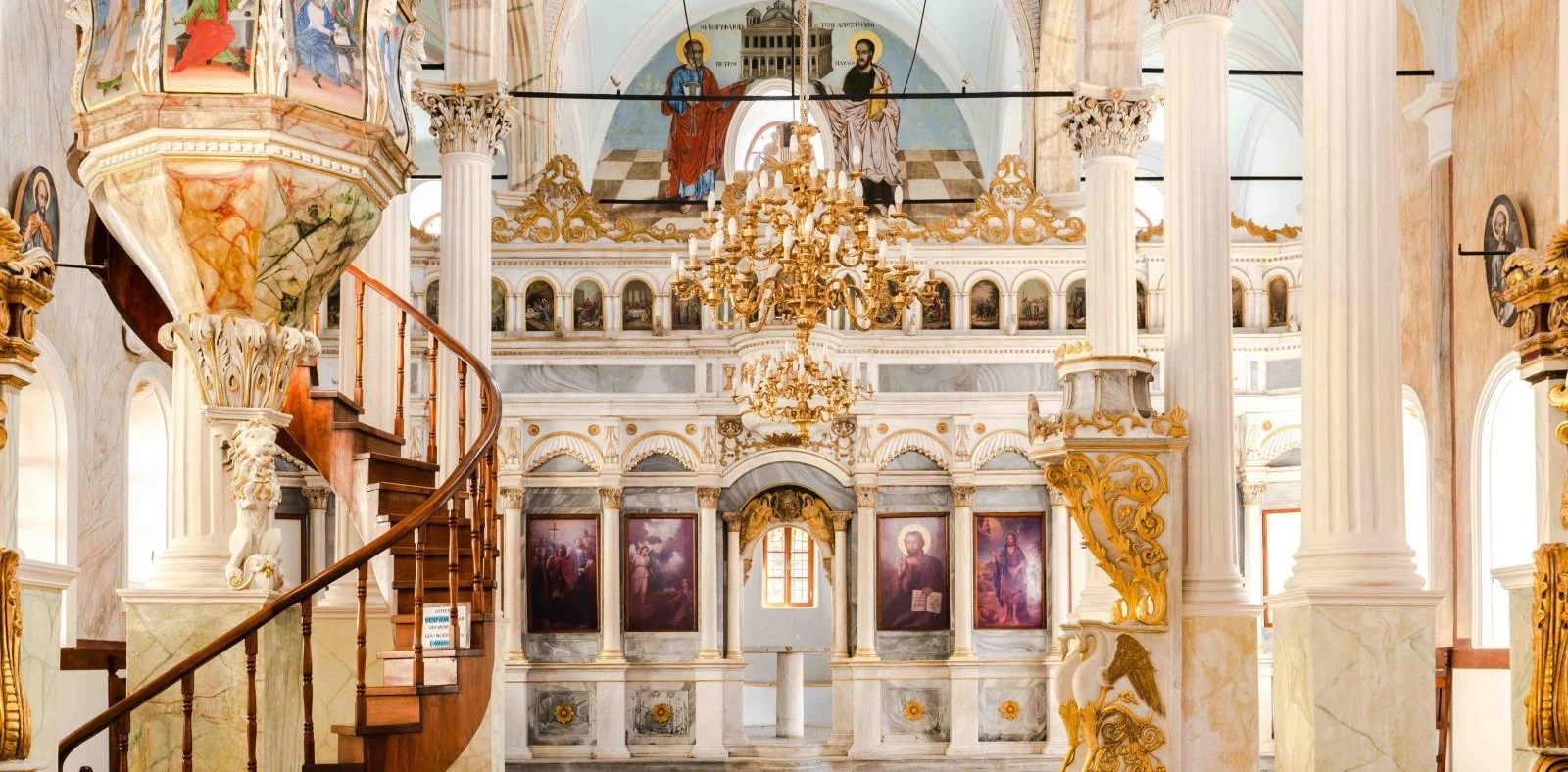
Compare Çınarlı's adapted mosque interior with a restored Orthodox church preserved as a monument museum in Ayvalık's historic centre.
View Taksiyarhis Guide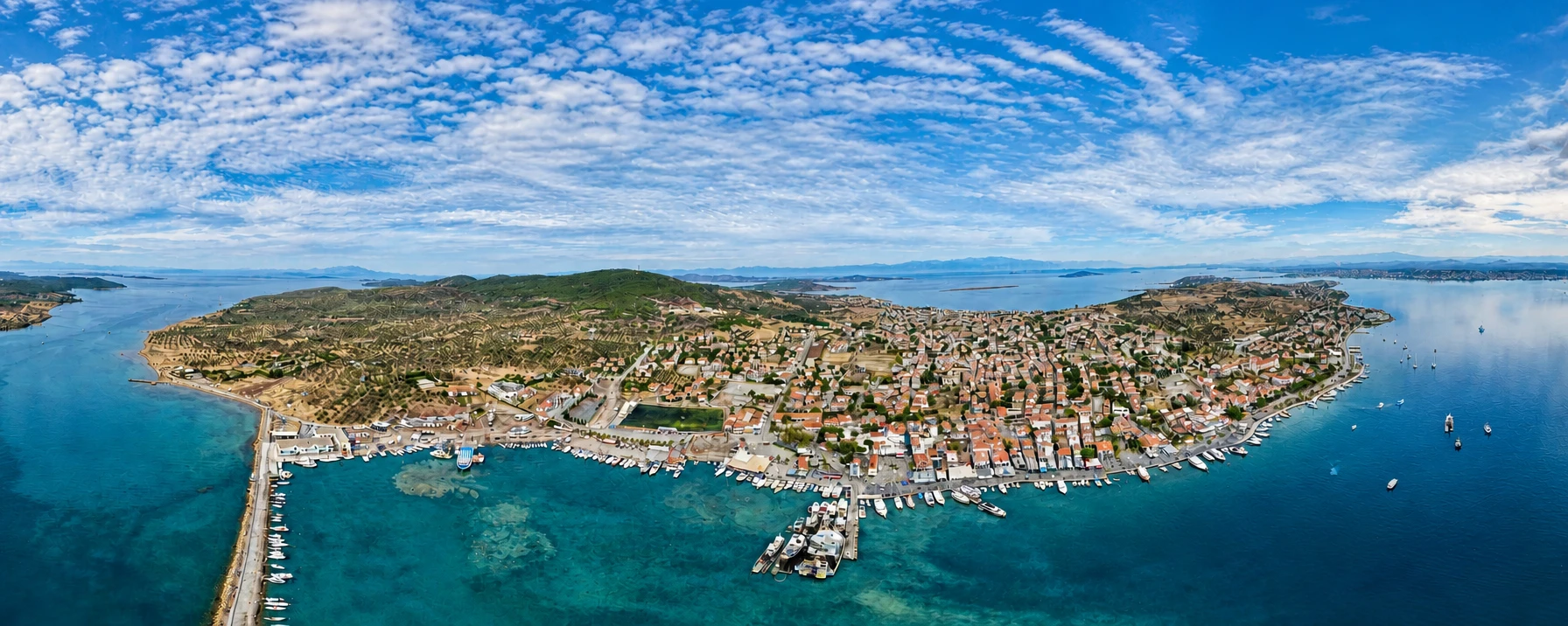
Continue to Alibey Island for historic Greek architecture, waterfront streets, Taksiyarhis Church, old windmills and classic Aegean atmosphere.
View Cunda Guide
Finish a day of Ayvalık heritage with panoramic views across the islands, bays and North Aegean from the town's most famous sunset viewpoint.
View Şeytan Sofrası Guide