Edincik Su Variety
The protected olive comes from trees of the Edincik Su cultivar of Olea europaea L.






Edincik Zeytini is a geographically protected olive produced from the Edincik Su variety of Olea europaea L. within the registered geographical boundary of Bandırma and Erdek districts in Balıkesir Province. The variety is especially associated with Edincik, where it has become an important part of the local olive-growing landscape.
Its most distinctive characteristic is its high water content. Registered fruit has a moisture content of approximately 50–74% and an oil content of around 13–24%. The fruit is soft, its skin is very thin, and it requires careful handling during harvest, transport and processing.
Edincik Zeytini received Turkish geographical-indication registration in 2024. It is protected as a Menşe Adı under TÜRKPATENT registration No. 1556.
Edincik Zeytini is registered by TÜRKPATENT as geographical indication No. 1556.
High water content is the defining physical characteristic of the protected olive.
The protected product is produced from the Edincik Su olive variety.
The registered geographical boundary covers the Bandırma and Erdek districts of Balıkesir.
Essential information about one of southern Marmara's distinctive protected olive products.
Edincik, Bandırma, Balıkesir Province, Türkiye.
Open Edincik on Google MapsEdincik Su, a high-moisture local olive variety used especially for table-olive production.
TÜRKPATENT Menşe Adı registration No. 1556.
Green harvest begins in early October; black table-olive harvest starts from late October into November.
Edincik Zeytini is closely tied to the olive-growing landscape around Edincik, Bandırma and Erdek.
The Edincik Su variety originates from the Edincik area of Balıkesir and has long been grown around Bandırma and Erdek. It is also known in older agricultural references by names including Erdek Su and Su Zeytini.
The word Su is particularly appropriate for the variety because its fruit contains unusually high moisture. This high water content, together with its relatively low oil content and soft flesh, has made the cultivar especially important as a table olive.
The protected identity of Edincik Zeytini depends not only on the variety but also on where and how it is grown and processed. The registered geographical boundary includes both Bandırma and Erdek districts, although production is especially concentrated around Edincik.
On 7 March 2024, Edincik Zeytini was formally registered as a Turkish geographical indication, giving legal protection to its name, production area and registered production method.
High moisture, thin skin, soft flesh and relatively large fruit help distinguish this local olive.
The protected olive comes from trees of the Edincik Su cultivar of Olea europaea L.
Registered fruit width generally falls between approximately 14 and 21 millimetres.
Registered fruit length generally falls between approximately 18 and 26 millimetres.
One hundred olives weigh approximately 250 to 600 grams under the registered specification.
The moisture content is approximately 50–74%, one of the product's defining characteristics.
The protected specification gives an approximate oil-content range of 13–24%.
The delicate skin makes the fruit vulnerable to physical impact and rough handling.
Ripe fruit has soft flesh, so harvesting, transport and processing require particular care.
Edincik Zeytini is the geographically protected form of the Edincik Su olive grown within the registered Bandırma and Erdek production area of Balıkesir Province.
The product can be processed as either green table olives or black table olives. The registration specifies fruit characteristics, orchard-management practices, harvest periods, brine preparation, fermentation, maturation and inspection requirements.
The protected product comes specifically from the Edincik Su olive variety.
Protected production is tied to the registered Bandırma and Erdek geographical boundary.
Its high water content and soft flesh make table-olive processing especially important.
Production rules cover orchard establishment, cultivation, harvest, fermentation and packaging.
Edincik Zeytini is registered by the Turkish Patent and Trademark Office as a Menşe Adı. The designation protects the relationship between the olive, its defined geographical area and the registered production method.
Edincik Zeytini
The TÜRKPATENT geographical-indication registration number is 1556.
The official application number is C2022/000025.
The application was filed on 21 January 2022.
The geographical indication was registered on 7 March 2024.
The registration holder is the Bandırma Chamber of Commerce.
The protected designation is a Menşe Adı.
The registered area covers Bandırma and Erdek districts in Balıkesir Province.
A Turkish Menşe Adı identifies a product whose essential characteristics are strongly connected with a defined geographical environment and the natural and human factors found there.
For Edincik Zeytini, the protected designation therefore ties the name to the Edincik Su variety, the Bandırma–Erdek production area, registered orchard practices and the prescribed green and black table-olive processing methods.
The protected geographical boundary is Bandırma and Erdek.
The protected fruit is produced from the Edincik Su variety.
Green and black table-olive methods are described separately in the registration.
Origin, fruit characteristics, production methods and name use are subject to inspection.
The protected geographical area lies in southern Marmara, where Edincik Su olives have become closely associated with the agricultural landscape around Bandırma, Edincik and Erdek.
The official registration draws particular attention to local soil conditions. Soils in the geographical boundary have a reported pH range of approximately 5.45–7.87, from moderately acidic to slightly alkaline, and are described as non-saline clay-loam to clay soils.
The stony structure of some local soils is also significant. According to the registration, stones can reflect summer sunlight and reduce excessive heating of the soil, helping the trees retain moisture and supporting the development of suitably large fruits.
The olive belongs to a long-established growing area around Bandırma and Erdek.
The registered production area is characterised by clay-loam and clay soils.
The official specification describes the local soils as non-saline.
Local stone cover can help limit excessive soil heating during the summer period.
Edincik Su trees show medium vigour and develop a medium-sized, spreading and rounded crown. Branching density and leaf density are also described as moderate.
Older branches tend toward beige-green tones, while younger branches are green-grey. The leaves are long, narrow and elliptical, with a hazy green-grey upper surface and a slightly hairy grey-green underside.
The trees are neither especially weak nor exceptionally vigorous under normal conditions.
The tree forms a medium-sized, spreading and rounded canopy.
Branch and leaf density are described as medium.
Leaves are long, narrow and elliptical with green-grey colouring.
Edincik Zeytini is a relatively substantial table olive. Registered fruit width ranges from approximately 14 to 21 mm, while fruit length ranges from approximately 18 to 26 mm.
One hundred fruits weigh approximately 250–600 g. The flesh is soft at maturity, and the very thin skin gives the olive a delicate structure that can be damaged if the fruit is handled roughly.
The geographical-indication specification identifies several phenolic and volatile compounds that contribute to the documented chemical profile of Edincik Zeytini.
The protected specification focuses more strongly on physical composition and processing than on a formal flavour vocabulary. What clearly distinguishes Edincik Zeytini is its high moisture, soft mature flesh and very thin skin.
Its final table character depends on whether it is prepared as a green or black olive and on the long fermentation process. Rather than judging the variety by the firm texture of some commercial olives, visitors should expect a more delicate fruit that must be handled carefully from tree to table.
The variety's water content is one of the principal reasons it is valued as a table olive.
Ripe fruit is naturally soft rather than exceptionally firm.
The skin is delicate, so bruising and physical damage are important quality concerns.
Green and black versions develop through lengthy brining and fermentation methods.
Edincik Su trees have a documented flowering period from approximately 12 May to 12 June. The variety shows periodicity, meaning crop level can vary between years.
Green maturity occurs in October, while black maturity generally falls between 15 November and 15 December.
The registered flowering period generally falls within this range.
The variety reaches the green-maturity stage during October.
Black maturity generally occurs during this later autumn period.
The variety can show alternating production intensity from one year to another.
The registered production method states that Edincik Zeytini orchards should be established in fertile areas where irrigation is possible. On land with more than approximately 5% slope, specialised terracing is used to protect the orchard.
Where groundwater is high or standing water is a problem, drainage channels are opened. Planting holes are prepared to approximately 80 × 80 cm, basal fertiliser is applied, and the young tree is given water immediately after planting.
Tree spacing varies considerably according to water availability. Irrigated orchards may use spacing around 5 × 5 m, while dry-land plantings can be much wider, reaching approximately 18 × 18 m.
The registered method favours productive sites where irrigation can be provided when necessary.
Special terracing is used where slope exceeds approximately 5%.
Drainage measures are required where high groundwater or water accumulation creates a risk.
Planting distance is adjusted substantially according to whether the orchard is irrigated or dry-farmed.
The geographical-indication method considers approximately two to three soil cultivations per year sufficient for the orchard.
The first cultivation is carried out after harvest when soil moisture is suitable, using a plough to around 15 cm. A second spring cultivation should generally not exceed 10–12 cm. A third operation can be used to level the soil and remove weeds, helping reduce the loss of fallen olives.
The registered system normally uses only a limited number of soil-working operations.
The first principal cultivation is performed when post-harvest soil conditions are suitable.
Shallower cultivation follows in spring, generally no deeper than 10–12 cm.
A later operation can help clear weeds and prepare the soil surface beneath the trees.
The first fertiliser application is made approximately one month before shoot growth begins. At this stage, all of the phosphorus and potassium fertiliser and approximately half of the nitrogen fertiliser are applied.
The remaining nitrogen is applied before the final rains end in non-irrigated orchards, or before the first irrigation in orchards that receive supplemental water.
The principal application begins roughly one month before active shoot development.
The registered method applies the full phosphorus and potassium requirement in the first stage.
Nitrogen is divided between the first application and a later application.
The timing of the second nitrogen application changes according to irrigation and rainfall.
In the traditional production area, olive trees are generally grown without regular irrigation. Natural rainfall supplies much of the annual water requirement.
When annual rainfall is insufficient, however, summer irrigation can be used. The registered method allows either surface irrigation or drip irrigation according to orchard conditions.
Established trees are generally managed without routine irrigation.
Summer irrigation can be introduced when rainfall does not meet the trees' needs.
Traditional surface irrigation is one permitted approach.
Drip systems may also be used to supply water efficiently during dry periods.
Olive pruning can be divided into training, production and rejuvenation pruning. The registered Edincik Zeytini method notes that rejuvenation pruning is particularly common for Edincik Su trees.
Pruning helps renew productive wood, maintain canopy structure and support the long working life of established olive orchards.
Young trees can be shaped to establish a practical long-term framework.
Established trees can be managed to balance fruiting wood and vegetative growth.
This is the pruning type most specifically associated with Edincik Zeytini in the registration.
Careful canopy renewal supports older trees and continued orchard productivity.
Edincik Zeytini has different harvest windows depending on the intended table-olive style. For green table olives, harvest begins around the first week of October as the fruit moves from green toward yellow.
For black table olives, harvest begins later, generally from the last week of October to the first week of November. Full black maturity is associated with the period from approximately 15 November to 15 December.
Green table-olive harvest begins around the first week of the month.
The first black table-olive harvests can begin toward the end of October.
Black table-olive harvest continues as the fruit darkens and matures.
The variety's documented black-maturity period falls mainly within this window.
Edincik Zeytini can be harvested by hand or mechanical methods. The fruit's soft flesh and very thin skin make careful handling particularly important.
After harvest, olives are placed into crates and taken to the processing facility, where they are sorted and graded by size before entering the appropriate green or black processing line.
Green and black table olives are picked at different maturity stages.
The thin skin is sensitive to impact, pressure and rough handling.
Harvested olives are collected in crates for transport to the processing facility.
Fruit is graded before fermentation and further table-olive processing.
For green table-olive production, harvest begins in the first week of October. Fruits that are changing from green toward yellow are harvested, transported in crates, graded by size and transferred to fermentation tanks.
The initial fermentation brine contains approximately 6% sea salt and 0.5% citric acid by weight. During fermentation, salt and acidity are monitored, with the salt content maintained at approximately 7–7.5% and acidity at approximately 0.8–1%.
The olives remain in fermentation brine for approximately nine months. Once eating maturity is reached, they are scored, selected and cleaned, then packed in brine and pasteurised before sale.
Green production begins as the fruit changes from green toward yellow.
The initial fermentation brine contains approximately 6% sea salt by weight.
Citric acid forms part of the registered starting fermentation brine.
The green olives mature gradually through a long natural fermentation period.
Once eating maturity is reached, the olives are scored before final sorting.
Brined olives are pasteurised after packaging before being placed on the market.
Black table-olive harvest begins from approximately the last week of October to the first week of November. The fruit is harvested, collected in crates, graded and transferred to processing pools.
The brine is prepared with drinking water and sea salt. Calcium chloride may be added at approximately 1–1.5 kg per tonne to help preserve colour and firmness, while lactic acid is used to achieve a pH of approximately 4.50–4.80. Brine salinity is maintained around 8–10%.
A distinctive pressing method is used: linen cloth is laid over the olives, wooden boards are placed above it, and natural granite stones weighing approximately 25–35 kg are used as pressure weights. This keeps the olives beneath the brine surface.
The brine is circulated approximately once a week, and the olives mature through fermentation for at least eight months before final washing and packaging.
Black table-olive processing begins with the later harvest window.
The registered black-olive brine contains approximately 8–10% salt.
Traditional natural granite weights help keep the olives submerged during fermentation.
Black olives remain in the fermentation pool for a prolonged maturation period.
One of the most visually distinctive parts of the registered black-olive method is the use of natural granite pressure stones. Linen cloth is placed over the olives, wooden boards are arranged on top, and the stones are positioned above the boards.
The stones generally weigh between 25 and 35 kilograms. The applied load is adjusted according to olive size—approximately 30% of the fruit weight for larger olives and 25% for smaller olives—so the crop remains below the brine surface throughout fermentation.
Traditional linen cloth forms the first covering above the olives.
Boards distribute the pressure above the fermentation pool.
Natural granite stones create the required downward pressure.
The purpose is to prevent fruit from rising above the brine surface.
After maturation, black olives are removed from the finishing brine and washed. They may then be packed again in brine or sold without brine in suitable packages, including vacuum packs or packs in which the olives are protected with refined vegetable oil.
Packaging can use food-compliant plastic, glass or metal containers in accordance with the Turkish Food Codex. Green olives are packed in brine and pasteurised after reaching eating maturity.
Both preservation and presentation can continue with an appropriate packaging brine.
Black olives may also be marketed without brine in suitable vacuum packs.
Several food-compliant packaging formats are permitted.
Packaging must preserve the delicate olives after their long fermentation period.
Edincik Zeytini is especially valued as a table olive. Its high moisture content is one of the principal reasons the variety is processed in this way.
The fruit can be prepared in both green and black forms. The region also produces Edincik Su Zeytinyağı, a separate geographically protected product made from the same local olive variety under its own registration and production specification.
Early-harvest fruit is fermented for approximately nine months before final preparation.
Later-harvest fruit is matured for at least eight months using the registered brining method.
Like many Turkish table olives, Edincik Zeytini fits naturally into local breakfast and meze traditions.
The Edincik Su variety is also used for the separately protected Edincik Su Zeytinyağı.
Edincik Zeytini and Edincik Su Zeytinyağı are legally distinct geographical indications. They share the same important local variety, but one registration protects the table olive while the other protects the finished olive oil.
This distinction is especially useful for food travellers. A single local cultivar can reveal two different expressions of place: the high-moisture fruit traditionally prepared for the table, and the oil produced from the same Edincik Su variety under a separate protected specification.
The protected table olive is registered under geographical-indication No. 1556.
The olive oil is protected separately under its own geographical indication.
Both products are closely connected with the Edincik Su olive cultivar.
Each product has its own production standards, quality parameters and inspection requirements.
Edincik Zeytini is not simply any olive of the same general appearance. The protected name identifies Edincik Su olives produced within the registered geographical area and in accordance with the official specification.
The usage rules require the wording Edincik Zeytini together with the official Menşe Adı emblem to appear on the product or its packaging. If this is not possible, the name and emblem must be displayed clearly at the business.
Look for the wording Edincik Zeytini.
The Turkish Menşe Adı emblem identifies the protected designation of origin.
Protected production must come from the registered Bandırma and Erdek geographical boundary.
The protected fruit comes from the Edincik Su cultivar.
Because the skin is thin and flesh soft, excessive crushing or impact damage should be avoided.
Clear provenance matters when purchasing any geographically protected agricultural product.
When buying Edincik Zeytini, look for the protected name and origin information rather than relying only on fruit colour or size. The official Menşe Adı designation is the clearest indication that the product belongs to the registered system.
If buying fresh fruit during harvest, remember that Edincik Su olives have very thin skins and soft flesh. Good-quality fruit should therefore be handled carefully and should not show unnecessary bruising, crushing or deterioration.
The protected name and Menşe Adı emblem provide the strongest formal identification.
The protected geographical boundary covers Bandırma and Erdek.
Decide whether you prefer the green or black table-olive preparation.
Packaging should be intact and suitable for the brined or vacuum-packed product.
If buying fresh olives, avoid excessive pressure and rough transport.
Origin, processing style and storage information help you understand exactly what you are buying.
October and November offer the best chance of seeing olive harvest and early processing activity.
The historic settlement provides the strongest cultural connection with the olive that carries its name.
Local producers may help you understand the different harvest and fermentation methods.
Direct conversations with growers and processors can reveal how delicate Edincik Su fruit is handled.
The registered geographical boundary extends into Erdek, making the coastal district a natural addition to the journey.
Ask how the same Edincik Su variety is also used for the separately protected local olive oil.
Olive groves are active agricultural properties and should only be entered with permission.
Olive-laden branches, crates and autumn orchard light can tell the story of the product without staging the scene.
Edincik Zeytini represents the close relationship between olive cultivation, table-olive processing and everyday food culture in the Bandırma–Erdek area.
Its protected production method preserves not only the fruit itself but also detailed practices such as long fermentation, careful brine management and, in black-olive production, the use of linen, wooden boards and natural granite stones to keep the olives submerged.
For travellers interested in regional Turkish food, the olive provides a direct way to connect agricultural landscape with local processing knowledge and the broader culinary traditions of Balıkesir.
Edincik Su is one of the distinctive olive cultivars associated with southern Marmara.
October and November are key months in the local table-olive calendar.
Months of brining and maturation transform the harvested fruit into a finished table olive.
The Menşe Adı formally connects the product with its registered Balıkesir production area.
For travellers interested in regional agriculture and Turkish food culture, Edincik Zeytini offers a particularly interesting example of how a local olive variety can develop its own protected identity.
Its high moisture content, soft flesh, extremely thin skin and lengthy green and black fermentation methods distinguish it from more generic commercial table olives.
The best way to understand the product is to connect the olive with its place: visit Edincik and the surrounding Bandırma–Erdek area, look for protected-name products and, during autumn, observe the harvest season that begins the long journey from orchard to table.
Edincik Su is a distinctive local olive with a clearly documented physical profile.
High moisture, soft flesh and thin skin make the fruit structurally unusual.
Green and black preparations each follow long, detailed fermentation processes.
The protected product connects food directly with Edincik, Bandırma, Erdek and southern Marmara.
Edincik Zeytini belongs to a remarkably varied Balıkesir food landscape shaped by olive groves, islands, dairy traditions, vineyards, seafood and protected regional products.
Explore the historic settlement that gave the Edincik Su olive its best-known name.
Continue through the protected production area with coastal landscapes, local food and olive-growing countryside.
Discover the separately protected olive oil produced from the same important local olive variety.
Move from Edincik's olive culture to the protected vineyards of nearby Avşa Island.
Continue exploring the province through one of Balıkesir's best-known protected dessert traditions.
Discover another geographically protected Balıkesir product rooted in local agricultural tradition.
An olive does not become protected Edincik Zeytini simply because it resembles the variety in size or colour. The protected designation represents a defined combination of cultivar, geographical origin, fruit characteristics, orchard practices and processing methods.
Protected Edincik Zeytini must be produced within Bandırma and Erdek.
The official specification identifies the Edincik Su variety.
Fruit size, 100-fruit weight, moisture and oil content are documented.
Green and black table-olive methods follow separate fermentation requirements.
The protected name and Menşe Adı emblem follow defined usage rules.
Origin, pomological characteristics, production and protected-name use are formally controlled.
Geographical-indication inspections are coordinated by the Bandırma Chamber of Commerce. The inspection body includes experts from the Bandırma District Directorate of Agriculture and Forestry, Bandırma Commodity Exchange and Bandırma Chamber of Agriculture.
Regular inspections take place every year during the October–December harvest period. Additional inspections can also be carried out after complaints or whenever considered necessary.
Controls cover production within the geographical boundary, conformity of fruit characteristics, compliance with production methods, analytical values when necessary, and correct use of the Edincik Zeytini name and Menşe Adı emblem.
Inspectors verify that protected production takes place within the registered Bandırma–Erdek area.
Pomological properties can be checked for conformity with the protected specification.
Orchard, harvest, fermentation and processing practices are part of the control system.
Correct use of the protected wording and Menşe Adı emblem is inspected.
Edincik Zeytini is a geographically protected table olive produced from the Edincik Su variety within the registered Bandırma and Erdek production area.
The geographical-indication boundary covers the Bandırma and Erdek districts of Balıkesir Province, Türkiye.
Yes. It is a registered Turkish geographical indication.
It is registered as a Menşe Adı.
The TÜRKPATENT registration number is 1556.
It was registered on 7 March 2024.
The official application number is C2022/000025.
The application was filed on 21 January 2022.
The registration holder is the Bandırma Chamber of Commerce.
The protected product is produced from the Edincik Su variety of Olea europaea L.
Agricultural references also use names such as Erdek Su and Su Zeytini.
Its high water content, soft flesh and comparatively low oil content make table-olive production especially important.
The protected specification gives a moisture range of approximately 50–74%.
The registered oil-content range is approximately 13–24%.
Fruit width is approximately 14–21 mm and fruit length approximately 18–26 mm.
One hundred fruits weigh approximately 250–600 grams.
Ripe Edincik Zeytini has soft flesh and a very thin skin, so careful handling is essential.
The documented flowering period is approximately 12 May to 12 June.
Green table-olive harvest begins around the first week of October.
Black table-olive harvest begins from approximately the last week of October to the first week of November.
Black maturity generally occurs between approximately 15 November and 15 December.
They mature in fermentation brine for approximately nine months.
They remain in fermentation pools for at least eight months.
Natural granite pressure stones help keep black olives submerged beneath the brine during fermentation.
The registered method specifies approximately 8–10% salt in the brine.
Its protected identity combines the Edincik Su variety, high-moisture fruit, delicate physical structure, a defined southern Marmara production area and detailed traditional table-olive processing methods.
The strongest images should show both the delicate fruit and the regional story behind it: olive groves, autumn harvest work, fermentation traditions and the historic landscape around Edincik.
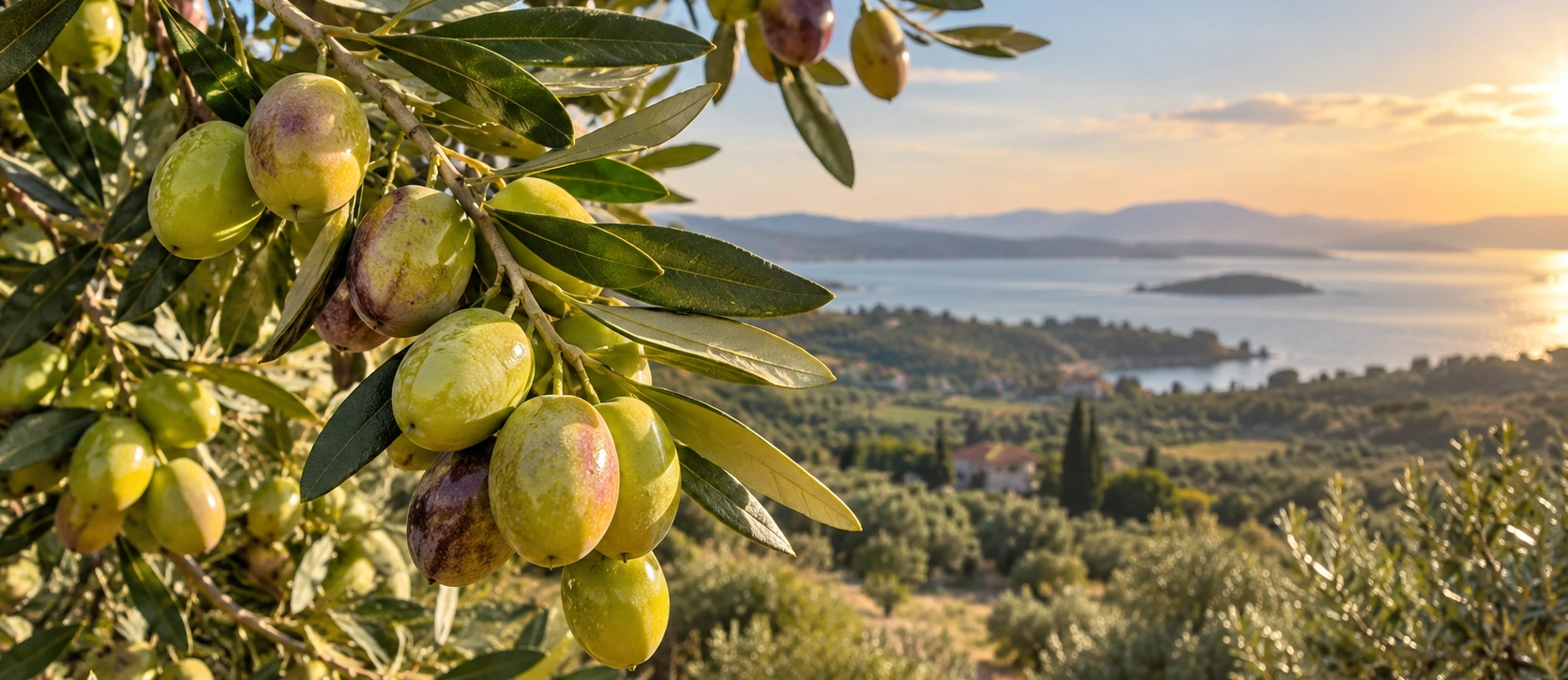
Photograph mature olives naturally on the tree with soft side light and visible leaves.
A detailed image can show fruit size, smooth skin and the changing colour of the ripening olive.
Hands carefully collecting the delicate fruit communicate why handling matters.
Wide orchard scenes place the protected product within the countryside that produces it.
Traditional processing images can show the scale and patience involved in long maturation.
The registered black-olive pressing method creates a highly distinctive documentary image.
Discover Edincik Zeytini together with olive groves, autumn harvest traditions, regional food and the landscapes of Bandırma and Erdek.
Custom-designed private programs can combine Edincik, local olive culture, seasonal harvest experiences, regional producers, Erdek and other Balıkesir highlights according to your dates and interests.
Explore Edincik through its protected olive, local food culture, olive-growing landscape and seasonal harvest traditions.
Request This Experience
Combine Edincik's olive heritage with Erdek, local producers, coastal scenery and the wider food culture of southern Marmara.
Request This Tour