Lamb or Kid Forequarter
The classic preparation uses the forequarter and opens the meat from the rib side to form a cavity.






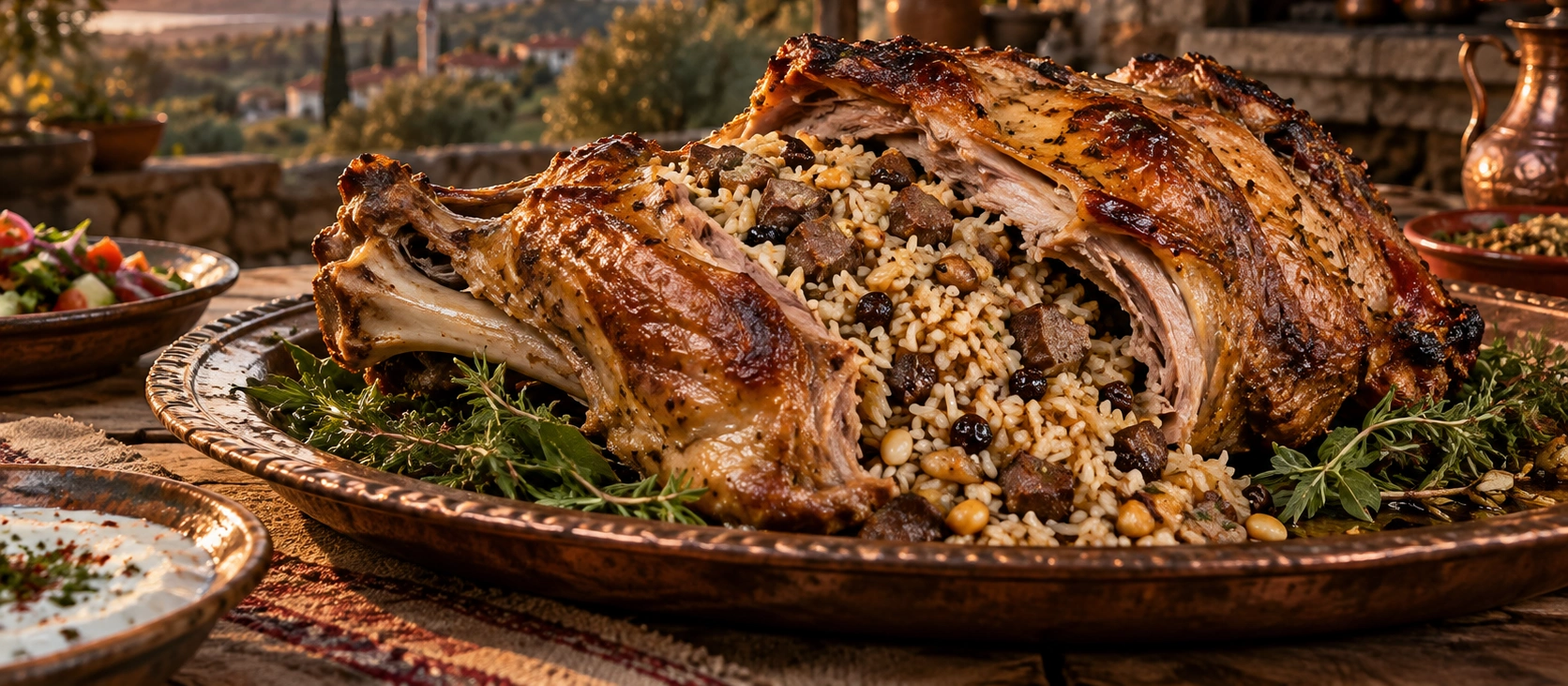
Balıkesir Sura is one of the region's most impressive traditional meat dishes: a lamb or kid forequarter is carefully opened from the rib side, filled with a richly seasoned iç pilav, sewn closed and slowly roasted until the meat becomes tender and the rice absorbs the flavours of the roast.
The filling traditionally combines rice, lamb liver, onion, pine nuts, currants and spices. Official cultural sources especially associate Sura with Kurban Bayramı and other special occasions, when a large shared roast naturally becomes the centre of the table.
The dish has a particularly strong connection with Havran. In Büyükdere and nearby villages, Sura is traditionally cooked in earthen ovens whose openings are sealed with mud, creating a slow enclosed roasting environment that has become one of the best-known parts of the dish's local story.
The traditional dish uses a forequarter opened from the rib side to create a pocket for the filling.
Rice is combined with liver, onion, pine nuts, currants and aromatic spices before stuffing the meat.
Sura is strongly associated with Kurban Bayramı and other important family or communal occasions.
Büyükdere is especially noted for Sura cooked slowly in traditional earth ovens sealed with mud.
Essential information about one of Balıkesir's best-known traditional meat dishes.
Balıkesir Province, especially Havran and the Büyükdere area.
Open Havran on Google MapsStuffed lamb or kid forequarter roasted with a fragrant rice filling.
Rice, lamb liver, onion, pine nuts, currants and aromatic spices.
Especially associated with Kurban Bayramı and other special gatherings.
Sura belongs to the celebratory side of Balıkesir cuisine: generous, slow-cooked and designed to feed a table rather than a single diner.
Balıkesir's food culture reflects an unusually varied landscape. Olive-growing districts meet inland farming areas, while livestock raising has long played an important role in the province. Traditional dishes therefore range from olive-oil vegetables and wild greens to dairy foods, pastries, soups and substantial lamb dishes.
Within that culinary landscape, Sura stands out because it brings several strands together in a single preparation: lamb or kid, rice, offal, dried fruit, nuts and spice. The result is both a roast and a pilaf, with the filling cooking inside the meat and absorbing its juices.
Official cultural descriptions identify Sura as a dish made especially for Kurban Bayramı and other important occasions. That context helps explain the size of the preparation, the labour involved in opening and sewing the meat, and the communal style in which it is normally served.
The strongest local association is with Havran, where the dish is described as one of the district's best-known meat specialities. The village tradition around Büyükdere adds another layer: there, Sura has been cooked in earthen ovens sealed at the mouth with mud, allowing the roast to cook slowly in retained heat.
A whole stuffed roast, fragrant pilaf, careful sewing and slow cooking define the traditional character of Sura.
The classic preparation uses the forequarter and opens the meat from the rib side to form a cavity.
The meat becomes a natural cooking vessel for the seasoned rice filling.
Lamb liver gives the iç pilav a deeper savoury character than ordinary rice pilaf.
Traditional additions bring nutty richness and a subtle sweet contrast to the filling.
Allspice, black pepper and cinnamon appear in the widely documented Balıkesir version.
After filling, the opening is stitched so the rice remains inside during roasting.
Diluted tomato paste is traditionally spread over the exterior before the meat is cooked.
The dish develops through long roasting, traditionally in especially distinctive local ovens around Büyükdere.
Sura is a traditional stuffed meat dish associated with Balıkesir and particularly with Havran. A lamb or kid forequarter is opened from the rib side so that a pocket can be formed between the meat and the rib area.
That cavity is filled with a prepared iç pilav. The classic Balıkesir recipe recorded by official cultural sources includes rice, lamb liver, olive oil, onion, pine nuts, currants, allspice, black pepper and cinnamon. Once filled, the meat is sewn closed, coated with diluted tomato paste and roasted with water in the cooking vessel.
A substantial lamb or kid joint forms the outer structure of the dish.
The rice mixture cooks inside the meat rather than beside it.
Its size and preparation make it naturally suited to family tables and special gatherings.
Balıkesir, Havran and Büyükdere are central to the dish's best-documented local identity.
Balıkesir cuisine is difficult to reduce to a single style. The province stretches from olive-growing Aegean districts to inland agricultural and livestock areas, creating a food culture in which olive oil, dairy, grains, meat, herbs and seafood all have important roles.
Sura represents the region's substantial meat-cooking tradition. Its use of lamb or kid, liver and rice places it alongside other ceremonial Anatolian dishes in which an entire joint or carcass section is transformed into food for a group.
The dish is also a useful reminder that Balıkesir's culinary identity is not limited to its famous cheeses, olives and desserts. Sura reveals the province's equally important pastoral and feast-food traditions.
Lamb, sheep and kid have long been important to the meat dishes of inland and northern Aegean communities.
Rice provides the body of the stuffing and absorbs the juices released during roasting.
Olive oil appears in the official Balıkesir recipe, reflecting the province's strong olive-growing culture.
Sura belongs naturally to the part of regional cuisine prepared for guests, holidays and important gatherings.
Although Sura is widely presented as a Balıkesir regional dish, Havran has an especially strong connection with it. Local tourism material describes Sura as one of Havran's best-known meat dishes and places it within a cuisine shaped by sheep and goat husbandry.
The Havran version follows the characteristic structure of the dish: the forequarter of a lamb or kid is opened from the rib side, filled with rice pilaf prepared with pine nuts, currants and spices, stitched closed, coated and roasted.
For travellers interested in the dish as cultural heritage rather than simply as a recipe, Havran is therefore one of the most meaningful places to explore its living tradition.
A district strongly associated with Sura and traditional lamb, sheep and kid dishes.
Local livestock traditions help explain the importance of roasted meat dishes in Havran cuisine.
Sura's scale and preparation suit the large shared tables of holidays and gatherings.
The dish has become one of the culinary names most closely linked with the district.
One of the most memorable details in descriptions of Balıkesir Sura is the traditional cooking method associated with Büyükdere and its surroundings in Havran.
Here, Sura has traditionally been placed into an earthen oven and the oven mouth sealed with mud. Closing the oven in this way helps retain heat and creates a slow, enclosed cooking environment in which the large stuffed joint can roast gradually.
This method matters because it turns the oven itself into part of the culinary heritage. The finished dish is not only about ingredients; it also reflects a rural cooking technique built around accumulated heat, patience and communal knowledge.
The traditional Büyükdere preparation is associated with locally used earth ovens.
The oven mouth is closed with mud to hold the heat inside during the long roast.
Large cuts benefit from gradual cooking that softens the meat while the filling develops inside.
The method represents practical cooking knowledge passed through local households and communities.
Sura is not traditionally an everyday meal. Official cultural descriptions say it is made especially during Kurban Bayramı and is also preferred for special occasions.
That role makes practical sense. Preparing the meat requires care, the filling has several components, the opening must be sewn closed and the stuffed joint needs time in the oven. The finished dish is also large enough to serve several people.
As a result, Sura carries the atmosphere of hospitality and celebration: a dish prepared when a household expects to gather around the table together.
The dish is especially associated with the Feast of Sacrifice.
Its generous size makes it well suited to shared meals.
Sura is traditionally chosen when the meal itself is meant to feel important.
The work involved in preparing Sura gives it the character of a dish made to honour a table.
The best-documented Balıkesir recipe uses one lamb or kid forequarter together with a seasoned rice stuffing enriched with liver, nuts, dried fruit and spices.
The official Balıkesir recipe specifies a lamb or kid forequarter. The meat is opened carefully from the rib side, creating a pocket large enough to receive the prepared rice filling without completely separating the layers of the joint.
The choice of a substantial bone-in section is essential to the identity of the dish. It provides enough meat for a communal roast while creating an enclosed space in which the pilaf can cook together with the meat juices.
When lamb is used in Balıkesir, the dish also sits naturally beside the province's well-known lamb tradition. Balıkesir Kuzu Eti is itself protected in Türkiye as a geographical indication, although that protection applies to the meat product rather than to Sura as a prepared dish.
A classic choice with enough fat and structure for long roasting.
Traditional descriptions also allow oğlak, or young goat.
The preparation uses the front section rather than a small boneless cut.
The meat is opened from the rib side to create the filling pocket.
The dish Sura should not be confused with the geographical indication for Balıkesir Kuzu Eti. The protected name applies to lamb meat produced according to the registered Balıkesir specification, not automatically to every serving of Sura.
Balıkesir Kuzu Eti was registered in Türkiye as a Menşe Adı in 2018. Its geographical boundary covers Balıkesir Province, and the registration documents the region's long-standing lamb production tradition.
For a traveller exploring local food, the connection is nevertheless useful: Sura is one of the traditional dishes that shows how lamb has been used at the table, while Balıkesir Kuzu Eti represents the protected agricultural product behind part of that wider culinary culture.
Explore the province's geographically protected lamb meat and its production tradition.
The lamb meat is protected as a Turkish designation of origin.
The geographical-indication registration dates to 2 January 2018.
The protected meat is linked to production within Balıkesir Province.
Sura's filling is more elaborate than plain rice. The traditional Balıkesir recipe combines rice and lamb liver with onion, pine nuts, currants and spice, producing a stuffing with savoury, nutty, lightly sweet and aromatic notes.
The filling is prepared before it enters the meat. It should have enough structure to remain distinct while still being able to continue cooking and absorb the juices released from the roast.
Provides the body of the stuffing and carries the flavours of the meat and spices.
Adds a deeper, more intensely savoury layer to the iç pilav.
Bring richness and a gentle toasted quality when prepared with the pilaf.
Add small bursts of sweetness that balance the richness of the meat.
Builds the aromatic foundation of the filling.
Provides warm aromatic depth traditionally associated with iç pilav.
Gives a clear savoury spice note without overwhelming the lamb.
Adds a subtle warm fragrance characteristic of festive rice stuffings.
A practical traditional sequence begins by chopping the onion and lamb liver. The onion and pine nuts are cooked in olive oil, then the rice is added and turned through the aromatic base. The liver is incorporated before water is added to bring the rice toward partial or near-complete cooking, depending on the household method.
Currants and spices complete the filling. Because the pilaf will spend further time inside a large roasting joint, cooks generally aim for a filling that can continue developing without collapsing into a soft mass.
Onion and pine nuts form the first flavour layer of the filling.
The rice is coated in the seasoned oil before liquid is introduced.
Small pieces of lamb liver enrich the rice with savoury depth.
Currants, allspice, pepper and cinnamon create the characteristic festive aroma.
The defining technique of Sura is opening the lamb or kid forequarter from the rib side. A knife is used carefully to create a cavity without cutting the entire joint apart.
This creates a natural pocket for the rice. The cut must be large enough to allow the filling to be packed inside, but the surrounding meat must remain intact enough to hold its shape during sewing and roasting.
For anyone making Sura for the first time, this is the step most likely to benefit from an experienced butcher. Asking for the forequarter to be prepared specifically for stuffing can make the rest of the process considerably easier.
The goal is to create a pocket, not to separate the meat into pieces.
Traditional descriptions specify opening the forequarter from this side.
The cavity must accommodate the pilaf while leaving room for the rice to settle.
A butcher familiar with stuffed roasts can prepare the cut more safely and neatly.
Once the rice mixture is ready and the meat pocket has been prepared, the iç pilav is spooned into the cavity. The filling should be distributed through the available space rather than compressed excessively.
The open edge is then closed with needle and thread. This traditional step prevents the rice from spilling into the roasting vessel and helps the joint retain its filled shape as the meat contracts during cooking.
Before serving, the thread is removed and the opening is cut back so the pilaf can be spooned out and served with pieces of the roasted meat.
Spread the pilaf throughout the pocket rather than packing it into one point.
Rice and meat both change during cooking, so the filling needs a little space.
Kitchen-safe thread keeps the stuffing inside during the long roast.
The stitching must be taken out carefully before carving the meat.
The Balıkesir recipe recorded by official cultural sources includes tomato paste diluted with water and spread over the outside of the stuffed meat before cooking.
During roasting, this coating contributes colour and a savoury outer layer. Water is also added to the cooking vessel so the large joint can cook gradually without drying too quickly.
Tomato paste is loosened so it can be spread across the meat more evenly.
The seasoned surface develops colour while the joint roasts.
Moisture in the cooking vessel supports the long cooking process.
The goal is tender meat and fully developed stuffing rather than fast browning.
Traditional Sura depends on slow oven cooking. Once stuffed, sewn and coated, the meat is placed in a suitable roasting vessel with water and left to cook until the joint becomes tender and the pilaf has absorbed the surrounding flavours.
In the best-known Büyükdere tradition, the dish is cooked in an earthen oven. The oven opening is sealed with mud, retaining heat around the roast for an extended period.
Because animal size, oven construction and heat retention vary greatly, there is no single historical oven temperature or cooking time that represents every household. Traditional cooks judge doneness by the tenderness of the meat and the condition of the rice rather than by a universal timer.
The stuffed forequarter needs enough room to cook without crowding.
Added water supports gradual roasting and helps prevent scorching.
Traditional sealed ovens use stored heat rather than constant direct flame.
The meat should soften enough to carve easily while the filling remains fragrant and distinct.
Yes. A home oven cannot reproduce the exact environment of a mud-sealed village earth oven, but the core technique can be adapted: prepare the stuffed and sewn joint, place it in a deep roasting tray with liquid and cook it slowly until tender.
Modern published recipes vary in temperature and timing because the size of the forequarter can differ considerably. The safest approach is to treat Sura as a large stuffed roast rather than as a fixed-minute recipe and to verify that both the meat and the interior filling are thoroughly cooked.
Covering the roast for much of the cooking can help retain moisture, while uncovering it toward the end allows the exterior to brown. Exact timing should be adjusted to the weight of the joint and the performance of the oven.
The pan must hold the large joint together with the roasting liquid.
Slow covered roasting can help recreate part of the gentle traditional cooking environment.
Finishing uncovered can deepen the colour of the exterior.
Both the meat and the stuffed rice must reach a safe, fully cooked state.
Sura is a rich and deeply savoury dish. The slow-roasted lamb or kid provides the dominant flavour, while the interior rice absorbs rendered fat and roasting juices from inside the joint.
Liver adds depth to the pilaf, pine nuts contribute buttery richness, currants provide gentle sweetness and spices such as allspice, black pepper and cinnamon bring warmth rather than aggressive heat.
The most satisfying servings contrast tender roasted meat with fragrant, separate grains of rice. The browned exterior and soft inner meat create another important textural contrast.
Lamb or kid and liver give the dish substantial savoury depth.
Warm spices make the filling fragrant without turning it into a hot or chilli-driven dish.
Currants provide restrained sweetness against the meat, liver and rice.
The ideal contrast is soft roasted meat with flavourful rice from inside the joint.
After cooking, the stitched opening is carefully opened and the thread removed. The rice filling can then be spooned onto a serving platter while the roasted meat is carved or pulled into portions.
Sura is traditionally compelling because the two components are served together: the rice has cooked inside the meat, and the meat is accompanied by the very pilaf it flavoured during roasting.
For a large gathering, the most attractive presentation is often a generous platter with pieces of roasted lamb arranged around or beside the fragrant iç pilav.
Check the entire stitched edge carefully before carving.
The rice filling becomes one of the main components of the finished plate.
Serve tender pieces of the forequarter with the filling.
A large platter suits the communal character of the dish.
Yes. As with many traditional dishes, published versions of Sura do not always use exactly the same ingredient list. The official Balıkesir cultural recipe includes lamb liver, pine nuts, currants, allspice, black pepper and cinnamon, but household and media recipes may add or omit ingredients.
Some modern versions use different spice combinations, while others add ingredients such as almonds, chestnuts or small onions. These adaptations can be enjoyable, but they should be understood as recipe variations rather than proof that every Sura has one fixed formula.
The most consistent identity remains the technique: a lamb or kid forequarter is opened, filled with seasoned rice, closed and roasted.
Households may adjust the balance of pepper, allspice, cinnamon or other seasonings.
Pine nuts are traditional, while some newer recipes add other nuts.
Chestnuts or small onions appear in some contemporary interpretations.
The stuffed and roasted forequarter is the central idea that keeps the dish recognisable.
Sura belongs to the broader family of Anatolian stuffed-rib and stuffed-meat dishes often described as kaburga dolması. A South Marmara regional-products catalogue describes Sura as Balıkesir's interpretation of this wider Turkish culinary tradition.
The Balıkesir identity comes from the local combination of ingredients, occasion, regional livestock culture and especially the documented cooking tradition around Havran and Büyükdere.
For travellers, the useful distinction is therefore not that Sura is unrelated to other stuffed rib dishes, but that it represents a recognisable Balıkesir version within a much larger Anatolian family of celebratory meat preparations.
Both traditions involve creating a cavity in a large cut of meat and filling it with rice.
Sura is the regional name and preparation associated with Balıkesir cuisine.
The local oven tradition gives Balıkesir Sura a particularly strong place-based story.
Both belong to a broader tradition of large stuffed roasts prepared for important gatherings.
Sura is not the kind of dish that every restaurant can prepare quickly to order. It requires a suitable cut of meat, advance preparation, stuffing, sewing and long roasting, so availability can be limited even in its home region.
Regional tourism material recommends looking for local restaurants and, because the preparation is labour intensive, asking in advance or reserving. Havran and the northern Aegean districts of Balıkesir are especially meaningful places to enquire about the dish.
When arranging a meal specifically for Sura, ask whether the restaurant serves a traditional stuffed forequarter, whether advance notice is required and whether the rice filling includes liver, pine nuts and currants.
Sura may require pre-ordering because it is not a quick à-la-carte preparation.
The district has one of the clearest documented associations with the dish.
Ask whether the serving uses a whole stuffed lamb or kid forequarter rather than a simplified plate.
Its size and richness make Sura particularly suitable for several diners.
Traditional Sura may need hours of preparation and is not always available without notice.
The district is one of the most meaningful places to explore the dish's local identity.
The mud-sealed earth-oven tradition is one of the most distinctive stories connected with Sura.
A traditional stuffed forequarter is designed for a group rather than a light individual meal.
Lamb, liver, rice, nuts and roasting juices make this a substantial dish.
Traditional Balıkesir versions commonly feature liver, pine nuts, currants and aromatic spices.
Combine Sura with the province's cheeses, olive products, soups, rice dishes and desserts.
The whole roasted and sewn forequarter tells the story of the dish better than a plated portion alone.
Sura shows how a regional dish can preserve several kinds of knowledge at once. It depends on butchery, rice cookery, seasoning, sewing, roasting and the ability to judge a large cut of meat over a long cooking period.
It also reflects a food culture in which very little is treated as an isolated component. The meat surrounds the rice; liver enriches the filling; roasting juices move back into the pilaf; the oven becomes part of the technique; and the finished dish is portioned for a group.
For food travellers, this makes Sura especially valuable. It is not simply a restaurant speciality to taste once, but a window into the relationship between livestock, household labour, festive hospitality and village cooking in Balıkesir.
The forequarter must be opened carefully enough to form a stuffing pocket.
The rice must be prepared to continue cooking successfully inside the roast.
Traditional cooks manage retained heat over a long period rather than relying on a short recipe timer.
The large finished roast naturally belongs to a shared table.
For travellers interested in regional Turkish food, Sura is one of Balıkesir's most revealing dishes because it combines local ingredients with a distinctive method and a strong special-occasion identity.
The attraction is not simply that it is a large lamb dish. Sura brings together a carefully opened forequarter, seasoned rice, liver, pine nuts, currants, warm spices, hand stitching and long roasting in a single preparation.
The experience becomes even more meaningful when the dish is tasted in or around Havran, where the connection with Büyükdere's traditional earth ovens gives the food a clear sense of place.
Stuffing and sewing a whole forequarter makes Sura unlike an ordinary lamb roast.
The rice absorbs flavours that cannot be reproduced by simply serving plain pilaf beside roasted meat.
The dish belongs to holiday and celebration cooking rather than everyday convenience food.
Havran and Büyükdere connect the dish with a living northern Aegean food tradition.
Sura is only one part of Balıkesir's unusually broad food landscape. Continue from feast-day lamb into protected meat, dairy, soups, desserts, olive products and village foods from across the province.
Explore the geographically protected lamb tradition closely connected with Balıkesir's meat culture.
Discover another dish associated with ceremonial meals and shared regional tables.
Move from a rich meat feast to one of the province's most famous cheese-based desserts.
Explore Balıkesir's dairy heritage through one of its distinctive regional cheeses.
Discover the olive-growing culture that shapes the western side of Balıkesir's cuisine.
Continue through the northern Aegean coast with another important Balıkesir cheese tradition.
What makes Sura distinctive is not merely the presence of lamb and rice. The identity of the dish comes from stuffing the rice inside the forequarter and roasting the two together.
Traditional Sura begins with a substantial lamb or kid joint rather than small pieces of meat.
The pilaf cooks inside the meat cavity rather than in a separate saucepan alone.
Sewing the opening is a defining practical step of the traditional preparation.
Meat and rice exchange flavours during the same long cooking process.
Liver, pine nuts, currants and spice create a richer pilaf than an everyday side dish.
The finished roast is opened, carved and served communally with its own stuffing.
Because Sura combines a large cut of meat with a dense rice-and-liver filling, home cooks should treat it as a stuffed meat roast and pay close attention to thorough cooking. A beautifully browned exterior does not automatically mean that the deepest part of the filling is ready.
Use clean kitchen-safe needle and thread, keep raw liver and meat chilled until preparation, avoid cross-contamination and verify doneness in the centre of the filling as well as in the thickest part of the meat. Exact safe temperatures can depend on the meat and local food-safety guidance, so current official guidance should take priority over traditional visual cues when cooking at home.
Raw meat and liver should remain properly chilled before cooking.
Kitchen twine or suitable cooking thread is preferable to ordinary household materials.
The interior rice-and-liver stuffing must be fully cooked, not merely warmed by the roast.
A short rest can make the large roast easier to handle and portion after cooking.
Balıkesir Sura is a traditional stuffed lamb or kid dish in which a forequarter is opened from the rib side, filled with seasoned rice and roasted.
Sura is strongly associated with Balıkesir Province and especially with Havran.
Traditional descriptions use the forequarter of a lamb or kid, opened from the rib side.
Both are traditional. Published Balıkesir sources specify either lamb or kid.
The best-documented Balıkesir filling contains rice, lamb liver, onion, pine nuts, currants, olive oil and spices.
The official cultural recipe includes allspice, black pepper and cinnamon.
Yes. Lamb liver is part of the traditional Balıkesir recipe recorded by the Ministry of Culture and Tourism's cultural sources.
They are classic iç pilav ingredients that add richness, texture and a gentle sweet-savoury contrast.
The opening is stitched after filling so that the rice remains inside the meat during roasting.
Yes. The documented Balıkesir method spreads diluted tomato paste over the exterior before cooking.
It is especially associated with Kurban Bayramı and other special occasions.
Local tourism sources identify Sura as one of Havran's best-known meat dishes and connect the district with a long tradition of lamb, sheep and kid cooking.
In Büyükdere and nearby areas, Sura is traditionally associated with earthen ovens whose openings are sealed with mud during cooking.
Yes. The stuffed roast can be adapted to a modern oven, although it will not exactly reproduce the retained-heat environment of a traditional earth oven.
There is no single traditional cooking time because forequarter size and oven conditions vary. It should be cooked slowly until both the meat and the centre of the filling are thoroughly done.
Sura belongs to the same broader family of stuffed-rib dishes, but it is the Balıkesir regional interpretation with its own local ingredients, associations and cooking traditions.
Sura is widely documented as a traditional Balıkesir dish. The related product Balıkesir Kuzu Eti has a Turkish geographical indication, but that protection applies to the lamb meat rather than automatically to Sura as a prepared dish.
Balıkesir Kuzu Eti is geographically protected lamb meat from Balıkesir Province, registered in Türkiye as a Menşe Adı.
The stitching is removed, the roast is opened and the fragrant rice filling is served together with carved pieces of the cooked meat.
No. It is a rich feast dish built around roasted meat, liver-enriched rice, nuts and cooking juices.
Often, yes. Traditional Sura is labour intensive and slow to cook, so asking ahead is sensible when travelling specifically to try it.
Its combination of stuffed lamb or kid, liver-rich aromatic pilaf, hand-sewn preparation, feast-day tradition and the distinctive earth-oven heritage of Havran and Büyükdere makes it one of Balıkesir's most memorable regional dishes.
The strongest photography should show that Sura is more than roasted lamb: capture the stuffed forequarter, the fragrant rice inside, the hand-crafted preparation and the traditional oven story that connects the dish with Havran.
Photograph the finished golden-brown forequarter on a large platter before it is carved.
Show the roast cut open so the rice filling is clearly visible inside the meat.
Capture rice grains, pieces of liver, pine nuts and currants in a detailed food shot.
A preparation image of the filled opening being stitched immediately explains the technique.
When possible, document the traditional oven and mud-sealed opening associated with Büyükdere.
A wide photograph of Sura being served to several people conveys its special-occasion character.
Discover Balıkesir Sura together with local markets, regional meat traditions, olive country, village cuisine and the diverse food culture of the northern Aegean.
Custom-designed private programs can combine Balıkesir, Havran, regional food traditions, village landscapes, protected products and local producers according to your dates and interests.
Explore Balıkesir through Sura, regional lamb traditions, local markets and the dishes that define the province's special-occasion cuisine.
Request This Experience
Combine Havran and Balıkesir's meat traditions with olive oil, cheeses, desserts, village foods and the northern Aegean landscape.
Request This Tour