Firm Rind
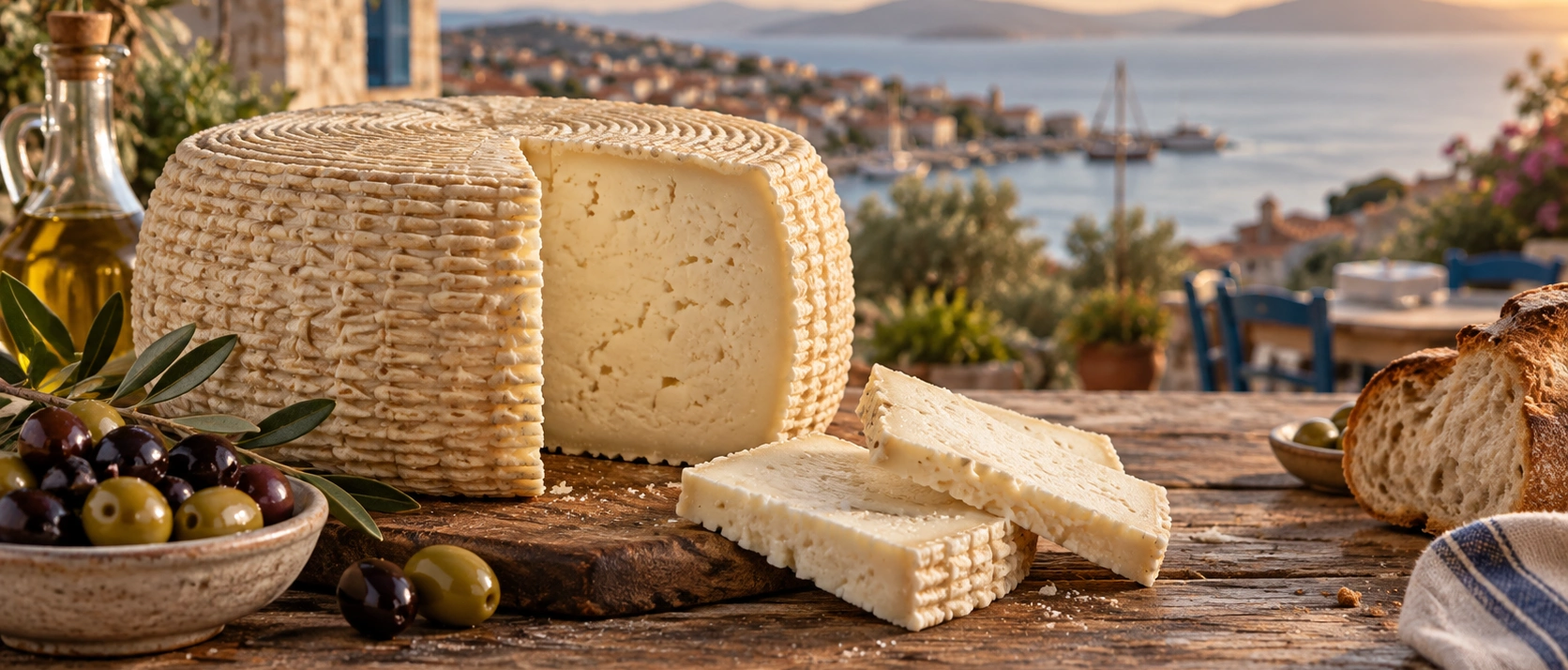
The matured cheese develops a characteristically firm outer surface.






Ayvalık Kelle Peyniri, also officially known as Ayvalık Sepet Peyniri, is one of the distinctive matured cheeses of Türkiye's northern Aegean coast. It is produced from sheep, goat or cow's milk — or a carefully controlled mixture of these milks — before being shaped in perforated basket-like moulds and matured in brine.
The cheese is recognised for its firm rind, white to yellow colouring, characteristic porous interior and predominantly hard texture. Its identity develops gradually during maturation, when the cheese becomes firmer and its internal openings become more pronounced.
Ayvalık Kelle Peyniri / Ayvalık Sepet Peyniri received Turkish geographical-indication protection in 2024 as a Mahreç İşareti. Registration No. 1664 protects a cheese tradition associated with the neighbouring districts of Ayvalık and Burhaniye.
The cheese is registered by TÜRKPATENT under registration No. 1664.
The protected cheese must mature in brine for a minimum of 120 days from production.
The characteristic rounded form develops when the curd is shaped in perforated basket-like strainers.
The protected geographical area covers these two neighbouring Balıkesir districts.
Essential information about one of the northern Aegean's protected traditional cheeses.
Ayvalık and Burhaniye districts of Balıkesir Province.
Open Ayvalık on Google MapsA predominantly hard, brine-matured cheese with a firm rind and porous interior.
TÜRKPATENT Mahreç İşareti registration No. 1664, registered in 2024.
The cheese is matured in brine for at least 120 days.
The history of Ayvalık's basket cheese is closely connected with the people who brought their cheesemaking knowledge to the northern Aegean.
Ayvalık Kelle Peyniri / Ayvalık Sepet Peyniri has a longstanding place in the culinary culture of the Ayvalık and Burhaniye area. According to its official geographical-indication specification, production of the cheese was established by cheesemakers who settled in the region following the population exchange.
The tradition became embedded in the local economy and food culture, where livestock farming, dairy production and the agricultural landscapes surrounding the northern Aegean supplied cheesemakers with the milk needed for production.
Over generations, the cheese developed a recognisable identity: a rounded basket-shaped wheel, a firm exterior, a naturally porous interior and an extended period of maturation in brine.
Its formal registration in 2024 recognised this longstanding reputation and established a protected production specification for cheese carrying the names Ayvalık Kelle Peyniri or Ayvalık Sepet Peyniri.
The protected specification defines the cheese through its milk, basket-shaped form, internal structure, maturation and final composition.
The matured cheese develops a characteristically firm outer surface.
The cheese may range from white through light yellow to more pronounced yellow tones.
Internal openings develop during maturation and become more noticeable as the cheese ages.
The cheese is predominantly hard, although some examples fall within the semi-hard category.
The curd is traditionally shaped in perforated strainers that create the characteristic basket-like exterior.
The finished wheels spend a minimum of 120 days maturing in brine.
The milk used for protected production comes from animals raised within the defined geographical area.
Sheep, goat and cow's milk may be used individually or in permitted combinations.
Ayvalık Kelle Peyniri / Ayvalık Sepet Peyniri is a traditional northern Aegean cheese made from sheep, goat or cow's milk, or combinations of those milks. It is shaped into rounded forms, salted and then matured in brine until a firm, porous cheese develops.
The word sepet means “basket” in Turkish and refers to the moulding technique that gives the cheese its recognisable exterior. The protected product is therefore not simply any cheese sold in a basket-shaped form; its milk, processing, maturation and geographical connection are formally defined.
The protected product is matured for at least four months rather than being sold as a fresh cheese.
The wheels develop their final character while resting in a controlled salt solution.
Basket-style moulding creates a recognisable rounded appearance and surface texture.
Cow, sheep and goat milk may all appear within the protected production specification.
Ayvalık Kelle Peyniri / Ayvalık Sepet Peyniri is registered by the Turkish Patent and Trademark Office as a Mahreç İşareti. The registration formally protects its connection with the cheesemaking traditions of Ayvalık and Burhaniye.
Ayvalık Kelle Peyniri / Ayvalık Sepet Peyniri
The geographical-indication registration number is 1664.
The application number is C2022/000202.
The official registration document records an application date of 28 June 2022.
The cheese was registered on 22 November 2024.
The registration holder is Ayvalık Municipality.
The geographical boundary of the protected cheese covers the neighbouring Ayvalık and Burhaniye districts of Balıkesir Province. Milk used for production is obtained within this area and all production stages of the protected cheese take place within the geographical boundary.
A Mahreç İşareti is a Turkish geographical-indication category used for products whose reputation, qualities or characteristics are associated with a particular geographical area.
In the case of Ayvalık Kelle Peyniri / Ayvalık Sepet Peyniri, its recognised reputation, historical cheesemaking tradition, regional milk and production method connect the product directly with Ayvalık and Burhaniye.
The protected geographical boundary includes Ayvalık and Burhaniye.
Milk used for protected production is obtained from animals raised within the geographical area.
Heating, coagulation, curd handling, shaping, salting and maturation are documented.
The registered name and Mahreç İşareti emblem are used when the protected designation is marketed.
One unusual feature of the protected specification is its flexibility regarding milk. Ayvalık Kelle Peyniri / Ayvalık Sepet Peyniri can be made from sheep's milk, goat's milk or cow's milk, as well as mixtures of these milks.
When a mixed-milk version is produced, sheep and/or goat milk together account for at least 10% and no more than 30% of the mixture. The producer determines the exact combination within these limits.
May be used alone or as part of an authorised mixed-milk production.
May likewise be used individually or within the permitted mixture.
Forms another recognised milk source within the protected specification.
Mixed versions follow defined proportions for their sheep and goat milk content.
The protected production method does not permit practices such as adding water or removing fat in order to alter the natural composition of the milk.
Milk used for protected Ayvalık Kelle Peyniri / Sepet Peyniri comes from animals raised within the geographical boundary. The official specification therefore connects the cheese not only with cheesemakers but also with the pastoral and agricultural landscape around Ayvalık and Burhaniye.
The official specification describes sheep and goats receiving most of their nutrition through grazing.
Alfalfa and barley-oat feed may supplement grazing for sheep and goats.
Cattle receive a combination of roughage and prepared feed as part of local dairy production.
Olive leaves and olive pomace from local olive-oil production may also be incorporated into cattle feeding.
That last detail creates an especially interesting connection between two of the area's great agricultural traditions: dairy farming and olive production.
The geographical-indication specification records several measurable characteristics that help distinguish the protected cheese from unrelated basket cheeses.
The cheese ranges from white through light yellow to yellow.
The mature cheese has a characteristically firm rind.
It belongs primarily to the hard cheese category, with some production falling into the semi-hard range.
The protected specification permits a maximum moisture content of 60%.
The cheese contains at least 40% milk fat in dry matter.
Salt content is limited to a maximum of 6% in dry matter.
The minimum maturation period is 120 days.
The interior is uncracked and porous, with the openings developing further during ageing.
The protected method is a multi-stage process that takes the cheese from carefully prepared milk through coagulation, curd handling, basket moulding, salting and extended brine maturation.
After heat treatment, the milk is cooled to a temperature appropriate for coagulation. The official method gives a seasonal range of approximately 27–36°C.
Rennet is then added to create the curd. The protected specification describes using approximately 10–20 grams of rennet per 100 litres of milk. Once the curd reaches the required strength, it is broken into small pieces.
The milk is cooled carefully before rennet is introduced.
The goal is to produce a curd strong enough for the later heating and shaping stages.
Breaking the curd encourages whey separation and prepares it for further heating.
Curd handling affects the firm structure that develops during maturation.
The Turkish word sepet means “basket.” The name refers directly to the shaping process that creates the cheese's characteristic form.
After the heated curd has settled and the whey has been drained, the curd is transferred into perforated basket-like strainers. These moulds create a rounded cheese and leave a distinctive textured pattern on the exterior.
The familiar name describes the mould in which the curd is formed.
The moulding stage gives the cheese its characteristic wheel-like shape.
Perforated moulds create the recognisable exterior associated with traditional basket cheese.
The protected identity also depends on milk, production, maturation and geography — not shape alone.
The geographical indication officially protects both names: Ayvalık Kelle Peyniri and Ayvalık Sepet Peyniri. They refer to the same registered regional cheese rather than two separate geographical indications.
Travellers may therefore encounter either name in local shops and markets. Packaging using the geographical indication should use the protected designation together with the appropriate Mahreç İşareti identification.
One of the two official names recognised by the geographical indication.
The alternative protected name referring to its characteristic basket shaping.
Both names are protected under TÜRKPATENT registration No. 1664.
The specification requires information about the milk or milk mixture used to accompany the protected designation.
After shaping, the cheese is first rested under cold conditions. The official method describes keeping it at approximately +4°C for one day before the exterior is salted.
Salt is rubbed over the surface at intervals. The specification gives approximately 250–270 grams of salt for a 2.5-kilogram cheese wheel. The salted cheeses then rest for approximately 10–21 days before entering the longer brine-maturation stage.
The newly moulded cheese rests under refrigerated conditions before salting.
Salt is applied externally rather than relying only on the later maturation brine.
The salted cheese rests before entering its long maturation period.
Salting contributes to flavour, preservation and the development of the cheese structure.
Maturation is one of the most important stages in the identity of Ayvalık Kelle Peyniri / Ayvalık Sepet Peyniri. The cheese is placed into a brine containing approximately 10–12% salt and matured for at least 120 days from its production date.
During this period, the cheese becomes firmer and its characteristic porous interior develops. Age therefore affects not only flavour but also the appearance and physical structure of the cheese.
The protected cheese cannot complete its defined maturation before this period.
The wheels mature in a controlled salt solution rather than through dry ageing alone.
The cheese becomes harder as maturation progresses.
The characteristic internal openings become more pronounced during ageing.
Ayvalık Sepet Peyniri belongs predominantly to the hard-cheese category, although some examples may be classified as semi-hard. Its exterior is firm, while the interior contains characteristic pores rather than being entirely compact.
Maturation plays an important role in determining texture. As the cheese ages, firmness increases and its internal structure becomes increasingly developed.
A hard rind protects the matured interior.
The cheese has considerably more structure than a fresh or soft brined cheese.
The mature interior is characteristically porous rather than completely closed.
Longer maturation contributes to increasing firmness and a more developed cheese character.
Because protected Ayvalık Sepet Peyniri can be made from different milk types, its precise flavour varies from producer to producer. The common character comes from its firm texture, extended maturation and controlled brining.
A cow's-milk version can taste different from one containing sheep or goat milk, while maturation generally creates a fuller, more concentrated cheese flavour than would be expected from a young fresh cheese.
Extended maturation gives the cheese a developed, distinctly savoury character.
The cheese is matured in brine, although its final salt level is controlled by the protected specification.
Sheep, goat and cow milk each bring somewhat different aromatic characteristics.
Maturation gradually concentrates flavour while increasing firmness.
Ayvalık Kelle Peyniri / Sepet Peyniri can be enjoyed simply enough for its flavour and texture to remain the focus. Thin slices or small pieces work particularly well alongside bread, tomatoes, seasonal vegetables, olives and other northern Aegean breakfast foods.
Its firm structure also makes it suitable for cheese boards and mezze-style tables where it can be combined with the area's olive products and fresh produce.
Serve slices with bread, tomatoes, cucumber and olives.
Use small pieces alongside other regional cheeses to compare textures and maturation styles.
The cheese naturally belongs beside the olive traditions of the northern Aegean.
Allowing a refrigerated piece to lose some of its chill can help its aroma become easier to appreciate.
Ayvalık is internationally associated with olives and olive oil, but the region's food culture extends far beyond the olive grove. Livestock farming and dairy production form another important part of the rural economy surrounding Ayvalık and neighbouring Burhaniye.
The official cheese specification even records a direct link between these agricultural worlds: olive leaves and pirina, the olive pomace left after olive-oil processing, may be used within cattle feeding in the geographical area.
Explore the olive-growing landscape that has shaped the town's economy and culture.
Continue along the Gulf of Edremit to another celebrated northern Aegean olive tradition.
Ayvalık's culinary identity combines coastal olive agriculture with livestock and dairy production.
Agricultural by-products can find uses within other areas of regional food production.
The official geographical-indication specification states that after maturation, the cheese is packaged in materials suitable for food contact and kept within a refrigerated chain.
Storage, transportation and sale of the protected cheese are carried out at temperatures below 4°C. Visitors buying cheese to take home should therefore plan how to keep it chilled during travel.
The protected supply chain maintains the cheese below 4°C.
An insulated bag can be useful when buying cheese before a longer journey.
Commercially packaged cheese should carry the required labelling information.
Once opened, follow the storage instructions supplied with the particular cheese you purchase.
Yes. Ayvalık Kelle Peyniri / Ayvalık Sepet Peyniri is a traditional dairy cheese and therefore contains milk and milk proteins.
The protected cheese is made from cow, sheep or goat milk, or an authorised combination of them.
People with lactose intolerance should confirm whether a particular matured cheese is suitable for their own tolerance level.
The cheese is not suitable for anyone who needs to avoid milk proteins.
The declared milk composition can be useful for travellers seeking or avoiding a particular animal milk.
If you have a serious food allergy or medical dietary restriction, confirm ingredients and handling directly with the producer or retailer before consuming the cheese.
Basket markings alone are not enough to demonstrate that a cheese complies with the geographical-indication specification. Protected Ayvalık Kelle Peyniri / Ayvalık Sepet Peyniri is defined by its geographical origin, milk, production method and maturation as well as its appearance.
Packaging may use Ayvalık Kelle Peyniri, Ayvalık Sepet Peyniri or the full registered designation.
The milk type or milk mixture used should accompany the protected name.
The Mahreç İşareti emblem is part of the protected product's presentation.
The protected cheese is matured for at least 120 days.
A firm rind and porous interior are characteristic features of the matured product.
The protected production is connected specifically with Ayvalık and Burhaniye.
Ayvalık's cuisine is often introduced through olive oil, seafood and Aegean herbs, yet its food heritage is broader. Cheese production provides another window into the town's migration history, surrounding agricultural landscape and everyday eating traditions.
Ayvalık Kelle Peyniri / Sepet Peyniri is particularly interesting because its story connects population movement, traditional cheesemaking, local animal husbandry and modern geographical-indication protection.
Discover Ayvalık's protected mastic-flavoured biscuit tradition.
Explore another protected speciality from Ayvalık's coastal food culture.
Discover the agricultural tradition most closely associated with the town.
Compare Ayvalık's basket cheese with another protected Balıkesir cheese tradition.
Cow, sheep and goat milk versions can differ noticeably in aroma and flavour.
The registered designation is Ayvalık Kelle Peyniri / Ayvalık Sepet Peyniri.
The protected cheese must mature for at least 120 days.
The textured exterior tells the story of the moulding technique behind the name sepet peyniri.
The mature cheese should have a characteristic porous rather than completely closed structure.
Plan refrigerated transport if you are buying cheese to take away from Ayvalık.
Sampling cheese and olive products together gives a broader picture of Ayvalık's agricultural heritage.
Different milk choices and maturation can create meaningful differences while remaining within the protected tradition.
For travellers interested in regional Turkish food culture, Ayvalık Kelle Peyniri / Ayvalık Sepet Peyniri offers much more than another cheese tasting. Its flavour is connected with a story of migration, local agriculture, inherited cheesemaking knowledge and the culinary relationship between Ayvalık and neighbouring Burhaniye.
It is also an excellent product for understanding how geographical indications preserve traditional techniques. The shape, regional milk, curd preparation, salting and minimum maturation period all contribute to the identity protected under the Ayvalık name.
The combination of a firm rind and porous mature interior makes it immediately distinctive.
Its modern identity is connected with cheesemakers who settled in the region through population exchange.
Comparing cow, sheep, goat and mixed-milk versions can reveal very different expressions of the cheese.
The 2024 registration preserves a living cheese tradition rather than simply a product name.
Ayvalık's food identity combines dairy traditions with olive oil, seafood, baked specialities and the multicultural influences of the northern Aegean.
Try Ayvalık's fragrant protected biscuit flavoured with mastic.
Move from dairy heritage to one of Ayvalık's distinctive coastal specialities.
Explore the olive groves and production culture behind Ayvalık's most famous agricultural product.
Continue through Balıkesir's geographically protected cheese traditions.
Discover another firm and matured cheese associated with Balıkesir Province.
Explore Balıkesir's famous intensely foamy fermented dairy drink.
Discover another rich expression of Balıkesir's dairy culture.
Finish with one of Balıkesir's best-known traditional dairy-based desserts.
Basket-shaped cheeses can be encountered in different parts of Türkiye and the eastern Mediterranean. The important distinction is that Ayvalık Kelle Peyniri / Ayvalık Sepet Peyniri has a formally documented regional identity.
The registered Ayvalık cheese is linked specifically with Ayvalık and Burhaniye.
The protected specification determines which milks and mixtures may be used.
A minimum 120-day brine maturation forms part of the registered process.
A visually similar cheese produced elsewhere does not automatically qualify for the protected Ayvalık designation.
It is a geographically protected, predominantly hard, brine-matured cheese associated with Ayvalık and Burhaniye in Balıkesir Province.
Yes. Both names form part of the same official geographical-indication registration.
Sepet peyniri literally means “basket cheese,” referring to the basket-like mould used to shape the curd.
Yes. It is a registered Turkish geographical indication.
It is registered as a Mahreç İşareti.
The TÜRKPATENT registration number is 1664.
It was registered on 22 November 2024.
The geographical-indication application number is C2022/000202.
The registration holder is Ayvalık Municipality.
The protected geographical boundary covers the Ayvalık and Burhaniye districts of Balıkesir Province.
No. The geographical indication covers both Ayvalık and Burhaniye.
It may be produced from sheep, goat or cow's milk, or mixtures of these milks within the conditions of the protected specification.
Yes. Cow's milk is one of the recognised milk types within the registered production method.
Yes. Sheep's milk may be used either alone or as part of an authorised mixture.
Yes. Goat's milk may also be used alone or within the permitted mixed-milk formula.
When milks are mixed, sheep and/or goat milk together account for at least 10% and no more than 30% of the mixture.
The protected cheese is matured for at least 120 days from the production date.
Yes. The official method uses a brine containing approximately 10–12% salt.
It is predominantly classified as hard, although some examples may fall into the semi-hard category.
The registered specification describes colours ranging from white through light yellow to yellow.
Yes. A porous internal structure is one of its recognised characteristics, and the openings develop further during maturation.
The drained curd is shaped in perforated strainers, giving the exterior its characteristic basket-like texture.
The protected method describes heating the filtered milk to 57–68°C for at least 15 seconds before cooling it to the coagulation temperature.
Yes. Rennet is used to coagulate the milk and form the curd.
The shaped wheel is salted externally before later being transferred into brine for long maturation.
It is a brine-matured cheese, but the registered product has a maximum salt content of 6% in dry matter.
The specification requires at least 40% milk fat in dry matter.
The registered specification allows a maximum moisture content of 60%.
Yes. It is made from animal milk and therefore contains dairy and milk proteins.
Anyone following a strict vegetarian diet should check the type of rennet used by the particular producer before purchasing.
No. It is a dairy cheese produced from animal milk.
The protected distribution specification requires storage, transportation and marketing below 4°C.
The milk used for protected production comes from animals raised within the geographical boundary.
Yes. The geographical-indication specification requires all production stages of the protected cheese to take place within the defined area.
The official registration connects its production tradition with cheesemakers who settled in the region following the population exchange.
It is a mature, savoury cheese whose flavour can vary according to the milk used and the length of maturation.
Look for the protected name, the Mahreç İşareti identification and information about the type or mixture of milk used.
No. Basket shape alone does not establish the protected identity; the cheese must comply with the registered geographical and production requirements.
Traditional cheese shops, markets and regional food businesses in Ayvalık and Burhaniye are natural places to look for the protected cheese.
Its identity combines basket shaping, regional milk, prolonged brine maturation, migration history and a protected connection with Ayvalık and Burhaniye.
The most effective photographs should make the cheese's basket-shaped exterior, firm body and porous cut surface easy to understand while keeping the setting natural and unmistakably northern Aegean.
Photograph an intact wheel from a three-quarter angle to show its rounded basket shape.
Show a freshly cut section so the characteristic internal pores remain clearly visible.
Use side lighting to reveal the patterned exterior left by the mould.
Pair the cheese with Ayvalık olives to connect the image with the region's wider food culture.
A cheese counter or local market setting can communicate provenance without making the scene overly staged.
Use simple bread, tomatoes, olives and understated local tableware rather than elaborate decoration.
Discover Ayvalık Sepet Peyniri together with local markets, olive-oil traditions, historic streets, regional producers and the flavours of the northern Aegean.
Custom-designed private programs can combine Ayvalık's historic neighbourhoods, olive heritage, traditional food shops and regional specialities according to your route, interests and travel dates.
Explore Ayvalık through protected cheeses, olives, olive oil, regional foods, traditional markets and the town's distinctive multicultural culinary heritage.
Request This Experience
Combine Ayvalık's historic architecture and neighbourhoods with its cheese, olive-oil, market and traditional food culture on a privately designed experience.
Request This Tour