Unfilled Dough
Unlike many famous mantı styles, the traditional strips are not wrapped around minced meat.






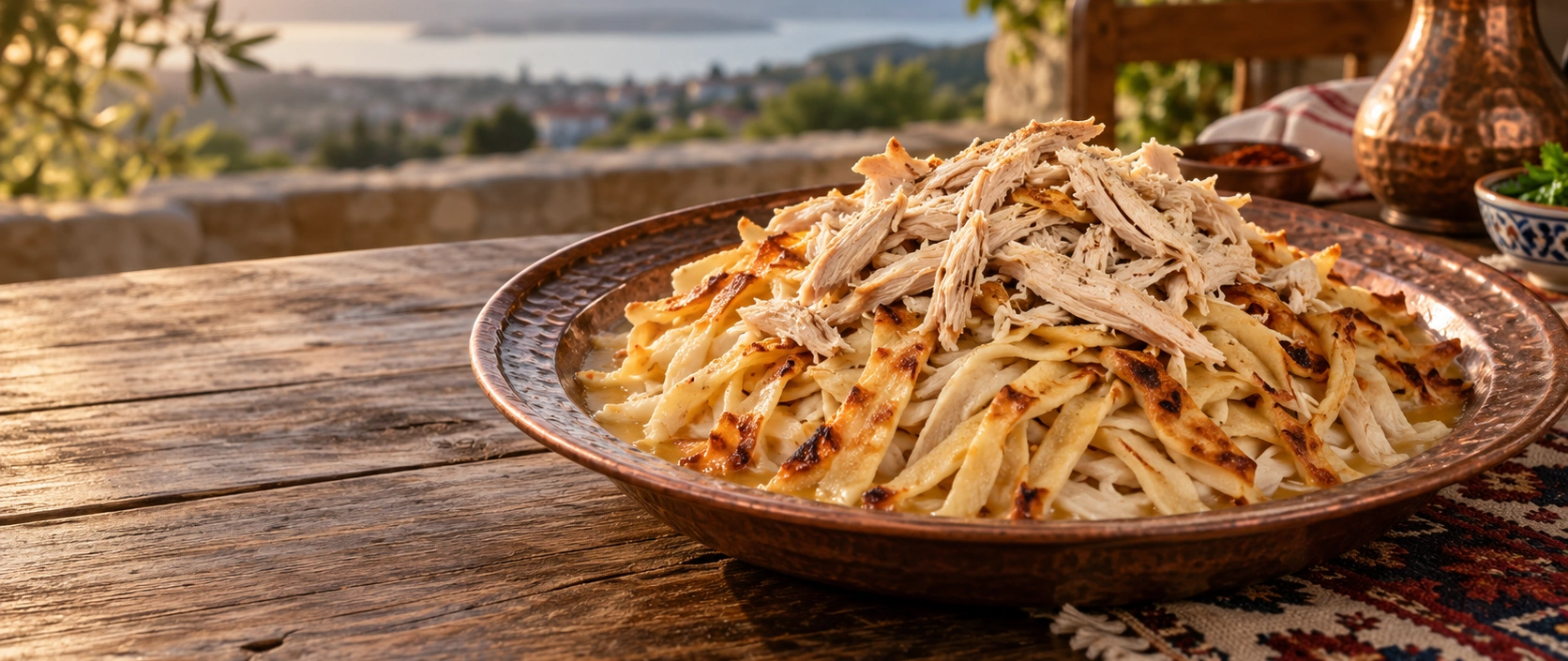
Saçaklı Mantı is one of Balıkesir's most distinctive traditional dough dishes. Instead of enclosing minced meat inside tiny parcels, cooks roll an egg-enriched dough into thin sheets, cut it into long narrow strips, brown those strips in the oven and then soften them with chicken broth. Shredded chicken is scattered over the top before serving.
That combination makes the dish look closer to handmade noodles than to the small folded mantı many visitors expect. Yet its identity is firmly rooted in Balıkesir's mantı tradition, where the preparation method—not a stuffed shape—is what defines the dish.
Regional and household versions can be more elaborate. Chickpeas, garlic yoghurt, tomato paste, peppered butter and other seasonings appear in contemporary and local recipes, but the official Balıkesir cultural record preserves a simpler core of handmade dough, fat, chicken, chicken stock and butter.
Thinly cut handmade dough creates the characteristic fringe-like appearance.
The strips are toasted in a tray before broth is added, giving the dish its distinctive structure.
The browned dough absorbs rich chicken stock instead of being boiled like ordinary pasta.
Tender chicken is pulled into fibres and distributed over the softened dough before serving.
Essential information about one of Balıkesir's most recognisable traditional dough dishes.
Balıkesir Province, with related names and versions across several districts.
Open Balıkesir on Google MapsHandmade dough strips oven-browned and finished with chicken broth.
Chicken boiled until tender, shredded and spread over the prepared dough.
The dough is browned before it absorbs broth, rather than simply being boiled.
Balıkesir turns a few familiar pantry ingredients into a dish whose texture depends on rolling, cutting, drying, browning and finally soaking.
Balıkesir's food culture contains many kinds of mantı and dough-based dishes. Saçaklı Mantı is especially memorable because it does not begin with filled squares or folded dumplings. Its starting point is a simple homemade dough rolled into broad yufka-like sheets.
The sheets are cut into long strips whose loose, trailing form gives the dish its “saçaklı” or fringe-like appearance. These strips are not immediately boiled. They are arranged in a tray and baked with fat until they take on colour and a dry, toasted character.
Only after browning does the second transformation happen: chicken broth is poured over the dough. The strips soften as they absorb the stock while retaining some of the flavour created in the oven. Shredded chicken then turns the tray into a substantial shared meal.
Different parts of Balıkesir preserve related names and household methods, which is why visitors may encounter references to Çıngıllı Mantı, Avunya Mantısı or closely related dishes such as Sakandık/Sakandırık. The exact relationship between these names can vary by locality and source, so the most useful guide is the cooking method in front of you.
Long dough strands, oven browning, broth absorption and shredded chicken define the classic Balıkesir preparation.
Unlike many famous mantı styles, the traditional strips are not wrapped around minced meat.
The dough is rolled out before being cut into narrow, elongated pieces.
The loose strips create the “saçak” appearance that gives the dish its name.
The raw or partly dried strips are browned in a tray with fat before stock is added.
Broth softens the baked dough and carries poultry flavour through the entire tray.
Cooked chicken is pulled into fibres rather than minced or sealed inside the dough.
The dish develops as a shared oven preparation rather than an individual dumpling plate.
Chickpeas, yoghurt, tomato paste and spiced butter appear in some household and modern versions.
Saçaklı Mantı is a traditional Balıkesir dish made from homemade dough cut into long thin strips. The strips are baked in a tray with fat until browned, then moistened with chicken broth and finished with shredded chicken.
The word mantı can be misleading for travellers who expect tiny meat-filled dumplings. Here, the dough itself is the central craft. Rolling, cutting and oven-toasting create the structure; the chicken broth then changes the crisp strands into a soft, savoury tray dish.
The official cultural recipe from Balıkesir is notably concise. More elaborate versions found in homes, restaurants and modern recipe collections may add chickpeas, garlic yoghurt, tomato paste, onions, pepper, mint or a butter sauce.
The classic dough strips contain no meat filling.
Traditional preparation begins with flour and egg dough rolled by hand.
Browning gives the strips flavour before they absorb the chicken stock.
The poultry appears on top and in the broth rather than inside each piece of dough.
Balıkesir cuisine reflects the meeting of Marmara and the northern Aegean. The province is known for livestock, dairy, olive oil, grains, vegetables and a broad collection of ceremonial and household dishes. Saçaklı Mantı belongs to the flour-and-dough side of that culinary landscape.
Provincial cultural material lists Saçaklı Mantı among characteristic Balıkesir foods alongside dishes such as Sura, keşkek, tirit, düğün çorbası, höşmerim and zerde. That places it within a larger tradition of food prepared for families, guests and shared tables.
Its ingredients are modest, but its technique is not. The cook must produce even sheets, cut long strips, brown them without burning and add enough stock to soften the dough without turning the tray into a paste.
Grain-based dishes form an important part of Balıkesir household cooking.
Chicken provides both the meat and the broth that defines the finished dish.
Fat supports browning and gives the simple dough a richer flavour.
A large tray naturally suits family meals and communal serving.
In Turkish, saçak refers to a fringe, edge or hanging strip. The name makes sense as soon as the rolled dough is cut: instead of neat squares, the cook creates long, narrow strands that fall loosely across the tray.
The visual identity is therefore built into the recipe. Keeping the strands long enough to look distinct—but narrow enough to brown and later absorb stock—is one of the practical details that separates Saçaklı Mantı from ordinary cut pasta.
The name also helps explain why the dish is sometimes compared with erişte. The resemblance is real, but Saçaklı Mantı is defined by its complete tray-cooking method with oven browning, broth and chicken rather than by the dough shape alone.
A Turkish word associated with fringe-like or hanging edges.
The dough is cut lengthwise instead of folded into small parcels.
The strands are distributed across the tray rather than individually shaped.
The name describes the appearance, while the cooking method completes the dish.
Travellers researching this dish quickly encounter several names. Saçaklı Mantı is the clearest province-wide name in official Balıkesir cultural material, while Çıngıllı Mantı is strongly associated with Gönen and Manyas in regional descriptions.
Avunya Mantısı is another frequently used name, particularly in discussions of the area between north-western Balıkesir and the neighbouring Çanakkale hinterland. Modern recipes often use the term for a chicken-and-chickpea version served with yoghurt.
Sources are less uniform around Sakandık/Sakandırık. Some regional catalogues treat it as a local name within the same family, while other research describes it as a closely related Edremit-area preparation with differences in cutting or serving. It is therefore safer to recognise a family resemblance rather than insist that every local version is identical.
The standard name used in Balıkesir provincial cultural material.
A name especially associated with Gönen and Manyas-area versions.
A related regional name widely used for chicken-and-dough preparations in the wider area.
A closely related name or variant in Edremit-area food culture, depending on local usage.
The official Balıkesir cultural recipe is surprisingly compact: flour, egg, margarine, one chicken and butter. The chicken supplies both the shredded meat and the broth used to soften the baked dough.
That simplicity is useful because it shows the foundation beneath later variations. Chickpeas, yoghurt, garlic, tomato paste, onions and additional seasonings may be delicious and locally meaningful, but they are not required to explain the basic preparation recorded by the Culture Portal.
For travellers and cooks comparing recipes, the safest distinction is therefore between the documented core method and the many household finishing styles that have developed around it.
The Ministry of Culture and Tourism's Culture Portal records the following ingredient list for Balıkesir Saçaklı Mantı.
Traditional descriptions begin with an egg dough. Flour and egg are worked together and the dough is kneaded until it can be rolled into broad, thin sheets. Household recipes may use additional egg, salt or a little water depending on flour and desired firmness.
The dough needs enough strength to survive several stages: rolling, cutting, handling, drying or airing, oven browning and finally contact with hot broth. If it is too soft, the strands can stick together before they ever reach the tray.
A short rest after kneading makes rolling easier. The goal is not paper-thin baklava pastry, but an even sheet that can be cut into recognisable long strips.
An even dough produces more consistent strands.
A short rest relaxes the gluten and makes rolling easier.
Uneven sheets can brown and absorb stock at different rates.
The sheet should be thin enough to cut neatly without becoming fragile.
Once the dough has been rolled into sheets, it is cut into long narrow strips. Some cooks let the sheets air briefly first so the surface is less sticky and the cut pieces separate more easily.
This step creates the dish's visual signature. The strips should remain distinct rather than clumping into a single mass, because each piece needs exposed surface area for browning in the oven and later for absorbing the broth.
Home methods vary. Some cooks stack or roll the sheet before slicing; others cut directly. What matters most is producing long pieces of reasonably similar width.
A little surface drying can make the dough easier to cut.
The elongated shape is central to the “fringed” appearance.
Loose strands brown more evenly than a compressed bundle.
Similar widths help the tray cook at the same rate.
The key technique in Saçaklı Mantı is browning the dough before moistening it. The strips are arranged in a tray with fat and baked until they develop colour.
This creates a toasted flavour and dries the surface of the dough. When broth is later added, the strips soften but carry the flavour created during the first baking stage. That two-step texture is one of the clearest differences between Saçaklı Mantı and ordinary boiled noodles.
The aim is controlled browning rather than deep burning. Turning or redistributing the strands during baking can help when the layer is thick or the oven browns unevenly.
A loose layer exposes more surface to the oven.
Fat helps the strips colour and prevents excessive sticking.
The desired flavour is toasted and nutty rather than bitter.
The baked strips are intentionally dry enough to absorb stock in the next stage.
Chicken performs two jobs in the dish. First, the bird is cooked until tender and then pulled into fine pieces. Second, the cooking liquid becomes the broth poured over the browned dough.
This is why the dish tastes more integrated than simply putting roast chicken on top of pasta. The stock penetrates the strips, so poultry flavour is carried through the tray before the shredded meat is added.
Traditional simplicity also means broth quality matters. A well-flavoured chicken stock gives the dough depth without requiring many additional sauces.
Simmer until the meat is tender enough to shred easily.
The cooking liquid is a central ingredient, not a by-product.
Fine pieces distribute more evenly over the tray.
Salt in the broth affects the entire dish once it is absorbed.
After the dough has browned, hot chicken broth is poured over or distributed across the tray. The amount must be controlled: the goal is for the strands to soften and absorb flavour, not to float in excessive liquid.
The shredded chicken is then spread over the top. In some household methods the tray returns briefly to the oven so the stock is absorbed and the chicken warms or lightly colours together with the dough.
The finished texture can vary from fairly separate strands to a softer, more cohesive tray depending on how much broth is used and how long the second cooking stage lasts.
It is easier to add more liquid than to rescue an oversoaked tray.
Dry corners and flooded centres create an inconsistent result.
Spread the shredded meat so every serving contains both components.
A short second bake can help the dough absorb the remaining stock.
The classic sequence is straightforward but distinctive: make the dough, roll it into sheets, cut long strips, arrange and brown them in the oven, add chicken broth, then distribute shredded chicken over the top.
What gives the dish character is the order of those steps. If the strips are simply boiled, the toasted flavour disappears. If broth is added before browning, the dough cannot develop the same dry roasted surface.
The method is therefore a good example of how regional identity can depend less on exotic ingredients than on the exact way ordinary ingredients are handled.
Prepare an egg-based dough and let it rest.
Create long, narrow fringe-like strips.
Toast the strips with fat until coloured.
Soften with stock and finish with shredded meat.
Modern Saçaklı or Avunya Mantısı recipes often include chickpeas. The cooked chickpeas may be mixed with the chicken, added to a broth-based sauce or distributed over the toasted dough before serving.
Garlic yoghurt is another common modern accompaniment, sometimes followed by melted butter with red pepper or a tomato-paste sauce. These additions bring the dish closer to flavours many travellers associate with other Turkish mantı styles.
The important distinction is historical accuracy: these versions are valid household and regional interpretations, but the official Balıkesir Culture Portal recipe does not require chickpeas, yoghurt or tomato paste. A careful guide should therefore present them as variations rather than universal ingredients.
Common in many Avunya and contemporary Saçaklı Mantı recipes.
A popular serving addition, but not part of the simplest official record.
Used in some chicken-and-chickpea sauces or finishing toppings.
A familiar mantı-style finish in many modern home recipes.
The biggest difference is structural. In classic stuffed mantı, small pieces of dough are wrapped around a filling—usually minced meat—and then boiled, baked or otherwise cooked. Saçaklı Mantı leaves the dough unfilled.
Its meat component arrives separately as shredded chicken, while the dough is cut into long strands and oven-browned. Broth is then used to soften and season the strips.
For visitors, this is a useful reminder that “mantı” in Turkish regional cuisine describes a much wider family of dough dishes than the tiny Kayseri-style parcels most international travellers recognise.
Saçaklı uses long strips; many classic mantıs use folded parcels.
Saçaklı strips are unfilled; the chicken is added separately.
Saçaklı is browned first and then moistened with stock.
The dish combines toasted edges, absorbed broth and tender chicken.
In practice, these names often overlap. Many Balıkesir-focused sources treat Avunya Mantısı as another name or close relative of Saçaklı Mantı, while Çıngıllı Mantı is particularly associated with Gönen and Manyas.
Recipe details can shift with the name. Avunya versions commonly feature chickpeas and yoghurt; Çıngıllı recipes may include tomato paste, garlic and additional spices. Saçaklı Mantı in the official provincial record is more stripped back.
Rather than forcing every version into a single fixed formula, it is more accurate to see a regional family of toasted-strip mantı dishes connected by handmade dough, poultry or meat, broth and tray cooking.
Best used for the simple Balıkesir-style long-strip preparation.
A related name strongly encountered around Gönen and Manyas.
A broader regional name often used for chicken-and-chickpea versions.
Ask how the dish is prepared rather than relying only on the menu name.
Saçaklı Mantı is savoury, comforting and strongly shaped by chicken broth. The dough carries a toasted flavour from the oven, then becomes tender as it absorbs stock.
Shredded chicken adds a soft meaty texture without making the dish feel like a heavy minced-meat dumpling. Butter or cooking fat adds richness, while regional additions such as yoghurt, chickpeas, tomato paste or pepper can make the final flavour brighter, tangier or spicier.
The most appealing versions preserve some distinction between the strands. They should be well hydrated and flavourful without becoming a completely uniform paste.
Oven browning gives the dough a roasted flavour before the broth arrives.
Chicken stock seasons the strands from the inside.
The broth softens the baked dough while the chicken stays moist.
Yoghurt, chickpeas and sauces can change the final balance significantly.
The simplest serving style brings the tray to the table with shredded chicken already spread over the softened dough. Portions are spooned out so each plate receives both strands and meat.
Depending on the household, the dish may be served plain, with yoghurt on the side, with garlic yoghurt spooned over the top, or with a butter-and-pepper or tomato-based finish.
Because the dough continues to absorb liquid as it sits, Saçaklı Mantı is usually best enjoyed soon after the final broth stage, while the strands still have a recognisable texture.
The broth, butter and chicken are most expressive while warm.
A serving spoon lifts both strands and shredded meat together.
This lets diners choose between the simplest style and a tangier finish.
The dough continues absorbing stock and becomes progressively softer.
Provincial food culture places Saçaklı Mantı within the wider world of Balıkesir household and communal cooking. It is substantial enough for family meals and practical enough to feed several people from one tray.
Contemporary oral-history and recipe sources also associate related versions with winter tables, guests and family gatherings. Research on Edremit Gulf food culture records Saçaklı Mantı as a filling dish prepared for sahur during Ramadan in some local communities.
These associations should not be read as a single province-wide rule. Balıkesir is large, and the dish changes across districts. The more reliable general point is that Saçaklı Mantı belongs naturally to shared, home-style eating.
A large tray is practical for several diners.
Handmade dough makes the dish feel more special than everyday pasta.
Some Edremit Gulf communities associate the dish with filling sahur meals.
Occasions and serving customs can differ between districts and households.
One practical advantage of the dish is that the dough can be prepared and dried or baked before the final meal. Once the strips have been properly dried and browned, the time-sensitive stage is adding broth and chicken.
Regional sources note that pre-baked or dried Saçaklı Mantı strips are also sold locally, allowing households to reproduce the final chicken-and-broth preparation without rolling dough from scratch every time.
For food travellers, these packaged strands are an interesting edible souvenir because they preserve the shape and preparation concept of the dish, although freshness, ingredients and storage instructions should always be checked on the individual package.
Rolling and cutting can be separated from the final cooking stage.
Moist strands are more likely to stick during storage.
The characteristic toasted stage can be completed in advance.
Once liquid is added, the dish is best finished and served relatively soon.
Saçaklı Mantı is a traditional dish rather than a guaranteed item on every restaurant menu. Your best chances are local restaurants, esnaf lokantaları and establishments that deliberately serve Balıkesir regional food.
Balıkesir city and the wider province are natural places to look, while Gönen and Manyas are especially interesting for travellers who want to explore the Çıngıllı name and related local methods. Edremit-area menus may use Avunya or Sakandık/Sakandırık terminology for related preparations.
Ask how the dish is finished. A menu may use the same regional name for a simple chicken-broth version, a chickpea version, or one served with yoghurt and sauce. Knowing the method tells you more than the name alone.
This is the clearest name for the Balıkesir preparation.
Regional home-style restaurants are more likely to serve traditional tray dishes.
Look for the name Çıngıllı Mantı as well as Saçaklı.
Ask whether the serving includes chickpeas, yoghurt or tomato sauce.
The dish is easiest to appreciate when you know what makes it unusual. Do not expect stuffed dumplings. Look instead for long handmade strips that have clearly been browned and then softened with stock.
If you enjoy comparing regional foods, try more than one version. A simple Balıkesir-style chicken preparation and a richer Avunya or Çıngıllı version can reveal how the same technique changes from one district or household to another.
Freshly rolled and cut dough gives the experience more regional character.
The toasted stage is one of the dish's defining techniques.
The stock carries much of the dish's flavour.
Saçaklı, Çıngıllı and Avunya may lead to different local versions.
The dish suits communal eating and makes comparison easier.
When offered, regional yoghurt can add an excellent tangy contrast.
Check ingredients and storage instructions if taking packaged mantı home.
Pair the experience with local cheeses, lamb, olive oil and desserts.
Saçaklı Mantı shows how regional cooking often depends on technique more than expensive ingredients. Flour, egg, chicken and fat become distinctive because the dough is rolled by hand, cut into a specific shape, browned and then rehydrated with stock.
It also demonstrates a strong thrift-and-flavour logic. The chicken is used fully: meat provides the topping while the cooking liquid becomes the seasoning medium for the dough. Nothing important to the dish is treated as a separate side component.
Finally, the many local names show how food traditions travel within a province. Balıkesir's districts preserve related forms while adapting ingredients, serving styles and terminology to their own household habits.
Rolling and cutting are as important as the ingredient list.
Both chicken meat and broth are central to the final tray.
Browning gives ordinary dough a regional identity.
Different district names reveal a living rather than frozen food tradition.
For travellers interested in regional Turkish cuisine, Saçaklı Mantı is especially rewarding because it challenges the standard idea of what mantı should look like.
Its appeal is not built on complexity for its own sake. The dish takes familiar ingredients and creates contrast through technique: dry dough becomes toasted, toasted dough becomes broth-soaked, and shredded chicken ties the whole tray together.
It is also a useful gateway to Balıkesir's lesser-known food heritage. After tasting it, names such as Çıngıllı and Avunya become part of a wider map of local dough traditions rather than isolated recipes.
Few mantı styles use this exact brown-first, broth-later sequence.
The transformation from toasted strands to tender stock-soaked dough is the point.
The dish connects Balıkesir city with several surrounding districts and names.
It reveals a side of Balıkesir cuisine beyond olives, cheese and höşmerim.
Saçaklı Mantı is only one piece of Balıkesir's broad culinary landscape. Continue from handmade dough into ceremonial soups, protected lamb, cheeses, olive oil, toast, ayran and the province's famous cheese-based dessert.
Discover another dish closely connected with communal and ceremonial tables.
Explore the province's geographically protected lamb tradition.
Finish with one of Balıkesir's most famous cheese-based desserts.
Continue into the dairy heritage of the Manyas area.
Discover the olive culture that defines western Balıkesir.
Taste one of the province's best-known drinks alongside regional road-food culture.
There is no need to treat modern versions as “wrong,” but it helps to know what has been added. The simplest documented Balıkesir form centres on browned handmade strips, chicken broth and shredded chicken.
A modern loaded version may include chickpeas, garlic yoghurt, tomato paste, red-pepper butter, herbs or extra spices. Those additions can be excellent, but they change both the flavour and the visual identity of the plate.
For culinary documentation, the best approach is to name the variation rather than silently merging every recipe into a single standard.
Handmade strips, oven browning, chicken broth and shredded chicken.
Adds body and makes the dish even more filling.
Adds acidity and links the serving style to other Turkish mantıs.
Brings colour and a stronger savoury-sweet finish.
Adds aroma, heat and richness at the table.
Long dough strips remain the defining structure of the dish.
The biggest technical risk is losing the strand texture. Keep the cut dough pieces separated before baking, brown them evenly, and add stock with restraint. The dough should absorb the liquid rather than drown in it.
Chicken and chicken broth also require normal food-safety care. Cook poultry thoroughly, chill leftovers promptly and avoid leaving the finished tray at room temperature for extended periods.
If using a prepared or packaged dried Saçaklı Mantı, follow the producer's instructions for storage and broth quantity because thickness and prior baking can vary considerably.
Prevent clumping before the first bake.
Thin dough can move quickly from golden to overly dark.
Add enough to soften, not so much that the tray becomes soupy.
Follow current food-safety guidance for chicken preparation and storage.
Saçaklı Mantı is a traditional Balıkesir dish made from long handmade dough strips that are browned in the oven, softened with chicken broth and topped with shredded chicken.
It is strongly associated with Balıkesir Province in north-western Türkiye.
The long narrow strips of dough create a fringe-like or “saçak” appearance.
No. The classic Balıkesir preparation uses unfilled dough strips; chicken is added separately.
The cut dough can resemble erişte, but the dish is defined by oven browning, chicken broth and the final chicken-topped tray preparation.
The official cultural recipe lists flour, egg, margarine, chicken and butter.
Chickpeas are common in many modern and Avunya-style recipes, but they are not required in the simplest official Balıkesir Culture Portal version.
It can be. Garlic yoghurt is common in some household and modern versions, but it is not universal.
Some versions use tomato paste or a tomato-based sauce; the simplest official Balıkesir recipe does not depend on it.
The dough is rolled into sheets, cut into long strips and browned in an oven tray before broth is added.
The broth softens the browned strips and carries chicken flavour throughout the tray.
Çıngıllı is a related local name particularly associated with Gönen and Manyas-area versions of this mantı tradition.
Avunya Mantısı is a related regional name often used for chicken-and-dough versions that may also include chickpeas and yoghurt.
Sources vary. Some treat Sakandık or Sakandırık as a local name in the same family, while others describe it as a closely related Edremit-area preparation with its own differences.
Yes. The strips can be dried or pre-baked before the final broth-and-chicken stage, provided they are stored correctly.
Yes. Dried or pre-baked local mantı strips are sold by some producers and shops in Balıkesir.
Look for Balıkesir regional restaurants and home-style lokantas; also search related names such as Çıngıllı or Avunya depending on the district.
It is savoury and comforting, with toasted dough, rich chicken stock and tender shredded chicken. Added yoghurt or sauces can make some versions tangier or spicier.
Yes. It is generally most enjoyable warm, soon after the broth has softened the dough.
Its defining technique is unusual: long unfilled dough strips are oven-browned first, then softened with chicken broth and served with shredded chicken.
The strongest images should make the dish understandable at a glance: show the long dough strips, the browned tray, the moment broth is added and the finished surface covered with shredded chicken.
Photograph the finished mantı from a slight angle so both chicken and long strands are visible.
Show the handmade strips immediately after slicing to explain the “saçaklı” name.
Capture the browned dough before broth is added.
An action shot of chicken stock soaking into the tray immediately explains the technique.
Use a close-up showing tender chicken distributed across the strands.
A second image with chickpeas or yoghurt can illustrate how household versions change.
Discover Saçaklı Mantı together with local markets, regional cheeses, olive country, village foods and the diverse culinary traditions of Balıkesir.
Custom-designed private programs can combine Balıkesir's traditional foods, local producers, markets, village landscapes and regional cooking according to your dates and interests.
Explore Balıkesir through handmade mantı, regional markets, cheeses, local produce and the dishes that define the province's home-style cuisine.
Request This Experience
Combine traditional dough dishes with Balıkesir's olive oil, cheeses, lamb, desserts, village foods and northern Aegean landscapes.
Request This Tour