Ask About a Private Uşak Programme
Share your dates, party size and interests. We will check what can realistically be arranged.
Request a Private Programme





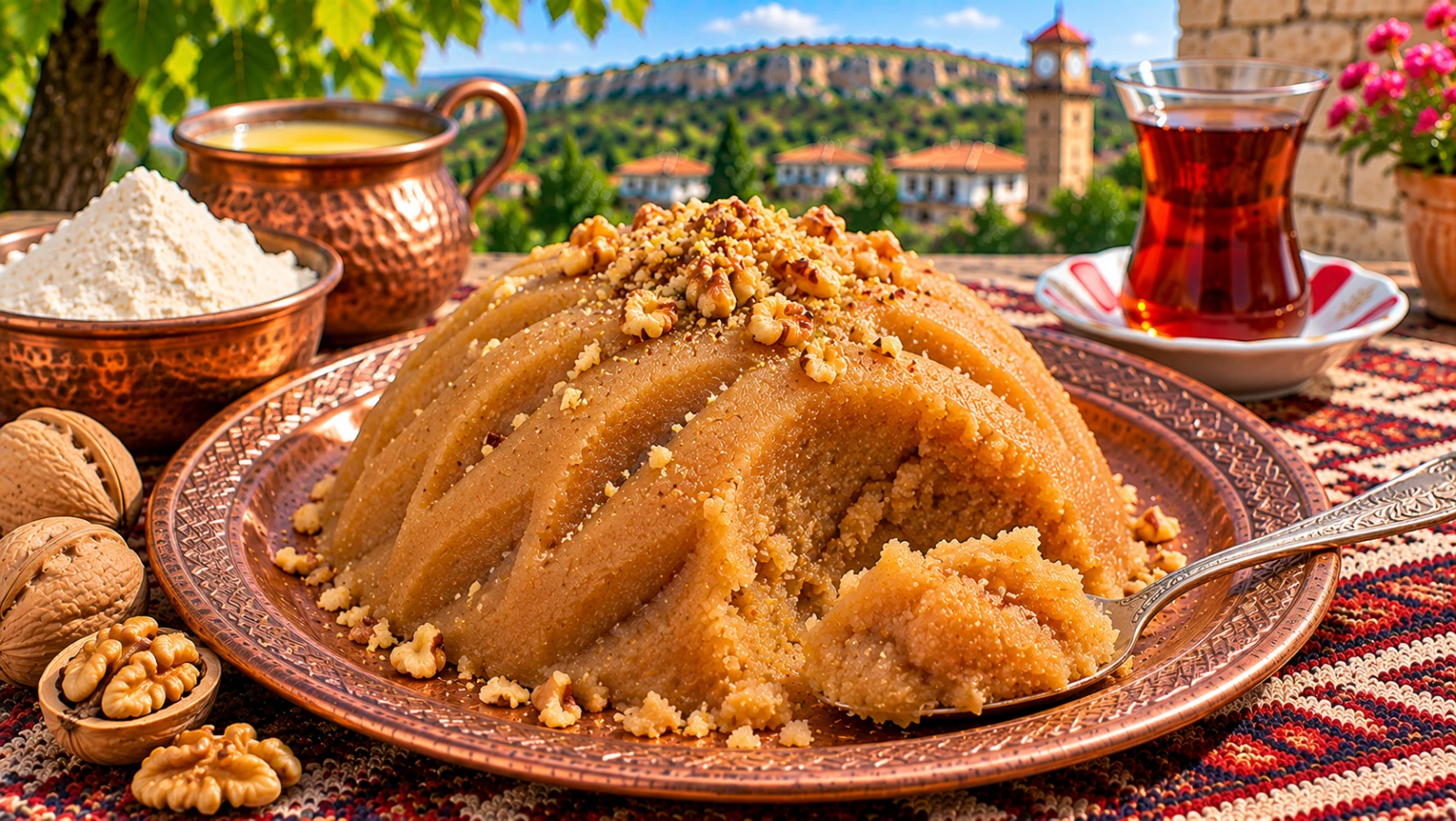
Un helvası is one of the simplest-looking yet most technique-sensitive sweets in Uşak’s traditional kitchen. Flour is slowly cooked in fat until its aroma changes and the colour deepens. Syrup is then incorporated and the mixture is stirred until it reaches a spoonable or shapeable consistency.
The Ministry of Culture and Tourism’s Culture Portal publishes a Uşak version using flour, oil, sugar and water. Its recorded quantities are a large household batch: 1 kg flour, 650 g oil, 1.35 kg sugar and 2 litres water. A cook may scale the proportions down, but should not mistake this archival formula for a universal recipe followed by every family.
Constant stirring prevents scorching and develops the dessert’s characteristic toasted flavour.
Sugar and water are boiled separately before being incorporated into the browned flour.
The mixture thickens as flour absorbs liquid; continued stirring is essential to avoid lumps.
The recorded Uşak recipe allows serving the dessert either warm or after it has cooled.
Practical orientation for an informed Uşak visit.
Uşak kitchens and local eateries
Slow-roasted flour and syrup
Traditional household sweet documented by the Culture Portal
Food heritage and local production
Around 45–70 minutes for a home preparation
Check current access, local conditions and any applicable permissions.
The distinctive value of Uşak Un Helvası (Flour Halva) lies in the relationship between the roasting stage and syrup preparation. These are useful details to ask about when tasting or buying a product associated with Uşak kitchens and local eateries.
A local food guide should distinguish a documented recipe or registered product from a maker’s individual variation. The focus here is slow-roasted flour and syrup, rather than unverified claims about a single origin story.
The Ministry of Culture and Tourism’s Culture Portal publishes a Uşak version using flour, oil, sugar and water. Its recorded quantities are a large household batch: 1 kg flour, 650 g oil, 1.35 kg sugar and 2 litres water. A cook may scale the proportions down, but should not mistake this archival formula for a universal recipe followed by every family.
The geographical focus is Uşak kitchens and local eateries. For orientation, begin with the roasting stage and then consider texture control; their relationship is more instructive than treating the subject in isolation.
Constant stirring prevents scorching and develops the dessert’s characteristic toasted flavour.
Sugar and water are boiled separately before being incorporated into the browned flour.
The mixture thickens as flour absorbs liquid; continued stirring is essential to avoid lumps.
The recorded Uşak recipe allows serving the dessert either warm or after it has cooled.
For a fuller picture, compare Uşak Un Helvası (Flour Halva) with Uşak Halva Traditions and Tahini Halva. These are related but distinct subjects; follow the relevant guides for their own historical or culinary context.
A useful first question is what makes the roasting stage different from syrup preparation. The following sections explain the practical details, materials or historical evidence needed to answer it.
The provincial recipe lists flour, cooking oil, granulated sugar and water. Unlike tahini halva, this formula does not rely on sesame paste.
The proportions above are from a heritage recipe intended for a large quantity. For a home experiment, divide the quantities consistently and use a deep, heavy pan.
Heat the fat gently, add flour and stir steadily until the flour takes on a pinkish-golden tone. In a separate vessel, boil the sugar with water to make syrup.
Add the hot syrup cautiously to the roasted flour because the mixture can bubble and release steam. Stir until the liquid is absorbed, then allow the halva to settle before serving.
High heat can burn the flour before the inside is evenly cooked. Adding liquid too fast can cause lumps or splashes; both problems are best prevented by patient stirring.
Some households shape halva with spoons or add garnishes. Those are serving variations and should not be confused with ingredients specified in the cited Uşak recipe.
Constant stirring prevents scorching and develops the dessert’s characteristic toasted flavour.
Sugar and water are boiled separately before being incorporated into the browned flour.
The mixture thickens as flour absorbs liquid; continued stirring is essential to avoid lumps.
The recorded Uşak recipe allows serving the dessert either warm or after it has cooled.
If preparing it yourself, use a deep pan, low-to-moderate heat and caution when combining hot syrup with fat.
Opening hours, admission arrangements and product availability may change. Confirm them with the museum, municipality, venue or producer rather than relying on an old price list.
Order a small portion at a traditional restaurant when available, then compare it with sesame-based tahini halva. The different textures make an excellent culinary lesson.
Allow extra time for breaks and for local circumstances. A short, meaningful visit is preferable to a schedule that depends on unconfirmed access or shopping stops.
This is a pantry-based dessert that can be prepared in any season; it is not dependent on fresh fruit.
If your visit involves exposed landscapes, check weather and daylight. For food or indoor heritage, opening hours and the availability of a knowledgeable host matter more than a particular season.
Photograph the preparation, product and its context only with permission. A sequence of raw ingredients, working hands and finished serving can tell a better story than a single staged plate.
Ask before photographing people, private property or production areas. Never enter restricted spaces or put objects at risk to obtain a picture.
A tasting can be arranged in an accessible restaurant, but verify step-free access individually.
If travelling with reduced mobility or young children, confirm gradients, steps, seating and toilet access for each individual stop.
The starting area is Uşak kitchens and local eateries. Verify actual road and public-transport connections, especially for rural sites or specialised producers; map distances alone do not guarantee a practical visit.
If an access point or venue is not clearly identified by an official operator, request directions before setting out.
Compare three halva families.
See how sesame changes the sweet.
Try a layered syrup pastry.
Pair food with a city walk.
Check actual opening conditions and travel times before combining several stops. Links to new editorial guides in this package may not appear on the Uşak hub until the site owner adds them.
The published Uşak recipe uses flour, cooking oil, sugar and water.
Un helvası is based on roasted flour and syrup, while tahini halva is made from sesame paste.
Stirring promotes even browning and reduces the risk of scorching or clumping.
The documented Uşak version can be served warm or cooled.
The ingredient amounts are reproduced from a large traditional Uşak recipe; scale them carefully for a home batch.
Yes. The documented recipe contains wheat flour; check any additional ingredients when buying prepared halva.
Present the archival formula as one documented Uşak preparation, not as the only authentic household version.
Information on protected heritage, opening arrangements and local production should be rechecked before travel. This guide does not grant access to archaeological or private property.
This guide draws on Turkish cultural authorities and, where relevant, academic research. For background and current institutional information, consult: Official or research reference 1 Official or research reference 2.
Wow Cappadocia / Venere Travel can discuss a tailor-made Uşak itinerary with suitable transport and guiding, subject to availability and confirmed access. No compulsory shopping stops.
Choose archaeology, craft, cuisine or landscape according to your interests.
Share your dates, party size and interests. We will check what can realistically be arranged.
Request a Private Programme