Ask About a Private Uşak Programme
Share your dates, party size and interests. We will check what can realistically be arranged.
Request a Private Programme





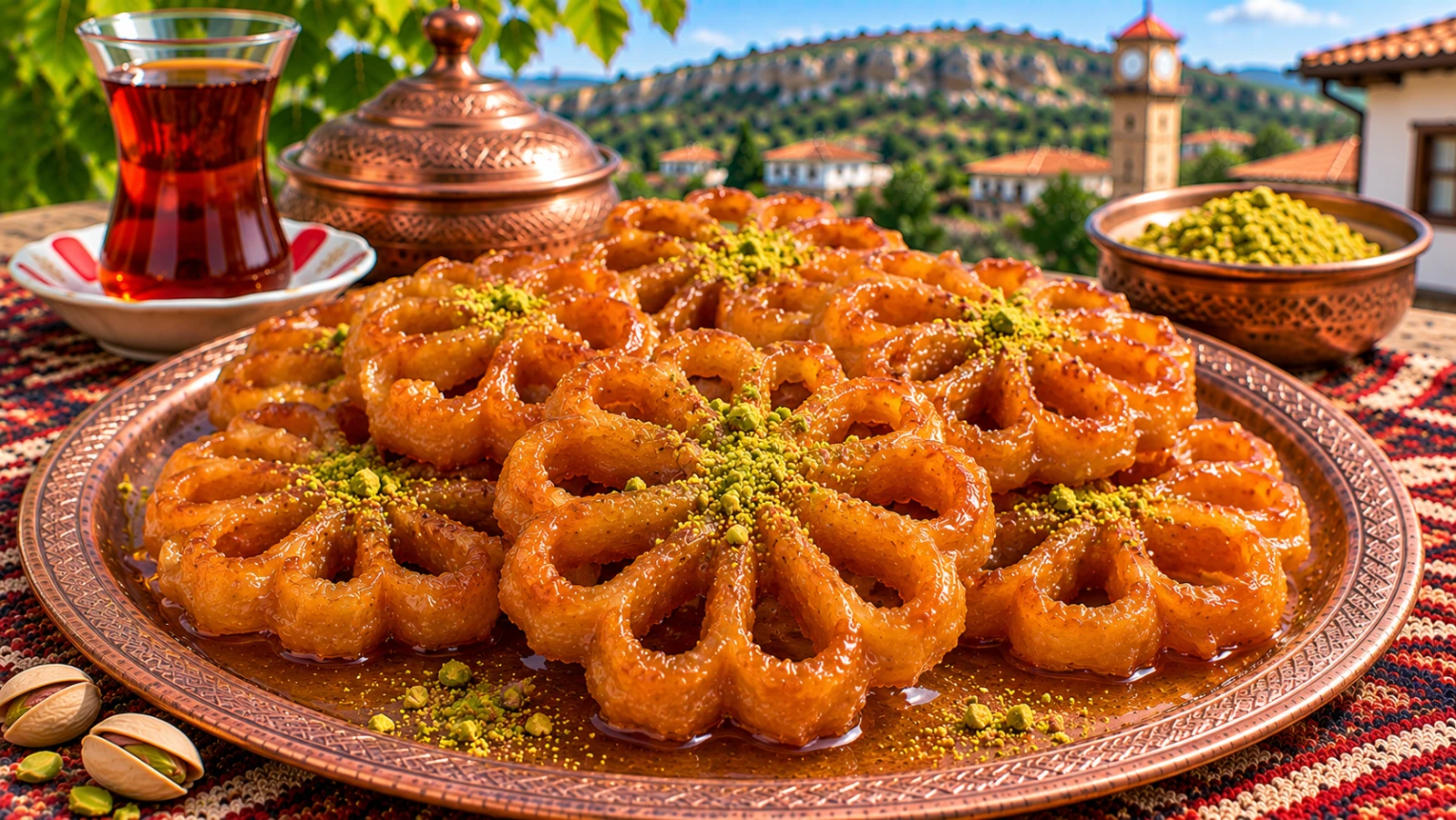
Demir tatlısı takes its name from the iron mould used to shape it. Rather than rolling a pastry by hand, the cook dips a hot patterned iron into a thin batter, then lowers it into oil so the batter sets and releases in a crisp shape. The fried pieces are sweetened with syrup.
Uşak’s Provincial Directorate of Culture and Tourism identifies demir tatlısı with Ulubey district and special occasions. A separate Culture Portal recipe supplies a batter of eggs, flour, starch, water, baking powder and salt, with a sugar-water-lemon syrup. The mould is essential to the technique.
The hot mould determines the recognisable patterned shape; it must be heated in oil before dipping.
A pourable mixture coats the iron without creating a thick pancake-like shell.
The pattern sets in hot oil; the mould is moved only when the batter has firmed enough to release.
The fried pieces are dipped into prepared syrup, giving crisp pastry a sweet coating.
Practical orientation for an informed Uşak visit.
Ulubey district and Uşak Province
Iron mould, hot oil and syrup
Regional special-occasion dessert
Food heritage and local production
45–90 minutes for home preparation
Check current access, local conditions and any applicable permissions.
The distinctive value of Uşak Demir Tatlısı (Iron-Mould Dessert) lies in the relationship between a special iron tool and thin batter. These are useful details to ask about when tasting or buying a product associated with Ulubey district and Uşak Province.
A local food guide should distinguish a documented recipe or registered product from a maker’s individual variation. The focus here is iron mould, hot oil and syrup, rather than unverified claims about a single origin story.
Uşak’s Provincial Directorate of Culture and Tourism identifies demir tatlısı with Ulubey district and special occasions. A separate Culture Portal recipe supplies a batter of eggs, flour, starch, water, baking powder and salt, with a sugar-water-lemon syrup. The mould is essential to the technique.
The geographical focus is Ulubey district and Uşak Province. For orientation, begin with a special iron tool and then consider careful frying; their relationship is more instructive than treating the subject in isolation.
The hot mould determines the recognisable patterned shape; it must be heated in oil before dipping.
A pourable mixture coats the iron without creating a thick pancake-like shell.
The pattern sets in hot oil; the mould is moved only when the batter has firmed enough to release.
The fried pieces are dipped into prepared syrup, giving crisp pastry a sweet coating.
For a fuller picture, compare Uşak Demir Tatlısı (Iron-Mould Dessert) with Cendere Dessert and Ulubey District. These are related but distinct subjects; follow the relevant guides for their own historical or culinary context.
A useful first question is what makes a special iron tool different from thin batter. The following sections explain the practical details, materials or historical evidence needed to answer it.
The Culture Portal lists 4 eggs, 4 tablespoons starch, half a packet of baking powder, 2 cups flour, 1½ cups water and a pinch of salt. Its syrup uses 3 cups sugar, 3 cups water and a little lemon juice.
The recorded formula is a heritage example. Consistency, pan size and mould design can require adjustments, and no specific oil temperature is guaranteed by the source.
Mix the batter until smooth and fluid. Heat the mould in deep frying oil, dip it into batter without covering the top of the mould, and return it to the oil.
Allow the coating to firm before trying to release it. Turning or removing the piece too early can break the pattern. Keep the iron hot between batches.
Prepare syrup in advance and allow it to cool as described in the local recipe. Dip the fried pastries, drain briefly and serve.
This is a hot-oil technique with a metal implement: use a stable pan, protective tools and adult supervision. Never introduce wet tools into hot oil.
The hot mould determines the recognisable patterned shape; it must be heated in oil before dipping.
A pourable mixture coats the iron without creating a thick pancake-like shell.
The pattern sets in hot oil; the mould is moved only when the batter has firmed enough to release.
The fried pieces are dipped into prepared syrup, giving crisp pastry a sweet coating.
A live frying demonstration should be arranged in a suitable professional kitchen, not improvised in a public market.
Opening hours, admission arrangements and product availability may change. Confirm them with the museum, municipality, venue or producer rather than relying on an old price list.
Ask at a bakery in Ulubey or Uşak whether demir tatlısı is available. Seeing the iron tool itself helps explain the technique even if a live demonstration is not possible.
Allow extra time for breaks and for local circumstances. A short, meaningful visit is preferable to a schedule that depends on unconfirmed access or shopping stops.
The dessert is connected to celebrations and may not be stocked daily. Call ahead if it is a priority.
If your visit involves exposed landscapes, check weather and daylight. For food or indoor heritage, opening hours and the availability of a knowledgeable host matter more than a particular season.
Photograph the preparation, product and its context only with permission. A sequence of raw ingredients, working hands and finished serving can tell a better story than a single staged plate.
Ask before photographing people, private property or production areas. Never enter restricted spaces or put objects at risk to obtain a picture.
For tastings, check the individual venue. Hot-oil preparation areas are generally not visitor spaces.
If travelling with reduced mobility or young children, confirm gradients, steps, seating and toilet access for each individual stop.
The starting area is Ulubey district and Uşak Province. Verify actual road and public-transport connections, especially for rural sites or specialised producers; map distances alone do not guarantee a practical visit.
If an access point or venue is not clearly identified by an official operator, request directions before setting out.
Compare another syrup dessert.
Explore the area linked with the dessert.
Pair a local sweet with canyon views.
Plan a day around Ulubey.
Check actual opening conditions and travel times before combining several stops. Links to new editorial guides in this package may not appear on the Uşak hub until the site owner adds them.
It is a patterned Uşak dessert made by frying batter on a heated iron mould and coating it with syrup.
The Uşak Provincial Directorate of Culture and Tourism specifically associates it with Ulubey.
Its name refers to the metal mould that shapes the batter.
The documented method fries the batter in oil rather than baking it.
The local recipe includes eggs, flour, starch, water, baking powder and salt, plus a sugar-lemon syrup.
The traditional patterned form requires the special iron tool; an ordinary spoon cannot reproduce the same method.
Do not reach into working frying areas for photographs. Ask permission before filming cooks.
Information on protected heritage, opening arrangements and local production should be rechecked before travel. This guide does not grant access to archaeological or private property.
This guide draws on Turkish cultural authorities and, where relevant, academic research. For background and current institutional information, consult: Official or research reference 1 Official or research reference 2.
Wow Cappadocia / Venere Travel can discuss a tailor-made Uşak itinerary with suitable transport and guiding, subject to availability and confirmed access. No compulsory shopping stops.
Choose archaeology, craft, cuisine or landscape according to your interests.
Share your dates, party size and interests. We will check what can realistically be arranged.
Request a Private Programme