Thick-Cut Eggplant
The provincial recipe uses broad rounds sturdy enough to hold cheese between two slices.






Peynirli Patlıcan is one of Balıkesir's characteristic regional dishes: thick pieces of eggplant are paired with cheese, fried until tender and golden, and traditionally served with a garlicky tomato sauce.
The Balıkesir Provincial Directorate of Culture and Tourism records a particularly clear version using eggplant, Manyas cheese, garlic and tomato sauce. The eggplant is peeled in stripes, soaked briefly in salted water, cut into broad rounds, filled between two slices with grated cheese, secured with a toothpick and fried.
That simple formula is only the beginning. Around Balıkesir, local versions can change the shape of the eggplant, the type of cheese and even the filling. Bandırma recipes may combine cheese with egg, parsley, black pepper and flour, while a Gömeç version uses a cheese-and-egg filling placed inside split eggplants. The dish is therefore best understood as a living regional tradition rather than one rigid recipe.
The classic idea is simple: soft fried eggplant surrounding or carrying a savoury local cheese filling.
Balıkesir's official provincial recipe specifically calls for Manyas cheese, linking the dish with one of the province's important dairy districts.
A cooked tomato sauce with garlic provides acidity and freshness against the richness of fried eggplant and cheese.
Bandırma, Gömeç and household recipes demonstrate how technique and filling can vary across the province.
Essential information about one of Balıkesir's most appealing eggplant-and-cheese dishes.
Balıkesir Province in north-western Türkiye, with documented local versions from the central regional tradition, Bandırma and Gömeç.
Eggplant, usually peeled in stripes and cut into thick rounds or split into pocket-like pieces.
The provincial recipe specifies Manyas cheese; other local versions may use different firm white cheeses.
A garlic-and-tomato sauce is a traditional accompaniment in the best-documented Balıkesir version.
Eggplant, dairy and tomato come together in a dish that reflects the province's agricultural and culinary character.
Balıkesir's cuisine is unusually diverse because the province stretches from the Marmara region toward the northern Aegean and includes fertile agricultural plains, dairy districts, olive-growing areas and long-established village food traditions.
The province's own culture authority lists Peynirli Patlıcan among characteristic local dishes alongside foods such as tirit, sura, Manav Tarhanası, saçaklı mantı, keşkek, düğün çorbası and zerde.
What makes the dish especially Balıkesir-like is the meeting of two ingredients strongly at home in the region: summer eggplant and local cheese. The provincial recipe's use of Manyas cheese is particularly meaningful because Manyas, Bandırma and Gönen form one of Balıkesir's important dairy-producing areas.
At the same time, the dish shows how regional cooking evolves. A compact official recipe survives beside richer household versions using egg, parsley, flour or different cheeses. Those variations do not weaken the tradition; they reveal how widely it has been adapted.
The dish is built around contrast: tender eggplant, savoury cheese, fried edges and the freshness of tomato and garlic.
The provincial recipe uses broad rounds sturdy enough to hold cheese between two slices.
Peeling the eggplant in alternating strips leaves some skin for structure while exposing tender flesh.
The cut eggplant is traditionally rested briefly in salted water before frying.
Grated or crumbled cheese is placed between eggplant pieces or inside a slit, depending on the local version.
In the classic round-slice method, a toothpick keeps the eggplant-and-cheese sandwich together during frying.
Frying softens the eggplant while browning its exterior and warming the cheese.
The classic provincial presentation balances the fried components with a cooked sauce of tomato and garlic.
Some recipes add egg, parsley, black pepper or flour, proving that the dish changes from kitchen to kitchen.
Balıkesir Peynirli Patlıcan is a fried eggplant-and-cheese dish associated with the regional cuisine of Balıkesir. In its clearest documented form, thick eggplant rounds are paired around grated Manyas cheese, fixed together and fried.
The finished pieces are served with a cooked tomato sauce scented with garlic. This creates a combination that is both rich and fresh: the eggplant absorbs flavour and softens in the oil, the cheese adds salt and dairy depth, and the tomato sauce cuts through the richness.
The name is completely descriptive—peynirli means “with cheese” and patlıcan means “eggplant”—but the Balıkesir identity comes from the local choice of cheese, the frying method and the regional variations preserved in different districts.
The vegetable provides the structure, softness and characteristic richness of the dish.
Manyas cheese is the key dairy element in the provincial version.
The oil transforms the eggplant from firm slices into tender, browned layers.
Garlic and tomato provide acidity, aroma and moisture at the table.
The Balıkesir Provincial Directorate of Culture and Tourism records a concise recipe using 1 kg of eggplant, Manyas cheese, 2–3 cloves of garlic and tomato sauce.
The eggplants are peeled in alternating strips, rested in salted water for several minutes and cut into broad rounds. Grated cheese is placed between two eggplant rounds to form a small sandwich.
A toothpick is used to hold the two slices together, and the assembled pieces are fried in hot oil. After frying, the eggplants are transferred to a serving plate and topped with garlic tomato sauce.
Leave alternating bands of skin so the slices keep some structure.
Rest the eggplant in salted water before drying and cutting.
Place grated Manyas cheese between two broad slices.
Use a toothpick so the sandwich stays together.
Cook in hot oil until the eggplant is tender and coloured.
Finish with cooked tomato and garlic.
The most authoritative Balıkesir recipe specifically names Manyas cheese. That detail is important because Manyas is one of the province's best-known dairy districts and gives the dish a direct regional connection.
Manyas's most famous registered cheese today is Manyas Kelle Peyniri, a firm, porous, brined cheese produced within the geographical area covering Manyas, Bandırma and Gönen. It was registered as a geographical indication in 2020.
The provincial Peynirli Patlıcan recipe says simply “Manyas peyniri,” so it is safest not to assume that every household historically used one exact protected cheese specification. What is clear is that a firm local cheese capable of holding its character during frying is central to the dish.
Manyas, Bandırma and Gönen are strongly associated with milk and cheese production.
A firmer cheese is easier to grate or place between eggplant slices.
The cheese seasons the mild eggplant from within.
Using regional cheese turns a simple eggplant fry into a recognisably Balıkesir dish.
The eggplant needs to be firm enough to cut into substantial pieces yet tender enough to soften completely during frying. Long purple eggplants work well for round-slice versions, while larger or more elongated eggplants can suit pocket-style local preparations.
Traditional recipes commonly peel the skin in alternating strips. This is practical as well as visual: removing some skin encourages tenderness while the remaining strips help the slices keep their shape.
After cutting, the eggplant is rested in salted water. Modern eggplants are not always strongly bitter, but the step remains part of the traditional preparation and can also help season the flesh before cooking.
Avoid eggplants that feel soft, wrinkled or excessively seedy.
Very thin slices can collapse before the cheese is properly enclosed.
Striped peeling provides a useful balance between tenderness and structure.
Surface water should be removed before the eggplant goes near hot oil.
The official Balıkesir method places the striped eggplant in salted water for roughly five to ten minutes before it is cut into the broad pieces used for frying.
Salting is a familiar technique in Turkish eggplant cooking. It seasons the flesh and has traditionally been used to draw out harsh or bitter notes. The exact effect depends on the variety and maturity of the eggplant.
Whatever the reason for soaking, one practical rule matters greatly: the eggplant should be drained and dried before frying. Water on the surface can make hot oil spit aggressively.
Salted water appears in the documented provincial method.
A little salt begins flavouring the vegetable before cooking.
The technique has long been associated with moderating harshness in eggplant.
Removing surface water improves both safety and browning.
In the classic Balıkesir presentation, two broad eggplant rounds are used for each portion. Grated cheese is placed between them so the vegetable effectively forms a small sandwich.
The amount of cheese should be generous enough to be tasted but not so excessive that it spills immediately into the frying oil. A toothpick through the centre holds the layers together.
This assembly method gives the dish one of its most appealing textures: the outside of the eggplant browns, the centre becomes silky and the warm cheese remains tucked between the two pieces.
Choose slices of similar size so they line up neatly.
A shredded filling spreads more evenly than one large lump.
Excess cheese is more likely to escape into the oil.
A toothpick gives the sandwich enough stability for turning.
Once assembled, the eggplant-and-cheese pieces are fried in hot oil until the eggplant softens and takes on colour. Because eggplant absorbs oil readily, temperature control is important.
If the oil is too cool, the slices can become heavy before they brown. If it is excessively hot, the surface can darken while the inside remains firmer than desired.
After frying, the pieces are usually rested briefly on absorbent paper or another draining surface. The goal is not to remove all richness—the dish is meant to be fried—but to prevent unnecessary excess oil from dominating the finished plate.
A properly heated pan gives better browning and less greasy results.
Crowding the pan drops the oil temperature.
Use the toothpick assembly as support without tearing the softened eggplant.
A short rest removes surface oil before saucing.
The garlic-tomato sauce is not a decorative afterthought. It is the element that balances the fried eggplant and salty cheese.
A simple version begins with crushed or finely chopped garlic, followed by grated or crushed tomato cooked until it loses its raw edge and becomes spoonable. Some household recipes may alter the order or add a little oil.
The sauce can be spooned over the fried eggplant shortly before serving. This preserves some crispness around the edges while allowing the tomato to soak into the softer centre.
Provides acidity, sweetness and moisture.
Adds a sharp aromatic note that stands up to fried eggplant.
The tomato should concentrate enough to cling to the food.
Late saucing helps preserve the contrast in texture.
A Bandırma recipe attributed to Bandırma Onyedi Eylül University records a notably different version. Bostan eggplants are peeled in stripes, cut crosswise and rested in salted water before drying.
Instead of placing plain grated cheese between two rounds, the recipe makes a mixture from eggs, Manyas cheese, parsley, black pepper and flour. Spoonfuls of this mixture are placed on the eggplant pieces.
The eggplant is then fried, first on the plain side and then on the cheese-topped side. This version shows how the same regional name can describe a different shape and cooking technique while preserving the central partnership of eggplant and cheese.
A rounder eggplant provides a broad surface for the topping.
Egg, parsley, pepper and flour turn the cheese into a more substantial coating.
The filling sits on the eggplant rather than between two separate slices.
The topping itself is cooked directly against the pan.
A Gömeç version recorded in a television cooking programme takes yet another route. Eggplants are cut lengthwise and opened without completely separating the final section, creating a pocket.
The filling combines cheese, egg, parsley and black pepper. The mixture is tucked into the eggplant and the whole piece is then fried.
That recipe uses Ezine cheese rather than Manyas cheese. The variation is useful evidence that Peynirli Patlıcan is not defined by one universal cheese or one exact cut of eggplant across all of Balıkesir.
The eggplant itself becomes a container for the filling.
Egg helps bind the cheese and herbs.
Fresh herb and black pepper add aroma.
Gömeç's recorded version shows that local cheese choice can vary.
No. The official provincial recipe is beautifully simple, but local and household versions show meaningful variation.
Some recipes use a plain grated cheese filling and tomato sauce. Others mix cheese with egg, parsley, pepper or flour. Some create a sandwich from two eggplant rounds, while others make a slit or pocket in one larger piece.
Even the cheese can change. Manyas cheese is central to the provincial version, yet recipes from other parts of Balıkesir may use another local white cheese. The most accurate way to present the dish is therefore to distinguish the version being described rather than forcing every recipe into one formula.
Manyas cheese is traditional in the provincial version, but not universal.
Rounds, sandwiches and pocket-style pieces all appear.
Egg, parsley, pepper and flour may be included in some variants.
Garlic tomato sauce is classic, but not every recorded version uses it.
The first impression is richness: properly fried eggplant becomes soft, almost creamy inside, while the cheese adds salt and concentrated dairy flavour.
The tomato sauce changes the balance. Its acidity and sweetness brighten the dish, and garlic provides a sharper aromatic contrast that keeps the plate from feeling one-dimensional.
Texture depends strongly on the version. The classic sandwich gives you layers of browned eggplant and melting or softened cheese, while Bandırma and Gömeç variations can have a more substantial, egg-bound filling.
Frying gives the vegetable a soft interior.
The filling provides savoury intensity.
Sauce contributes acidity and sweetness.
A small amount of garlic transforms the finish.
Peynirli Patlıcan is at its most expressive when served warm, soon after frying, while the eggplant is tender and the cheese is still heated through.
The garlic-tomato sauce can be spooned over the top or served generously around the pieces. If toothpicks were used to hold the sandwiches together, they should be removed before eating unless the presentation makes them very obvious.
The dish works naturally as part of a shared Turkish table. Its richness means it pairs well with fresh salad, herbs, bread and lighter vegetable dishes.
Warmth keeps the cheese soft and the eggplant fragrant.
Tomato and garlic are part of the flavour balance, not merely decoration.
Do this before guests begin eating whenever practical.
The dish suits a spread of regional starters and side dishes.
Because the dish depends on good eggplant and ripe tomato, it has a natural connection with the warmer growing season, when both vegetables are at their most flavourful.
That does not mean it belongs to one formal festival or ceremony. Unlike Balıkesir dishes strongly linked with weddings or religious charity meals, Peynirli Patlıcan is best understood as a regional home-style vegetable dish that can appear at ordinary meals and shared tables.
Modern recipe sources also present it as suitable from breakfast-style spreads to evening meals, or as an ara sıcak—a warm small plate served between cold starters and the main course.
Eggplant and tomato are at the centre of the dish.
The recipe is practical enough for household tables.
It works well as part of a larger meal.
Some modern presentations treat it as an ara sıcak.
Balıkesir's food culture is shaped by both agriculture and animal husbandry. Official provincial descriptions emphasise the importance of vegetables and herbs alongside strong dairy traditions in districts such as Manyas, Gönen and Susurluk.
Peynirli Patlıcan sits neatly at that intersection. Eggplant and tomato represent the vegetable side of the regional table, while cheese connects the dish with Balıkesir's deep dairy culture.
The result is a useful reminder that regional identity does not always require a complicated ingredient list. Sometimes it comes from combining ordinary ingredients in a way that belongs unmistakably to a place.
Eggplant and tomato are fundamental ingredients in western Anatolian home cooking.
Balıkesir is nationally recognised for milk and cheese production.
Frying and saucing transform a short ingredient list into a distinctive dish.
Plant and dairy ingredients meet in one plate.
Manyas Kelle Peyniri is a geographically indicated cheese associated with Manyas, Bandırma and Gönen. It is described in official agricultural sources as a hard, porous, brined cheese with a strong aroma.
Its registration dates to 16 December 2020. The registered product can be made from cow's milk, sheep's milk or permitted mixtures, and undergoes brining and extended maturation.
That makes it a compelling cheese to understand when exploring Peynirli Patlıcan, but one distinction matters: the provincial recipe says “Manyas cheese” rather than explicitly naming the full geographical-indication product. The dish should therefore be presented as connected with Manyas cheese tradition without claiming that every historic plate used today's registered specification.
Manyas Kelle Peyniri carries a Turkish geographical indication.
Its firm structure distinguishes it from softer fresh cheeses.
The cheese develops character through a lengthy maturation process.
Its production area overlaps the Balıkesir districts strongly connected with this dish.
For a home version closest to the provincial recipe, begin with firm eggplants, a firm salty cheese from the Manyas tradition, garlic, ripe tomatoes and frying oil.
Peel the eggplants in stripes, rest them briefly in salted water, dry them and cut into thick rounds. Put grated cheese between matched rounds and secure each sandwich with a toothpick.
Fry until both sides are browned and the eggplant is completely tender. Separately cook grated tomato with garlic until saucy. Drain the fried eggplant briefly and finish with the warm tomato sauce.
The classic version does not need a long spice list.
Similar-sized rounds make neater sandwiches.
It is easier to contain during frying.
The centre should be soft, not spongy or raw.
Cooking the tomato on its own gives better control of flavour.
The textures are best before the eggplant sits too long.
The most common problems are structural rather than complicated: slices that are too thin, cheese that is too wet, eggplant that has not been dried after soaking or oil that is not hot enough.
Overfilling is another temptation. A large mound of cheese may sound appealing, but once the eggplant softens it can squeeze out into the pan.
Finally, do not forget the sauce. Without the tomato and garlic, the classic Balıkesir version loses the bright component that balances its fried richness.
They soften quickly and may tear around the filling.
Surface water causes dangerous splattering in hot oil.
Overfilling makes the sandwiches difficult to turn.
The eggplant can become excessively oily before browning.
The flesh should be fully tender.
Tomato and garlic are essential to the classic balance.
When ordering Peynirli Patlıcan, ask which cheese is used. A kitchen using Manyas cheese is following the provincial tradition particularly closely, while another cheese may reflect a different local interpretation.
Ask whether the dish is made as a two-slice sandwich or as a stuffed eggplant pocket. That one question can reveal which branch of the recipe you are about to taste.
If you are exploring Balıkesir specifically for food, compare the dish with local cheeses, Susurluk ayranı, tirit, keşkek, lamb dishes and höşmerim. Together they show how broad the province's food identity really is.
Manyas cheese gives the dish a strong local connection.
Sandwich and pocket versions can be quite different.
It is a hallmark of the classic provincial method.
Warm fried eggplant is difficult to beat.
Bandırma and Gömeç offer useful contrasts.
This dish makes even more sense as part of the wider regional table.
Peynirli Patlıcan is a regional home-style dish, so it may not appear on every restaurant menu every day. Traditional lokantas, family-run kitchens and restaurants focusing on Balıkesir cuisine are better places to ask than menus built mainly around generic national dishes.
Bandırma is especially interesting for travellers who want to compare a local variation because the district has a documented version using egg, Manyas cheese, parsley, black pepper and flour.
Along the Gulf of Edremit and in Gömeç, local cooking traditions may present the dish differently again. If you see the name on a menu, ask how that kitchen prepares it rather than assuming it will look exactly like the provincial recipe.
Look for kitchens that advertise Balıkesir or local village dishes.
A documented version gives the dish an open-faced cheese-and-egg treatment.
Another recorded local version uses a filled pocket-style eggplant.
The same name can lead to very different presentations.
Türkiye has countless eggplant dishes, but Peynirli Patlıcan should not be confused with baked stuffed eggplants such as karnıyarık or olive-oil preparations such as imam bayıldı.
The Balıkesir dish is fundamentally about frying and cheese. Its filling is dairy-based rather than minced-meat based, and the classic presentation uses thick slices rather than a whole eggplant split and baked with a cooked filling.
It is also different from simple fried eggplant with yoghurt. Here the cheese is structurally part of the eggplant itself—inside, between or on top of the vegetable—before frying.
Cheese-centered and usually fried.
Typically stuffed with a cooked minced-meat mixture and finished separately.
An olive-oil eggplant dish traditionally filled with onion and tomato.
Usually served without a cheese filling enclosed in the vegetable.
Peynirli Patlıcan reveals how Balıkesir's cuisine draws strength from overlapping food landscapes. The province has fertile vegetable-growing areas, important dairy districts and a long tradition of home cooking built around seasonal produce.
The dish also demonstrates how migration and district-level identity create variation. A central provincial recipe, a Bandırma version and a Gömeç version can all preserve the same central idea while changing cheese, shape and filling.
That makes the dish valuable not because it is complicated, but because it shows regional cuisine behaving exactly as living cuisine does: repeating a familiar pattern while allowing families and communities to make it their own.
Eggplant and tomato anchor the dish in summer agriculture.
Cheese gives it a strong connection with Balıkesir's milk-producing districts.
Small recipe changes preserve family preferences.
One name can contain several local cooking traditions.
For travellers who love eggplant, the answer is easy: this is one of the most direct ways to taste the vegetable alongside Balıkesir's cheese culture.
It is especially worth seeking out because the dish can look completely different depending on where you find it. A Manyas-cheese sandwich with garlic tomato sauce, a Bandırma-style topped slice and a Gömeç-style filled pocket each reveal a different side of the same regional idea.
The dish is also approachable. There are no difficult flavours to decode—just eggplant, cheese, tomato, garlic and frying—yet the regional choice of ingredients gives those familiar elements a distinctive identity.
Manyas cheese links the dish directly with Balıkesir's dairy heritage.
Tender eggplant and salty cheese are a natural pairing.
Garlic tomato sauce brings the plate into balance.
The variations are part of the story, not a problem to be solved.
Peynirli Patlıcan is an ideal bridge into Balıkesir's wider food culture. Continue with the province's cheeses, grain dishes, ceremonial foods, dairy drinks and desserts.
Explore the registered hard, porous cheese connected with Manyas, Bandırma and Gönen.
Discover one of the province's most important slow-cooked grain and meat traditions.
Continue with a classic combination of bread, broth and meat.
Learn about another dish closely connected with the province's communal food culture.
Move from savoury cheese to Balıkesir's famous cheese-based dessert.
Pair the journey with one of Balıkesir's best-known dairy drinks.
Eggplant, cheese and hot oil require a little organisation. Prepare the cheese, sauce ingredients and draining tray before you begin frying so the cooked pieces do not sit around while you search for the next component.
If using a very salty aged cheese, taste it before seasoning anything else. The eggplant and tomato sauce may need less additional salt than expected.
Most importantly, dry the eggplant thoroughly after its salted-water rest. This improves browning and reduces splattering. Keep children and pets away from the stove while frying.
Have the filling, sauce and draining surface ready.
A mature cheese may already provide plenty of salt.
Moisture and hot oil are a bad combination.
Give each piece enough room to brown.
Softened eggplant can tear if handled roughly.
Fried textures deteriorate if held too long.
It is a regional fried eggplant-and-cheese dish associated with Balıkesir, often finished with garlic tomato sauce.
The Balıkesir Provincial Directorate of Culture and Tourism specifies Manyas cheese in its published recipe.
Manyas Kelle Peyniri is the best-known registered cheese of the district, but the provincial dish recipe says simply “Manyas cheese,” so the two terms should not automatically be treated as identical in every historical recipe.
Two thick eggplant rounds are placed around grated cheese, secured with a toothpick and fried.
It is a traditional preparation step used before frying; it also lightly seasons the flesh and has long been associated with reducing harsh or bitter notes.
No. Bandırma and Gömeç recipes show open-faced and pocket-style versions.
The classic provincial recipe does not list egg, but several local variations do.
The classic provincial recipe does not list flour, while the documented Bandırma version does.
The dish contains no meat in the documented versions discussed here, but travellers following a strict vegetarian diet may wish to ask about the cheese-making rennet used.
The simple provincial recipe does not list wheat flour, but some regional variants use flour, so ask how the kitchen prepares it.
Not usually. Black pepper appears in some local versions, but the dish is generally savoury rather than hot.
The classic Balıkesir version is topped with tomato sauce flavoured with garlic.
Expect soft fried eggplant, salty cheese, tomato sweetness and acidity, and a garlicky finish.
Yes, especially if Manyas cheese is unavailable. Choose a firm, savoury cheese that will hold up during frying.
You can create a lighter adaptation, but frying is central to the documented traditional versions.
It is especially good warm. Some modern recipes also describe it as suitable at cooler serving temperatures.
The provincial culture authority records the general dish, while separate published versions are associated with Bandırma and Gömeç.
One documented Bandırma recipe uses bostan eggplant topped with a mixture of egg, Manyas cheese, parsley, black pepper and flour before frying.
A recorded Gömeç version fills split eggplant with cheese, egg, parsley and black pepper before frying.
It brings together the province's vegetable cooking and strong dairy tradition in a simple regional preparation.
The strongest photographs should make the structure of the dish immediately obvious: browned eggplant, visible cheese and the vivid red of garlic-tomato sauce. A rustic Balıkesir table setting works beautifully with the food's home-style character.
Show three or four finished eggplant-cheese pieces with tomato sauce spooned over and around them.
Slice one piece so the cheese between the eggplant layers can be clearly seen.
Include a small wedge or grated pile of local cheese beside the raw eggplant ingredients.
Capture two eggplant rounds being filled and secured with a toothpick.
A close-up of the eggplant browning in a shallow pan communicates texture and technique.
Photograph the garlic tomato sauce being spooned over the finished dish for a vivid final frame.
Discover Peynirli Patlıcan together with regional cheeses, markets, olive country, village dishes, desserts and the many food traditions that shape Balıkesir.
Custom-designed private programs can combine Balıkesir's traditional dishes, local producers, markets, dairy culture and northern Aegean landscapes according to your dates and interests.
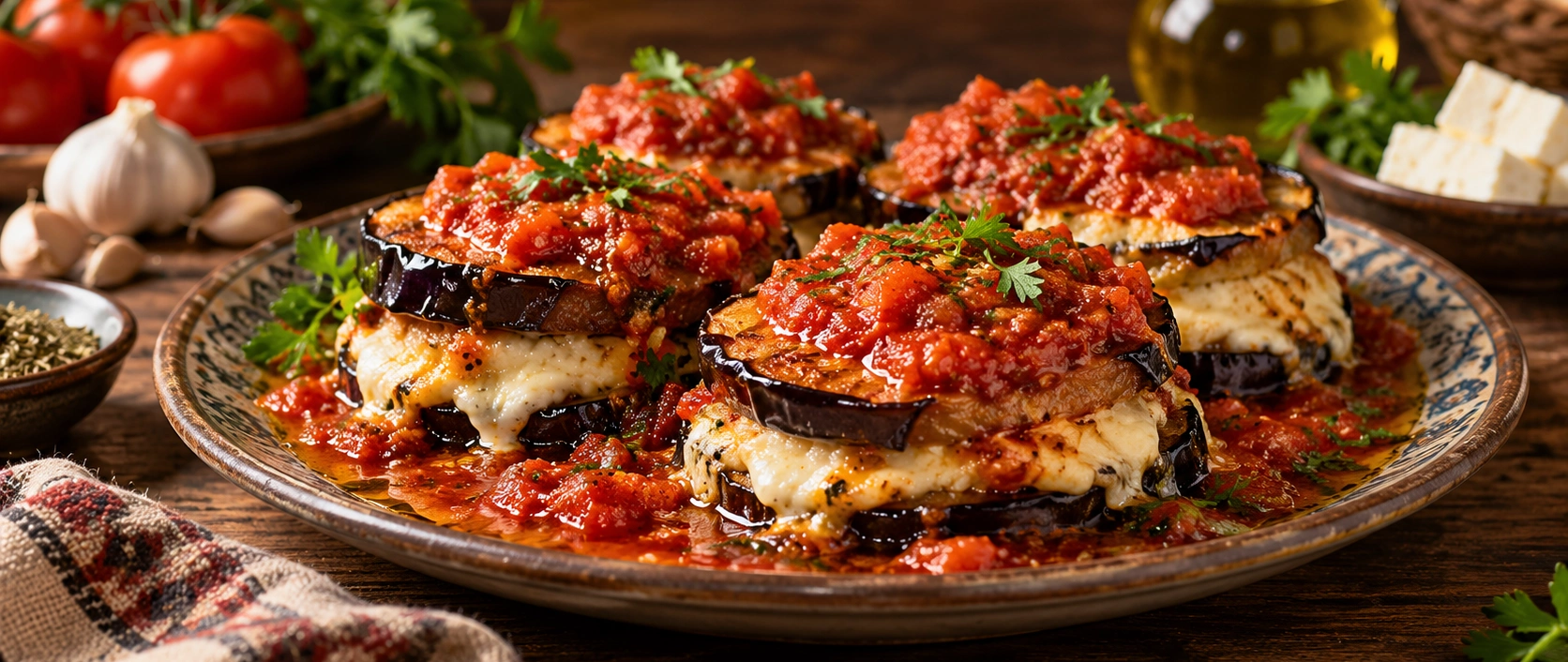
Explore Balıkesir through eggplant dishes, Manyas cheese, regional markets, local dairy products, olive oil, village cooking and classic desserts.
Request This Experience
Combine Peynirli Patlıcan with Balıkesir's cheeses, lamb dishes, olive oil, village foods, höşmerim and northern Aegean landscapes.
Request This Tour