Karagöz & Hacivat, Turkish Shadow Theatre, Traditional Puppets, Tasvir Figures, Live Performances, Workshops, UNESCO Heritage & Bursa Culture

Karagöz Museum Bursa – Complete Shadow Theatre & Visitor Guide

Discover the colourful world of Karagöz and Hacivat in Bursa,
from translucent leather figures and comic dialogue to live shadow plays, workshops and a centuries-old performance tradition.

Discover Karagöz Museum Bursa

Step Behind the Shadow Screen of One of Türkiye's Most Beloved Traditions

Few museums in Bursa feel as alive as the Karagöz Museum – Karagöz Müzesi.

Rather than presenting traditional culture only as something preserved behind glass, the museum is devoted to a performance art that still depends upon voice, movement, music, improvisation and direct contact with an audience.

Its central figures are Karagöz and Hacivat, the famous comic pair whose misunderstandings, arguments, wordplay and contrasting personalities have entertained generations.

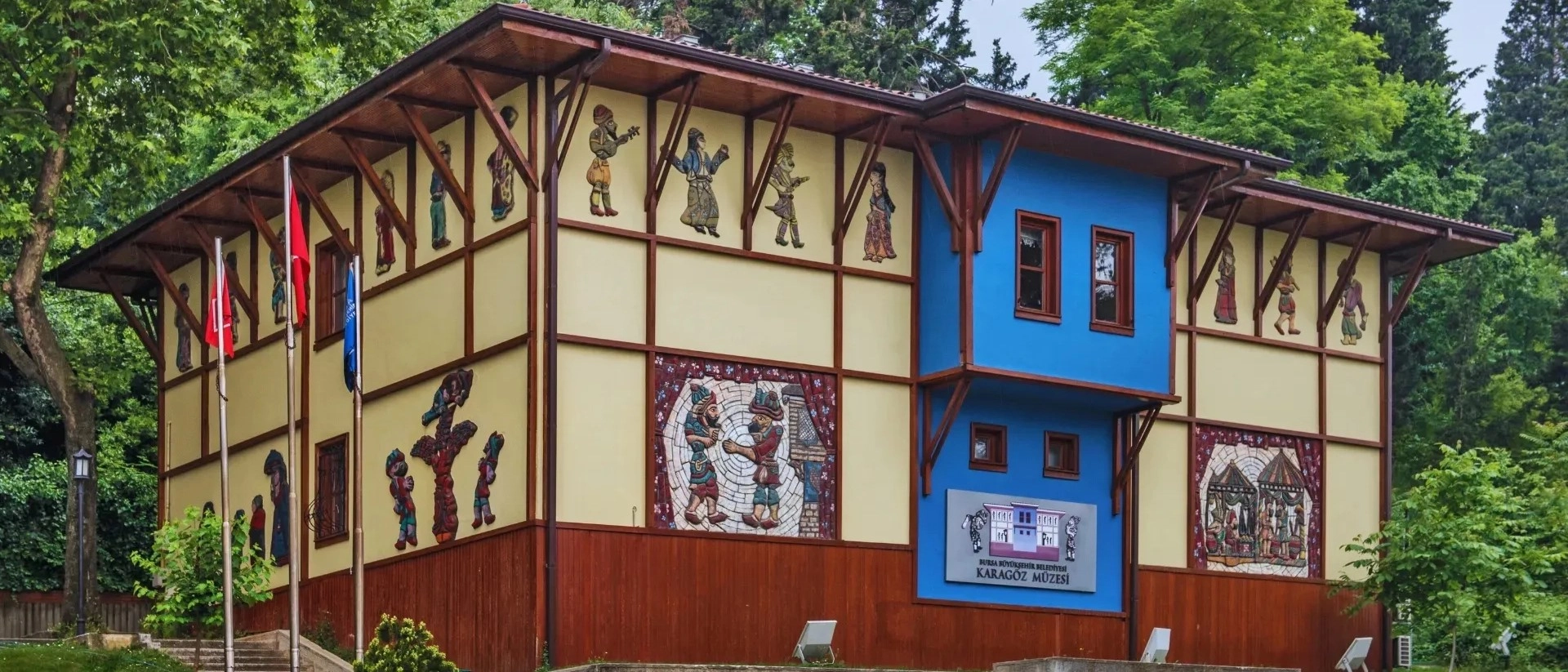
The museum occupies a former utility building on Çekirge Caddesi in Osmangazi, directly opposite the Karagöz and Hacivat memorial associated with Bursa's traditional legends about the pair.

The building first became a Karagöz House in 1997 and was reorganised by Bursa Metropolitan Municipality as Türkiye's first specialised Karagöz Museum in 2007.

Today its galleries introduce the history of shadow theatre, the craft of making tasvir figures, important Karagöz masters, historic character designs, international puppets and the technical world behind the illuminated screen.

The museum also includes a performance hall, specialist library and figure-making workshop, allowing visitors to understand Karagöz not only as an old collection, but as a living art still being performed and taught.

That living quality is especially important because Karagöz was inscribed by UNESCO in 2009 on the Representative List of the Intangible Cultural Heritage of Humanity.

For families, theatre lovers, travellers interested in Ottoman popular culture and anyone searching for a museum experience very different from Bursa's monumental mosques and tombs, Karagöz Museum is one of the city's most distinctive cultural stops.

Karagöz & Hacivat

Meet the contrasting comic characters at the centre of Türkiye's most famous traditional shadow theatre.

Historic Tasvir Figures

See colourful translucent figures used by generations of shadow-theatre artists and preserved as part of the museum collection.

Live Shadow Theatre

Experience Karagöz as performance rather than only exhibition when scheduled live shows are available.

Traditional Craft

Learn how leather figures are cut, pierced, coloured, articulated and manipulated behind an illuminated screen.

UNESCO Living Heritage

Explore an art form recognised internationally as part of the Intangible Cultural Heritage of Humanity.

Perfect for Families

Colourful figures, comedy, performance and creative workshops make the museum particularly engaging for younger visitors.


Plan Your Visit

Karagöz Museum Bursa – Quick Facts

Essential information for visiting Bursa's museum of Karagöz, Hacivat and traditional Turkish shadow theatre.

📍

Location

Çekirge Mahallesi, Çekirge Caddesi No:159, Osmangazi, Bursa.

Open on Google Maps
🎭

Museum Theme

Karagöz shadow theatre, Hacivat, traditional tasvir figures, puppetry, performance history and living cultural heritage.

🏛️

Museum Since

The building became Karagöz House in 1997 and was reorganised as Karagöz Museum in 2007.

🌍

UNESCO

Karagöz was inscribed in 2009 on UNESCO's Representative List of the Intangible Cultural Heritage of Humanity.

🕘

Current Hours

The dedicated Bursa Museums website currently lists Tuesday–Sunday, 09:00–17:30.

📆

Closed

Monday; the municipal museum information also lists 1 January and the first day of religious holidays as closure days.

🎟️

Shows & Workshops

Live performances and children's figure-making workshops are separately scheduled; advance registration or ticketing may be required.

⏱️

Recommended Visit

Allow around 45–75 minutes for the museum; add more time if attending a scheduled performance or workshop.


A Museum That Still Performs

Why Visit Karagöz Museum Bursa?

Karagöz Museum is one of the best places in Bursa to experience the city's living cultural heritage rather than only its monumental past.

Bursa is famous for early Ottoman mosques, royal tombs, bazaars, silk and historic neighbourhoods.

Karagöz Museum reveals another side of the city: the world of popular entertainment, oral humour, performance, craftsmanship and social satire.

The museum is particularly rewarding because the art it presents was never meant to be silent.

Karagöz comes to life through voices, misunderstandings, songs, music, rapid dialogue, movement and improvisation.

Even when no live performance is taking place, the figures and displays allow visitors to imagine the illuminated screen, the hidden performer and the audience reacting on the other side.

The museum is also unusually suitable for families because its subject is immediately visual. Children do not need a deep knowledge of Ottoman history to understand the basic magic: a flat leather figure becomes a moving character when light passes through it.

For travellers interested in intangible heritage, the museum is especially important because it demonstrates how a tradition survives: not simply by preserving old objects, but by training artists, holding performances, organising workshops and introducing new audiences to the craft.

What to See

Top Highlights of Karagöz Museum Bursa

The museum combines historic figures, performance history, puppetry, craftsmanship and the living stage tradition of Karagöz.

Karagöz & Hacivat Figures

The central pair appear in numerous forms and demonstrate how character can be expressed through silhouette, colour, costume and movement.

  • Karagöz: Direct, impulsive & plain-speaking
  • Hacivat: Educated, formal & elaborate in speech
  • Comedy: Misunderstanding & verbal contrast

Historic Tasvir Collection

Traditional translucent figures reveal the craftsmanship required to turn leather into articulated performers for the shadow screen.

  • Material: Traditionally camel or bovine hide
  • Technique: Cutting, piercing, colouring & articulation
  • Purpose: Shadow-theatre performance

Master Karagöz Artists

Displays introduce important hayali masters and preserve figures connected with influential performers and makers.

  • Role: Hayali – master performer
  • Training: Master-apprentice tradition
  • Skills: Voice, movement, music & improvisation

International Puppets

Puppets donated or collected through international exchanges place Turkish shadow theatre within a wider world of puppet traditions.

  • Types: String & hand puppets
  • Origin: Different countries
  • Context: International festivals & exchange

Performance Hall

The museum has a dedicated hall where visitors can encounter Karagöz as a live theatrical experience when performances are scheduled.

  • Capacity: Officially listed as 69 seats
  • Experience: Live shadow theatre
  • Check: Current programme & booking rules

Figure-Making Workshop

Creative workshops help younger visitors understand that a tasvir is both a crafted object and a tool for performance.

  • Focus: Design & making
  • Current Age Group: Workshops advertised for ages 8–13
  • Reservation: Check current programme

Karagöz History Gallery

Introductory displays explain the development of the tradition, its characters and the technical world behind the screen.

  • Theme: History of Karagöz
  • Objects: Tools & materials
  • Context: Turkish popular theatre

Karagöz & Hacivat Memorial

The memorial directly opposite the museum connects the galleries with Bursa's powerful local legends about the two characters.

  • Location: Across Çekirge Caddesi
  • Meaning: Symbolic memorial
  • Important: Legend, not proven biography

What Is Karagöz Shadow Theatre?

Karagöz is the name both of the central comic character and of the traditional Turkish shadow-theatre form built around him.

Figures known as tasvir are traditionally made from translucent animal hide, cut into shapes representing people, animals, objects and scenery, then moved on rods in front of a light source.

The illuminated figures appear against a pale screen, transforming flat pieces of coloured leather into a complete theatrical world.

The performance combines dialogue, character voices, music, song, poetry, riddles, wordplay, physical comedy and improvisation.

The result is much more than a puppet show. It is a compact form of theatre in which one principal performer can create an entire neighbourhood of characters from behind the screen.

The Screen

The white performance screen is traditionally associated with the expression Küşteri Meydanı, linking the theatrical space symbolically with Şeyh Küşteri.

The Light

A light source behind the figures allows colour and silhouette to appear clearly to spectators seated on the opposite side.

Tasvir Figures

Characters are cut from translucent hide and often articulated so arms, legs or other parts can move.

Control Rods

Thin rods allow the performer to position, turn, strike, dance and animate the figures against the screen.

Voice

The performer gives different characters distinctive voices, accents, rhythms and personalities.

Improvisation

A skilled hayali can adapt dialogue and comic detail to the audience, occasion and contemporary context.

The History of Karagöz Museum Bursa

The building occupied by Karagöz Museum had a very different life before becoming a cultural institution.

Municipal museum information states that it functioned for decades as a transformer building and remained in that role until 14 June 1997.

Bursa Metropolitan Municipality then adapted the structure as a Karagöz House – Karagöz Evi, creating a dedicated place for the city's shadow-theatre tradition.

In 2007, the building was reorganised and expanded conceptually as Karagöz Museum.

That transformation is important because it shifted the site from simply presenting Karagöz to combining museum display, performance, research, education and transmission of the craft.

Before 1997 The building serves for decades as an electrical transformer facility
14 June 1997 The former utility building enters its cultural life as Karagöz House
2007 Bursa Metropolitan Municipality reorganises the site as the specialised Karagöz Museum
2009 Karagöz is inscribed on UNESCO's Representative List of the Intangible Cultural Heritage of Humanity
Today The museum continues with galleries, performances, workshops, a specialist library and public cultural activities

Inside the Three Galleries of Karagöz Museum

The dedicated Bursa Museums website describes the present museum as containing three galleries.

Together they move from historical explanation to the figures used by Turkish masters and then outward toward international puppetry traditions.

This arrangement allows visitors to understand Karagöz simultaneously as history, craft, performance collection and part of a global family of puppet theatres.

History & Technique Gallery

Introduces the historical development of Karagöz and the tools and materials used in making traditional shadow figures.

Traditional Figure Gallery

Displays historic Karagöz tasvirs and material associated with important Turkish shadow-theatre masters.

International Puppet Gallery

Presents string and hand puppets from different countries, many connected with festival visits and cultural exchange.

Performance Hall

A separate 69-seat hall brings the tradition back to its original purpose: being watched as live theatre.

Workshop Space

A small educational area is used for tasvir-making activities and creative learning.

Specialist Library

The museum also preserves a focused library for visitors and researchers interested in Karagöz, puppetry and traditional theatre.

Historic Karagöz Tasvir Figures

The heart of the collection is the group of colourful tasvir figures created for traditional shadow theatre.

The museum's dedicated website states that 119 Karagöz figures registered in the Ministry of Culture inventory are displayed in the traditional-figure gallery.

These are not simply illustrations.

Every figure was designed to function under specific theatrical conditions: light passing through translucent material, movement controlled from behind, and a silhouette that must remain immediately readable to the audience.

Look carefully at the joints, perforated decoration, painted colour, costume details and the way different figures communicate personality before they even speak.

Karagöz

Recognisable through his distinctive profile, expressive body language and direct comic personality.

Hacivat

Often visually more composed and refined, reflecting the character's educated and ceremonious manner.

Articulation

Joints allow selected body parts to swing, turn or strike in ways that exaggerate comic movement.

Perforation

Pierced patterns can make clothing and ornament glow when illuminated from behind.

Colour

Translucent pigments transform the figures from dark silhouettes into jewel-like coloured characters.

Wear & Repair

Historic performance figures may preserve traces of handling, repeated use and practical adaptation by their makers.

Karagöz Masters – The Hayali Tradition

A Karagöz performance depends on the skill of the artist hidden behind the screen.

The principal performer is known as the hayali.

Traditional training developed through a master-apprentice relationship, with assistants gradually learning how to handle figures, manage the performance, understand music and eventually give life to the characters themselves.

The official Ministry description emphasises that a skilled hayali may combine the roles of writer, director, musician, actor, improviser and puppet-maker.

This helps explain why preserving Karagöz requires more than keeping old figures in museum cases: the knowledge must also survive in living practitioners.

Hayali

The principal shadow-theatre artist who manipulates figures, voices characters and shapes the performance.

Yardak

An assistant or apprentice who learns the craft while helping the master behind the screen.

Voice Artist

The hayali must rapidly switch between characters with different rhythms, speech patterns and personalities.

Improviser

Traditional performance allows dialogue to be adjusted according to audience and occasion.

Figure Maker

Many masters also understand how to design, cut, colour and repair the tasvir figures they use.

Tradition Bearer

The master-apprentice relationship is one of the principal ways the art has been transmitted between generations.

Masters Represented in Karagöz Museum

Municipal tourism information identifies the museum collection with several important figures in the modern history of Turkish traditional theatre.

The displays include material connected with the scholar Prof. Dr. Metin And and tasvir examples associated with masters such as Orhan Kurt, Metin Özlen and Tacettin Diker.

The dedicated museum page also highlights figures made by Hayali Küçük Ali – Mehmet Muhittin Sevilen, one of the important twentieth-century representatives of the art.

For visitors, these names turn the display from an anonymous collection into a history of individual artists who each helped carry Karagöz into the modern period.

Prof. Dr. Metin And

An influential scholar of Turkish traditional theatre whose work and collection contributed greatly to documenting performance culture.

Hayali Küçük Ali

The stage name of Mehmet Muhittin Sevilen, remembered as an important twentieth-century Karagöz master.

Orhan Kurt

A major Karagöz artist represented in the museum's traditional-theatre material.

Metin Özlen

A well-known performer and figure maker associated with the continuation of Karagöz tradition.

Tacettin Diker

Another important modern master whose work demonstrates the continuing vitality of the art.

Şinasi Çelikkol

Closely associated with Bursa's Karagöz culture and earlier museum collections of traditional figures.

International Puppets & Shadow Theatre

Karagöz Museum is not limited entirely to Turkish figures.

Its central gallery also includes string puppets and hand puppets from different countries.

Many entered the collection through international encounters connected with Bursa's puppet and shadow-theatre festivals.

These objects are valuable because they allow visitors to compare how different cultures solve similar theatrical problems: how to transform wood, cloth, leather, string or articulated forms into believable characters.

The international collection also reinforces a larger idea: Karagöz is distinctly Turkish, but shadow theatre and puppetry belong to a much broader human tradition of storytelling through animated figures.

String Puppets

Figures controlled from above demonstrate a very different relationship between performer, gravity and movement.

Hand Puppets

Direct hand control produces a more physical and immediate style of manipulation.

Shadow Traditions

Other cultures also developed performance forms based on silhouette, translucent figures and projected light.

Festival Gifts

International artists have contributed puppets to Bursa through cultural exchange and festival participation.

Comparative Theatre

Seeing different techniques together helps visitors understand what makes Karagöz visually and theatrically distinctive.

Cultural Dialogue

The collection turns the museum into a meeting point between Bursa's local tradition and world puppetry.

How a Karagöz Tasvir Is Made

Traditional shadow figures begin as carefully prepared translucent hide rather than ordinary paper or cardboard.

UNESCO describes Karagöz tasvirs as traditionally made from camel or ox hide, while museum interpretation also refers to bovine and camel leather used by makers.

The material is prepared, the character design is transferred, the outline is cut, decorative details are pierced and colour is applied so the figure glows under backlighting.

Separate pieces may then be joined to create movable limbs before control rods are attached.

The finished tasvir must satisfy two demands at once: it must be visually beautiful when examined closely and mechanically practical enough to survive repeated performances.

Prepare the Hide

The material must become thin, clean, smooth and translucent enough to transmit light.

Draw the Design

The maker plans the profile, costume, proportions and moving parts of the character.

Cut the Figure

The outer silhouette and internal shapes are carefully cut from the prepared hide.

Pierce the Details

Small openings create decorative pattern and allow points of light to shine through.

Apply Colour

Transparent colour gives the figures their characteristic brilliance on the illuminated screen.

Join & Control

Movable parts are articulated and rods are attached so the performer can animate the completed character.

Karagöz & Hacivat – Why the Pair Works

The lasting power of the tradition depends largely on the contrast between its two central characters.

Karagöz is typically direct, impulsive, plain-speaking and suspicious of pretension.

Hacivat is more educated, ceremonious and fond of elaborate language.

The comedy frequently begins when Karagöz misunderstands Hacivat's vocabulary, takes expressions literally or responds to formality with blunt common sense.

Their arguments allow the performance to move constantly between high and low language, education and instinct, politeness and impatience, social convention and irreverence.

Because both characters have weaknesses, the comedy does not need a simple hero and villain. Their relationship works because each repeatedly exposes the other's absurdities.

Karagöz

Plain-speaking, reactive, energetic and often unwilling to accept complicated explanations.

Hacivat

Educated, socially polished and inclined toward formal expressions and elaborate speech.

Misunderstanding

Different vocabularies produce comic confusion and repeated verbal traps.

Wordplay

Double meanings, puns and deliberately distorted expressions are central to the humour.

Conflict

Arguments and physical comic exchanges give the dialogue rhythm and theatrical energy.

Friendship

Despite constant quarrelling, the two characters repeatedly return to one another and remain inseparable.

Other Characters in Traditional Karagöz

Karagöz and Hacivat may dominate the title, but traditional plays developed a much larger cast.

Historic repertoires include figures representing different occupations, personalities, social positions and regional or communal identities within Ottoman urban society.

Characters such as Çelebi, Tiryaki, Beberuhi, Zenne, Matiz and Külhanbeyi appear in different plays, alongside historic stock types associated with regional accents and communities.

Modern visitors should remember that some of these traditional stereotypes reflect the social attitudes and comic conventions of earlier centuries.

Read historically, the cast offers a fascinating window into the multilingual, multi-regional urban world from which the theatre developed, while contemporary performers may adapt older material for modern audiences.

Çelebi

A refined young gentleman type associated with elegance, manners and urban sophistication.

Tiryaki

A sleepy or habit-bound comic figure whose behaviour provides physical and verbal humour.

Beberuhi

A small, energetic and often mischievous character with exaggerated comic qualities.

Zenne

A traditional category of female characters appearing in domestic and social situations.

Matiz

A rougher comic type traditionally associated with drinking and unruly behaviour.

Regional Types

Historic plays used accents and local identities as theatrical shorthand, reflecting the diversity of Ottoman city life.

The Traditional Structure of a Karagöz Performance

Karagöz developed a recognisable theatrical structure rather than consisting of random comic scenes.

Traditional descriptions divide the play into mukaddime, muhavere, fasıl and bitiş.

Understanding these parts makes a live performance easier to follow even when the language is unfamiliar.

1. Mukaddime – Introduction

Hacivat enters, traditionally with song and a curtain poem, calls for Karagöz and establishes the central comic relationship.

2. Muhavere – Dialogue

Karagöz and Hacivat engage in extended verbal exchange, misunderstanding, riddles or comic conversation.

3. Fasıl – Main Play

The principal story develops and other characters enter the screen according to the subject of the performance.

4. Bitiş – Finale

The main action concludes and Karagöz and Hacivat return to close the performance, traditionally addressing the audience.

Göstermelik

Before the action, an introductory image may appear on the screen to attract attention and prepare the audience.

Nareke

A distinctive whistle sound traditionally helps mark the beginning of the theatrical action.

Music, Language, Accents & Improvisation

The visual figures are only half of Karagöz.

Traditional performance also depends heavily on speech, song, rhythm, poetry and musical cues.

Different characters may enter with characteristic songs, regional melodies or distinctive speech patterns.

Wordplay is especially important. Karagöz frequently twists, mishears or deliberately misunderstands Hacivat's expressions, turning language itself into the engine of the comedy.

Because the hayali can improvise, the tradition has historically been able to absorb contemporary references and respond to the audience in front of the screen.

Puns

Words with multiple meanings allow dialogue to collapse repeatedly into comic misunderstanding.

Tongue-Twisters

Rapid or confusing speech tests both the performer and the listener.

Accents

Historic characters were often identified through regional or social speech patterns.

Music

Songs and instrumental accompaniment give entrances and scenes distinctive rhythm.

Dance

Some figures are animated in ways that transform the flat screen into a miniature dance stage.

Improvisation

The performer can reshape jokes, timing and references according to audience response.

The Bursa Legend of Karagöz & Hacivat

Bursa has one of the strongest cultural claims on the legendary origins of Karagöz and Hacivat.

A widely repeated story places the two men in the 14th century during the reign of Sultan Orhan.

In the legend, their humorous conversations distract fellow workers during the construction of an important mosque in Bursa, leading to punishment and, in later retellings, to the creation of shadow figures that keep their personalities alive.

Another figure, Şeyh Küşteri, is traditionally associated with bringing their images to the shadow screen after their deaths.

The story is culturally important, but visitors should distinguish legend from established biography.

Historical sources do not prove with certainty that Karagöz and Hacivat were real individuals who worked on a specific Bursa mosque. The museum is valuable precisely because it allows visitors to explore both the tradition and the stories Bursa has told about its beginnings.

Traditional Setting

The legend places the pair in early Ottoman Bursa.

Mosque Construction

Different versions connect them with the building of Orhan Mosque, Ulu Cami or another major project.

Comic Distraction

Their conversations supposedly entertain other workers and delay construction.

Şeyh Küşteri

Tradition remembers him as the spiritual or artistic pioneer who recreated the pair on the shadow screen.

Cultural Memory

The legend has become inseparable from Bursa's local identity even though its historical details remain uncertain.

Museum Context

Presenting the story as legend allows visitors to appreciate its cultural power without confusing folklore with proven fact.

Şeyh Küşteri & the Küşteri Meydanı

The name Şeyh Küşteri occupies a special place in the traditional memory of Karagöz.

Performers have regarded him as a kind of spiritual master or patron of the art, and the Karagöz screen is traditionally associated with the name Küşteri Meydanı – the arena or square of Küşteri.

According to the Bursa legend, Küşteri creates representations of Karagöz and Hacivat after their deaths and brings them back to life through shadow performance.

Whatever the historical origin of the story, the association gives the screen a deeper symbolic meaning: it is not merely a piece of cloth, but the special space in which memory, illusion, comedy and reflection meet.

Pir of the Tradition

Karagöz artists traditionally honour Şeyh Küşteri as a spiritual predecessor of the craft.

Küşteri Meydanı

The screen itself can be described symbolically as Küşteri's performance arena.

Legendary Creator

Bursa stories connect him with the first shadow representation of Karagöz and Hacivat.

Spiritual Dimension

Traditional curtain poems can give the performance philosophical and mystical meanings beyond simple comedy.

Karagöz & Hacivat Memorial in Çekirge

One of the most useful things about visiting the museum is that Bursa's symbolic Karagöz memorial stands directly opposite.

The cultural heritage inventory records that a memorial was created in this area in 1950 and later redesigned.

The monument includes a symbolic screen with representations of the two characters and commemorative stones connected with the local tradition.

This does not prove the historical burial place of Karagöz and Hacivat, but it demonstrates how deeply Bursa has adopted the pair into the city's cultural memory.

Spend a few minutes at the memorial either before or after the museum. The two sites work together: the monument tells you how Bursa remembers the legend, while the museum explains how the characters actually function as theatre.

Across the Street

The memorial is immediately opposite Karagöz Museum on Çekirge Caddesi.

1950 Memorial

The site was transformed into a commemorative monument in the mid-twentieth century.

Symbolic Screen

Relief representations connect the memorial visually with the theatrical shadow curtain.

Representative Stones

Commemorative stones behind the monument reinforce the memorial character of the site.

Legendary Association

Treat the site as cultural memory rather than confirmed archaeological evidence of the characters' graves.

Easy Combination

Museum and memorial can be seen together in a single short visit.

Karagöz & UNESCO Intangible Cultural Heritage

In 2009, Karagöz was inscribed by UNESCO on the Representative List of the Intangible Cultural Heritage of Humanity.

The inscription recognises that the tradition is valuable not simply because it is old, but because it continues to transmit cultural knowledge through performance, craft, music, storytelling, humour and community participation.

UNESCO's description emphasises the translucent tasvir figures, the cotton screen, the central role of the hayali and the performance's mixture of song, poetry, riddles and comic dialogue.

Karagöz Museum gives that international recognition a very concrete local setting. Visitors can see the objects, learn the techniques and, when performances or workshops are scheduled, watch the tradition being transmitted in real time.

Inscribed

2009

UNESCO List

Representative List of the Intangible Cultural Heritage of Humanity

Country

Türkiye

Core Element

Traditional shadow theatre performed with translucent figures

Safeguarding

Training, documentation, festivals, performance and transmission to younger generations

Bursa's Role

One of the major Turkish cities where the tradition remains strongly associated with local cultural identity

Live Karagöz Shows at the Museum

The most memorable way to experience Karagöz Museum is to combine the galleries with a live shadow-theatre performance.

Bursa Museums continues to programme Karagöz shows, including recurring weekend performances and special festival events.

The exact calendar changes, so visitors should never assume that a show automatically takes place during ordinary museum opening hours.

The official museum programme may require online registration or ticket purchase in advance, and admission to the auditorium can close once the performance begins.

Current programme notes also indicate that standard live Karagöz activities are designed for ages five and above.

For international visitors, a performance can still be enjoyable even when not every line is understood: movement, rhythm, repetition and the relationship between Karagöz and Hacivat carry much of the comedy visually.

Check the Calendar

Look at the official Bursa Museums event page shortly before your visit.

Reserve Early

Some performances require online booking and the hall has limited capacity.

Arrive Before Start

Event rules may require ticket or registration control before the performance begins.

Age Guidance

Current museum programming commonly lists live Karagöz shows for ages five and above.

Language

Performances are normally in Turkish; visual comedy still makes the experience rewarding for many foreign visitors.

Special Events

Festival periods can bring additional artists, evening shows and international puppet performances.

Karagöz Tasvir Workshops for Children

Karagöz Museum is particularly strong as an educational museum because children can encounter both performance and making.

The current official museum information advertises tasvir-making workshops for children aged 8–13.

These activities introduce the basic visual principles of the tradition through drawing, colour, cutting and character design.

The aim is not simply to produce a souvenir. By making a figure, children begin to understand why profile, joints, movement, colour and the relationship with light all matter in shadow theatre.

Workshop dates, capacity, fees and reservation requirements vary, so families should check the official Bursa Museums programme before travelling.

Drawing

Participants begin by understanding the outline and visual personality of a character.

Colour

Bright transparent-looking colours reproduce the visual energy of traditional tasvirs.

Cutting

Careful cutting develops hand skills while demonstrating how the silhouette is created.

Movement

Articulated pieces help children understand how a flat figure becomes theatrical.

Performance

Some educational activities allow participants to experiment with their figures against a screen.

Booking

Small workshop capacity makes advance checking especially important.

The Karagöz Specialist Library

Beyond the public galleries, the museum includes a specialist library devoted to the tradition and related performing arts.

This reflects an important part of the museum's mission: Karagöz is not only a tourist attraction, but also a subject of folklore, theatre history, music, craft studies, performance research and intangible-heritage documentation.

Researchers or visitors with a serious interest should contact the museum in advance regarding access, available materials and current library procedures.

Traditional Theatre

Sources on Karagöz, meddah, puppetry and other forms of Turkish popular performance.

Artists & Masters

Material documenting individual hayalis and the transmission of performance traditions.

Scripts & Repertoire

Studies of classic plays, comic dialogue, character types and performance structure.

Craftsmanship

Resources concerning tasvir design, materials and techniques.

UNESCO & Heritage

Documentation connected with safeguarding intangible cultural heritage.

Research Visits

Contact the museum before travelling if library access is an important part of your visit.

Visiting Karagöz Museum with Children

Karagöz Museum is especially well suited to family travel.

The figures are colourful, the characters are comic, the museum is relatively compact and the connection between object and performance is easy for children to understand.

A live show can turn what might otherwise be an abstract lesson about heritage into something immediate and memorable.

For younger visitors, focus less on dates and more on a few simple questions: How does the figure move? Where is the light? Who makes the voice? Why does the audience see colour through the screen?

Families should remember that current live shows are generally advertised for ages five and above, while figure-making workshops are currently aimed at ages 8–13.

Compact Visit

The museum can be explored without requiring a full-day attention span.

Colourful Displays

Translucent figures are visually engaging even before children understand the history.

Live Theatre

A performance adds sound, movement and humour to the museum experience.

Creative Workshops

Hands-on activities make traditional culture participatory.

Good Questions

Ask children to identify moving joints, character differences and how light changes the figures.

Plan Ahead

Check age limits and reservation requirements before promising a show or workshop.

Karagöz Museum & Bursa Turkish and Islamic Arts Museum

Travellers interested in Karagöz can encounter the tradition in more than one Bursa museum.

The Bursa Turkish & Islamic Arts Museum inside Yeşil Madrasa includes Karagöz material within a much broader collection of Ottoman and Islamic art.

Karagöz Museum, by contrast, is entirely devoted to the shadow-theatre tradition, its figures, performers, techniques and living continuation.

Visiting both is worthwhile because they provide different contexts: one places Karagöz inside the wider material culture of Ottoman Bursa, while the other allows the performance tradition itself to take centre stage.

Karagöz Museum

Best for shadow theatre, performance technique, masters, live shows and workshops.

Turkish & Islamic Arts Museum

Best for placing Karagöz within broader Ottoman decorative art and Bursa cultural history.

Together

The two museums reveal both the popular theatrical world and the artistic civilisation around it.

Different Districts

Allow travel time between Çekirge and Yeşil rather than treating them as neighbouring attractions.

Karagöz Museum Bursa Opening Hours & Visitor Information

Current Official Opening 09:00
Current Official Closing 17:30
Open Days Tuesday – Sunday
Closed Monday; Bursa Museums also states closure on 1 January and the first day of religious holidays
Address Çekirge Mahallesi, Çekirge Caddesi No:159, 16265 Osmangazi / Bursa
Telephone +90 224 716 37 61
Live Performances Separately scheduled; online registration or ticketing may be required
Guided Tours The official museum site states that guided tours require reservation
Accessibility The official museum page warns that the historic building is not suitable for visitors with physical mobility disabilities; contact the museum for current assistance options

Important: Museum opening hours, holiday arrangements, performance schedules, workshop age limits, fees and reservation rules can change. Check the official Bursa Museums website shortly before travelling, especially if a live show or workshop is an essential part of your visit.

How to Get to Karagöz Museum Bursa

Karagöz Museum is located on Çekirge Caddesi, west of Bursa's traditional historic centre.

The museum stands opposite the Karagöz and Hacivat memorial, making the site easy to recognise once you reach this part of Çekirge.

Official transport information identifies the nearby Süleyman Çelebi bus stops and also describes a rail connection followed by a short walk.

Because Bursa's transport routes can change, use current BURULAŞ information on the day of travel rather than relying on an old bus-number list.

Taxi

Ask for “Karagöz Müzesi, Çekirge Caddesi.” The museum and opposite memorial are distinctive local landmarks.

City Bus

The D0136 and D0154 Süleyman Çelebi stops are listed beside the museum and are served by numerous city routes.

Rail + Walk

The official museum page currently suggests using the T1/T2 connection to Sırameşeler and walking roughly 600 metres toward the museum.

Walking

From nearby Çekirge sights, the museum is easy to reach on foot; from central Bursa the distance is less convenient for a short sightseeing schedule.

Private Tour

A private Bursa itinerary can combine the museum with Çekirge, Hüdavendigar and the historic centre without worrying about transport changes.

Parking

The museum states that there is no dedicated nearby car park; limited street parking may be possible around the memorial area.

Accessibility at Karagöz Museum

Visitors with mobility requirements should plan this museum carefully.

The current official Bursa Museums page states that, because the museum is housed in an older adapted building, it is not suitable for visitors with physical disabilities.

That statement may reflect stairs, narrow circulation or other architectural limitations.

If accessibility is important, contact the museum directly before travelling to ask about the present entrance route, gallery access, seating, assistance and whether any part of the programme can be experienced more easily.

Contact First

Telephone the museum before your visit if step-free access is essential.

Performance Seating

Ask whether the auditorium can accommodate your specific mobility requirements.

Companion Access

Confirm whether staff assistance is available for difficult internal transitions.

Alternative Experience

If parts of the building are inaccessible, ask whether scheduled performances or educational materials can still be accessed.

Best Time to Visit Karagöz Museum Bursa

There is no single best season for Karagöz Museum because most of the experience is indoors.

The more important decision is whether you want a quiet museum visit or a visit timed around a live performance or workshop.

For ordinary gallery viewing, morning and early afternoon are comfortable.

For families, a scheduled weekend show can be the highlight, but advance registration becomes much more important.

Festival periods may offer the richest programme, although they can also produce greater demand for limited seats.

Weekday Morning

Best for a calmer look at the figures and historical displays.

Weekend

Potentially ideal if a live Karagöz performance is scheduled.

Festival Period

Excellent for special performances and visiting artists; reserve early.

Ramadan

Karagöz has deep historical associations with Ramadan entertainment, and special cultural programming may appear.

Rainy Day

A very good indoor cultural option when Bursa's outdoor sightseeing is less appealing.

Family Visit

Choose your day around the official show or workshop calendar rather than simply the museum opening hours.

What to See Near Karagöz Museum

Karagöz Museum sits in the Çekirge area, one of Bursa's historically important western districts.

The most immediate stop is the Karagöz and Hacivat memorial across the road.

From there, visitors can continue toward Ottoman monuments, thermal-bath heritage and other cultural sites in Çekirge and neighbouring districts.

One of the most meaningful historic combinations is the Hüdavendigar Murad I Complex, which adds a major 14th-century Ottoman architectural context to the same part of Bursa.

Karagöz & Hacivat Memorial

The essential companion stop directly opposite the museum.

Hüdavendigar Murad I Complex

A major early Ottoman mosque, madrasa and dynastic complex associated with Sultan Murad I.

Çekirge Thermal District

Historic baths and thermal culture reveal another side of Bursa's identity.

Atatürk House Museum Area

Another cultural stop in the wider Çekirge district for visitors interested in modern Turkish history.

Reşat Oyal Kültürpark

A large green area that can provide a break between museum visits.

Central Bursa

Continue toward the historic centre for Ulu Cami, Koza Han and the traditional bazaar district.

Suggested Karagöz Museum & Çekirge Route

Karagöz Museum works particularly well as part of a half-day exploration of western Bursa.

The following route balances popular culture, local legend, Ottoman architecture and the thermal identity of Çekirge without trying to cover the entire city at once.

1 Karagöz & Hacivat Memorial – Begin with the Bursa legend and symbolic commemorative site
2 Karagöz Museum – Explore the galleries, figures, masters and performance tradition
3 Live Show – If available, time your visit around a reserved Karagöz performance
4 Hüdavendigar Murad I Complex – Continue into Bursa's early Ottoman architectural world
5 Çekirge Thermal Area – End with the neighbourhood's historic bath and thermal-water heritage

If you have a full day, continue into central Bursa and combine this route with Ulu Cami, Koza Han, the bazaar district and the city's major Ottoman monuments.

Karagöz Museum Bursa Visitor Tips

Check the Event Calendar First

A live show transforms the experience, but performances are not guaranteed during every museum visit.

Reserve Performances Online

Current Bursa Museums rules may require registration or ticket purchase before arrival.

Arrive Before the Show

Late entry may not be allowed once a performance has begun.

See the Memorial Too

Do not leave without crossing to the Karagöz and Hacivat memorial opposite the museum.

Study the Joints

Look closely at how arms, legs and other parts are articulated to create movement.

Compare Karagöz & Hacivat

Notice how silhouette, clothing and posture reinforce their contrasting personalities.

Look Beyond the Main Pair

The supporting cast reveals the social world and historic stereotypes of Ottoman popular theatre.

Ask About Workshops

Families with children aged 8–13 should check whether tasvir-making activities are running.

Allow Time for Çekirge

The museum is more rewarding when combined with nearby cultural and Ottoman sites.

Verify Accessibility

Visitors with mobility limitations should contact the museum because the official page notes significant access constraints.

Frequently Asked Questions About Karagöz Museum Bursa

What is Karagöz Museum Bursa?

Karagöz Museum is a specialised Bursa museum devoted to Karagöz and Hacivat, traditional Turkish shadow theatre, tasvir figures, puppetry, performance history and the living transmission of the craft.

What is the museum called in Turkish?

Its Turkish name is Karagöz Müzesi. The earlier cultural centre created in the same building was known as Karagöz Evi – Karagöz House.

Where is Karagöz Museum?

The museum is at Çekirge Mahallesi, Çekirge Caddesi No:159, Osmangazi, Bursa, opposite the Karagöz and Hacivat memorial.

When did Karagöz Museum open?

The former transformer building became Karagöz House in 1997 and was reorganised as the specialised Karagöz Museum in 2007.

Is Karagöz Museum the only museum of its kind in Türkiye?

Bursa's official cultural sources describe it as Türkiye's first and only specialised Karagöz Museum.

What can I see inside Karagöz Museum?

Highlights include historic Karagöz and Hacivat tasvir figures, displays about shadow-theatre history and technique, material connected with important masters, international puppets, a performance hall, a workshop and a specialist library.

How many galleries does Karagöz Museum have?

The current dedicated Bursa Museums page describes three galleries: one introducing the history and technique, one focusing on Turkish shadow figures and masters, and one displaying puppets from different countries.

How many historic Karagöz figures are displayed?

The official museum page states that the traditional-figure gallery displays 119 Karagöz tasvirs registered in the Ministry of Culture inventory.

Does Karagöz Museum have live performances?

Yes. Live Karagöz shadow-theatre performances are regularly programmed, but dates and times vary. Check the official Bursa Museums event calendar and reserve in advance when required.

Are Karagöz performances suitable for children?

Current official programming commonly states that live Karagöz shows are suitable for ages five and above. Always check the age rule for the specific event you plan to attend.

Are there workshops for children?

Yes. The official museum information currently advertises tasvir-making workshops for children aged 8–13, subject to the current programme, capacity and reservation conditions.

What are Karagöz Museum opening hours?

The dedicated Bursa Museums website currently lists 09:00–17:30, Tuesday through Sunday. Opening arrangements can change, so verify shortly before travelling.

Is Karagöz Museum open on Monday?

No. The current Bursa Museums information states that the museum is closed on Monday.

How long should I spend at Karagöz Museum?

Allow roughly 45–75 minutes for the galleries and memorial. If you attend a live performance or workshop, plan additional time according to the event schedule.

Is Karagöz Museum worth visiting?

Yes, especially for travellers interested in Turkish culture, theatre, UNESCO intangible heritage, family-friendly museums, traditional craftsmanship and Bursa's local identity.

Were Karagöz and Hacivat real people from Bursa?

Their exact historical identities are not proven. Bursa preserves strong legends that place them in the early Ottoman period, but these stories should be understood as cultural tradition rather than certain biography.

What does Şeyh Küşteri have to do with Karagöz?

Traditional accounts regard Şeyh Küşteri as a spiritual predecessor or legendary pioneer of the shadow theatre. The performance screen is traditionally associated with the expression Küşteri Meydanı.

Is Karagöz recognised by UNESCO?

Yes. Karagöz was inscribed in 2009 on UNESCO's Representative List of the Intangible Cultural Heritage of Humanity.

Is the museum accessible for wheelchair users?

The current official museum page states that the older building is not suitable for visitors with physical disabilities. Contact the museum directly for the most recent access information and possible assistance.

Can I visit the Karagöz and Hacivat memorial too?

Yes. The memorial is directly opposite the museum and takes only a few minutes to add to your visit.

Details Not to Miss at Karagöz Museum Bursa

Karagöz's Profile

The bold silhouette makes the main character instantly recognisable even before the figure begins to move.

Hacivat's Costume

Compare his clothing and posture with Karagöz to see how visual design supports character contrast.

Pierced Leather

Tiny perforations transform into glowing decoration when light passes through the figure.

Articulated Joints

Look for the mechanical points that allow arms and other parts to move independently.

Control Rod Positions

Imagine where the hayali's hands must be placed to manipulate several figures rapidly.

Historic Master Figures

Pay special attention to tasvirs attributed to or associated with recognised Karagöz masters.

International Puppets

Compare string and hand puppets with the flat shadow figures to understand different performance technologies.

The Performance Screen

If the hall is open, study how little physical space is needed to create a complete theatrical world.

Workshop Designs

Children's work reveals how strongly the tradition continues to inspire new interpretations.

Memorial Across the Road

End by comparing the museum's theatrical history with Bursa's legendary memory of the characters.

Private Bursa Tours & Cultural Heritage Journeys

Karagöz Museum can be incorporated into private Bursa journeys exploring Ottoman history, living traditions, UNESCO heritage, historic neighbourhoods, local crafts, thermal culture and the remarkable cultural identity of Türkiye's first Ottoman capital.

Private Bursa Cultural Experiences

Flexible private journeys with transportation and professionally licensed guiding.

Longer Türkiye Heritage Journeys

Connect Bursa with the great cultural landscapes of Türkiye.