
Private Işıklı Lake & Water Lily Experience
Plan a seasonal flower boat excursion with private road transport and time for photography, depending on local boat availability.
Request a Custom Visit





Işıklı Gölü (Lake Işıklı) is a large freshwater lake in the Çivril Plain of Denizli Province, southwestern Türkiye. Known for its extraordinary summer displays of floating white water lilies (nilüfer flowers), the lake has become one of the region’s most memorable places for small-boat excursions, landscape photography and birdwatching.
Its scenic beauty is only one part of the story. The lake and neighbouring Gökgöl belong to an ecologically important wetland system supporting reeds, freshwater life, breeding birds and wintering waterfowl. Water entering and leaving this landscape is also significant to the upper Büyük Menderes (Great Menderes) River basin and the agricultural lands of the Çivril Plain.
The signature visitor experience is a seasonal, locally operated boat trip from the lakeside communities of Beydilli, Sundurlu or Seraserli. During suitable flowering conditions, boats move through channels among vast green lily pads and white blossoms. The best period is generally late spring through summer, although bloom conditions, boat schedules, prices and routes vary by year.
This guide explains where to board, how the boat trips work, published 2026 fares, the best time for flowers, bird observation points, family safety, conservation rules and worthwhile places to visit around Çivril. We clearly separate historical and published information from arrangements that must be confirmed locally before your trip.
Seasonal flowering and dramatic floating leaves across the lake.
Local departures from Beydilli, Sundurlu and Seraserli.
Herons, waterfowl and wetland species in different seasons.
Combine the lake with Eumeneia, Beycesultan and Akdağ.
Location, seasonal flowers, boat trips, conservation and practical visitor information at a glance.
Çivril district, northeastern Denizli Province, Türkiye.
Open on Google MapsFreshwater wetland and managed lake within the upper Büyük Menderes basin.
Approximately 800 metres above sea level.
Approximately 3,500 hectares in the provincial Culture Directorate’s lake description; extent changes with water levels.
Usually most photogenic from late May or June through summer, weather permitting.
Beydilli, Sundurlu and Seraserli; seasonal routes and availability vary.
Waterfowl, reeds, breeding birds and birdwatching viewpoints.
Allow 2–3 hours for a boat excursion and waiting; half to full day for a regional visit.
The most remarkable attraction is the seasonal contrast between white water lily flowers, broad green leaves, blue sky and dark freshwater. Seeing the flowers from a low, gently moving boat is very different from standing at a distant lookout.
The lake is also a serious nature destination. Marshes and shallow-water habitats support birds throughout the year, and the surrounding plain reveals another side of Denizli beyond its better-known Pamukkale travertines.
For travellers who enjoy meaningful, unhurried experiences, a carefully planned lake visit can be paired with ancient Eumeneia, the prehistoric settlement of Beycesultan or the mountain landscapes of Akdağ.
Experience a natural carpet of leaves and delicate white flowers.
Travel with local boat operators during the visitor season.
Observe herons, marsh birds and wintering waterfowl from suitable viewpoints.
Photograph repeating flower patterns, birds and reflections.
Discover a productive landscape shaped by water and agriculture.
Connect lake scenery with Eumeneia and Beycesultan archaeology.
Işıklı Lake is in the Çivril Plain, in northeastern Denizli Province near the routes connecting Çivril, Dinar and surrounding settlements. It lies northwest of Dinar and is associated with the wider Işıklı–Gökgöl wetland landscape.
The lake is not at the centre of Çivril town and does not have one universal visitor entrance. If you want a water lily boat tour, navigate to your chosen departure village and boarding point, not only to the lake pin. Işıklı Mahallesi, the historical settlement that gives the lake its name, is also a separate map destination.
Official tourism directions describe a route from Denizli towards Çivril via the road network near Kaklık, followed by a further drive to Işıklı. They are general guidance; verify the correct route to Beydilli, Sundurlu or Seraserli before setting off.
Denizli, Türkiye.
Çivril, in the northeastern part of the province.
Freshwater lake, marshes, floodplain and agricultural fields.
Işıklı, Beydilli, Sundurlu, Seraserli, Süngüllü and other rural neighbourhoods.
Use a specific embarkation point rather than the general lake label.
Private car or prearranged driver is the most flexible option.
The Türkiye Culture Portal and Denizli’s provincial tourism service describe the lake as lying at approximately 800 metres elevation, with an area of about 3,500 hectares. As a managed wetland, its visible water surface can expand or contract with rainfall, inflow, irrigation management and season.
Some tourism reports quote larger numbers for Işıklı Lake or the wetland landscape. Such measurements may use different boundaries, including the wider wetland system, rather than only the open-water lake. Avoid treating these figures as a fixed shoreline measurement.
The lake is fed by the waters of the upper Büyük Menderes basin, including flows associated with Karanlıkdere and Kufi/Kuti waterways. Embankments and water regulation have altered the water regime and reed habitats over time.
The history of Işıklı Lake cannot be separated from the Büyük Menderes River. Local authorities link the lake to the river’s upper basin and describe it as an important freshwater resource in the Çivril Plain.
Water regulation makes the lake significant for agricultural irrigation as well as biodiversity. Nearby farms and rural settlements depend on reliable water; wildlife in the marshes likewise depends on the timing, quantity and quality of flows.
A changing lake level can affect how far boats can enter the lily beds, whether reed edges are exposed and which places are suitable for birds. That is why a photograph taken in one month or year may not represent the conditions that you find on arrival.
Part of a much larger river system flowing through western Türkiye.
Shallow-water habitats rely on seasonal inflow and retained water.
The lake also serves surrounding farmland.
A natural and managed influence on lake ecology and tourism.
Important for sheltering and nesting wetland birds.
Responsible boating helps reduce additional stress on wildlife.
Işıklı Lake is especially famous for white-flowering aquatic water lilies (nilüfer). Large floating leaves spread over sheltered portions of the lake, creating striking green patterns punctuated by blossoms. Popular visitor descriptions sometimes use the word “lotus” loosely; water lily is the appropriate general visitor term here.
The flowers and their leaves do not cover the entire lake uniformly. Their visibility varies between coves, channels and seasons, and flowering responds to water temperature, light and water conditions. The amount of visible growth is never guaranteed for a specific travel date.
Avoid picking a flower for a photograph, drawing boats through densely rooted vegetation unnecessarily or reaching out to break stems. These plants are part of a functioning freshwater habitat, not a floral display maintained for tourists.
The best-known summer attraction.
Broad leaves form continuous-looking green patterns.
Flowering timing responds to weather and local conditions.
Low viewpoints reveal details not visible from the road.
Leave flowers, leaves, roots and seeds untouched.
Follow authorised boat routes and the captain’s instructions.
The flowering period generally develops in late May and June and can remain visually attractive through parts of July and August. June and July are often a sensible starting point for planning, but bloom dates change with water conditions and weather.
A May visit can offer emerging leaves and an early-season atmosphere without fully developed flower coverage. Later summer may still be lovely for a boat ride, but changes in the vegetation and water level can alter the visual experience. By autumn and winter, the famous flower display should not be expected.
Flowers are often particularly enjoyable earlier in the day when conditions are suitable, while calm weather also benefits reflections and photography. Ask the boat operator what is currently flowering and what time is best before travelling a long distance.
Early seasonal growth; confirm flowering locally.
Often one of the best months for blooming and photography.
A popular summer period, subject to weather and water levels.
Potentially rewarding, but flowering varies as the season progresses.
Come mainly for wetland scenery or birdlife, not guaranteed blooms.
Morning light and calm conditions are often ideal.
During the tourism season, small, locally operated boats take visitors over the lake and among its famous fields of water lilies. These are primarily scenic nature excursions rather than high-speed water activities. Departures depend on operator availability, weather, water conditions and any applicable conservation restrictions.
The three reported boarding areas are Beydilli, Sundurlu and Seraserli, each offering a different approach and excursion length. Not every boat will follow exactly the same path or reach the same concentrations of flowering plants on any given day.
Allow time for parking, finding the boat operator, waiting in a queue and receiving safety instructions. During peak flower season and at weekends, waiting times may be substantial. For groups or guests with mobility requirements, it is especially helpful to confirm vessel capacity and boarding arrangements beforehand.
Small vessels guided by local boatmen familiar with the lake.
Seasonal journeys into accessible lily-growing areas.
Beydilli, Sundurlu and Seraserli.
Wind, water level or local notices can affect departure.
Confirm boat capacity, child-size life jackets and safe boarding.
Flower concentrations and operator itineraries can change.
Reports for the 2025 season described three routes with different typical durations: approximately 45 minutes from Beydilli, 60 minutes from Sundurlu and 80 minutes from Seraserli. These are historical planning estimates, not confirmed 2026 or future fixed durations. Routes, trip lengths and available boats may have changed.
Beydilli is a recognised lake access and boat-tour location, and national nature-tourism records also describe a bird-observation tower there. Sundurlu provides another lakeside departure, while Seraserli has been associated in prior tariff announcements with the longer excursion option.
Rather than selecting only by the cheapest rate, ask which route currently reaches the best flowering areas, how many passengers are allowed, what safety equipment is provided, and whether you will be sharing or chartering the boat.
Local news reports published in April–May 2026 announced the following starting-season tariffs for the principal boat-tour routes. The quoted amounts were presented as per boat, not per passenger, but operators may have different capacity rules or payment arrangements.
These prices are included to help visitors understand the recent cost range, not as a guaranteed live quotation. Since the date of this guide is October 2026, prices and operating arrangements may change for the next flower season. Confirm the total payable amount and accepted payment method directly with the boat operator.
Most tours are offered in small boats, so stability, passenger distribution and embarkation matter. Wear a properly fitted life jacket, particularly for children, and never exceed the operator’s stated passenger capacity. Do not stand or lean over the side to touch water lilies.
Take a hat, sunscreen, drinking water, and a protective case for your camera or phone. A cap or shade canopy does not eliminate reflected sunlight. For photography, secure your belongings and avoid sudden movements that could unbalance the vessel.
If the wind strengthens, thunderstorms develop or the captain advises against departure, reschedule rather than pushing ahead. The lake is a living wetland, and protected bird-breeding areas should not be entered merely to obtain a closer photograph.
Request properly sized flotation equipment for every passenger.
Confirm the authorised number of passengers before boarding.
Follow the captain’s directions, especially among lily beds.
Bring a hat, sunscreen and water.
Use straps and waterproof pouches where possible.
No flower-picking, wildlife chasing or unauthorised routes.
Photography is one of the main reasons people make the journey to Işıklı Lake. The most distinctive compositions show repeating lily pads, scattered white blossoms, a small boat and the hills of the Çivril Plain. A lower camera angle can make the flowers feel close without disturbing them.
Try a wide shot that includes the boat and landscape, followed by tighter frames isolating flowers and reflections. If photographing people, ask the captain to pause in a safe location before standing up or changing seats. A small telephoto lens is useful for birdlife on the far side of the reeds.
The light and flower opening may be particularly pleasant in the morning; however, wind, haze, cloud and current flowering are stronger predictors than any fixed photography timetable. A drone should be used only if both aviation and wetland-specific rules permit it.
Focus on clean blossoms framed by round floating leaves.
Create perspective with a boat amid the vegetation.
Shoot from your seat instead of stepping into the lake.
Add hills, sky and reeds to tell the wider story.
Use optical zoom; never approach nests.
Check current aviation and conservation permissions first.
Long before flower boat tours became popular, Işıklı Lake was recognised in regional natural-history descriptions for its importance to waterbirds, reed-nesting species and migrants. The Denizli Provincial Culture and Tourism Directorate’s ornithology page lists a broad historical inventory.
Examples include herons and egrets, little bittern, purple heron, greylag goose, ruddy shelduck, ferruginous duck, marsh harrier, black-winged stilt and terns. In the colder months, regional records also refer to ducks, geese and other wintering waterfowl.
These species are reported in official inventories, not guaranteed sightings. Birdwatchers should stay outside reed-bed nesting zones, use binoculars and maintain a quiet distance. In spring and early summer, the same places that attract photographers may contain particularly sensitive breeding habitat.
Among the wetland birds described in provincial records.
Bitterns and marsh birds depend on undisturbed cover.
Seasonal and wintering waterfowl use the wetland.
A wetland raptor recorded in the wider area.
Look for birds using shallow edges and open water.
No feeding, bird-call playback near nests or close approaches.
Türkiye’s official nature-tourism catalogue identifies two bird-observation towers in the Işıklı Lake area, at Süngüllü and Beydilli. The municipality also has a dedicated listing for the Süngüllü birdwatching tower.
These viewing points are useful starting places for visitors more interested in birds and panoramic lake scenery than in taking a flower boat trip. Their existence in an official catalogue does not guarantee current unrestricted public access, upkeep or opening arrangements.
Take binoculars and confirm the state of the access track before travelling. When a tower is busy, keep voices low and allow other observers room to use the viewpoint.
Municipally described facility for observing birdlife.
Identified by the national nature-tourism inventory.
Binoculars, telephoto lens and a field notebook.
Check recent road and maintenance conditions.
Summer and winter offer different observations.
Remain at authorised viewpoints, especially in nesting season.
Işıklı Lake and neighbouring Gökgöl form part of a connected freshwater environment with open water, reedbeds, wet meadows, channels and areas affected by river flow and agricultural land use. The complexity of these habitats explains why the region is more than a single seasonal photo spot.
An academic habitat review using Turkish ministry data reports that the wider Işıklı–Gökgöl wetland area received nationally important wetland status on 10 June 2016. The study gives a broad administrative/protection-area figure of 33,693 hectares, which must not be mistaken for the lake’s open-water surface.
Aquatic plants, fish and invertebrates help support wetland birdlife. Any change to water depth, water quality or reed cover has consequences across the ecosystem; responsible tourism therefore means staying on suitable paths and following the operator’s route restrictions.
A habitat for fish and many waterbirds.
Important cover and nesting areas.
Feeding habitat for waders and other birds.
Water lilies and other aquatic plants.
Neighbouring marsh and lake habitats within the wetland system.
Farmland and water management influence the ecosystem.
The wetland’s ecological importance and national conservation designation make it essential to approach Işıklı Lake carefully. Older regional tourism materials use the language of Ramsar wetland classes, but visitors should not confuse importance under Ramsar criteria with verification of a separate Ramsar List inscription. The designation clearly supported by the national nature-tourism and academic records is the wider Işıklı–Gökgöl nationally important wetland.
The main practical rules are straightforward: do not pick water lilies; do not damage reedbeds; do not approach nesting birds; do not leave litter; and do not ask boat operators to enter restricted wildlife areas. Rules about drones, fishing, camping, fires and privately operated boats must be checked locally.
Tourism and ecological conservation can coexist when boats keep to authorised routes and visitors respect seasonal sensitivities. Choose an operator who takes safety and wildlife protection seriously rather than promising to take the boat into every flower patch.
No picking flowers or damaging roots and leaves.
Keep clear of nests and breeding reed areas.
Follow local environmental signage and boat rules.
Carry away bottles, packaging and food scraps.
Respect seasonal and site-specific restrictions.
Fishing, drones and camping may be regulated separately.
Işıklı Lake is also associated with fishing and aquaculture. Çivril Municipality lists irrigation and fisheries among uses of the water, and the provincial tourism authority describes freshwater fish as part of the lake’s natural character.
That does not mean visitors may fish anywhere or at any time. Species protection, closed seasons, gear rules, licensed activity and restrictions within sensitive wetland areas must all be considered. Leisure boat tours and commercial fishing are different activities.
Enjoy the working landscape respectfully. Leave access for local fishers and other lake users, do not interfere with equipment, and avoid treating fisheries as an attraction where fish handling is automatically offered to tourists.
A long-standing element of the local lake economy.
Follow current species, season and location rules.
Small-boat tourism supports some lakeside livelihoods.
Irrigation is part of the lake’s economic importance.
Respect landing areas, gear and local activity.
Fish presence does not equal public fishing permission.
Although the lake sits within Denizli Province, its upland-plain setting differs from the famous thermal landscape around Pamukkale. Spring can be changeable; summer brings sunshine and more dependable opportunities for lily sightseeing; autumn and winter can bring cooler air, wind, fog and more difficult boat conditions.
Summer is generally the most popular period for visitors wanting flowers and boat trips, while cooler months may appeal to experienced birdwatchers. Outdoor lake access should never be assumed to include year-round boat service.
Wind matters as much as temperature. A seemingly clear day can still be unsuitable for small-boat departures, and roads around the margins can become muddy after rainfall. Check the latest forecast and confirm with the operator on the day.
Changing weather, early blooms and breeding-bird sensitivity.
Main lily-tour season; sun and weekend crowds are common.
Quieter wetland observation, not a guaranteed flower season.
Cold conditions and variable birdlife; tours may be unavailable.
Can disrupt boating even when skies look clear.
Avoid informal tracks if muddy or flooded.
Most independent visitors reach the area via Çivril. The Ministry’s Culture Portal gives a broad road approach from Denizli using the Kaklık–Çivril direction, followed by the road towards Işıklı. Depending on your chosen boat departure, you will then continue to a different lakeside village.
For a flower excursion, navigating straight to the lake name may be the wrong choice. Use the specific Beydilli, Sundurlu or Seraserli meeting point supplied by the operator. Some tracks near the shoreline serve farms or fishing operations and are not public boat terminals.
Regional buses or minibuses can get travellers as far as Çivril or certain communities, as described in older official visitor sources, but they do not provide a guaranteed, convenient connection directly to the three boat jetties. A private vehicle, local taxi arranged in advance or customised regional transfer is usually more practical.
Drive towards Çivril, then follow your confirmed embarkation address.
Plan as a separate regional excursion with significant road travel.
Continue to the selected lakeside departure area; do not assume walkability.
Plan using current roads and the operator’s exact location.
Check local services; last-mile boat access may require a taxi.
Download offline directions and reconfirm the boarding pin.
Facilities vary by the boarding community and by the season. Some landing areas may have small local refreshments, limited seating or parking, but visitors should not assume a full tourist complex, year-round café or reliably available toilet at every embarkation point.
The most dependable plan is to bring drinking water, a hat, sunscreen, small snacks and any medication you may need. Allow time to use facilities in Çivril before reaching more rural areas. Carry cash as a backup, while asking the operator in advance which payment methods are accepted.
If you want a more substantial meal, Çivril town can be a useful stop. The municipality lists local dishes such as tarhana, etli keşkek, topalak aşı, gömbe and lake fish dishes among the district’s traditional foods.
Carry your own supply even if seasonal kiosks are present.
Confirm availability at the exact departure point.
Use established spaces without blocking farms or boat access.
Seasonal snacks may be available; Çivril offers broader choices.
Confirm the final fee and payment options ahead of time.
Take all litter back to a proper bin or town.
A short lake excursion can be memorable for families, but the boats are small and boarding may require stepping over a gunwale from an uneven or wet landing area. Parents should confirm the permitted age range and passenger capacity, request correctly sized life jackets, and closely supervise children.
Wheelchair accessibility should not be assumed. Paths and jetties may have steps, gravel, slippery surfaces or changing water height. Visitors with limited mobility should ask the operator for photos of the actual boat, boarding place and seating before booking.
If a boat trip is unsuitable, consider an authorised dry-land viewpoint or an observation tower with independently verified access. The lake is not a formal beach: never encourage children to swim or walk among the lily beds.
Ask for the correct sizes before committing.
Confirm handholds and whether assistance is available.
Check each operator’s maximum passenger count.
Request current photos of the landing and vessel.
Slippery banks and deep water may lack barriers.
Choose a suitable shore viewpoint if boating is not practical.
It is possible to appreciate parts of Işıklı Lake from land, although not every section of shore is open or suitable for walking. Reedbeds, irrigation infrastructure, private fields, marshy ground and local access rules limit where visitors can move.
A short visit to a recognised viewing spot can be rewarding for general photography, especially outside the lily-tour period. The national nature-tourism information describes opportunities for day use, picnicking and nature walking in appropriate areas; that is not a blanket authorisation to picnic or camp at any lakeshore.
There is no basis for advertising the entire perimeter as a continuous, safe public walking loop. Choose established access, avoid creating paths through vegetation, and bring footwear suited to uneven ground.
Enjoy lake scenery without boarding.
Use established public access rather than marsh margins.
Good with binoculars from quiet viewing areas.
Reflections and distant mountain views vary through the year.
Respect farmland, signs and bird nesting areas.
Use designated areas only and verify seasonal fire restrictions.
The lake belongs to the wider landscape of Çivril, a district known for agriculture and its connection with the upper Büyük Menderes valley. Its surrounding orchards and rural settlements add context to a trip that might otherwise focus entirely on the water lily photographs.
Apples are among the district’s recognised agricultural products, celebrated in local events. Food specialities noted by Çivril Municipality include tarhana soup, etli keşkek, gömbe, topalak aşı and traditional lake-fish preparations. Availability depends on the restaurant and season.
A relaxed day can include a boat ride followed by lunch in Çivril and a separate archaeological stop. Choose what interests your guests rather than overloading one day with multiple remote destinations.
An important aspect of the district’s farming identity.
A traditional wheat-and-meat preparation.
A familiar regional soup tradition.
One of the foods named by the municipality.
Another local dish worth asking about.
A traditional association of lakeside cuisine.
Işıklı Lake works best when the experience is planned around actual flowering conditions and a confirmed boat operator. It can be a focused half-day outing or the natural centrepiece of a more leisurely exploration of Çivril.
The examples below are suggested itineraries, not fixed tour departures. Road times, wait times, site access and boat availability should be checked before finalising the day.
The most relevant nearby cultural sites are in Çivril district. Visitors can explore the history of Işıklı settlement and the wider upper Menderes plain, while scenic outings reach the foothills of Akdağ. More distant Denizli attractions can be included on a longer circuit.
These suggestions vary widely in distance and accessibility. Some archaeological areas have limited visitor facilities, while Tokalı Canyon is a serious technical route, not a casual sightseeing walk.
Historic remains near Işıklı settlement and the old source landscape.
Major prehistoric archaeological site in the upper Menderes basin.
A municipally listed bird observation location.
Forests, upland scenery and wildlife habitat near Çivril.
Separate waterfall excursion near Gümüşsu.
Beautiful but demanding canyon requiring suitable expertise and conditions.
World-famous terraces and ancient city on a longer Denizli itinerary.
More natural, archaeological and rural places to discover.
Işıklı is also associated with Eumeneia (often written Eumania in local listings), an ancient settlement linked in local heritage records to King Eumenes II of Pergamon. The municipality situates its remains around today’s Işıklı neighbourhood, including the slopes near Sarıbaba Tepesi.
The landscape saw long periods of occupation, and the area contains traces connected with Hellenistic, Roman, Byzantine and later eras. This makes a lake visit more meaningful for travellers interested in archaeology as well as natural scenery.
Do not expect a large excavated park with the infrastructure of Ephesus or Hierapolis. Check current access, land ownership and signage, and avoid collecting pottery or entering unstable ruins.
The ancient settlement associated with Işıklı.
Named in local accounts in honour of Eumenes II.
A landscape associated with settlement and necropolis remains.
Archaeological traces spanning a long history.
No collecting or entering unsafe structures.
A rewarding short heritage add-on when practical.
The appeal of Işıklı Lake relies on delicate living habitats. A flower collected for a photograph, a boat passing too close to reeds or a discarded bottle can damage the environment that draws people here.
The most thoughtful visitors bring reusable water bottles, follow marked access, observe birds quietly and accept a captain’s decision to avoid sensitive areas. Leave the lilies in the water; photographs and memories are enough.
Supporting local operators who respect passenger safety and wildlife protection can help sustain a more responsible form of tourism in Çivril.
Leave every flower and plant rooted in place.
Human food changes behaviour and can harm wildlife.
Avoid boat or foot traffic through nesting cover.
Prioritise safety and environmental care.
Do not cross fields or wetland mudflats for photos.
Remove all litter and keep the shoreline clean.
Işıklı Lake lies in the Çivril Plain of Denizli Province in southwestern Türkiye, northwest of Dinar.
Yes. Işıklı Gölü is the Turkish name. Lake Işıklı and Işıklı Lake refer to the same freshwater lake.
Its seasonal white water lilies, small-boat excursions and important waterbird habitats.
They are commonly described as nilüfer, meaning water lilies. “Lotus” is often used loosely in tourist descriptions.
June and July are often good choices, but conditions vary. Ask a local operator about current flowering.
They can begin flowering during late spring; a May visit does not guarantee peak coverage.
They may still be visible in August, depending on weather, water levels and seasonal growth.
October is outside the typical peak flower-viewing season. Do not count on a water lily display.
The main reported lakeside areas are Beydilli, Sundurlu and Seraserli. Confirm the operator’s exact landing point.
Do not assume year-round service. Boat trips are seasonal and weather-, water-level- and operator-dependent.
Earlier published routes were around 45 minutes from Beydilli, 60 from Sundurlu and 80 from Seraserli, but current durations must be confirmed.
Reported opening-season 2026 fares were ₺1,200 from Beydilli, ₺1,300 from Sundurlu and ₺1,600 from Seraserli per boat. These are not guaranteed live fares.
The 2026 local news tariff was described as per boat. Capacity restrictions may apply; confirm the final total with the operator.
It is sensible to contact an operator before travelling, especially at weekends or with a group.
It is better to decide in advance because the three areas are separate locations, not adjacent jetties.
Ask the operator directly and confirm appropriately sized life jackets for all passengers before boarding.
A suitable boat trip may be possible, but confirm the permitted age, boarding conditions, capacity and child-size life jackets.
Do not assume accessibility. Ask for current photos of the landing, steps and boat and discuss assistance needs in advance.
Yes, from a safe seated position. Avoid standing, leaning overboard or handling lilies.
No. Leave water lilies and their habitat undisturbed.
Only if current aviation permissions and any wetland-specific restrictions allow it; do not assume recreational drone access.
Public tourism pages mention Ramsar terminology, but a separate Ramsar List inscription was not verified for this guide. The wider Işıklı–Gökgöl wetland’s nationally important status is documented.
The wider Işıklı–Gökgöl area has nationally important wetland status, and visitors should follow current local protection and access rules.
Official historic inventories mention herons, egrets, bitterns, ducks, geese, harriers and other wetland birds; sightings vary.
National nature-tourism listings identify birdwatching towers at Süngüllü and Beydilli. Check present access and condition.
Fishing is subject to current regulations, seasons and site restrictions. Fish in the lake does not establish unrestricted visitor fishing permission.
Do not treat it as a designated swimming beach. Check local rules and do not enter wetland vegetation.
Do not assume camping or fires are allowed at a given shoreline; confirm designated locations and current regulations.
The lake is an outdoor natural area, but boat services have separate fees. Any parking or site-specific charge should be verified locally.
The lake is not a conventional ticketed museum; individual operators and visitor facilities keep their own seasonal hours.
Facilities vary by departure point. Bring supplies and consider food and toilet stops in Çivril.
Road distance depends on the specific dock and start point; use live navigation rather than a single straight-line figure.
Yes, with enough time for substantial road travel; a dedicated day works better than a brief stop.
Eumeneia in the Işıklı area and Beycesultan in the Çivril district are relevant historical additions, subject to access.
Gökgöl is a neighbouring wetland/lake area connected to the broader Işıklı wetland ecosystem; it is not another name for all of Işıklı Lake.
Water, sun protection, grippy shoes, a camera or binoculars, cash backup, and suitable clothing for the weather.
A customised private regional itinerary may be discussed on request, with any seasonal boat component and local access confirmed before booking.
This visitor guide draws on Çivril Municipality, the Denizli Provincial Culture and Tourism Directorate, the Türkiye Culture Portal, the national nature-tourism catalogue and published reporting on the 2026 boat-tour season. These sources address different subjects and have different update cycles.
The lake’s conservation status, extent, visitor amenities, boat prices and flower displays cannot all be reduced to one permanently fixed figure. Official environmental records are used for ecological context; seasonal prices are identified by their publication year and should be reconfirmed before a booking.
Municipal background on the lake, freshwater ecology and seasonal nature tourism.
Official visitor description, elevation, area and bird habitat.
Official listing of historically recorded wetland birds.
Listing of Işıklı–Gökgöl wetland and bird towers.
Published analysis of the wider nationally important wetland and boundaries.
Per-boat reported fares for Beydilli, Sundurlu and Seraserli.
Design a flexible private sightseeing day around seasonal lilies, Çivril archaeology and Denizli landscapes. Transport and licensed guiding can be discussed on request; local boat service and access are confirmed separately. No compulsory shopping stops.
Slow travel, seasonal experiences and responsible wetland visits.
Plan a seasonal flower boat excursion with private road transport and time for photography, depending on local boat availability.
Request a Custom Visit
Combine the floating-flower landscape with the cultural history of Işıklı and the remains of Eumeneia where access is allowed.
Customise Your ItineraryRegional experiences with flexible transport and meaningful sightseeing.

Explore famous travertines, Roman remains and ancient thermal heritage in the wider province.
View Private Tour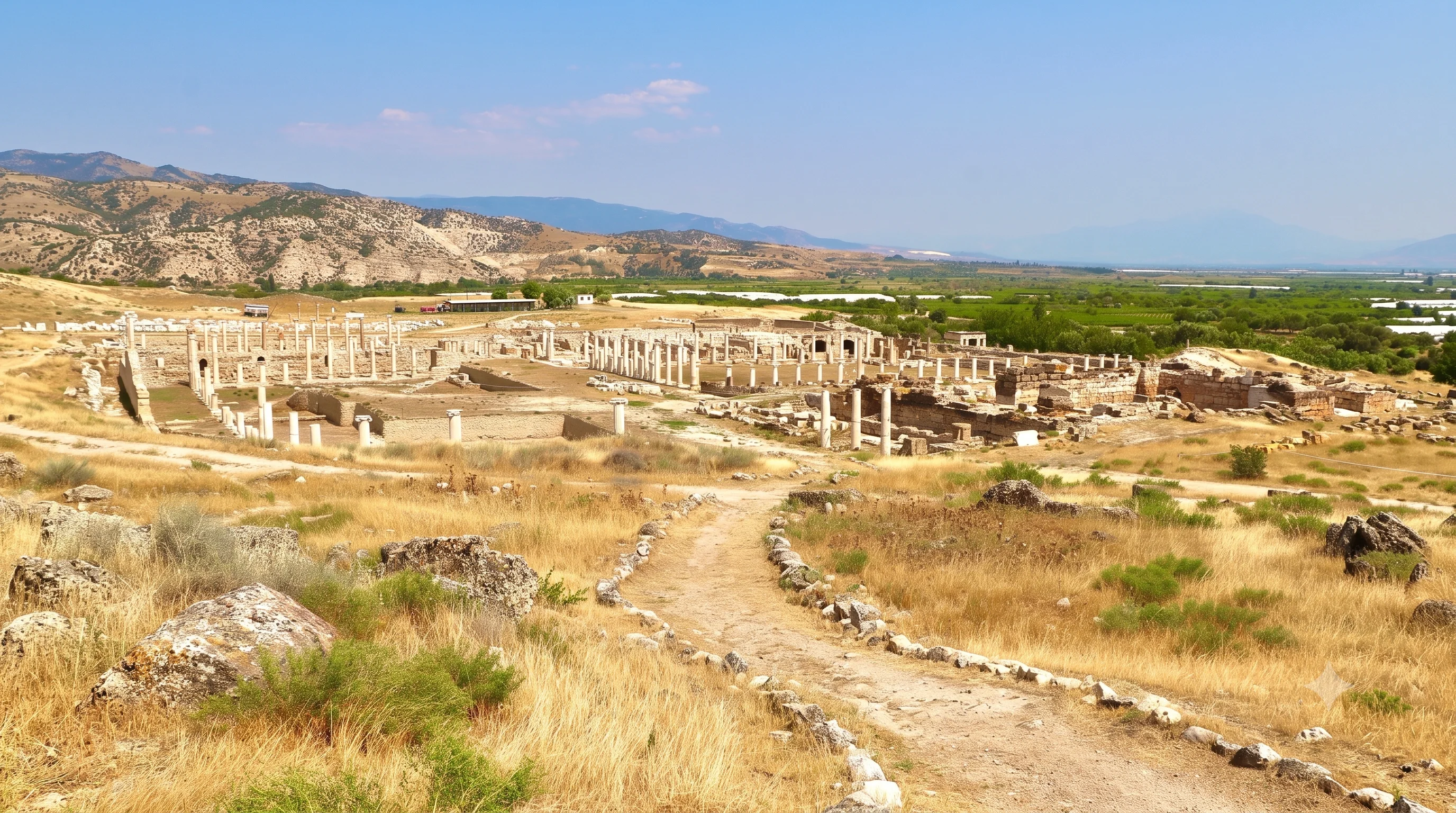
Discover Roman-period streets and monuments on a separate heritage excursion in Denizli.
Explore Tripolis
Combine archaeology, waterfalls, wetland nature and rural discoveries at your preferred pace.
Explore Regional Tours