Private Gökeyüp Pottery Village Experience
Share your dates, group size and interests. We will propose a sensible route and confirm access before booking.
Request Your Private Programme





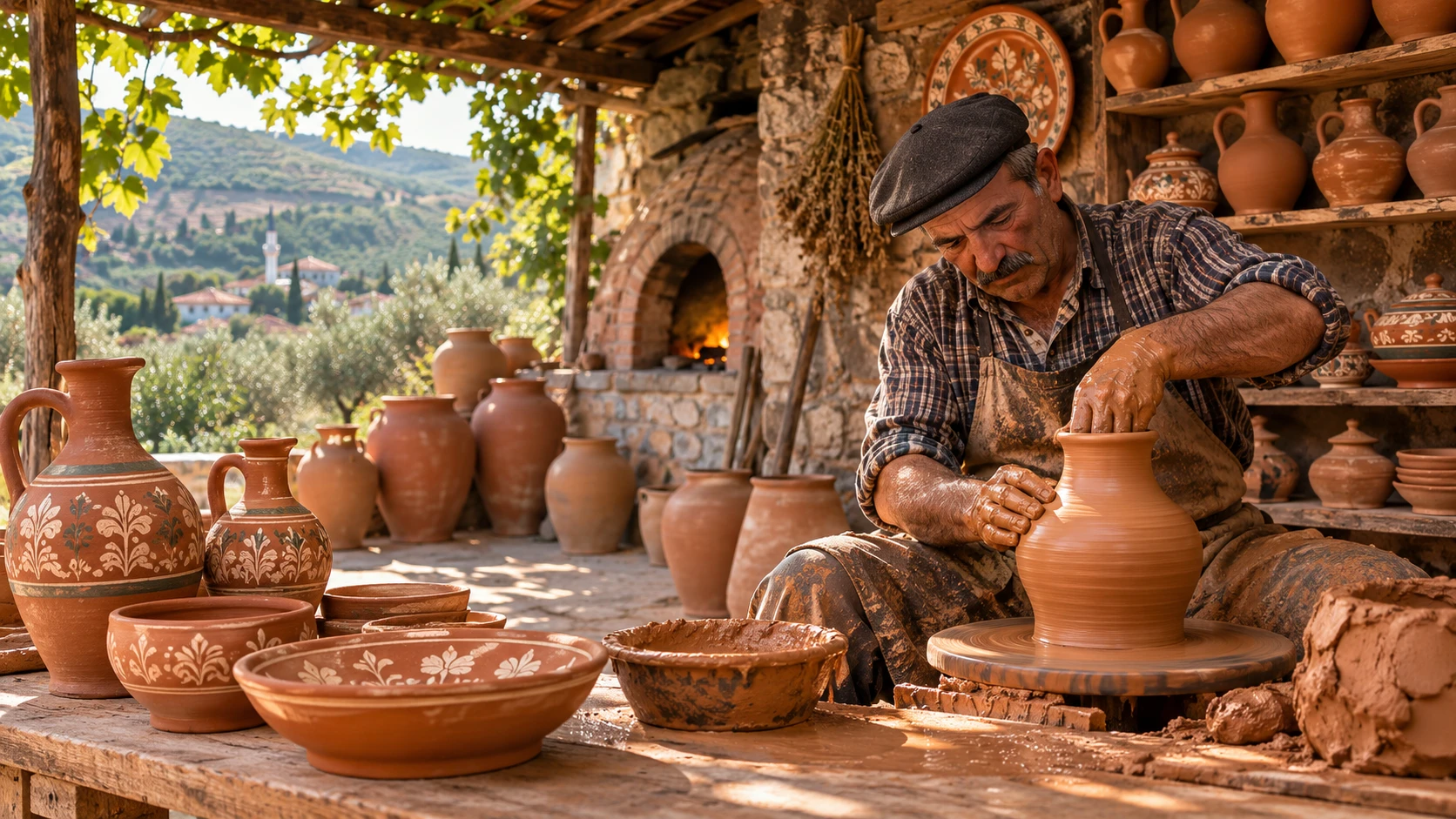
Gökeyüp is one of the most distinctive living-craft destinations in the Manisa countryside. Its pottery is shaped by hand rather than on a conventional fast potter's wheel, preserving a slow, highly skilled method of raising a vessel from clay.
Women potters traditionally form cooking and storage vessels with coils on a rotating support, then dry and fire the wares using local methods. The result is both practical and deeply connected to everyday food culture.
Gökeyüp pottery received a Turkish geographical indication registration in January 2025. That recognition concerns the craft and its place of production; it does not mean every workshop operates as a walk-in tourist attraction.
Watch how a potter adds and smooths successive coils to raise the vessel walls without relying on a modern electric wheel.
The texture of the material and added mineral ingredients influence how a vessel holds its shape and responds to firing.
Firing methods are adapted to local materials and weather. Demonstrations are not guaranteed and should only be observed with permission.
These ceramics are designed around use, from food preparation to storage, rather than purely decorative display.
Useful orientation before planning a visit.
Gökeyüp, Salihli district
Traditional craft community
Long-established pottery tradition; current practice
Village workshops and local clay landscape
1–2 hours if a workshop visit is arranged
Confirm current entry and route conditions before travel
Gökeyüp connects visitors to skilled makers and the relationship between geology, food and domestic life.
A short, prearranged visit can provide a meaningful human contrast to the nearby volcanic landscape.
Pottery has long served Anatolian households, and Gökeyüp's method is often discussed as a rare continuation of older hand-building traditions. Specific claims of an unbroken prehistoric lineage should be treated cautiously without archaeological proof.
The craft is transmitted through observation, repetition and knowledge of local materials. Preparing the clay, controlling moisture and deciding when a pot is ready to fire are as important as shaping it.
Geographical indication registration has brought formal recognition to the local technique. It also underlines the importance of naming makers and supporting authentic work rather than treating the village as a staged demonstration.
The village belongs to the wider Salihli countryside, where local earth materials underpin craft as well as agriculture.
Workshops may be part of private homes or working spaces. Treat the village as a community, not an open-air museum with unlimited access.
Watch how a potter adds and smooths successive coils to raise the vessel walls without relying on a modern electric wheel.
Look at this feature in relation to the broader setting rather than as an isolated photo opportunity.
The texture of the material and added mineral ingredients influence how a vessel holds its shape and responds to firing.
Small construction or geological details can tell a different story from the broad panorama.
Firing methods are adapted to local materials and weather. Demonstrations are not guaranteed and should only be observed with permission.
What is visible today may reflect more than one historical period or natural process.
These ceramics are designed around use, from food preparation to storage, rather than purely decorative display.
Interpret this feature alongside the other highlights, while respecting current access limits.
Manisa brings together Lydian history, the Seven Churches of Revelation, Ottoman architecture, craft villages and volcanic geology. Gökeyüp Pottery Village offers a particular window into that varied region.
For a coherent itinerary, choose neighbouring sites by theme and geography rather than trying to cover the whole province in a single day.
Ask about clay preparation, hand-building and the firing sequence, rather than expecting a rapid souvenir-making show.
The maker’s skill lies in consistency, judgment and the transmission of knowledge. A pot’s slight variation can be evidence of hand production, not a defect.
Watch how a potter adds and smooths successive coils to raise the vessel walls without relying on a modern electric wheel.
The texture of the material and added mineral ingredients influence how a vessel holds its shape and responds to firing.
Firing methods are adapted to local materials and weather. Demonstrations are not guaranteed and should only be observed with permission.
These ceramics are designed around use, from food preparation to storage, rather than purely decorative display.
Arrange a workshop or maker visit in advance through a local contact. Never assume photographs, filming or hands-on participation are permitted.
If purchasing a pot, ask whether it is intended for cooking or decoration and follow the maker’s care instructions.
Combine a prearranged pottery visit with a Salihli or geopark itinerary, leaving time for conversation and a fair purchase if you wish.
Do not schedule a craft stop as a compulsory shopping visit; makers’ availability and consent should guide the plan.
Workshop schedules depend on makers and weather, especially for outdoor drying or firing. Confirm a suitable day before setting out.
Ask permission before photographing people, hands, private workshops or unfinished wares. A process sequence can tell a stronger story than a product-only image.
Village lanes and working areas may be uneven. Ask the host about seating, steps and safe viewing positions in advance.
Gökeyüp is in the Salihli district of Manisa. A confirmed workshop address is more useful than a village-centre map pin.
Explore Kula–Salihli UNESCO Global Geopark as a complementary stop. Check travel time and access before combining sites.
Explore Sardis Ancient City as a complementary stop. Check travel time and access before combining sites.
Explore Adala Canyon as a complementary stop. Check travel time and access before combining sites.
It is a traditional hand-built pottery craft using coil-building techniques rather than a conventional fast potter’s wheel.
Gökeyüp is in the Salihli district of Manisa Province.
Yes. Gökeyüp Çömleği received a Turkish geographical indication registration in January 2025.
Possibly, but a visit should be arranged with a willing maker; demonstrations are not guaranteed.
Some traditional vessels are made for practical use. Ask the maker about the specific pot and its care requirements.
Yes. UNESCO’s Kula–Salihli geopark description highlights the village’s pottery tradition as part of its cultural landscape.
Respect signs, barriers and any directions from site staff.
Support craftspeople fairly, respect private workspaces and do not touch unfinished clay or firing equipment without invitation.
Keep entrances clear and ask before photographing residents or worshippers.
Carry away rubbish and avoid disturbing vegetation, rocks or historic material.
Wow Cappadocia / Venere Travel can plan a private, tailor-made route with a licensed guide and suitable vehicle, subject to confirmed access and without compulsory shopping stops.
Combine archaeology, living culture and natural landscapes at your preferred pace.
Share your dates, group size and interests. We will propose a sensible route and confirm access before booking.
Request Your Private Programme
Discover a related destination and plan a route with realistic travel times.
Read the Nearby Guide