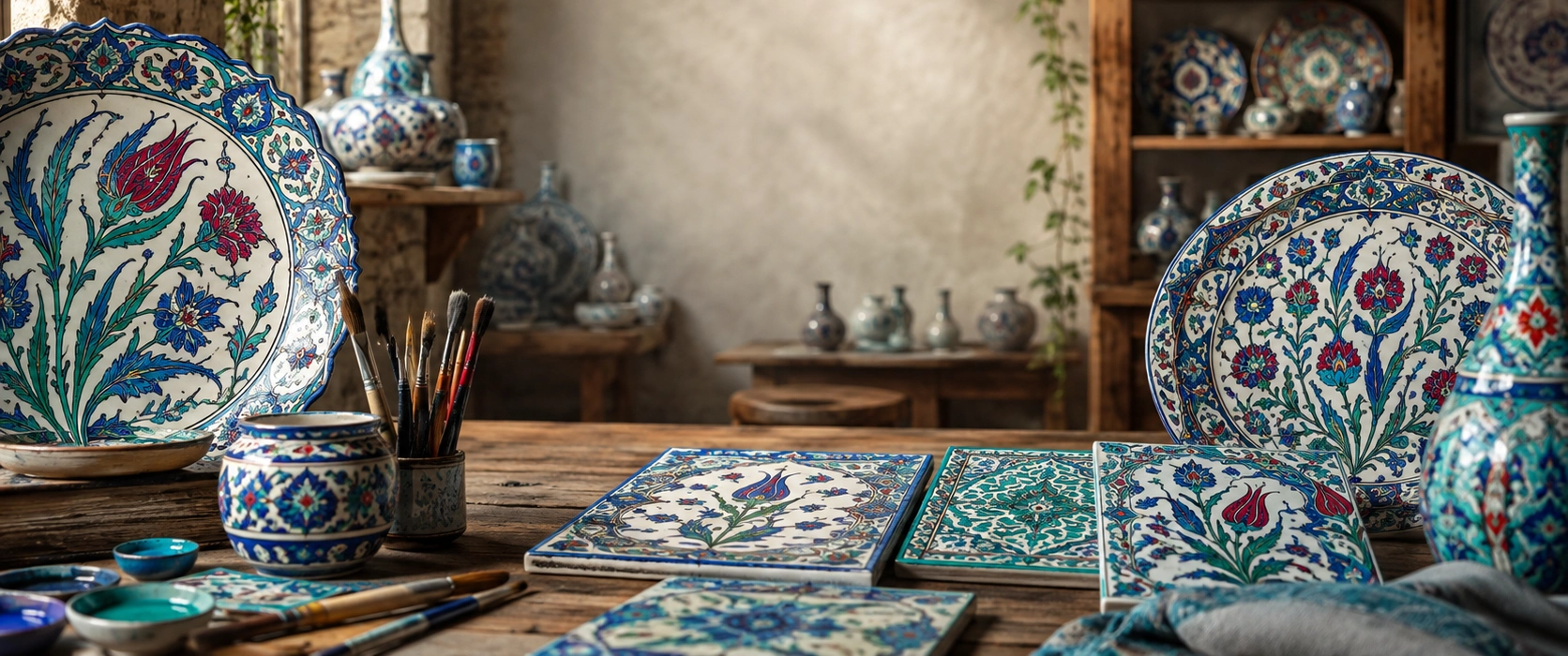
Private İznik Ceramic Heritage Tour
Ask us about a tailor-made route combining İznik Museum, ceramic workshops, historic kiln archaeology and the city's remarkable Ottoman and Byzantine heritage.
Request a Custom Tour





The small lakeside town of İznik became one of the most celebrated ceramic-production centers of the Ottoman world. From workshops and kilns in this historic city came brilliant tiles and vessels whose white surfaces, rich cobalt blues, turquoise, green and unmistakable red transformed Ottoman decorative art.
During the 15th and especially the 16th centuries, İznik potters developed a sophisticated tradition of glazed ceramics combining technical skill with designs influenced by Ottoman court art, earlier Islamic traditions and imported Chinese porcelain.
Tulips, carnations, roses, hyacinths, saz leaves, lotus blossoms, cloud bands, cypress trees and rhythmic arabesques appeared across tiles, plates, bowls, jugs and other objects. Many of the greatest Ottoman monuments were enriched with tiles associated with the workshops of İznik.
Today the tradition is not confined to museums. Archaeological investigations continue to reveal the remains of historic kilns, while contemporary artisans in İznik still paint, glaze and fire ceramics inspired by centuries-old designs.
Discover one of the most internationally recognized artistic traditions of the Ottoman Empire.
Learn what archaeological excavations reveal about İznik's famous ceramic workshops.
Meet a tradition that continues in contemporary studios and artisan workshops across İznik.
Understand the wider Turkish çini-making tradition recognized by UNESCO as intangible cultural heritage.
Essential information about one of Türkiye's most famous ceramic traditions.
İznik, Bursa Province, on the eastern shore of Lake İznik in northwestern Türkiye.
Open on Google MapsEspecially the 16th century, when İznik ceramics reached extraordinary technical and artistic refinement.
Cobalt blue, turquoise, green, black outlining and the celebrated raised İznik or bole red.
Tulips, carnations, roses, hyacinths, saz leaves, lotus forms, cloud bands and arabesques.
Excavations have uncovered kilns, firing materials, workshop remains and large quantities of ceramic fragments.
Contemporary İznik artists continue producing hand-painted tiles, panels, plates and decorative ceramics.
İznik ceramics became one of the defining visual expressions of classical Ottoman art.
İznik's importance lies in the extraordinary relationship between craftsmanship, technology, court design and monumental architecture. The town's potters did not simply manufacture decorative objects. They participated in a much larger artistic world connected with imperial architects, painters, designers and patrons.
At their finest, İznik ceramics achieved remarkably bright colors against a clean white ground beneath a transparent glaze. Their surfaces allowed complex floral compositions to remain clear and luminous, whether viewed on a small dish or across an entire wall of architectural tiles.
The tiles helped define the interiors of major Ottoman buildings. Vast floral panels created permanent gardens of tulips, carnations and scrolling leaves on the walls of mosques, tombs, palaces and pavilions.
İznik ware also became internationally admired. Historic pieces are today preserved in major museum collections across Türkiye, Europe, North America and elsewhere, while the visual language created by İznik's craftsmen continues to influence ceramic artists and designers.
The wider traditional craftsmanship of çini-making in Türkiye was inscribed on UNESCO's Representative List of the Intangible Cultural Heritage of Humanity in 2016, recognizing the importance of preserving the knowledge, skills and cultural transmission behind this art.
Ceramic production in Anatolia has a history extending far beyond the Ottoman period, and İznik itself occupied an important position through Roman, Byzantine and early Turkish history. The distinctive ceramic tradition now internationally identified with the name İznik ware, however, developed principally under Ottoman patronage.
By the late 15th and early 16th centuries, İznik workshops were producing sophisticated white-bodied ceramics decorated predominantly in cobalt blue. Imported Chinese blue-and-white porcelain, especially pieces appreciated at the Ottoman court, provided an important source of inspiration.
İznik artists did not simply imitate Chinese designs. They gradually transformed lotus blossoms, cloud bands and other imported motifs while combining them with arabesques, geometric ornament and the increasingly naturalistic floral vocabulary developed by Ottoman court artists.
During the 16th century the palette expanded. Turquoise appeared beside cobalt blue, followed by additional tones of green and purple. By the middle decades of the century, potters mastered the brilliant raised iron-rich red that became one of the most recognizable characteristics of mature İznik ceramics.
The second half of the 16th century represents the artistic high point of the tradition. Architectural tile commissions became increasingly important, filling Ottoman religious and imperial buildings with floral panels of exceptional scale and complexity.
Production continued into the 17th century, although designs, glazing and production quality varied over time. The decline of İznik's classical ceramic industry was gradual rather than the result of one single event. Changing patronage, economic conditions, workshop organization and competition from other production centers all played a role.
Interest in the tradition revived centuries later. Archaeological research, museum scholarship and experimental ceramic production have helped reconstruct techniques that had largely disappeared, while modern workshops have once again made İznik a center for traditional çini production.
High-quality white-bodied Ottoman ceramics begin developing into the tradition now associated with İznik.
Blue-and-white ceramics flourish, combining Chinese inspiration with Ottoman and Islamic designs.
The palette grows richer as turquoise, greens, outlines and new decorative styles appear.
The celebrated thick red pigment becomes a defining feature of mature İznik production.
Large architectural tile commissions represent one of the greatest achievements of Ottoman decorative art.
Production continues while style, technical quality and workshop conditions gradually change.
Creating an İznik ceramic was a multi-stage process requiring specialists to understand the behavior of ceramic bodies, pigments, glazes and kiln temperatures. A mistake at almost any stage could ruin days or weeks of work.
Classical İznik ware is especially associated with a quartz-rich fritware or stonepaste body rather than ordinary earthenware alone. This helped create the pale surface on which the painted decoration could appear exceptionally bright.
A quartz-rich ceramic mixture was prepared and carefully worked into a suitable material for forming.
Tiles were formed to regular dimensions while vessels were shaped into dishes, bowls, bottles, jugs and other forms.
The shaped body had to dry carefully before firing to reduce cracking and deformation.
The ceramic body was fired before its painted decoration and final glaze were completed.
Artists transferred or drew compositions of flowers, leaves, arabesques, geometric forms and other motifs.
Mineral-based pigments were applied beneath the glaze, with outlines controlling the complex compositions.
A transparent glaze covered the painted decoration and produced the characteristic luminous surface after firing.
Careful temperature control transformed the pigments and glaze into the brilliant finished ceramic surface.
The history of İznik pottery can almost be followed through its changing palette. Different colors appeared, disappeared or changed character as craftsmen experimented with pigments, glazes and firing techniques.
Dominant in many early pieces and strongly associated with the influence of Chinese blue-and-white porcelain.
Introduced beside cobalt to create greater depth and contrast in floral and geometric compositions.
Appears in transitional groups of 16th-century ceramics alongside blue, turquoise and green tones.
Different green tones eventually became a fundamental part of mature Ottoman floral decoration.
Dark outlines gave flowers and leaves clarity and helped separate colors beneath the transparent glaze.
The famous thick iron-rich red of mature İznik ware often stands slightly raised above the surrounding surface.
One of the great achievements of İznik design was its ability to turn architectural surfaces into stylized gardens. Flowers bend across white backgrounds, serrated leaves sweep through compositions and repeating patterns connect individual tiles into much larger decorative schemes.
Elegant pointed tulips became among the most recognizable flowers of classical Ottoman decorative art.
Layered carnation blossoms provide rhythm and volume in many mature floral compositions.
Stylized roses appear among flowering stems and garden-like compositions.
Long flowering stems add vertical movement and fine detail to panels and vessels.
Long serrated leaves create dramatic curves and energetic movement across ceramic surfaces.
Older Islamic and East Asian-inspired forms were transformed within the Ottoman decorative vocabulary.
Chinese-inspired cloud forms were adapted into highly stylized Ottoman compositions.
The tall, slender cypress became an important element of Ottoman garden imagery and decorative art.
Fruit and flowering branches sometimes appear alongside more familiar floral ornament.
Some vessels feature birds, animals, fish and imaginative creatures beyond the classic floral repertoire.
Vessels with sailing ships and maritime scenes reveal another playful side of İznik ceramic decoration.
Scrolling stems, split leaves and repeating geometry connect İznik art to broader Islamic decorative traditions.
The term İznik tiles is often used broadly by travelers, but historic workshops produced far more than square architectural tiles. Some of the most admired surviving İznik objects are dishes, bowls, bottles, tankards, jugs and other ceramic vessels.
Designed individually or as repeating panels for the walls of mosques, palaces, tombs and other prestigious buildings.
Large dishes gave painters circular surfaces on which to create complex floral and geometric compositions.
Decorated bowls demonstrate how İznik designs were adapted to both interior and exterior curved surfaces.
Functional shapes were transformed into prestigious decorative objects through elaborate underglaze painting.
Long-necked and globular vessels offered different proportions for vertical floral arrangements.
Historic workshops experimented with a wide range of shapes for courtly, religious and domestic use.
The reputation of İznik ceramics is inseparable from Ottoman architecture. During the 16th century, imperial building programs created enormous demand for high-quality decorative tiles.
Tiles were arranged as borders, repeating fields, inscription panels and large naturalistic floral compositions. Because the glaze protected their pigments, the colors could retain an extraordinary visual intensity across centuries.
Successive Ottoman additions preserve outstanding tile panels representing different phases of İznik production.
One of Istanbul's most celebrated ensembles of 16th-century İznik tile decoration.
Fine tilework contributes to the richly integrated decorative program of this Sinan-designed monument.
Imperial mausoleums frequently used tiled walls to create richly colored ceremonial interiors.
Tiles brought permanent floral imagery into private and ceremonial spaces of the Ottoman court.
Ottoman architectural tilework carried the artistic language associated with İznik far beyond the production town.
For centuries, scholars knew İznik ceramics mainly through surviving objects and architectural decoration. Archaeological excavations inside the modern town have provided direct physical evidence for where and how these ceramics were produced.
Early archaeological investigations of ceramic-production areas were carried out during the 1960s. Research resumed in 1981, and systematic excavation of the principal area has continued for decades.
Recent archaeological publications report that eleven kiln structures have so far been identified within the excavated workshop zone. Researchers have also uncovered ceramic dumps, firing equipment, water systems, glaze-related material and large quantities of successful and defective ceramic fragments.
Surviving kiln foundations help researchers understand the firing technology used by İznik workshops.
Broken, warped or misfired ceramics reveal what went wrong during production and how craftsmen experimented.
Terracotta supports and other kiln materials show how multiple ceramics were arranged safely during firing.
Scientific analysis contributes to reconstructing the materials responsible for İznik's characteristic surfaces.
Archaeology reveals that ceramic production required much more infrastructure than simply a potter's wheel and kiln.
New excavation seasons and laboratory studies continue refining our understanding of İznik production.
UNESCO recognition connected with İznik and Turkish ceramics is sometimes described inaccurately, so it is useful to distinguish between two different designations.
Historic İznik was submitted to Türkiye's UNESCO World Heritage Tentative List in 2014.
Traditional craftsmanship of çini-making in Türkiye was inscribed on UNESCO's Representative List of the Intangible Cultural Heritage of Humanity in 2016.
UNESCO emphasizes skills passed through craftspeople, trainers, families, apprenticeships and educational institutions.
The heritage includes knowledge of preparation, drawing, painting, glazing, firing and traditional artistic vocabulary.
The best way to understand İznik ceramics is to combine archaeology, museum collections and contemporary craftsmanship. The main ceramic-related sights are close to the historic center and can easily be combined with İznik's Byzantine and Ottoman monuments.
See archaeological material from İznik and important finds recovered during the İznik Tile Kilns excavations.
Observe the archaeological zone connected with the historic workshops that made İznik famous.
Visit the historic madrasa now known for workshops where artisans produce and sell traditional ceramic work.
Browse independent ateliers where painters reinterpret tulips, carnations, saz leaves and classical Ottoman designs.
Learn about modern research and production connected with recreating the technical qualities of historic İznik ceramics.
See the colorful tile decoration of an important early Ottoman monument and place İznik's later ceramic achievements in context.
One of the most enjoyable places to encounter living ceramic culture is the historic Süleyman Paşa Medresesi. Built during the early Ottoman period, the restored madrasa has been adapted as a center for traditional crafts.
Today it is commonly known as the Çiniciler Çarşısı, or Tile Makers' Market. Bursa's official tourism portal currently describes nine ceramic workshops operating inside the complex.
Visitors can see contemporary interpretations of historic designs, speak with craftspeople and compare different painting styles. Some workshops also offer instruction or demonstrations depending on the artisan and current program.
The İznik Museum, housed in the historic Nilüfer Hatun İmareti, is one of the best places to connect the finished masterpieces seen in world museums with the archaeological evidence discovered inside İznik itself.
Its collections include archaeological material ranging from prehistoric periods through the Ottoman era. Of particular importance for this page are finds excavated from the İznik Tile Kilns, which document historic ceramic production.
Fragments, firing-related material and other archaeological evidence allow visitors to see ceramics not only as works of art but as the products of skilled urban workshops involving raw materials, tools, kilns, experimentation and trade.
İznik offers everything from inexpensive decorative souvenirs to individually painted studio pieces requiring many hours of skilled work. These should not be expected to have the same price.
The term “İznik style” can also describe a design tradition rather than automatically proving that an object was handmade in İznik. If origin, technique and craftsmanship matter to you, ask the artist or seller directly.
Independent artists and workshops should normally be able to explain where and how a piece was produced.
Ask whether the design was individually painted, transferred, printed or produced through another method.
Hand-painted pieces often contain tiny natural variations rather than perfectly identical repeated lines.
Look at the glaze, outlines, color density, edges and reverse rather than judging only the front design.
A serious workshop should be comfortable discussing materials, glazing and firing in understandable terms.
For larger panels or fragile pieces, ask about protective packing and international shipping before purchasing.
Archaeological finds provide valuable context before you begin exploring modern workshops.
Different artists specialize in different motifs, techniques, colors and forms.
Some craftspeople welcome photography while others prefer that original designs or workspaces are not photographed.
If demonstrations are available, notice the drawing, outlining and painting rather than seeing only the finished object.
Carry ceramics in padded packaging and place them in hand luggage when practical.
Respect barriers around archaeological kiln areas and observe only from permitted locations.
Add the museum, early Ottoman monuments, Hagia Sophia and city walls for a fuller understanding of İznik.
A discussion with an artisan can reveal far more about the craft than a quick shopping stop.
Begin at İznik Museum, where archaeological finds establish the historical background of ceramic production. Pay particular attention to objects recovered from the Tile Kilns excavations.
Continue toward the İznik Tile Kilns archaeological area. Because this remains a research site rather than a conventional visitor attraction, view the excavation only from currently permitted areas.
Next walk to Süleyman Paşa Medresesi. Its historic courtyard now brings together working ceramic studios and provides the easiest opportunity to compare contemporary interpretations of classical İznik designs.
After visiting the workshops, continue through the historic center toward Yeşil Mosque. Its early Ottoman decoration helps place İznik's later ceramic golden age within the longer artistic history of the city.
Finish with Hagia Sophia–Orhan Mosque and a walk through central İznik, or continue to the city walls and Lake İznik if you have more time.
There is no single entrance ticket or opening schedule for İznik's ceramic heritage. The museum, archaeological research areas, private studios and artisan market operate independently.
The İznik Museum currently provides the most straightforward formal museum experience, while Süleyman Paşa Medresesi offers direct contact with contemporary ceramic production. Private workshop opening times may vary according to the artisan, season, production schedule and holidays.
Ceramic workshops can be enjoyed throughout the year, making this one of İznik's best activities during both good and poor weather. Seasonal conditions become more important when combining the workshops with the city walls, archaeological sites and lakeside.
Excellent weather for combining workshops with long walks through İznik's historic center.
Visit indoor museums and ateliers during the hottest part of the day and explore outdoors morning or evening.
Comfortable temperatures and softer light make this another excellent season for a full İznik itinerary.
Workshops provide an excellent indoor cultural experience when cold or rain limits outdoor sightseeing.
Often better for speaking with working artisans, though remember that İznik Museum is currently closed Monday.
A practical time to visit several studios after businesses have opened and before the afternoon becomes busy.
Browse the ceramic studios inside Süleyman Paşa Medresesi.
Visit several workshops and compare traditional motifs and techniques.
Combine artisan workshops with the ceramic and archaeological collections of İznik Museum.
Add the kiln excavation area, Yeşil Mosque and a longer exploration of central İznik.
An excellent ceramic-focused visit with museum, archaeology, workshops and major historic monuments.
Combine ceramic heritage with Hagia Sophia, the city walls, archaeological sites and Lake İznik.
İznik ceramics are exceptionally photogenic because their strong outlines, white backgrounds and saturated colors remain visually clear even in close-up photographs.
Photograph individual brushstrokes, outlines and small variations in hand-painted decoration.
Frame cobalt, turquoise, green and red together to emphasize the classic İznik palette.
With permission, photograph hands drawing or painting to show the human skill behind the finished ceramic.
Use the historic architecture of Süleyman Paşa Medresesi to give contemporary craft a sense of place.
Photograph groups of plates or tiles to show how motifs and color palettes vary between artists.
Glazed surfaces reflect strong light, so change your angle rather than relying directly on flash.
Accessibility differs between the modern streets, historic buildings and archaeological areas included in a ceramic-focused visit.
Most ceramic-related sights are located within or close to İznik's compact historic center.
Old thresholds, stone surfaces and changes in level may create barriers in restored Ottoman structures.
Contact İznik Museum directly if you require detailed information about current wheelchair access.
Individual studios vary in entrance width, thresholds, interior space and seating.
The archaeological area should not be treated as a conventional accessible visitor attraction.
A vehicle can reduce walking between ceramic sites and other monuments for visitors with limited mobility.
The principal ceramic workshops, museum and archaeological kiln area are located around central İznik. Once inside the historic town, many highlights can be reached on foot.
Süleyman Paşa Medresesi, İznik Museum and the kiln area can be combined as part of a walking route.
İznik can be reached by road from Bursa using regional buses, private vehicles or organized tours.
İznik is possible as a full-day excursion, particularly with private transportation or a carefully planned road-and-ferry route.
The easiest option for combining İznik with other destinations around Bursa and the Marmara region.
The historic center is compact, although summer heat and uneven historic surfaces should be considered.
A guide can connect ceramic techniques with İznik's Ottoman, Byzantine and archaeological history.
Ceramics are only one layer of İznik's extraordinary history. Use our complete İznik visitor guide to combine Ottoman craftsmanship with Roman, Byzantine, Christian and lakeside heritage.
Visit the monument associated with the Seventh Ecumenical Council and centuries of Byzantine and Ottoman history.
Explore the massive Roman and Byzantine fortifications surrounding the historic city.
Discover the extraordinary submerged Early Christian basilica beside the shore of Lake İznik.
Admire one of the finest early Ottoman monuments in İznik and its distinctive decorated minaret.
Explore archaeological discoveries from the city and finds connected with the historic ceramic kilns.
Combine early Ottoman architecture with the contemporary workshops of İznik's tile makers.
See one of the most important surviving monuments from ancient Nicaea's Roman period.
Finish your cultural route with a walk along the lakefront and sunset views across the water.
İznik tiles are glazed ceramics associated especially with the Ottoman workshops of İznik. They became famous for brilliant underglaze-painted floral and geometric decoration used on architectural tiles and ceramic vessels.
İznik is a historic town in Bursa Province in northwestern Türkiye, located on the eastern shore of Lake İznik. The ancient city was known as Nicaea.
The celebrated Ottoman İznik ceramic tradition developed from the late 15th century and flourished particularly during the 16th century, with production continuing into the 17th century and beyond.
The 16th century is generally regarded as the great age of İznik ceramics, especially its middle and later decades.
They combine refined ceramic technology with brilliant colors, elegant drawing and some of the most recognizable floral designs in Ottoman art.
Cobalt blue, turquoise, green and black outlining are common, while mature 16th-century pieces are especially famous for their vivid iron-rich red.
It is the famous thick red pigment associated with mature İznik ceramics. On fine examples the red often appears slightly raised from the surrounding surface.
Ottoman artists greatly admired imported Chinese blue-and-white porcelain. Early İznik potters drew inspiration from this tradition while gradually developing their own distinctly Ottoman vocabulary.
Tulips, carnations, roses and hyacinths are among the most famous flowers, often combined with saz leaves, lotus forms and scrolling stems.
No. Floral decoration is famous, but historic ceramics can also include geometric ornament, cloud bands, arabesques, cypress trees, animals, birds, ships and other designs.
Classical İznik ware is particularly associated with a quartz-rich fritware or stonepaste ceramic body that helped create a pale surface suitable for brilliant underglaze decoration.
Designs were painted with mineral-based pigments beneath a transparent glaze before the final firing. The exact processes varied across different periods of production.
They were used extensively in prestigious Ottoman architecture, including mosques, tombs, palaces and pavilions. Historic İznik vessels were also made for domestic and courtly use.
Outstanding examples can be seen in monuments including Topkapı Palace and the Rüstem Pasha Mosque, together with numerous other Ottoman mosques, tombs and museum collections.
Yes. Archaeological excavations in İznik have uncovered kilns, workshop remains, firing equipment and large quantities of ceramic production waste that provide direct evidence for manufacturing in the town.
The kiln excavation zone is an active archaeological area rather than a conventional open-air museum. Visitors should observe it only from currently permitted locations and follow all barriers and instructions.
Good starting points include İznik Museum, Süleyman Paşa Medresesi Çiniciler Çarşısı, the historic kiln area and independent ceramic studios around the town center.
Some workshops provide demonstrations or allow visitors to observe parts of the painting process. Availability varies, so contact a specific workshop in advance if this is important to your visit.
Yes, contemporary artisans in İznik produce hand-painted ceramics. Ask the workshop about the artist, materials, painting method and firing process if handmade production is important to you.
Not necessarily. “İznik style” can refer to a decorative vocabulary inspired by historic İznik ceramics, even when the modern object was produced elsewhere.
Traditional craftsmanship of çini-making in Türkiye was inscribed on UNESCO's Representative List of the Intangible Cultural Heritage of Humanity in 2016. İznik itself is separately included on Türkiye's UNESCO World Heritage Tentative List.
İznik is currently on Türkiye's UNESCO World Heritage Tentative List. Tentative List status is different from inscription on the World Heritage List.
İznik Museum is an excellent starting point because its collections include finds recovered from the archaeological excavations of the historic tile kilns.
As checked in September 2026, the official museum website lists opening hours of 08:00–17:00, with the ticket office closing at 16:30 and Monday as the weekly closing day. Always verify before visiting.
Allow around two hours for the museum and several workshops, or three to four hours for a deeper route including the archaeological kiln area and nearby Ottoman monuments.
Yes. Hagia Sophia–Orhan Mosque, İznik's city walls, Yeşil Mosque, İznik Museum and Lake İznik are all natural additions to a ceramic-focused itinerary.
Absolutely. Their combination of color, technical sophistication, Ottoman design and living craftsmanship makes ceramic heritage one of the most distinctive cultural experiences in İznik.
When buying ceramics, consider purchasing directly from artists and independent workshops.
Respect the intellectual and creative work represented by original designs and workshop processes.
Never cross barriers or remove ceramic fragments from archaeological areas.
Recognize that handmade ceramic production requires design skill, painting, glazing, firing and significant time.
Understanding the history behind a motif makes the finished ceramic far more meaningful than a simple souvenir.
Responsible cultural tourism helps maintain skills, workshops and knowledge for future generations.
Combine İznik's famous ceramic heritage with Byzantine Nicaea, early Ottoman monuments, city walls, archaeological discoveries and Lake İznik through a private itinerary designed around your interests and without compulsory shopping stops.
Explore workshops, archaeological evidence and historic monuments while learning how İznik became one of the great ceramic centers of the Ottoman world.
Ask us about a tailor-made route combining İznik Museum, ceramic workshops, historic kiln archaeology and the city's remarkable Ottoman and Byzantine heritage.
Request a Custom Tour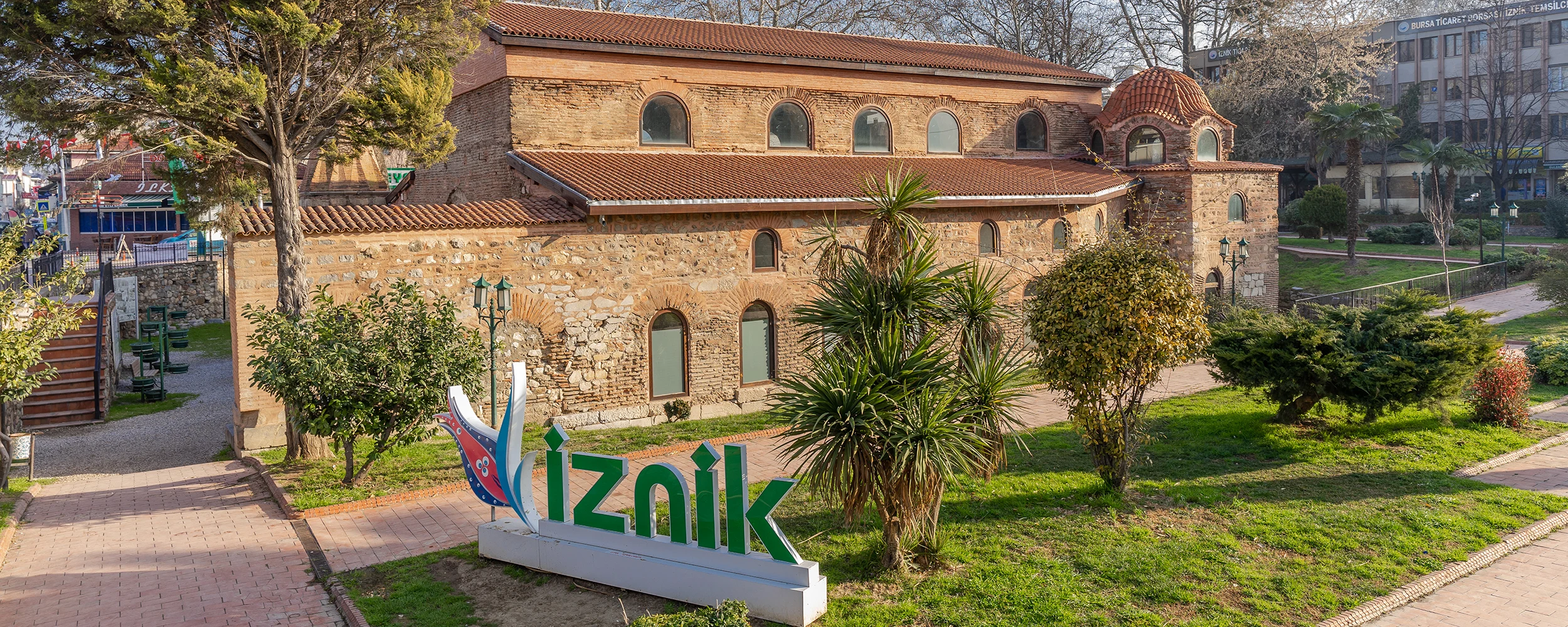
Discover ancient Nicaea, Christian councils, Roman and Byzantine walls, early Ottoman architecture, archaeological sites and the shores of Lake İznik.
View İznik GuideConnect ceramic artistry with the civilizations, architecture and landscapes that shaped the region.
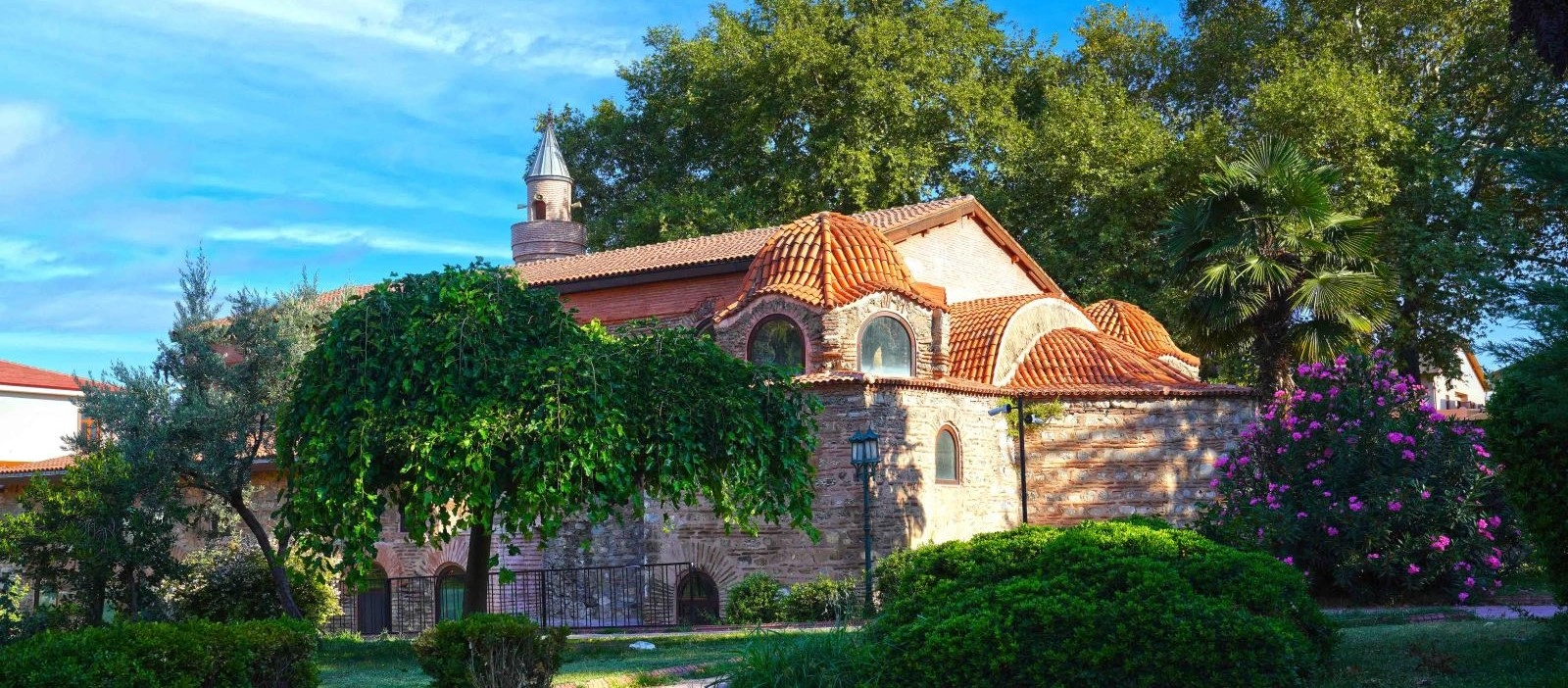
Explore one of İznik's most important monuments and a site associated with the religious history of Byzantine Nicaea.
Explore Hagia Sophia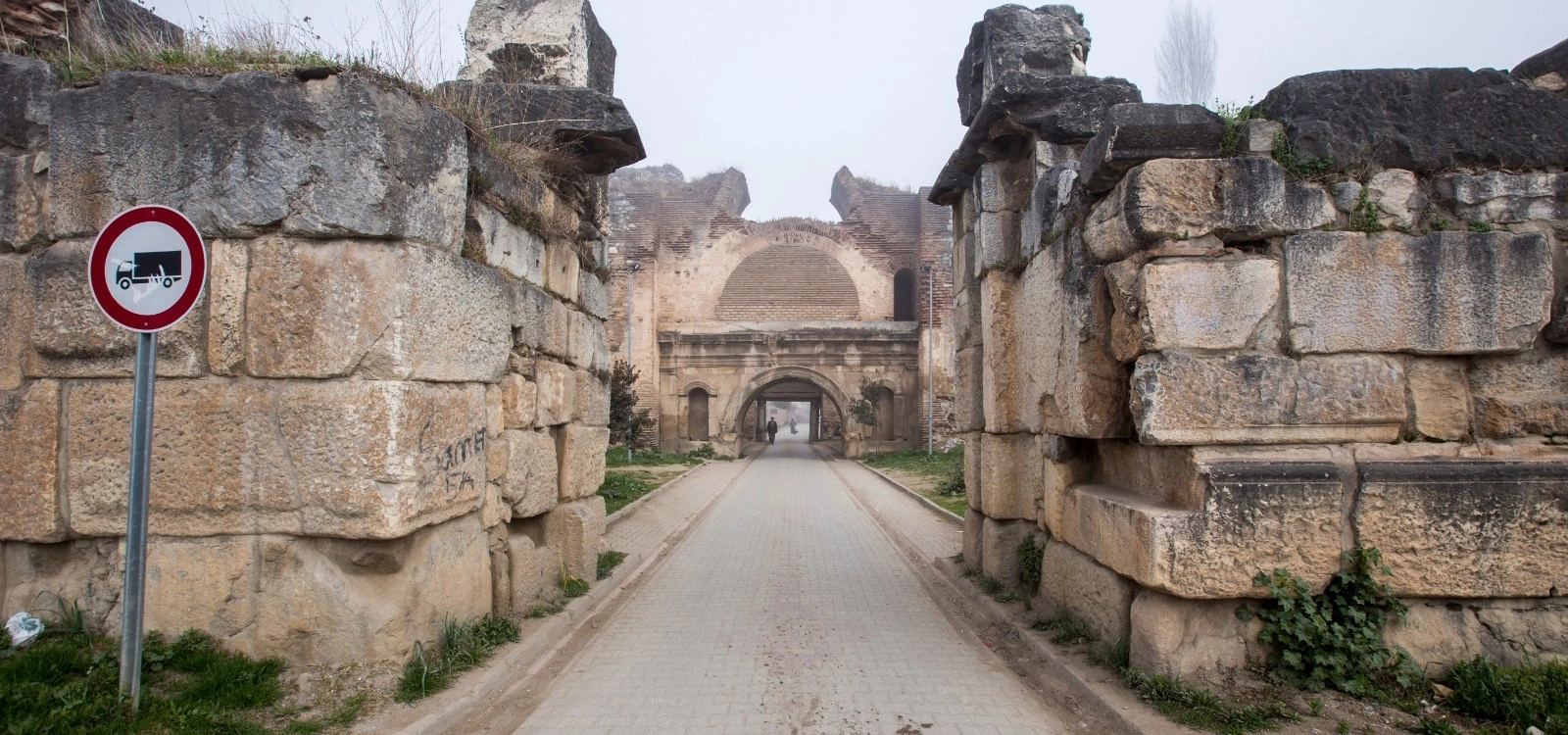
Walk beside the monumental Roman and Byzantine fortifications that still define the historic form of ancient Nicaea.
Explore İznik Walls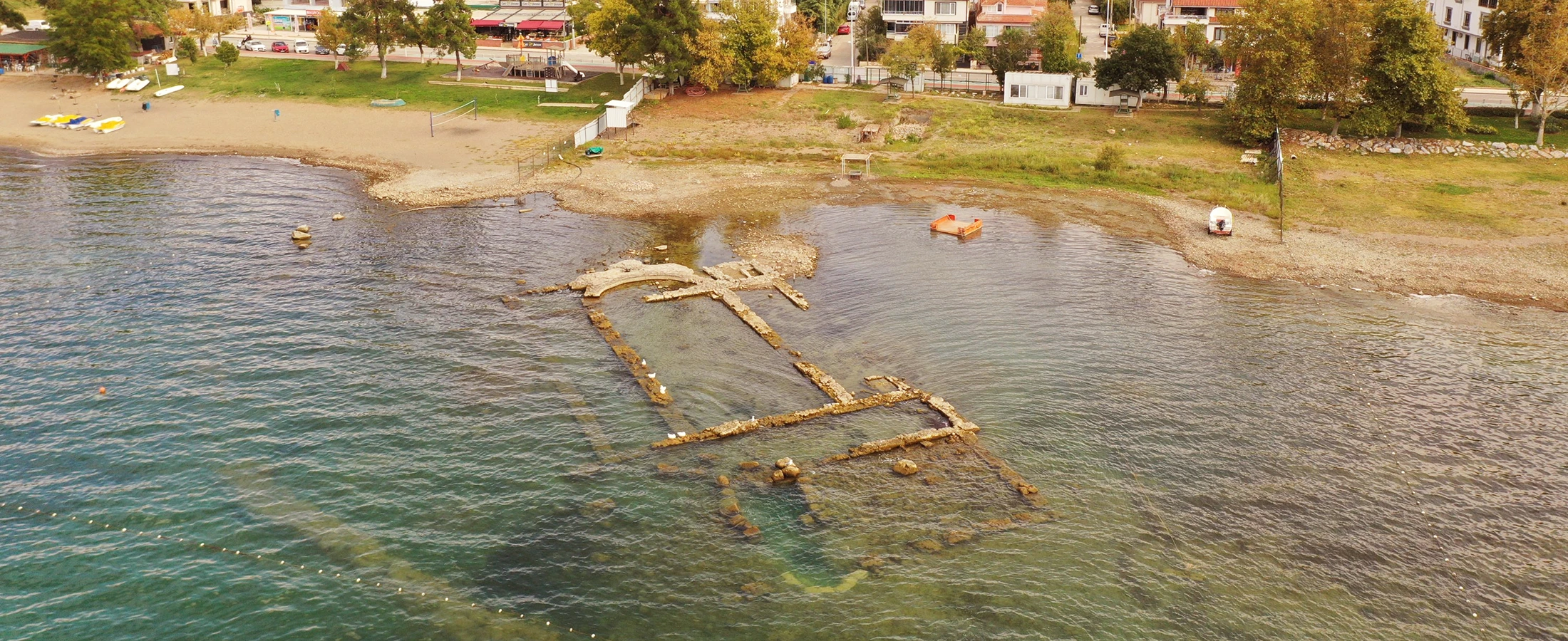
Discover the remarkable remains of an Early Christian basilica submerged just offshore beneath the waters of Lake İznik.
Explore the Lake Basilica