The entrance pediment
The central projection stands above the rounded entrance arch. A surviving inscription position is recorded to the upper right of the doorway.






A landmark of the city’s educational heritage, best appreciated from public space while respecting the school’s use.
From the Ottoman İdâdî of 1895 to the Republican High School
The entrance pediment · Boarding education
Related Places & Traditions
Merkez, Yozgat, Türkiye
Architecture & cultural heritage
From the Ottoman İdâdî of 1895 to the Republican High School
Yozgat’s historic school began in 1895 under Abdülhamid II as a five-year daytime idâdî, an institution intended to prepare pupils for higher study after the rüştiye level. The Ministry of Education notes that the original foundation inscription was erased in 1927 and the architect and patron are not securely known. The school’s surviving stone building is thus a witness to the expansion of provincial education, but its erased inscription prevents a more precise attribution.
In 1912, a small number of teachers and pupils arrived from the closed Manastır Sultanîsi. The school subsequently experienced an interruption, with students transferred to Konya, before reopening at local request in 1924. It acquired high-school status in 1933–34, with the support of the local community, parliamentarian Salih Bozok and Governor Baran Bey. Increased enrolment led to several arrangements for the middle school before it finally became independent in 1966–67.
Known locally as Taş Mektep or Sarı Mektep, the yellow dressed-stone building extends east to west under a hipped roof. Its south-facing central projection, two columns and triangular pediment give the entrance a ceremonial emphasis. The school has undergone substantial twentieth-century repair, so the present interior should not be described as entirely original.
The central projection stands above the rounded entrance arch. A surviving inscription position is recorded to the upper right of the doorway.
A boarding-house building was added in 1948. Pupils from surrounding provinces also studied here as boarders.
Major works are recorded for 1980–81, 1986–88 and 1999–2001, including replacement of deteriorated stone and windows.
A school museum was established for the Republic’s seventy-fifth anniversary in 1998–99. The Ministry also records a historical library collection; access requires the school’s permission.
This is not an invitation to enter a working school.
Observe the exterior from public space and avoid photographing pupils or restricted areas; confirm any heritage access with the institution.
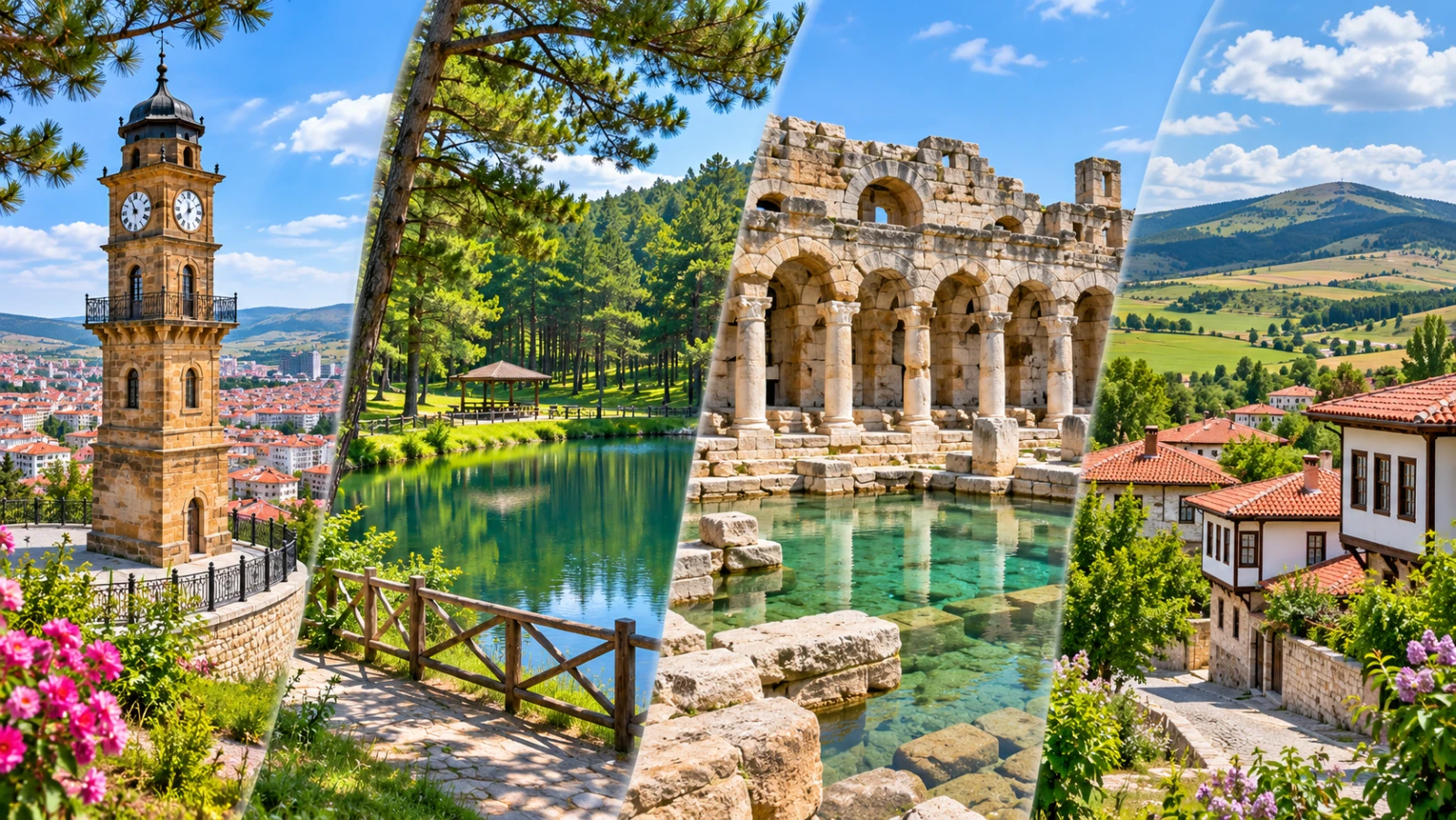
The yellow-stone tower has four clock faces; archival evidence places its construction in 1897, earlier than the frequently cited 1908 date.
A historic residence associated with Atatürk’s first visit to Yozgat and later used as a governor’s residence.
Traditional courtyard houses and surviving mansions illustrate the urban growth of the Bozok provincial centre.
Plan a personal itinerary through Central Anatolia.
Contact Wow Cappadocia