Private Historic Edirne Tour
Ask us about a tailor-made route connecting Üç Şerefeli Mosque, Eski Cami, Selimiye, traditional bazaars and other Ottoman monuments with your own private guide.
Request a Custom Tour





The Üç Şerefeli Mosque stands in the historic center of Edirne, only a short walk from Eski Cami and Selimiye Mosque. Built for Sultan Murad II in the 15th century, it occupies a crucial place in the development of Ottoman architecture.
Its name means the “Mosque with Three Balconies”, a reference to the spectacular three-şerefe minaret that once ranked among the tallest and most technically ambitious minarets in the Ottoman world. Yet the mosque is remarkable for much more than that single tower.
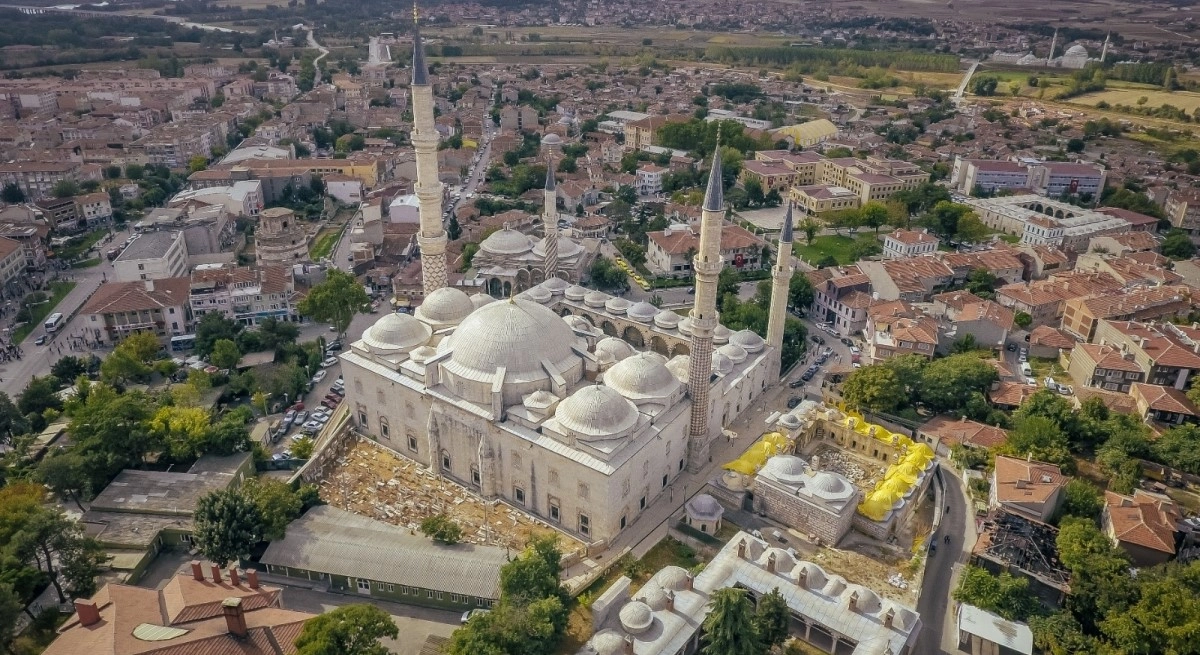
Its four minarets are deliberately different from one another. Visitors encounter zigzag stonework, diamond-patterned masonry, spiraling decoration and fluted forms, creating one of the most distinctive mosque silhouettes in Türkiye.
Inside, an enormous central dome approximately 24 meters in diameter dominates a wide transverse prayer hall. Outside, a spacious arcaded courtyard, monumental portal, stone ornament and surviving historic decoration demonstrate how Ottoman architects were moving beyond the earlier multi-domed congregational mosque.
For travelers interested in the architectural story of Edirne, Üç Şerefeli should be visited between Eski Cami and Selimiye. Together, the three monuments form one of the clearest architectural journeys anywhere in Türkiye.
Built for Sultan Murad II and completed in 1447.
See four towers with different balcony numbers, proportions and decorative patterns.
Experience one of the decisive early steps toward centralized Ottoman mosque space.
Explore a pioneering arcaded courtyard with a fountain and richly designed entrances.
Essential information for visiting one of Edirne's most important Ottoman monuments.
Historic central Edirne, between Eski Cami and the wider Selimiye district.
Open on Google MapsBuilt for Sultan Murad II in the 15th century and completed in 1447.
Transverse prayer hall dominated by a large central dome and fronted by an arcaded courtyard.
Four highly distinctive minarets with seven balconies in total.
Approximately 24 meters in diameter and carried by a six-support structural system.
Normally free because the building remains an active mosque.
Allow approximately 45–60 minutes for the mosque, courtyard, portal and minarets.
Dress respectfully, remove shoes inside and avoid sightseeing during congregational prayers.
Üç Şerefeli Mosque represents one of the decisive architectural experiments that prepared the way for the great centralized mosques of the classical Ottoman period.
Before Üç Şerefeli, important Ottoman congregational mosques often relied on multiple domes or several relatively independent spatial units. At Edirne, the architects pursued a different idea: a much larger central dome dominating a broad prayer hall.
The result was not yet the complete spatial unity later achieved by Mimar Sinan at Selimiye. Nevertheless, the mosque demonstrates a clear change in ambition. Instead of treating every bay equally, the central dome becomes the visual and structural focus of the interior.
The courtyard was equally influential. Its monumental arcades, fountain, ceremonial entrances and four minarets created a composition much closer to the imperial mosque complexes that would dominate Ottoman architecture after the conquest of Constantinople.
For this reason, Üç Şerefeli is best understood as an architectural laboratory of the 15th century: a place where ideas concerning scale, centralized worship space, courtyard planning, minaret design and monumental entrances were tested with extraordinary confidence.
Travelers following our complete Edirne visitor guide should therefore view the mosque not only as a beautiful monument, but as one of the key buildings in the evolution of Ottoman architectural history.
Üç Şerefeli Mosque was commissioned by Sultan Murad II, at a time when Edirne was one of the principal political, ceremonial and cultural centers of the Ottoman state.
Modern scholarly and official sources agree that the mosque was completed in 1447, although the precise starting date varies between references. The TDV İslâm Ansiklopedisi dates the principal construction to 1437–1447, while Türkiye's Culture Portal gives 1433–1447.
The building is generally associated in scholarship with Mimar Muslihuddin and Şehâbeddin Usta, although attribution of early Ottoman architecture can be more complex than the later documentary record of architects such as Mimar Sinan.
The mosque formed the center of a small religious and educational complex. Associated structures included a medrese, school, fountain, sebil and burial ground. The Peykler Medresesi was added later, during the reign of Sultan Mehmed II.
The monument suffered damage in the powerful 1762 Edirne earthquake. Repairs were undertaken under Sultan Mustafa III in 1763–1764, and some architectural and decorative elements visible today reflect those later restoration phases.
Üç Şerefeli continued to function as a mosque through the Ottoman and Republican periods. Most recently, the General Directorate of Foundations announced in June 2026 that restoration work at the mosque had been completed as part of a major conservation program covering several important monuments in Edirne.
Sultan Murad II commissions one of the most ambitious mosques yet built in Ottoman Edirne.
The mosque is completed and becomes a major landmark of the Ottoman capital.
Peykler Medresesi is added and one of the mosque's distinctive minarets is associated with this phase.
A major earthquake damages the building and leads to significant repair work.
Repairs under Sultan Mustafa III renew parts of the architecture and decorative program.
Major restoration work is reported complete by the General Directorate of Foundations.
The mosque consists of a broad transverse rectangular prayer hall and an even more expansive arcaded courtyard. The overall composition is strikingly different from Eski Cami, which relies on a three-by-three arrangement of nine domes.
At Üç Şerefeli, a huge central dome approximately 24.1 meters in diameter dominates the prayer hall. Four smaller domes cover the lateral sections, while smaller transitional elements help connect the central dome with the surrounding structure.
The great dome rests on a system of six major supports and arches. This allowed the architects to create a far stronger sense of centralized space than in earlier Ottoman congregational mosques.
The building therefore marks a decisive transition: the worshipper's eye is no longer distributed evenly across many equal domes. Instead, the center becomes architecturally dominant. This principle would become increasingly important in later Ottoman architecture.
The prayer hall stretches broadly from side to side rather than forming a simple square.
A dome of roughly 24 meters dominates the interior and organizes the entire spatial composition.
The principal dome is carried through a system of massive arches and six major structural supports.
Smaller domes cover the lateral sections while reinforcing the hierarchy of the central space.
A monumental courtyard creates a ceremonial transition from the city into the prayer hall.
Each corner of the courtyard composition is marked by a minaret with a different design.
The main dome is the architectural heart of Üç Şerefeli Mosque. With a diameter of approximately 24.1 meters, it was an extraordinary engineering and spatial statement for 15th-century Ottoman architecture.
The dome rises above a polygonal drum and is carried by six great arches. Some of the structural supports are integrated into the surrounding walls, while others project more forcefully into the interior.
This arrangement allowed the architects to create a space in which one dome visually dominates all others. The result anticipates the Ottoman fascination with unified, centralized interiors that would eventually reach its highest expression in monuments such as Selimiye Mosque.
The dome should therefore be viewed not merely as a roof, but as an architectural idea: the attempt to gather a large congregation beneath one visually commanding center.
The mosque's courtyard is one of its most historically important features. Surrounded by arcades and organized around a central fountain, it creates a ceremonial space between the streets of Edirne and the sacred interior of the mosque.
The courtyard measures roughly 60.7 × 35.5 meters, making it a substantial architectural space in its own right. The arcades consist of multiple domed bays supported by marble, granite and other stone columns.
Three principal courtyard entrances connect the mosque with the surrounding city. The most elaborate is the western entrance, which responds dramatically to the sloping ground and leads visitors toward the great portal of the prayer hall.
Official Turkish heritage sources often identify Üç Şerefeli as a pioneering example of the şadırvanlı and arcaded courtyard in Ottoman mosque architecture. Whether approached as a strict “first” or as a decisive early example, its importance in the evolution of imperial mosque planning is unmistakable.
Domed porticoes surround the courtyard and create sheltered circulation around the open center.
The courtyard fountain reinforces the ceremonial and devotional character of the space.
Multiple gates connect the mosque with different approaches through historic Edirne.
Marble, granite and other stones create subtle variation throughout the arcades.
The courtyard composition is visually anchored by four very different towers.
The courtyard prepares visitors for the architectural ambition of the prayer hall beyond.
The main entrance into the prayer hall is one of the most impressive 15th-century Ottoman portals in Edirne. Set within the arcaded entrance zone, it rises considerably above the surrounding façade.
The portal is framed by layered stone moldings, small niches, inscriptions and muqarnas, the stalactite-like geometric carving used throughout Islamic architecture to create richly modeled transitions.
Calligraphic panels above and around the entrance include Qur'anic texts and the building inscription. The combination of written ornament, stone carving and deep shadow creates a ceremonial threshold between the bright courtyard and the darker prayer hall.
An old Edirne saying traditionally contrasts the city's three great mosques: Selimiye for its architecture, Üç Şerefeli for its gateway, and Eski Cami for its writing. The saying captures how strongly the portal has impressed generations of visitors.
Few Ottoman mosques possess a group of minarets as visually varied as Üç Şerefeli. The mosque has four minarets, but they differ in height, number of balconies, surface decoration and construction history.
Together they contain seven şerefes, or minaret balconies. The most famous tower has three, another has two, and the remaining two have one balcony each.
Their surfaces are equally distinctive. Red and pale stone create zigzags and geometric patterns, while other shafts use spiraling bands, fluting and diamond-like arrangements.
The result is almost a catalogue of 15th- and 18th-century Ottoman minaret design concentrated around a single courtyard.
The mosque's namesake tower is the tallest and most technically celebrated of the four.
A two-balcony minaret decorated with diamond-like stone patterns.
A single-balcony minaret wrapped by dramatic spiraling red-and-white stone bands.
A fluted or ribbed single-balcony tower that adds another contrasting surface treatment.
The four towers together contain seven şerefes of different heights and arrangements.
The differences between the minarets partly reflect additions and repairs across several centuries.
The mosque takes its modern name from the spectacular three-şerefe minaret standing beside the prayer hall. It was an exceptional structure in its own age and became one of the great landmarks of Ottoman Edirne.
According to the TDV İslâm Ansiklopedisi, the minaret has a shaft height of approximately 67.75 meters and reaches around 76 meters including its conical cap. Its substantial base and richly patterned stonework make it appear powerful rather than excessively slender.
The most celebrated feature lies inside. The tower contains three intertwined staircase systems arranged so that different routes serve different balconies. One stair reaches the first and second balconies, another reaches the second and third, and a third route leads directly toward the upper balcony.
This ingenious circulation system allowed multiple callers to prayer to move through the tower without simply following one another along a single staircase. It was a remarkable demonstration of architectural planning long before the later multi-stair minarets of Selimiye.
Three balconies rise at different levels around the monumental shaft.
The overall height including the conical cap made the tower extraordinary for its period.
Interwoven routes connect the balconies in a sophisticated internal circulation design.
Red stone patterns animate the shaft and emphasize the tower's exceptional height.
Although the mosque is celebrated primarily for its architecture, its decorative details are equally rewarding. Stone carving, calligraphy, colored masonry and painted ornament appear throughout the building.
The courtyard contains surviving examples of blue-and-white tile decoration in several window tympana. These small but important details provide a glimpse of the decorative vocabulary of 15th-century Ottoman Edirne.
The entrance portal combines muqarnas, inscriptions, carved moldings and contrasting stone surfaces. Inside the prayer hall, painted decoration survives from different periods, including elements renewed during the 18th-century repairs.
The four minarets contribute another layer of ornament. Instead of relying on applied decoration alone, the builders turned the structure itself into pattern through contrasting stone colors, fluting, spirals, diamonds and zigzags.
Historic tile panels survive in parts of the courtyard architecture.
Stalactite-like stone carving enriches the monumental entrance portal.
Qur'anic passages and foundation texts form part of the architectural decoration.
Kalem işi decoration reflects both early fabric and later restoration phases.
Red and pale masonry create geometric patterns on several minaret shafts.
Pattern is created through the physical form of arches, shafts, niches and stone joints.
The mosque's marble mihrab marks the qibla direction toward Mecca. Compared with the spectacular portal and minarets, its design is relatively restrained, allowing the large-scale architecture of the prayer hall to remain visually dominant.
Beside it stands a marble minbar with a distinctive arched passage. The entrance carries religious inscription, while the upper sections use geometric forms to transition toward the small canopy.
Historic wooden furnishings and gallery elements add another material layer to the interior. Some features visible today belong to later Ottoman periods, reflecting the mosque's long life as an active religious building.
A relatively restrained prayer niche that anchors the qibla wall.
The Friday pulpit combines stone craftsmanship with inscription and geometric form.
Later Ottoman wooden elements reveal the mosque's continuing religious use.
Elevated interior spaces and later additions reflect changing ceremonial needs over time.
Üç Şerefeli was not conceived as an isolated prayer building. It formed the center of a small külliye, or religious and educational complex.
Structures associated with the foundation included a medrese, school, fountains, sebil and a burial ground. The nearby Saatli Medrese belongs to the Murad II foundation, while the Peykler Medresesi was added later under Sultan Mehmed II.
The surviving medrese buildings help visitors understand the mosque's role as a center of education and religious life, not simply a place for congregational prayer.
A historic hazîre, or burial ground, also preserves the memory of scholars, officials and prominent Edirne families associated with the religious complex over the centuries.
An educational building associated with Sultan Murad II's original complex.
A later medrese associated with Sultan Mehmed II and the expanding religious foundation.
A historic burial ground preserving numerous Ottoman gravestones.
Water structures reflect the charitable and civic functions of an Ottoman religious complex.
The mosque rewards visitors who explore both the prayer hall and the exterior courtyard. Many of its most important architectural ideas are easier to understand by moving slowly through the complex.
Stand beneath the approximately 24-meter central dome and compare its scale with the smaller side domes.
Study the tower that gave the mosque its name and look for the patterned stonework on its shaft.
Find the two-balcony minaret decorated with diamond-like geometric masonry.
Look for the dramatic red-and-white spiraling bands wrapping around the tower.
Compare the fluted single-balcony tower with the mosque's other three minarets.
Examine the muqarnas, inscriptions, moldings and deeply modeled stone entrance.
Walk the perimeter and study the varied columns, domed bays and changing viewpoints.
Look carefully for surviving blue-and-white decorative tile panels in the courtyard architecture.
Edirne offers a remarkable opportunity to understand the development of Ottoman mosque architecture within a very small area. Three major monuments stand only minutes apart on foot.
Eski Cami, completed in 1414, represents the early multi-domed congregational tradition. Its prayer hall is organized beneath nine domes supported by massive central piers.
Üç Şerefeli Mosque, completed in 1447, breaks from that equal multi-dome rhythm. Its huge central dome takes command of the prayer hall, while its courtyard and minarets point toward a more monumental imperial composition.
Selimiye Mosque, built by Mimar Sinan in the 16th century, takes the search for centralized space much further. A single immense dome unifies the interior with astonishing clarity.
Visited together, the three buildings form a compact architectural narrative spanning roughly a century and a half.
Üç Şerefeli Mosque remains an active place of worship. Visitors are welcome when religious services allow, but the needs of worshippers always take priority.
Leave footwear in the designated area before entering the carpeted prayer hall.
Shoulders and knees should be covered; women should carry a headscarf for the prayer space.
Sightseeing is most comfortable between congregational prayers.
Expect much greater activity around the Friday midday prayer.
Do not spend all your time inside; the courtyard, portal and four minarets are essential parts of the visit.
Avoid flash photography and never photograph people praying at close range without permission.
Different corners provide the best way to compare the four minaret designs.
Eski Cami and Selimiye are close enough to form one continuous architectural walk.
Begin at Eski Cami, where the nine-domed prayer hall and monumental calligraphy introduce the architecture of early 15th-century Ottoman Edirne.
Walk a few minutes to Üç Şerefeli Mosque. Spend time in the courtyard, compare the four minarets, examine the monumental portal and then enter the prayer hall to experience the dramatic shift toward a dominant central dome.
Continue toward Selimiye Mosque, where Mimar Sinan transformed the search for centralized space into one of the greatest architectural achievements of the Ottoman world.
Afterward, return through Edirne Bedesten, Ali Paşa Bazaar and Saraçlar Street for a broader experience of the city's historic commercial center.
Üç Şerefeli remains an active mosque rather than a conventional ticketed museum. Visitors can normally enter respectfully outside periods when prayers or religious services require the interior.
Prayer times change throughout the year. The busiest regular period is generally the Friday congregational prayer, when sightseeing should be postponed until worship is completed.
The General Directorate of Foundations reported on 12 June 2026 that restoration work at Üç Şerefeli Mosque had been completed along with restoration work at several other major monuments in Edirne. Temporary maintenance or access restrictions may still occur at any historic religious building.
The mosque can be visited throughout the year, but light, prayer schedules and seasonal weather change the character of the experience.
Often quieter and ideal for studying the courtyard and interior architecture.
Excellent for exterior photography as warm light emphasizes patterned stone and minaret surfaces.
Mild temperatures make it easy to combine the mosque with a long walking tour of central Edirne.
Comfortable temperatures and softer light create excellent conditions for architecture photography.
Religiously important but very busy around midday prayer; sightseeing is better before or afterward.
The mosque can have a particularly strong spiritual atmosphere around prayer and evening worship.
Enough for a quick courtyard view and short respectful visit inside.
Ideal for most visitors wishing to see the four minarets, portal, courtyard and central dome.
Recommended for architecture enthusiasts who want to study stonework, decoration and the nearby medreses.
Combine Üç Şerefeli with Eski Cami and the surrounding historic commercial center.
Add Selimiye Mosque, Bedesten, Ali Paşa Bazaar and the principal monuments of central Edirne.
Continue to the Sultan Bayezid II Complex, river bridges and wider historic city.
The mosque is especially rewarding for photographers because no single viewpoint reveals all of its architectural character. The four minarets, courtyard, portal and interior dome system each require a different perspective.
Move around the exterior until several different minaret patterns appear in one frame.
Use a low angle to emphasize the height and zigzag stone decoration of the namesake minaret.
Arcades, columns and the central fountain create excellent symmetrical compositions.
Photograph the muqarnas and inscription bands with enough surrounding stonework to show their scale.
Use the central axis of the prayer hall to show the relationship between the great dome and smaller side domes.
Warm directional light can dramatically reveal the patterned masonry of the minarets.
The mosque is located in the walkable historic center of Edirne, but the complex contains centuries-old stone surfaces, steps and changes in level. Accessibility may therefore differ from that of a modern visitor attraction.
The mosque is close to cafés, shops, bazaars and other major historic sites.
Some entrances respond to the sloping terrain with stairways and raised thresholds.
Stone surfaces around the courtyard may be uneven in places.
Visitors entering the carpeted prayer area must remove footwear.
Ask mosque staff about the most suitable current entrance and accessible route.
Central Edirne offers numerous cafés and public spaces within a short walk.
Üç Şerefeli Mosque stands in central historic Edirne and is easily combined with the city's principal Ottoman monuments. Walking is usually the best way to experience the surrounding district.
The two mosques are only a short walk apart and should ideally be visited together.
Walk through the historic center toward Üç Şerefeli while comparing the changing skyline.
Continue through the central commercial district toward the monumental mosque zone.
Ask for “Üç Şerefeli Camii”; it is one of Edirne's best-known historic landmarks.
Municipal transport reaches central Edirne, after which the mosque can be approached on foot.
Walking is ideal for connecting Üç Şerefeli with Eski Cami, Selimiye and the historic bazaars.
The mosque lies inside one of the richest concentrations of Ottoman architecture in Türkiye. Use our complete Edirne visitor guide to continue exploring the former Ottoman capital.
Compare Üç Şerefeli's centralized architecture with an earlier nine-domed Ottoman congregational mosque.
Continue to Mimar Sinan's masterpiece and see how the search for spatial unity reached its classical peak.
Explore the historic covered market at the heart of the old commercial district.
Walk through the long covered Ottoman bazaar designed by Mimar Sinan.
Experience the pedestrian center of modern Edirne with shops, cafés and local life.
See another important Sinan-era monument in the historic center.
Discover another important layer of Edirne's diverse religious and cultural heritage.
Visit the celebrated Ottoman medical complex and Health Museum beside the Tunca River.
Üç Şerefeli Mosque is a major 15th-century Ottoman mosque in the historic center of Edirne, commissioned by Sultan Murad II.
Üç Şerefeli means “with three balconies” and refers to the mosque's famous minaret with three separate şerefes, or minaret balconies.
The mosque was completed in 1447. Scholarly and official sources differ slightly on the starting date, with dates of 1433 and 1437 both appearing in modern references.
It was commissioned by Sultan Murad II. The design and construction are generally associated in scholarship with Mimar Muslihuddin and Şehâbeddin Usta.
It represents a crucial transition from early Ottoman multi-domed mosques toward centralized prayer halls dominated by one large dome. Its monumental courtyard and minaret composition were also highly influential.
The principal dome is approximately 24.1 meters in diameter and dominates the central section of the prayer hall.
Üç Şerefeli Mosque has four minarets, each with a different decorative design and balcony arrangement.
The four minarets contain seven balconies in total: three on the namesake minaret, two on another tower and one each on the remaining two.
Besides its exceptional height and patterned masonry, the tower contains three intertwined staircase systems arranged to serve its different balconies.
Scholarly descriptions give the shaft height as approximately 67.75 meters and the overall height with the conical cap at around 76 meters.
It is the two-balcony minaret decorated with diamond-like geometric patterns formed from contrasting stone. It is associated with the period of Sultan Mehmed II.
The Burmalı, or twisted, minaret has a single balcony and is wrapped by dramatic spiraling bands of contrasting red and pale stone.
The Yivli, or fluted, minaret is another single-balcony tower, distinguished by its ribbed shaft treatment.
Yes. Its large arcaded courtyard with a central fountain is one of the most important early examples in the development of Ottoman imperial mosque planning.
The monumental portal combines muqarnas, calligraphy, layered stone moldings and deep architectural carving. It has long been regarded as one of the mosque's greatest artistic features.
Yes. The powerful 1762 Edirne earthquake caused major damage, after which significant repairs were carried out under Sultan Mustafa III.
Yes. The General Directorate of Foundations reported in June 2026 that restoration work at the mosque had been completed as part of a broader heritage conservation program in Edirne.
Yes. Regular Islamic worship continues inside the building.
Yes. Respectful visitors can normally enter outside periods when prayers or religious ceremonies require the prayer hall.
There is normally no entrance ticket because the monument remains an active mosque.
Women should use a headscarf when entering the active prayer space, and all visitors should wear clothing that covers shoulders and knees.
Yes. Shoes must be removed before entering the carpeted prayer hall.
Yes, but the mosque becomes especially busy around the Friday congregational prayer. Sightseeing is better before or after worship rather than during the service.
Approximately 45–60 minutes is ideal for most visitors, although architecture enthusiasts may wish to stay longer.
Respectful photography is generally possible when it does not disturb worship. Avoid flash and never photograph people praying at close range without permission.
Yes. The two mosques are only a short walk apart and are especially rewarding when visited together.
Yes. Selimiye Mosque is within comfortable walking distance through the historic center of Edirne.
For architectural history, visit Eski Cami first, continue to Üç Şerefeli Mosque and finish at Selimiye Mosque. This follows the development of Ottoman mosque design chronologically.
Absolutely. Its four extraordinary minarets, great central dome, monumental courtyard and portal make it one of the most important and visually distinctive Ottoman mosques in Edirne.
Stop sightseeing and remain quiet when congregational worship begins.
Wear modest clothing suitable for entering an active mosque.
Use designated shoe storage areas and keep the prayer carpet clean.
Do not touch carved stone, historic tiles, painted decoration or fragile architectural details.
Never photograph individuals at prayer without explicit permission.
Quiet behavior protects both the religious atmosphere and the experience of other visitors.
Discover Üç Şerefeli Mosque together with Eski Cami, Selimiye Mosque, Ottoman bazaars, historic bridges and the extraordinary heritage of the former Ottoman capital through a private route shaped around your interests.
Choose a focused architectural walk through central Edirne or a full-day private exploration of the city's Ottoman monuments, religious heritage, bazaars and local culture.
Ask us about a tailor-made route connecting Üç Şerefeli Mosque, Eski Cami, Selimiye, traditional bazaars and other Ottoman monuments with your own private guide.
Request a Custom Tour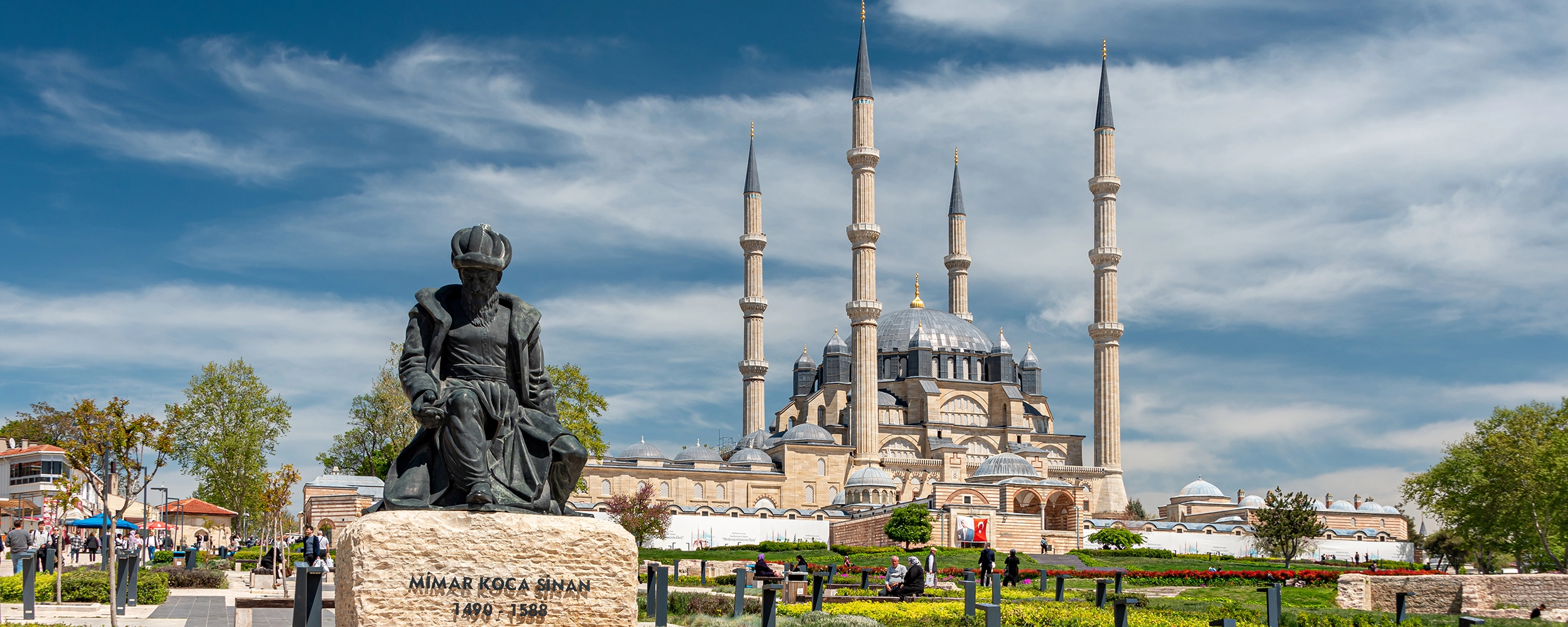
Discover monumental mosques, Ottoman medical history, covered bazaars, historic bridges, traditional food and the layered heritage of one of Türkiye's most fascinating historic cities.
View Edirne GuideUse Üç Şerefeli Mosque as the central bridge in a deeper journey through the development of Ottoman architecture in the former imperial capital.
Follow the architectural sequence from Eski Cami to Üç Şerefeli and Selimiye and see how Ottoman mosque design evolved across the centuries.
Explore Historic Edirne
Walk through Bedesten, Ali Paşa Bazaar and Saraçlar while discovering the commercial city that developed around Edirne's monumental mosques.
Discover More
Create a private route focused on early Ottoman architecture, central-dome experimentation, minaret design and the development of Edirne's great imperial mosques.
Plan Your Private Experience