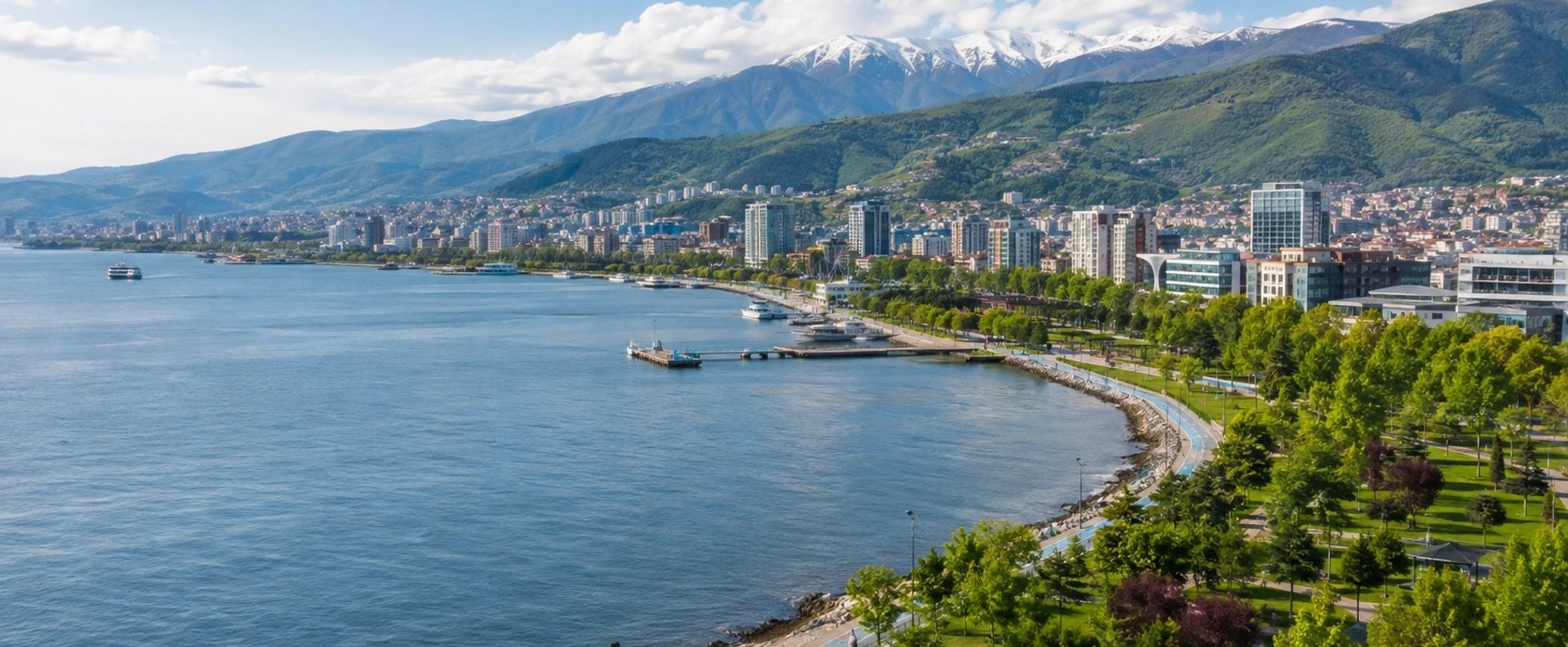
Kocaeli Travel Guide
Continue beyond Sardala to discover Bağırganlı, Kerpe, Kefken, Pembe Kayalar, nature parks, İzmit and the landscapes of the wider province.
Explore Kocaeli
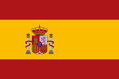




Sardala Bay, known in Turkish as Sardala Koyu, is one of the most dramatic natural coastal areas in Kandıra, Kocaeli. Located close to the boundary between Kocaeli and Şile, the area combines forest, rocky headlands, small beaches, clear Black Sea water and an unusually secluded atmosphere.
Sardala is not simply one tiny cove. The name is traditionally used for three adjoining coves extending along almost 1.5 kilometres of coastline. Their mixture of rock, greenery and turquoise water has made Sardala one of northern Kocaeli's best-known destinations for nature photography and coastal exploration.
But the most unusual attraction lies behind the bay. After a walk of approximately 1 kilometre through the forest, visitors can reach Cennet Havuzu, meaning Heaven Pool. This remarkable natural grotto is filled with seawater entering through an opening in the rock, creating the appearance of a hidden natural swimming pool inside the coastal cliffs.
Sardala remains far less developed than a conventional resort beach. That is an important part of its appeal, but it also means visitors should arrive prepared, check current access regulations, respect Black Sea conditions and treat the surrounding forest and coastline carefully.
Explore a rugged coastal area formed by three adjoining Black Sea coves.
Walk through the forest to a spectacular seawater-filled natural grotto.
Experience one of Kandıra's strongest combinations of woodland, cliffs and turquoise water.
Come for hiking, photography and nature rather than conventional resort facilities.
Essential information for visiting one of the wildest and most photogenic parts of Kocaeli's Black Sea coast.
Kandıra District, Kocaeli Province, near the Bağırganlı–Şile side of the coast.
Open on Google MapsThree secluded coves, turquoise water, rock formations, forest and Cennet Havuzu.
Approximately 1.5 km of coastline formed by three adjoining coves.
Approximately 1 km from Sardala through a rough and potentially demanding forest route.
A natural grotto filled with seawater through an opening connecting it with the Black Sea.
Allow at least 3–4 hours, or a full day for hiking and coastal exploration.
Sardala brings together secluded Black Sea coves, forest, cliffs and a remarkable natural sea pool without the atmosphere of a conventional beach resort.
The first reason to visit Sardala is its sense of geographical isolation. The coastline lies away from the larger beach settlements, and the transition from forest to open sea gives the area a much wilder character than many better-known beaches around Kandıra.
The second is its unusual shape. Rather than one broad beach, the Sardala coastline is made up of three connected coves separated and framed by rocky coastal formations. Moving between viewpoints reveals a different scene every few hundred metres.
The third attraction is Cennet Havuzu. Hidden behind the coastline, this natural sea-filled grotto is one of Kocaeli's most memorable geological attractions. Its shadowed rock walls, clear water and narrow opening toward the Black Sea create an atmosphere completely different from the open coves nearby.
Finally, Sardala is an excellent example of why Kandıra should be explored as a landscape rather than simply as a collection of beaches. Visitors following our guide to places to visit in Kocaeli can combine Sardala with Bağırganlı, Kerpe, Kefken and the other natural attractions of the Black Sea coast.
One detail that is easily missed when seeing Sardala in photographs is that the name refers to more than a single beach. Local descriptions identify three adjoining coves along a coastal strip approaching 1.5 kilometres in length.
The coves are separated by rocky projections and backed by green countryside and woodland. Depending on your position, the coastline can appear like a broad open bay, a small sheltered beach or an almost completely enclosed pocket of water.
This variety is one of the reasons Sardala is so rewarding on foot. Instead of arriving, swimming and leaving from the same point, visitors can spend time observing the changing coastline, rock formations and views toward the open Black Sea.
The name Sardala is used for a sequence of three adjoining coves rather than one isolated inlet.
Natural rock projections divide the coastline and create changing views between the coves.
Some sections offer beach-like shorelines while others are dominated by rock and cliff.
Dense greenery behind the coast gives Sardala its distinctive wild appearance.
Despite the sheltered appearance of some coves, the wider coast remains exposed to Black Sea weather.
Higher ground and rocky sections can provide beautiful perspectives across several parts of Sardala.
Cennet Havuzu, literally meaning Heaven Pool, is the most extraordinary natural feature associated with Sardala. It lies behind the bay and is reached by walking through the surrounding forest.
Despite its name, Cennet Havuzu is not a freshwater forest pool. It is a natural rocky grotto whose interior is filled with Black Sea water. The sea enters through an opening between the rocks, creating what looks like a secret pool hidden inside the coastline.
From inside, the opening in the rock frames the outside sea almost like a natural window. Sunlight entering through the opening can illuminate sections of the clear water while other parts of the grotto remain in shadow.
The result is one of the most unusual swimming and photography environments in Kocaeli, but visitors should remember that the pool remains physically connected to the sea. Its conditions therefore depend on waves, weather and the wider Black Sea.
Cennet Havuzu contains seawater entering naturally through the coastal rock.
An opening between the rocks creates a dramatic framed view toward the Black Sea.
Clear water and changing light can produce striking green and turquoise tones.
High surrounding rock gives the pool a secluded, cave-like atmosphere.
Large parts of the grotto remain protected from direct summer sun.
Never treat Cennet Havuzu like a controlled swimming pool; its water conditions remain influenced by the Black Sea.
Cennet Havuzu is not located immediately beside the main vehicle approach to Sardala. Official tourism information describes an approximately 1 kilometre walk through the forest behind the bay.
The route should not be confused with an urban promenade. It is described as a difficult or challenging trail, and conditions can vary substantially after rain, during periods of vegetation growth or when seasonal access restrictions are in force.
Good footwear is therefore important. Closed walking shoes or trainers with reliable grip are much better than beach sandals. Carry water, protect yourself from ticks and insects, and leave enough daylight to complete both the outward and return walk.
Approximately 1 km each way between the Sardala area and Cennet Havuzu.
Expect a natural forest route rather than a paved walkway.
Closed shoes with grip are strongly preferable to flip-flops or smooth sandals.
Mud, wet roots and slippery rock can make the route considerably harder.
Do not begin the trail so late that the return journey will be in darkness.
Do not rely only on social-media photographs; confirm the current route and local access before setting out.
Sardala and Cennet Havuzu sit within a sensitive forest-and-coast environment. Access rules can therefore change because of wildfire danger, weather, sea conditions or local safety decisions.
For the 2026 season, Kocaeli authorities introduced extensive forest-fire precautions, including restrictions on entry to forest areas between 15 May and 1 November 2026, along with restrictions on unauthorized overnight stays and fire use in forest areas.
Because the traditional route to Cennet Havuzu passes through forest, visitors should not assume that the trail is legally accessible simply because older travel blogs describe it. Check the latest announcements from Kocaeli authorities and Kandıra authorities before attempting the walk.
Sardala's strongest visual feature is the meeting of three landscapes: dense greenery, layered coastal rock and clear Black Sea water.
Rocky projections break the shoreline into separate coves, while small beaches and low rock shelves appear between them. Seen from above, the water can look surprisingly turquoise, especially during calm, bright conditions.
At sea level, the experience is more rugged. The coast includes uneven rock, small cliffs, wave-washed surfaces and places where the land drops directly into deeper water.
This combination gives Sardala its untouched appearance, but it also means visitors should not expect the infrastructure of a municipal beach. Its appeal comes precisely from the fact that the landscape still feels predominantly natural.
Calm, sunny conditions can make the shallower sections appear bright green and turquoise.
Cliffs, shelves and natural rock formations frame much of the shoreline.
Green woodland reaches close to the coast and creates the characteristic Sardala scenery.
Beach areas appear within the wider rocky landscape rather than forming one long resort beach.
Wave action has created hollows, openings and grotto-like spaces along parts of the coast.
The same bay can feel peaceful on a calm morning and powerful when Black Sea weather develops.
Swimming is one of the activities traditionally associated with Sardala, and the clear water is naturally inviting during summer. However, this is part of the Black Sea coastline, where wave and current conditions can change rapidly.
Sardala should not be treated like a fully managed resort beach. Do not assume that lifeguards, warning flags, buoyed swimming zones or immediate rescue services will be available.
Kocaeli authorities regularly issue temporary swimming restrictions along Kandıra beaches when weather and sea conditions become dangerous. Official warnings also specifically identify rip currents as a serious hazard on the Kandıra coast.
Do not enter simply because the water looked calm in photographs taken on another day.
Kandıra's Black Sea coast is known for potentially dangerous currents.
Larger wave sets can arrive after apparently calm periods.
Never jump from rocks without knowing the depth and underwater terrain.
Natural beaches and rocky edges require much closer attention than a managed pool.
If Kandıra authorities prohibit swimming because of sea conditions, the restriction must be respected.
Cennet Havuzu is widely known as a natural swimming place, and its enclosed shape can make the water appear much calmer than the exposed coastline.
Nevertheless, the grotto remains connected to the Black Sea. Water enters through the natural opening, which means waves, water movement and sea conditions can still influence the pool.
Rock surfaces around the water may also be slippery, and underwater depth can be difficult to judge. Visitors should therefore avoid jumping from rock ledges and should never interpret the word “pool” as meaning that the site has controlled depth, lifeguards or engineered safety features.
Walk through accessible sections and see how the three adjoining bays differ from one another.
When legal access and trail conditions allow, follow the forest route to the hidden sea grotto.
Experience the transition between coastal forest, rocky headlands and open Black Sea views.
Capture turquoise water, cliffs, green forest and the dramatic natural opening of Cennet Havuzu.
The quieter coastal and forest environment can reward patient observation away from busy beach areas.
Calm conditions can make the coves attractive for experienced paddlers who understand Black Sea weather.
Clear conditions can reveal rocky underwater scenery close to shore, where swimming is permitted and safe.
Late-day light can produce beautiful contrast between dark forest, warm cliffs and the sea.
Sardala has long been known among nature travellers as a popular wild-camping location, and older descriptions frequently show tents around the larger central cove.
Visitors should not, however, interpret this historical popularity as permanent permission to camp. Local rules have become considerably stricter because of forest-fire risk, environmental pressure and public safety.
Kocaeli's 2026 regulations restrict unauthorized camping and overnight stays in forest, beach and similar natural areas, while separate seasonal forest-access rules may also apply. Use only locations that are currently officially permitted, licensed or specifically designated for camping.
Regulations change and older camping reports may no longer reflect current rules.
Verify current Kandıra and Kocaeli announcements before bringing camping equipment.
Forest-fire restrictions can prohibit barbecues, campfires, stoves and other flame-producing equipment.
A designated or licensed campsite is the safer choice when an overnight stay is important.
Remote coastal locations cannot absorb the rubbish generated by large numbers of campers.
Avoid damaging vegetation, cutting branches or creating new vehicle tracks.
One of the reasons Sardala still feels wild is the absence of major permanent tourism infrastructure. Official tourism information notes that the nearest settlement is approximately 6 kilometres away.
Visitors should therefore not depend on finding a reliable restaurant, market, changing room, shower or other beach service immediately beside the coves. Conditions can also change from season to season.
Bring sufficient drinking water, simple food if needed, sun protection and anything essential for the day. If you want restaurants, markets or more predictable facilities, use nearby coastal settlements such as Bağırganlı before or after the visit.
Do not begin the forest walk assuming you will find water along the route.
A simple packed lunch is useful if you intend to remain in the area for several hours.
Do not expect the level of facilities available at a municipal beach.
Exposed beach and rock sections can become very hot even though forest shade is nearby.
Remote terrain makes a small personal first-aid kit particularly sensible.
Purchase essentials before leaving the nearest settlement for Sardala.
Sardala is one of the most photogenic natural locations on the Kandıra coast. Its strongest compositions come from contrast: dark green forest against blue water, sunlit rock against shaded caves, and secluded coves against the open Black Sea horizon.
Cennet Havuzu offers a completely different style of photograph. The narrow opening toward the sea can be used as a natural frame, while reflected light on the water creates green, turquoise and deep-blue tones.
Photograph the relationship between forest, rock and the shape of the coves from safe elevated ground.
Calmer conditions can produce better transparency and reflections.
Use the rock opening toward the Black Sea as the central frame of your composition.
Clear shallow water can reveal stone and pebbles beneath the surface.
A person beside the grotto walls can emphasize the size of the natural formation.
Warm evening light can highlight exposed cliffs while the forest becomes darker and more dramatic.
Green vegetation and mild temperatures make spring attractive for coastal scenery and walking, subject to trail conditions.
Long daylight is excellent for combining Sardala with other Kandıra coastal stops.
Warm weather attracts the largest number of visitors, especially on weekends.
Warm light and fewer peak-season crowds can make September particularly attractive.
Forest colour and dramatic seas are beautiful, but wet terrain and waves require additional caution.
The landscape remains impressive, but strong wind, rain and rough sea conditions can make exploration unsuitable.
Sardala can be an exciting destination for older children who enjoy nature, walking and coastal exploration. However, families should understand that it is very different from a developed municipal beach.
Uneven terrain, forest trails, open water, rocky edges and potentially strong Black Sea conditions require constant adult attention. The route to Cennet Havuzu may also be too demanding for very young children depending on current trail conditions.
Keep younger children physically close around cliffs, rocks and open water.
Wet and polished surfaces can become unexpectedly slippery.
The approximately 1 km Cennet Havuzu route is not comparable with a paved park path.
Carry water, food, hats and other essentials rather than depending on nearby shops.
Do not allow children to swim when waves, current warnings or official restrictions are present.
Families wanting conventional beach facilities may prefer an officially managed Kandıra beach.
Sardala is a natural coastal landscape rather than an engineered visitor attraction. Uneven ground, rough approach surfaces, sand, rock and forest paths can make access difficult for anyone with limited mobility.
The approximately 1 km route to Cennet Havuzu is particularly important to consider. It should not be expected to provide step-free, wheelchair-accessible or stroller-friendly conditions.
Expect irregular surfaces rather than continuous paved paths.
Full exploration of Sardala and the Cennet Havuzu trail is generally unsuitable for standard wheelchair access.
Rough forest and coastal terrain can make ordinary strollers impractical.
Some shoreline areas require careful footing and balance.
Visitors should not expect handrails, ramps or fully surfaced walkways throughout the area.
Anyone with specific mobility requirements should verify access before making the journey.
Forest, camping and swimming restrictions can change according to season and weather.
Use footwear suitable for forest ground and potentially slippery coastal rock.
Do not depend on finding reliable facilities beside the bay.
Save the area offline before leaving stronger mobile coverage.
A waterproof pouch is useful around rocks, spray and the Cennet Havuzu grotto.
Early arrival provides more daylight and usually a quieter experience.
Remote coves have no capacity to absorb bottles, plastic, food packaging or camping rubbish.
The character and safety of the coast change dramatically when Black Sea conditions deteriorate.
Begin the day at Sardala Bay while temperatures are comfortable and the coastline is relatively quiet. Explore the accessible coves, photograph the surrounding cliffs and observe sea conditions before considering swimming.
If current regulations permit access and trail conditions are suitable, continue on foot toward Cennet Havuzu. Allow considerably more time than the distance alone suggests, because the approximately 1 km route passes through natural terrain.
After returning to Sardala, continue toward Bağırganlı for food, supplies and a more conventional coastal atmosphere.
Visitors with additional time can continue through the wider Kandıra region using our Kocaeli travel guide to connect Sardala with other Black Sea attractions.
Enough only for a quick look at the main bay and photographs close to the approach area.
Suitable for exploring part of the Sardala coastline without visiting Cennet Havuzu.
A better minimum if you hope to combine the coves with the Cennet Havuzu walk.
Comfortable for unhurried exploration, photography and a packed lunch.
Best if combining Sardala with Bağırganlı and another Kandıra coastal destination.
Allow additional time for changing light rather than trying to see everything quickly.
Sardala is best understood as a remote natural coastal landscape rather than an organized tourism complex. Access, parking, forest regulations, camping rules and swimming conditions can all change.
For that reason, the final stage of planning should always be done shortly before your visit. Check weather, sea conditions and official Kandıra or Kocaeli announcements, especially in summer.
Sardala lies in Kandıra District of Kocaeli close to the border with Şile. Official tourism information describes access from the Bağırganlı–Ağva road.
The traditional approach leaves the main road at approximately the 7th kilometre of the Bağırganlı–Ağva route and continues along an unpaved road toward the coast.
Road condition can change because of rain, erosion and seasonal traffic. Drivers should therefore avoid assuming that the final approach will resemble an ordinary paved beach road.
A private vehicle is generally the most practical way to approach Sardala.
Follow the road toward Ağva and use current navigation for the Sardala turn.
Official descriptions identify the final approach as an unpaved road.
Mud, ruts and surface damage may make the approach more difficult.
Sardala can be reached as a road trip via the Şile–Ağva side, but journey time varies greatly with traffic.
Do not assume there is direct regular public transport to the remote bay itself; confirm current regional options before travelling.
Parking at a remote natural site should not be expected to operate like a large municipal car park. The number of visitors can change dramatically between a quiet weekday and a hot summer weekend.
Sardala's growing popularity has historically created periods when both parking and places around the main cove became extremely crowded. Arriving early is therefore strongly recommended.
Morning offers a better chance of avoiding peak summer congestion.
Keep narrow roads and any emergency access routes completely clear.
Do not create new parking spaces by driving over forest or coastal vegetation.
The final parking environment may be natural rather than paved and marked.
An unpaved approach can change considerably after rain.
Do not attempt badly damaged or muddy sections simply because another vehicle has done so.
Sardala lies within one of the most rewarding nature-and-coast regions of Kocaeli. Use our complete Kocaeli travel guide to build Sardala into a longer Black Sea itinerary.
The nearest important coastal settlement, with a broad beach, fishing atmosphere and easier access to food and supplies.
A popular Kandıra resort with a sheltered bay, dramatic cliffs and a long history associated with ancient Kalpe.
Striking Black Sea rock formations that are particularly attractive for photography and sunset views.
A broad sandy coastal area between Kerpe and Kefken that becomes lively during the summer season.
A coastal settlement known for its harbor, beaches and access to several natural attractions.
Kefken's extraordinary pink-toned coastal rocks combine geology with traces of historic stone quarrying.
A long Black Sea beach east of Kefken, popular during the summer season.
Continue west toward the Şile side for river scenery, coastline and another well-known Black Sea getaway.
Sardala Bay is in Kandıra District of Kocaeli Province, close to the Kocaeli–Şile boundary on Türkiye's Black Sea coast.
Sardala Koyu is a remote coastal area consisting of three adjoining coves, rocky shoreline and forest on the Kandıra coast.
Local and official descriptions use the name Sardala for three adjoining coves stretching along almost 1.5 kilometres of coastline.
Cennet Havuzu, or Heaven Pool, is a natural seawater-filled grotto hidden behind the Sardala coastline.
No. The pool contains seawater entering naturally through an opening in the coastal rock.
Official tourism information describes an approximately 1 kilometre walk from Sardala through the forest.
No. Official descriptions characterize the route as challenging, so proper shoes and sufficient daylight are recommended.
Access can be affected by seasonal forest restrictions. Check the latest Kocaeli and Kandıra official announcements before attempting the route.
Swimming is traditionally popular, but Black Sea waves and currents can be dangerous. Enter the water only when conditions are suitable and no official restriction is in force.
The grotto is known as a natural swimming place, but it remains connected to the Black Sea and should not be treated like a controlled swimming pool.
Do not assume so. Its enclosed form may provide shelter, but it remains connected to the sea and conditions can change. Follow all current official warnings and swimming restrictions.
Yes. Kocaeli authorities specifically warn that rip currents can create serious danger along Kandıra's Black Sea coast.
Rock jumping is not recommended. Water depth, submerged rocks and changing waves are difficult to judge safely from above.
Older children who enjoy nature may like it, but close supervision is essential around water, rocks and forest trails. The Cennet Havuzu route may be unsuitable for very young children.
Sardala has historically been popular with wild campers, but camping regulations have changed. Use only currently authorized or designated camping areas and check local rules before travelling.
Do not assume that fires are permitted. Seasonal wildfire regulations in Kocaeli can prohibit campfires, barbecues, stoves and other flame-producing equipment in or near forest areas.
Do not rely on finding permanent food facilities at the remote coves. Bring essential supplies and use nearby settlements for restaurants and shopping.
Facilities can be limited and seasonal. Prepare for a natural site rather than assuming municipal beach infrastructure.
Official tourism information states that the nearest settlement is approximately 6 kilometres away.
Official directions describe leaving the Bağırganlı–Ağva road around its 7th kilometre and continuing toward Sardala along an unpaved road.
The final approach is traditionally described as an unpaved road. Its condition can change after rain and heavy seasonal use.
Road conditions vary, so no permanent vehicle requirement should be assumed. Check recent local conditions before travelling, especially after heavy rain.
Do not rely on direct regular public transport reaching the remote coves. Confirm the latest regional options and the final connection before travelling.
It is a natural coastal area rather than a conventional ticketed attraction, but parking, access, camping or other local arrangements can change.
Bring drinking water, food, proper walking shoes, sun protection, a charged phone and anything else you would normally need for several hours in a remote natural area.
Closed walking shoes or sturdy trainers with reliable grip are recommended, especially if attempting the Cennet Havuzu trail.
Morning is particularly useful because temperatures are cooler, parking may be easier and you have maximum daylight for exploration.
Late spring through early autumn provides the warmest conditions, but seasonal forest-access rules, summer crowds and Black Sea weather must also be considered.
Although it feels remote, its popularity has grown considerably and summer weekends can be very busy.
Allow around 2 hours for the coves alone and approximately 3–4 hours or more if you intend to include Cennet Havuzu when access is permitted.
Absolutely. The forest, three coves, rock formations, photography and coastal scenery make Sardala worthwhile even if you never enter the water.
Kayaking is traditionally associated with the bay, but paddlers should have appropriate experience and check Black Sea wind and wave conditions carefully.
Yes. The combination of turquoise water, forest, rocky headlands and the dramatic opening inside Cennet Havuzu makes it one of Kocaeli's strongest natural photography locations.
Yes. Bağırganlı is the most natural nearby addition and provides easier access to food, supplies and a broader beach environment.
Yes. With an early start, Sardala can form part of a full-day Kandıra coast route including other natural attractions around Kerpe and Kefken.
Forest access, camping rules and swimming permissions can change rapidly because of wildfire danger, weather and Black Sea conditions.
Take bottles, food packaging, cigarette waste and every other item away with you.
Never light a fire when local wildfire restrictions prohibit it.
Use existing access routes rather than cutting new paths through the forest.
Avoid carving, painting or otherwise altering natural coastal formations.
Observe birds and other animals quietly and do not disturb nests or feeding areas.
The absence of urban noise is one of the qualities that makes Sardala special.
Do not drive over vegetation or block tracks used by residents and emergency services.
Forest, camping and swimming bans exist to protect both visitors and the landscape.
Combine Sardala's hidden coves and Cennet Havuzu with fishing settlements, rock formations, beaches, forests and the wider landscapes of northern Kocaeli.
Turn Sardala into a complete Kandıra coast journey with Bağırganlı and the wider Black Sea shoreline.
Continue beyond Sardala to discover Bağırganlı, Kerpe, Kefken, Pembe Kayalar, nature parks, İzmit and the landscapes of the wider province.
Explore Kocaeli
Ask us about including Sardala Bay, Bağırganlı, Kerpe, Kefken and other Kocaeli highlights inside a privately designed Turkey journey.
Request a Custom RouteWe can combine Kocaeli's Black Sea coast with Istanbul, Cappadocia and destinations throughout Türkiye.
Build a private coastal journey around Sardala, Bağırganlı, Kerpe, Kefken and the quieter landscapes of northern Kocaeli.
Plan Your Journey
Discover the Gulf of İzmit, Kandıra coast, Kartepe, historic sites, nature attractions and regional food traditions.
Explore Kocaeli
Continue throughout Türkiye with archaeological sites, historic cities, coastal landscapes, food traditions and cultural heritage.
Explore Türkiye