Private Historic Edirne Tour
Ask us about a tailor-made route connecting Eski Cami, Üç Şerefeli Mosque, Selimiye, traditional bazaars and other Ottoman monuments with your own private guide.
Request a Custom Tour





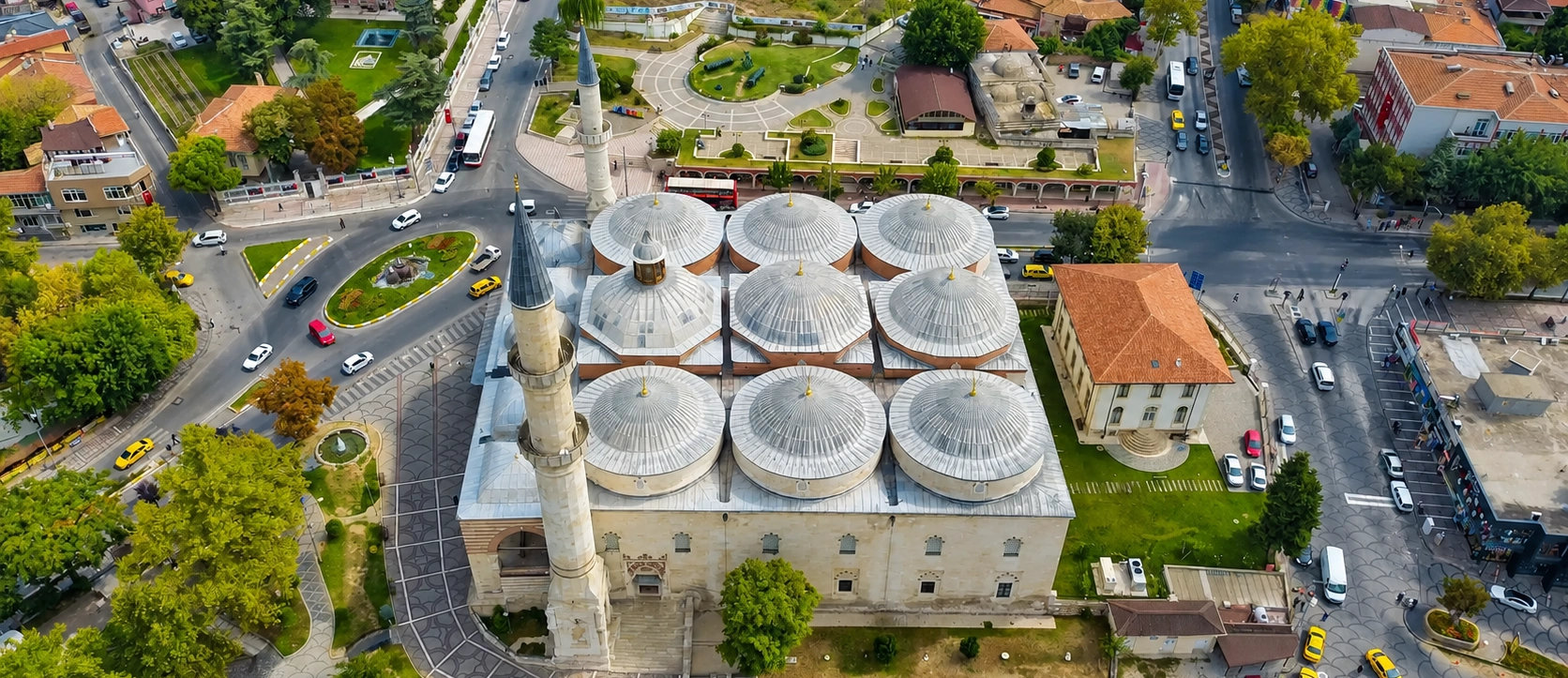
The Old Mosque of Edirne, known in Turkish as Eski Cami, stands at the heart of the historic Ottoman capital between Selimiye Mosque, Üç Şerefeli Mosque and the traditional commercial streets of the city center. Completed in 1414, it is among the most important surviving monuments from the formative period of Ottoman architecture.
Construction began in 1403 under Emir Süleyman Çelebi, a son of Sultan Bayezid I, and was completed during the reign of Sultan Mehmed I, Çelebi Mehmed. Its monumental square prayer hall is divided by only four massive central piers and covered by nine domes arranged in a three-by-three composition.
Yet architecture alone is not what makes Eski Cami unforgettable. Its walls and enormous piers are covered with striking examples of Ottoman Islamic calligraphy. Gigantic names of Allah and the Prophet Muhammad, Qur'anic texts, religious sayings and remarkable compositions incorporating the Arabic letter vav turn the interior into one of Türkiye's most atmospheric historic prayer spaces.
Eski Cami is not a museum frozen in the past. It remains an active mosque, where religious worship, Friday prayers and traditions associated with Edirne's Ottoman heritage continue today. For travelers interested in architecture, calligraphy, Ottoman history or spiritual heritage, it deserves a place alongside Selimiye on any serious exploration of Edirne.
Discover one of Edirne's earliest surviving monumental Ottoman mosques.
Study an important example of the early Ottoman multi-domed mosque tradition.
See more than fifty historic inscriptions distributed across walls, arches and massive piers.
Experience a mosque where centuries-old religious and ceremonial traditions remain part of local life.
Essential information for visiting historic Eski Cami in central Edirne.
Sabuni neighborhood in central Edirne, close to Selimiye Mosque and Üç Şerefeli Mosque.
Open on Google MapsBegun in 1403 and completed in 1414 during the reign of Sultan Mehmed I.
Early Ottoman multi-domed mosque with a square prayer hall supported by four massive central piers.
Nine principal domes arranged across the prayer hall in a three-by-three grid.
Extraordinary monumental calligraphy covering walls, arches and structural piers.
There is normally no entrance ticket because Eski Cami remains an active mosque.
Allow approximately 30–45 minutes, or longer if studying the calligraphy and architectural details.
Dress respectfully, remove shoes before entering and avoid sightseeing during congregational prayers.
The Old Mosque represents a crucial stage between early Ottoman architecture and the great imperial mosque tradition that later transformed Edirne and Istanbul.
When Eski Cami was constructed in the early 15th century, Edirne was developing into one of the principal political and ceremonial centers of the Ottoman state. The mosque functioned as the city's great congregational or ulu cami, providing a monumental religious focus around which commercial and civic life developed.
Its importance is architectural as well as historical. Earlier Ottoman congregational mosques often consisted of multiple architectural units, but at Eski Cami the use of only four large central piers helped create a more unified interior beneath the nine domes. The building therefore forms an important chapter in the gradual Ottoman search for larger and more coherent worship spaces.
The city's commercial core also grew in close relationship with the mosque. The historic Edirne Bedesten nearby was associated with the economic network that supported religious foundations, helping create a combined religious and commercial center. Later monuments including Üç Şerefeli Mosque and Selimiye Mosque expanded this extraordinary concentration of Ottoman architecture.
Today Eski Cami remains one of the best places to understand Edirne before the age of Mimar Sinan. For travelers using our complete Edirne visitor guide, it provides an essential introduction to the evolution of Ottoman mosque architecture.
Construction of the mosque began in 1403 under Emir Süleyman Çelebi, one of the sons of Sultan Bayezid I. The project emerged during the politically complicated period following Bayezid's defeat by Timur at the Battle of Ankara in 1402, when competing Ottoman princes struggled for control of the state.
Work continued through this period of dynastic conflict and the mosque was finally completed in 1414 during the reign of Sultan Mehmed I, who reunited the Ottoman territories after the Interregnum. An inscription associated with the building identifies Konyalı Hacı Alaeddin and Ömer ibn İbrahim in connection with its construction.
The mosque was initially known by names including Süleymaniye and Ulu Cami. After the construction of the much larger Üç Şerefeli Mosque during the 15th century, the earlier building gradually became known simply as Eski Cami – the Old Mosque.
Over the following centuries the building witnessed earthquakes, fires, repairs and decorative changes. Its present interior therefore combines an early 15th-century architectural framework with later Ottoman calligraphy and ornament. Many of the monumental inscriptions that visitors admire today belong to periods considerably later than the original construction.
The mosque continued to hold an important ceremonial position in Ottoman Edirne. Historical traditions connect it with royal ceremonies, Friday worship and the symbolic use of a sword during sermons. Its connection with the respected Sufi scholar Hacı Bayram Veli added another layer of religious memory.
During the Republican period, Eski Cami underwent several conservation and restoration campaigns. Its architecture, surfaces, calligraphy and structural fabric have therefore been studied and repaired repeatedly in an effort to preserve one of Edirne's most important early Ottoman monuments.
Emir Süleyman Çelebi begins construction of the great mosque in Edirne.
The building is completed under Sultan Mehmed I, known as Çelebi Mehmed.
Eski Cami serves as Edirne's major congregational mosque and ceremonial center.
The earlier Ulu Cami increasingly becomes known as Eski Cami, the Old Mosque.
Large-scale calligraphy and decorative campaigns transform the character of the interior.
Successive conservation projects preserve the mosque as both heritage monument and active place of worship.
Eski Cami belongs to the early Ottoman tradition of multi-domed congregational mosques. Its main prayer hall is approximately square, with four enormous freestanding piers dividing the interior into nine principal bays. Each bay is crowned by a dome.
The result is a three-by-three dome arrangement that creates a rhythmic interior while still allowing the worship space to feel comparatively open. The mosque's interior covers approximately 2,116 square meters.
Different transition systems beneath the domes reveal the experimentation characteristic of early Ottoman architecture. Pendentives, muqarnas-related transitions and geometric forms help transfer the weight of the domes to the piers and surrounding walls. Windows placed at several levels bring daylight into the otherwise massive stone structure.
A five-bay portico forms the principal transition between the city and the prayer hall. Stone piers, arches, vaults and domed elements create a monumental entrance zone that is especially impressive when viewed from the historic streets around the mosque.
The main prayer hall follows a broad, almost square layout typical of important early Ottoman congregational mosques.
Massive structural supports carry the principal domes while leaving much of the worship space visually connected.
A three-by-three arrangement forms the defining architectural rhythm of the mosque.
The covered entrance area provides a monumental transition into the prayer hall.
Different masonry treatments and later repair phases reveal the long architectural history of the monument.
The entrance, mihrab and especially the finely decorated minbar add contrast to the massive architectural framework.
The mosque's two minarets are particularly interesting because they are not identical. The northern minaret is integrated into the building and has a single balcony, or şerefe. It belongs closely to the original architectural conception of the mosque.
The second minaret stands toward the western side and is taller and more independent from the principal prayer hall. It has two balconies and is associated with the period of Sultan Mehmed I. Its internal circulation was designed so that access to the balconies could follow separate stairways.
Together the two towers create the asymmetrical silhouette that distinguishes Eski Cami from the later, more geometrically balanced imperial mosques of the classical Ottoman period.
The minaret connected closely with the mosque structure has a single balcony.
A taller second tower was added as the monument developed.
The later minaret contains two şerefes and a more complex internal staircase arrangement.
The differing minarets reveal that the mosque evolved rather than being completed as one perfectly symmetrical composition.
No feature of Eski Cami leaves a stronger impression than its monumental Ottoman calligraphy. Visitors encounter enormous Arabic letters and religious texts painted directly onto walls, arches and the surfaces of the four great structural piers.
The mosque contains more than fifty calligraphic compositions in several styles and from different periods. Many of the best-known examples were produced between the 18th and 20th centuries rather than during the mosque's original construction. They therefore represent centuries of continued artistic engagement with the building.
Among the most immediately recognizable works are enormous renderings of Allah and Muhammad. Other inscriptions include Qur'anic passages, the names of important figures in early Islamic history, religious sayings, hadiths and highly inventive compositions created from individual Arabic letters.
Some designs employ mirrored or symmetrical arrangements. The most famous is associated with the Arabic letter vav, whose flowing form became especially important in Ottoman calligraphic and Sufi visual culture. Rather than functioning simply as decoration, such compositions carry layers of religious symbolism and artistic meaning.
Gigantic renderings of the divine name are among the mosque's most powerful visual elements.
The name of the Prophet appears prominently as part of the building's calligraphic program.
A celebrated composition uses two mirrored forms of the Arabic letter vav.
Verses and religious formulas appear throughout the prayer hall.
Short religious teachings become monumental visual statements on the mosque walls.
The inscriptions were created and renewed across different centuries rather than belonging to one single decorative campaign.
Among the many inscriptions inside Eski Cami, visitors frequently notice a symmetrical composition formed from two large Arabic vav letters. The curved shapes create an almost heart-like visual form, making the design distinctive even for visitors who cannot read Ottoman or Arabic script.
The letter vav acquired numerous symbolic associations within Ottoman calligraphy and Sufi visual culture. Calligraphers valued both its elegant shape and its ability to form complex mirrored and balanced compositions.
At Eski Cami the double-vav design is therefore best understood not merely as written language but as a combination of religious meaning, geometry and visual art. It is one of the details that makes the mosque particularly rewarding for travelers interested in Islamic calligraphy.
While the monumental calligraphy dominates the walls, the mihrab and minbar preserve another important form of early Ottoman craftsmanship. The mihrab indicates the direction of Mecca and occupies the central position along the qibla wall.
Beside it stands the mosque's impressive white marble minbar, from which the Friday sermon is delivered. Its side panels incorporate rumi vegetal ornament and geometric decoration, while an inscription band adds another layer of written ornament.
The combination of carved marble, geometric pattern, calligraphic decoration and the enormous scale of the surrounding prayer hall creates one of the most visually concentrated areas of the mosque.
The prayer niche marks the qibla direction toward Mecca.
A finely carved ceremonial pulpit used for the Friday sermon.
Stylized vegetal motifs connect the monument with established traditions of Islamic decorative art.
Carefully organized patterns balance the flowing calligraphic and vegetal decoration elsewhere in the interior.
Eski Cami was historically more than a neighborhood place of worship. As Edirne's principal early congregational mosque, it acquired an important position in the ceremonial life of the Ottoman capital.
Historical accounts associate the mosque with sword-girding and royal ceremonies, while a banner traditionally displayed near the minbar symbolized the city's Ottoman conquest and the mosque's status.
A particularly remarkable tradition survives in connection with the Friday sermon. The imam may ascend the minbar carrying or accompanied by a sword, preserving the memory of a practice associated with the mosque's historic status. The tradition continues to attract attention during Friday worship and important religious occasions.
One of the mosque's strongest spiritual traditions concerns Hacı Bayram Veli, the influential 14th- and 15th-century Anatolian Sufi scholar and founder of the Bayrami order.
According to long-established local tradition, Hacı Bayram Veli visited Edirne during the reign of Sultan Murad II and preached inside Eski Cami. The pulpit associated with his sermons has consequently been treated with particular reverence.
Tradition holds that the historic preaching platform is preserved rather than routinely used by mosque imams, maintaining the memory of Hacı Bayram Veli's presence. Whether visitors approach the story historically or devotionally, it adds another important dimension to the mosque's identity.
Near the mihrab is a small stone traditionally referred to locally as the Kâbe Taşı or associated with the Rükn-i Yemânî. Local religious tradition holds that the stone was brought from the sacred precinct of the Kaaba.
The location has consequently become a devotional point for some worshippers and visitors. Stories concerning blessings and prayers at the stone belong to the mosque's long tradition of popular religious practice.
Travelers should distinguish this devotional tradition from archaeologically documented provenance. Its importance lies above all in the faith, memory and customs that generations of worshippers have associated with the place.
Eski Cami rewards slow observation. The building may appear comparatively simple from outside, but its interior contains layers of architecture, calligraphy, stone carving and religious tradition.
Stand near the center and look upward to understand the mosque's three-by-three structural system.
The massive supports divide the prayer hall while providing surfaces for some of its most dramatic calligraphy.
Look for the enormous sacred names that define the visual character of the mosque.
Find one of the mosque's best-known symmetrical calligraphic compositions.
Study the geometric and rumi decoration carved into the historic pulpit.
Examine the prayer niche and surrounding qibla wall at the spiritual focus of the interior.
See the area associated with the famous Anatolian Sufi teacher's visit to Edirne.
Before entering, study the arches, masonry and monumental exterior calligraphy.
Few cities allow visitors to study the development of Ottoman mosque architecture within such a compact area as Edirne. Three major monuments stand only a short walk apart, yet represent very different stages of architectural history.
Eski Cami represents the early multi-domed congregational tradition. Its nine domes and massive piers reveal architects working toward a more unified monumental prayer hall.
Üç Şerefeli Mosque, constructed later in the 15th century, introduced a dramatically enlarged central dome and a more ambitious courtyard composition. It forms a major bridge between early Ottoman architecture and the classical imperial mosque.
Finally, Selimiye Mosque, built by Mimar Sinan in the 16th century, achieved extraordinary spatial unity beneath one immense central dome. Together the three monuments form an architectural lesson spanning roughly a century and a half.
Eski Cami is both a major heritage monument and an active place of worship. A respectful visit allows travelers to enjoy its architecture without interfering with the religious life of the mosque.
Leave footwear in the designated area before entering the carpeted prayer hall.
Shoulders and knees should be covered; women should carry a headscarf for the prayer area.
Sightseeing is easiest between congregational prayers when the mosque is quieter.
The mosque can become especially crowded around the Friday midday prayer.
Keep conversations and phone sounds low even when no formal prayer is taking place.
Avoid flash photography and never photograph individual worshippers without permission.
Some of the most impressive calligraphy is painted directly onto the enormous structural supports.
Selimiye and Üç Şerefeli Mosque are only a short walk away.
Begin at Eski Cami, taking time to examine the entrance portico, nine-domed interior, marble minbar and monumental calligraphy. Allow approximately 30–45 minutes when the mosque is not crowded.
From Eski Cami, walk toward the nearby Üç Şerefeli Mosque. Its enormous portal, courtyard and unusual minarets provide a striking contrast with the earlier multi-domed architecture you have just seen.
Continue uphill toward Selimiye Mosque. From the surrounding square, look back across the historic center and consider how Ottoman mosque architecture evolved from the many domes of Eski Cami toward Sinan's extraordinary single-dome composition.
After Selimiye, return through the traditional commercial streets, exploring Edirne Bedesten, Ali Paşa Bazaar, Saraçlar Street and the restaurants of the historic center.
Eski Cami remains an active mosque rather than a ticketed museum. Visitors can normally enter respectfully outside periods when worship or special religious services require the prayer hall.
Prayer times change throughout the year according to sunrise and sunset. The most important period for visitors to avoid is normally the Friday congregational prayer, when the mosque can become extremely busy. Religious holidays and special evenings may also attract large congregations.
The General Directorate of Foundations reported in June 2026 that conservation work connected with Eski Cami had been completed as part of a broader program involving major heritage monuments in Edirne. As with any historic religious building, temporary maintenance or access restrictions can still occur.
Eski Cami can be visited throughout the year, but the atmosphere varies according to prayer schedules, season and the number of visitors in central Edirne.
Often quieter and excellent for appreciating the architecture without large groups.
Soft exterior light can beautifully emphasize the stonework, portico and minarets.
Mild temperatures make it easy to combine the mosque with a long walking tour of central Edirne.
Comfortable weather and softer light make this another excellent season for sightseeing.
Historically atmospheric but very busy around the congregational prayer; sightseeing should wait until worship is completed.
The mosque can have a particularly strong spiritual atmosphere, especially around prayer and evening worship.
Enough for a respectful quick visit, central interior view and the most important calligraphy.
Ideal for most visitors wishing to appreciate the architecture, inscriptions and minbar.
Recommended for travelers seriously interested in Ottoman architecture or Islamic calligraphy.
Combine Eski Cami with the surrounding Bedesten and historic commercial streets.
Add Üç Şerefeli Mosque, Selimiye Mosque and the principal monuments of central Edirne.
Continue to the wider historic city, river bridges and Sultan Bayezid II Complex.
Eski Cami offers exceptional photographic opportunities, particularly for visitors interested in Islamic calligraphy, symmetry, architectural detail and historic interiors. Remember, however, that worship always takes priority over photography.
Use the central axis to frame several domes, arches and giant calligraphic panels in one composition.
Photograph individual inscriptions while preserving enough surrounding architecture to provide scale.
The massive supports create dramatic vertical compositions and reveal the extraordinary scale of the writing.
Focus on geometric carving and rumi decoration rather than photographing worshippers nearby.
The exterior arches work beautifully for symmetrical compositions and framing.
Warm light can bring out the texture and changing masonry of the historic façades.
Eski Cami stands in the relatively compact historic center of Edirne and can be approached from nearby streets and squares. However, it is a centuries-old religious building, so accessibility does not always match that of a modern visitor attraction.
The mosque is close to shops, cafés, restaurants and other major historic attractions.
Entrances may contain changes in level, stone surfaces or other traditional architectural features.
All visitors entering the carpeted prayer space must remove footwear.
Much of the principal prayer hall is open once the entrance threshold has been crossed.
Ask mosque staff about the most suitable entrance and current accessible route.
Central Edirne provides numerous cafés and public spaces within a short walking distance.
One of the great advantages of visiting Eski Cami is its location. The mosque stands in the historic center of Edirne, within easy walking distance of many of the city's most important monuments.
Eski Cami is only a short downhill walk from Selimiye and can easily be combined with it.
The two historic mosques stand only a few minutes apart on foot.
Walk through the central commercial area toward the historic mosque district.
Ask for “Eski Cami” or “Eski Camii”; every local taxi driver will recognize this central landmark.
Central Edirne is served by municipal transport, after which the mosque can be reached on foot.
Walking is the best way to connect Eski Cami with Selimiye, Üç Şerefeli Mosque and the historic bazaars.
Eski Cami stands inside one of the richest concentrations of Ottoman architecture in Türkiye. Use our complete Edirne visitor guide to continue exploring the former Ottoman capital.
Visit Mimar Sinan's great 16th-century masterpiece and the most famous monument in Edirne.
Explore the groundbreaking 15th-century mosque that links early and classical Ottoman architecture.
Discover the historic covered market associated with the commercial life that developed around Eski Cami.
Walk through the long covered Ottoman bazaar designed by Mimar Sinan.
Experience the pedestrian heart of modern central Edirne with shops, cafés and local life.
See another important Sinan-era monument in central Edirne.
Explore an important monument representing another layer of Edirne's diverse religious heritage.
Visit the celebrated Ottoman medical complex and Health Museum beside the Tunca River.
Eski Cami, meaning the Old Mosque, is an early 15th-century Ottoman congregational mosque in the historic center of Edirne.
Construction began in 1403 under Emir Süleyman Çelebi and was completed in 1414 during the reign of Sultan Mehmed I.
The project was begun by Emir Süleyman Çelebi and completed under Çelebi Sultan Mehmed. An inscription associates Konyalı Hacı Alaeddin and Ömer ibn İbrahim with its construction.
It originally functioned as Edirne's Ulu Cami. After newer monumental mosques such as Üç Şerefeli Mosque were constructed, the earlier building became known as Eski Cami, meaning Old Mosque.
The mosque was completed in 1414, making it more than six centuries old.
The principal prayer hall is covered by nine domes arranged in a three-by-three composition.
The mosque has two minarets. One has a single balcony, while the taller second minaret has two balconies.
It is especially famous for its enormous historic Islamic calligraphy, nine-domed early Ottoman architecture, marble minbar and living religious traditions.
Modern accounts describe more than fifty calligraphic compositions in different styles distributed across the walls, arches and large structural piers.
The inscriptions include the names of Allah and the Prophet Muhammad, Qur'anic texts, hadiths, religious sayings and numerous artistic calligraphic compositions.
It is a famous symmetrical calligraphic composition formed from two Arabic vav letters. The design combines writing, religious symbolism and visual balance.
A long-established tradition states that Hacı Bayram Veli visited Edirne during the reign of Murad II and preached in Eski Cami. A preaching platform associated with him is preserved with particular respect.
The practice preserves a historical ceremonial tradition associated with conquest symbolism and the mosque's status as Edirne's major early congregational mosque. The custom remains associated with Friday and important religious sermons.
A stone near the mihrab is traditionally associated with the Kaaba and has become a local devotional point. Its importance should be understood primarily as part of religious tradition rather than documented archaeological provenance.
Yes. It continues to function as a mosque and regular Islamic worship takes place inside.
Yes. Respectful visitors can normally enter outside periods when prayers or religious ceremonies require the prayer hall.
There is normally no entrance ticket because the building remains an active mosque.
Women should carry or use a headscarf when entering the active prayer area, and all visitors should wear clothing that covers shoulders and knees.
Yes. Shoes must be removed before entering the carpeted prayer hall.
Yes, but the mosque becomes especially busy around the Friday congregational prayer. Sightseeing is better before or after the service rather than during worship.
Approximately 30–45 minutes is ideal for most visitors, although architecture and calligraphy enthusiasts may wish to stay longer.
Respectful photography is generally possible when it does not disturb worship. Avoid flash and never photograph people praying at close range without permission.
Yes. The two mosques are only a short walk apart and should ideally be visited together.
Yes. Üç Şerefeli Mosque is also within easy walking distance, making it possible to explore three major periods of Ottoman mosque architecture in one route.
For an architectural journey, visit Eski Cami first, continue to Üç Şerefeli Mosque and finish at Selimiye Mosque. This follows the development of Ottoman mosque architecture chronologically.
Absolutely. Its monumental calligraphy, early Ottoman architecture, centuries-old traditions and central location make it one of the most rewarding historic monuments in Edirne.
Stop sightseeing and remain quiet when congregational worship begins.
Wear modest clothing suitable for entering an active mosque.
Use the designated shoe storage areas and keep the prayer carpet clean.
Do not touch, lean against or attempt to trace the historic calligraphic inscriptions.
Never photograph individuals at prayer without explicit permission.
Remember that silence contributes to both worship and the atmosphere of the historic interior.
Discover Eski Cami together with Selimiye Mosque, Üç Şerefeli Mosque, Ottoman bazaars, historic bridges and the extraordinary heritage of the former Ottoman capital through a private route shaped around your interests.
Choose a focused architectural walk through central Edirne or a full-day private exploration of the city's Ottoman monuments, religious heritage, bazaars and local culture.
Ask us about a tailor-made route connecting Eski Cami, Üç Şerefeli Mosque, Selimiye, traditional bazaars and other Ottoman monuments with your own private guide.
Request a Custom Tour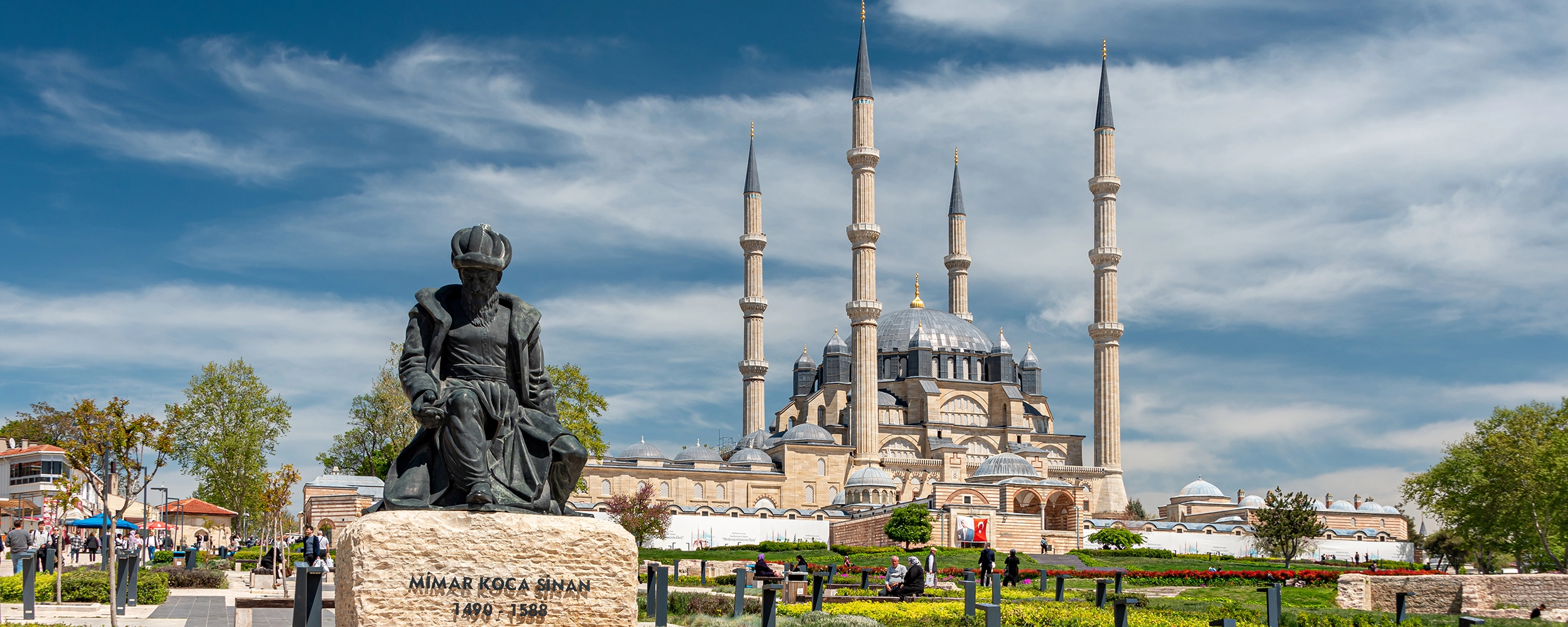
Discover monumental mosques, Ottoman medical history, covered bazaars, historic bridges, traditional food and the layered heritage of one of Türkiye's most fascinating historic cities.
View Edirne GuideUse Eski Cami as the starting point for a deeper journey through the architecture and history of the former Ottoman capital.
Continue toward Mimar Sinan's masterpiece and discover the extraordinary architectural evolution of Ottoman Edirne.
Explore Historic Edirne
Walk through Bedesten, Ali Paşa Bazaar and Saraçlar while discovering the commercial city that developed around Edirne's great mosques.
Discover More
Create a private route focused on Ottoman architecture, Islamic calligraphy, religious history and the artistic development of Edirne's great imperial mosques.
Plan Your Private Experience