Private Historic Edirne Tour
Ask us about a tailor-made route connecting Muradiye Mosque, Sarayiçi, Sultan Bayezid II Complex, Selimiye, Üç Şerefeli, Eski Cami and Edirne's traditional bazaars with your own private guide.
Request a Custom Tour





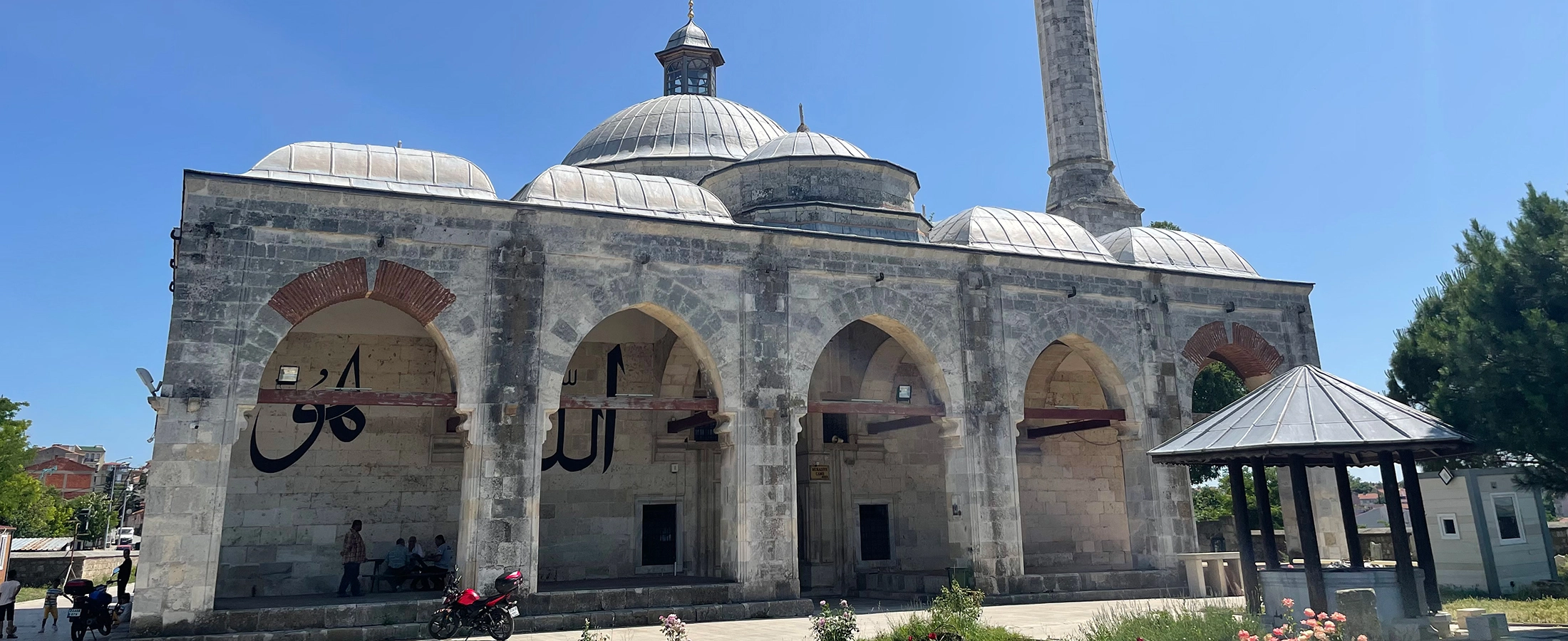
The Muradiye Mosque in Edirne, known in Turkish as Edirne Muradiye Camii, stands on a hill above the historic Sarayiçi area, away from the busiest streets of the city center.
Commissioned by Ottoman Sultan Murad II during the first half of the 15th century, Muradiye was much more than an ordinary neighborhood mosque. It formed part of a religious and charitable complex containing a Mevlevi lodge, imaret, school, fountains, cemetery and other buildings connected with spiritual, educational and charitable life.
Most of those surrounding structures have disappeared, but the mosque itself survives and remains one of the great monuments of early Ottoman Edirne.
Its exterior is remarkably restrained. Yet step inside and the character of the monument changes completely. The prayer area contains some of the most important 15th-century Ottoman tiles still preserved in Türkiye, including blue-and-white hexagonal panels, turquoise inserts, a monumental tiled mihrab and surviving layers of early painted decoration.
Muradiye is therefore particularly rewarding for travelers interested in Ottoman architecture, Islamic art, tile production, Sufi history and the development of Edirne before the age of Mimar Sinan.
Explore an important religious foundation created during the reign of the Ottoman ruler who made Edirne one of the great imperial centers of the 15th century.
See blue-and-white and multicolored tiles regarded among the masterpieces of early Ottoman ceramic decoration.
Discover the story of a major early Mevlevi lodge once established beside the mosque.
Enjoy the peaceful hilltop setting overlooking the landscape associated with Edirne's former Ottoman palace.
Essential information for visiting one of the finest surviving monuments of early Ottoman Edirne.
Muradiye neighborhood, on a hill overlooking Sarayiçi and the former Ottoman palace landscape.
Open on Google MapsCommissioned by Ottoman Sultan Murad II during the first half of the 15th century.
The foundation is documented from the late 1420s, while the mosque is generally associated with 1435–1436 in its surviving historic form.
An important example of an early Ottoman tabhaneli or zaviyeli mosque.
Exceptional 15th-century blue-and-white tiles and an extraordinary multicolored tiled mihrab.
The original complex contained one of the important early Mevlevi establishments of the Ottoman world.
Allow approximately 30–45 minutes, or longer if you are especially interested in Ottoman tiles and architecture.
Muradiye remains an active mosque, so visitors should respect prayer times and normal mosque etiquette.
Muradiye is one of the places where the architectural, artistic and spiritual world of 15th-century Ottoman Edirne survives most vividly.
Visitors usually associate Edirne first with Selimiye Mosque and the monumental architecture of the 16th-century Ottoman Empire.
Muradiye belongs to an earlier chapter. It was created when Edirne was developing as one of the principal cities of the expanding Ottoman state and before the classical architectural language associated with Mimar Sinan had emerged.
The mosque is particularly important for three reasons: its early Ottoman architectural plan, its connection with Mevlevi religious culture, and the exceptional quality of its ceramic and painted decoration.
The contrast between exterior and interior is one of the monument's greatest surprises. From outside, Muradiye appears calm, balanced and comparatively restrained. Inside, the tiled prayer area reveals a highly sophisticated artistic world of calligraphy, geometry, floral ornament and brilliant blue, turquoise and multicolored surfaces.
For travelers using our complete Edirne visitor guide, Muradiye is one of the best places to understand the artistic transition between the early Ottoman monuments of Bursa and the increasingly ambitious architecture that transformed Edirne during the 15th century.
Muradiye Mosque was commissioned by Sultan Murad II, who ruled the Ottoman Empire during a crucial period of territorial expansion, political consolidation and cultural development in the 15th century.
The precise dating of Muradiye requires some explanation. Historical documentation connected with the foundation goes back to the late 1420s, while the surviving mosque and its historical inscription are commonly associated with AH 839 / AD 1435–1436.
This difference probably reflects the development of the religious complex over several stages rather than a single moment of construction. For visitors, the safest way to understand Muradiye is as a major foundation of Murad II's Edirne during the 1420s and 1430s.
The complex originally contained far more than the mosque. Sources describe a Mevlevihane, imaret, school, fountains, dervish accommodation, cemetery and other associated buildings.
Over the following centuries Muradiye survived earthquakes, repairs, changes in religious institutions and the disappearance of most of the surrounding complex. The mosque itself, however, continued to serve the community and remains active today.
Sultan Murad II was one of the rulers who transformed Edirne from an important frontier capital into a sophisticated imperial center.
His reign saw major architectural activity, the strengthening of Ottoman institutions and the development of a court culture that connected Anatolia, the Balkans and the broader Islamic world.
Muradiye reflects this environment. It combined worship, Sufi practice, charity, hospitality, education and food distribution within one religious foundation.
This multifunctional character was typical of important Ottoman foundations, where architecture was not created simply as decoration. Buildings were designed to organize social, religious and charitable life around a network of endowed institutions.
Murad II ruled during the first half of the 15th century and made Edirne one of the central cities of his empire.
His reign supported mosques, religious complexes, charitable institutions and major architectural development.
Muradiye belongs to a period when Ottoman architects and artists were developing increasingly sophisticated forms and decorative programs.
The 15th century prepared the architectural foundations for the later monumental city dominated by Üç Şerefeli and Selimiye.
One of the most fascinating aspects of Muradiye is its connection with the Mevlevi Order, the Sufi tradition associated with Mevlana Jalal al-Din Rumi.
A substantial Mevlevihane once stood to the north of the mosque. Historical descriptions indicate that the complex contained a semahane for ceremonial gatherings, dervish cells, rooms for the sheikh, guest areas, a harem or family section, kitchen facilities, storage, a library and other service buildings.
The presence of the Mevlevi establishment gave Muradiye a spiritual function quite different from that of an ordinary congregational mosque. It became a center for Sufi education, music, hospitality, literary culture and communal life.
The wooden buildings of the lodge survived into the early 20th century. Historical photographs and drawings record parts of the complex, but the Mevlevihane itself was eventually demolished and had disappeared by the mid-20th century.
A ceremonial hall formed one of the spiritual centers of the former Mevlevi lodge.
Residential cells provided accommodation for members of the religious community.
Edirne's Mevlevi environment became closely connected with poetry, music and learned Ottoman culture.
Guest accommodation was an important function of the wider Muradiye foundation.
The lodge possessed a significant collection of manuscripts and books connected with its religious and intellectual life.
The historic Mevlevihane no longer survives, making the mosque especially important as the principal architectural witness to the complex.
Muradiye is an important example of the tabhaneli or zaviyeli mosque type developed during the early Ottoman period.
Instead of consisting only of a single prayer hall, this architectural tradition combined a sequence of domed spaces with additional rooms used for hospitality and religious-community functions.
Muradiye is built primarily of carefully cut stone and arranged along a north-south axis. Two principal domed spaces stand one behind the other, while smaller domed rooms occupy the sides.
The northern façade is preceded by a five-bay portico, or son cemaat yeri, while a single minaret rises near the northwest corner.
The overall exterior remains relatively simple. Decoration is concentrated around the entrance and, above all, inside the mosque. This restraint makes the discovery of the tiled prayer space even more dramatic.
Carefully worked masonry gives the mosque its strong and restrained exterior character.
The principal interior spaces are arranged sequentially beneath two domes.
Smaller domed tabhane rooms reflect the mosque's original role in hospitality and lodge life.
A covered entrance zone creates a transition between the courtyard and interior.
The present minaret reflects several phases of rebuilding following historic earthquakes.
A restrained exterior gives way to one of the richest surviving early Ottoman interiors in Edirne.
The terms zaviyeli mosque and tabhaneli mosque describe a distinctive group of early Ottoman buildings that combined a prayer space with additional rooms serving religious, social and charitable functions.
At Muradiye, visitors first enter a domed central space that preserves the architectural memory of an enclosed courtyard. Beyond it lies the principal prayer area, also covered by a dome.
Smaller rooms to the sides were equipped with features such as fireplaces and wall niches. These spaces were connected with hospitality and the accommodation of travelers, dervishes or members of the religious community.
This architecture makes Muradiye especially valuable because it preserves a form of Ottoman religious building that gradually became less common as large centralized mosque plans developed.
The main entrance to Muradiye is reached through the northern portico.
The marble portal contains a muqarnas-decorated hood, creating one of the principal areas of carved architectural ornament on an otherwise restrained exterior.
Windows, small niches and the geometry of the portico produce a balanced façade without competing with the visual richness reserved for the interior.
Visitors interested in Sufi history should also inspect the entrance carefully. Some decorative details around the mosque have been interpreted as symbolic references to the Mevlevi identity of the original complex.
The interior tiles are the principal reason Muradiye holds such an important place in the history of Ottoman art.
The lower sections of the walls on both sides of the mihrab are covered with blue-and-white hexagonal tiles decorated with numerous floral and geometric compositions.
Small turquoise triangular pieces fill the spaces between the hexagons, turning the wall surface into a continuous geometric arrangement.
No single repeated design dominates. Instead, visitors can discover a remarkable variety of flowers, scrolling stems, geometric patterns and motifs reflecting the artistic interaction between the Islamic world and East Asian ceramic traditions.
These tiles represent an important stage in the development of Ottoman ceramics before the later classical Iznik tile tradition reached its celebrated 16th-century form.
The dominant palette combines deep blue decoration with clear white backgrounds.
Six-sided tiles create a repeating geometric field across the lower walls of the prayer area.
Small turquoise inserts occupy the spaces between the hexagonal panels.
Scrolling stems and stylized flowers create an exceptionally varied decorative vocabulary.
Complex interlacing motifs demonstrate the sophistication of 15th-century Ottoman decorative design.
The tiles represent an important experimental stage leading toward the later achievements of Ottoman ceramic production.
The mihrab, which indicates the direction of Mecca, is the visual centerpiece of Muradiye Mosque.
Measuring approximately 3.65 × 6.35 meters, the monumental composition combines several different decorative techniques within an elaborate architectural framework.
Unlike the surrounding blue-and-white wall tiles, the mihrab incorporates a much richer palette, including turquoise, deep blue, yellow and pale green within raised geometric, floral and calligraphic compositions.
Both underglaze decoration and multicolored glazed techniques appear, making the mihrab an important document of technological experimentation during the early Ottoman period.
Calligraphic panels include the name of Sultan Murad II together with Quranic inscriptions, integrating imperial patronage, religious meaning and decorative art within one unified surface.
The mihrab dominates the prayer wall and is one of the largest decorative compositions inside Muradiye.
Different ceramic processes appear together within a single sophisticated design.
Turquoise, blue, yellow and green dramatically distinguish the mihrab from the surrounding blue-and-white wall tiles.
Quranic inscriptions form an integral part of the visual architecture rather than appearing as separate decoration.
Rumi, hatayi, palmette and scrolling plant motifs fill the architectural framework.
The mihrab is regarded as one of the outstanding surviving ceramic ensembles of the 15th century.
No surviving artist's inscription allows the tile makers of Muradiye to be identified with complete certainty.
However, art historians have long observed strong technical and stylistic connections between the tiles at Muradiye and the spectacular decoration created slightly earlier for the Yeşil Mosque and Yeşil Tomb in Bursa.
These similarities have led scholars to associate the Muradiye decoration with workshops influenced by, or directly involving, masters from Tabriz and craftsmen familiar with artistic traditions that circulated between Anatolia, Iran and Central Asia.
The result was not simply an imported style. At Edirne, these traditions were transformed within an emerging Ottoman artistic environment, helping create a decorative language that would later develop in completely new directions.
The tiles receive most of the attention, but Muradiye's kalem işi, or painted architectural decoration, is equally important for understanding the original interior.
Surviving fragments indicate that large parts of the upper walls, arches and domes were once covered with richly colored painted ornament.
Different decorative layers belong to different periods, allowing conservators and art historians to read the building almost like an archaeological sequence.
The earliest surviving fragments include combinations of red, white, yellow, dark blue and black outlines. Later layers introduced calligraphic bands and additional architectural decoration.
Some painted surfaces were rediscovered only after later coatings were removed, revealing elements of the much richer 15th-century interior hidden underneath.
Fragments preserve part of Muradiye's original multicolored decorative program.
Painted ornament once extended far beyond the tiled lower walls.
Written decoration formed an important transition between the tiled and painted surfaces.
Repairs and changing tastes introduced new decoration during subsequent Ottoman centuries.
Muradiye's ceramic decoration has not survived without serious loss.
In 2001, a number of historic tiles were deliberately damaged and stolen from the mosque. The incident caused permanent gaps within one of Türkiye's most important early Ottoman tile ensembles.
During subsequent conservation work, broken surviving fragments were repaired and returned where possible. Sections corresponding to stolen material were deliberately treated so that the difference between original historic fabric and missing areas could still be understood.
The episode is an important reminder that Muradiye is not simply a beautiful interior. Its tiles are irreplaceable archaeological and artistic documents that require careful protection.
Muradiye's single minaret stands beside the northwest side of the mosque.
Historical evidence indicates that the early minaret was originally associated with green tile decoration, giving it a considerably more colorful appearance than the structure seen today.
A powerful earthquake in 1752 caused major damage. The minaret was subsequently rebuilt in a plainer form during the Ottoman period, without reproducing all of its earlier tile decoration.
The structure was damaged again during a 20th-century earthquake and reconstructed once more. The present minaret therefore reflects a long history of repair rather than one completely unchanged 15th-century structure.
Historical descriptions indicate that the early minaret carried green tile decoration.
A major earthquake caused serious damage and resulted in reconstruction.
The replacement minaret was considerably plainer than the colorful early Ottoman version.
Further earthquake damage required another reconstruction during the 20th century.
The mosque standing today was once only one component of the much larger Muradiye Külliyesi.
Historical documents describe a complex containing a Mevlevi lodge, imaret, school, fountains, library, tomb, dervish accommodation and service buildings.
Together, these institutions supported worship, education, religious training, hospitality and the charitable distribution of food.
Most of the buildings disappeared during the 19th and 20th centuries, meaning the modern visitor must use the surviving mosque, cemetery and landscape to reconstruct the scale of Muradiye's original environment.
The principal surviving building and still an active place of worship.
The lost lodge contained ceremonial, residential and community spaces for Mevlevi life.
A charitable kitchen prepared food for dervishes, students, guests, mosque employees and others.
Education formed another important function of the original foundation.
The Mevlevi institution once possessed a significant collection of books and manuscripts.
Water facilities formed part of the practical and charitable infrastructure of the complex.
The vanished imaret was an important part of Muradiye's charitable mission.
Its facilities included kitchens, storage spaces, ovens and rooms used for preparing bread and other food.
Meals supported Mevlevi dervishes, students, travelers, guests and people serving the mosque.
Historical traditions also record the distribution of bread and special foods to people living around the complex, demonstrating how an Ottoman religious foundation could function as a social-support system for an entire neighborhood.
The historic hazire, or enclosed cemetery, survives around the mosque and forms an important part of the Muradiye experience.
The burial ground contains graves connected with generations of Mevlevi sheikhs, poets, religious scholars and prominent figures of Ottoman Edirne.
Among the individuals associated with the cemetery are leading figures from the literary and spiritual life of the Edirne Mevlevihane.
Some burials were moved here after structures belonging to the old lodge, including its tomb, were demolished during the 20th century.
Visitors should treat the cemetery as an active place of memory rather than simply an architectural feature.
Another unusual feature inside Muradiye is a stone traditionally known locally as the “Kaaba Stone.”
The object is located near the mihrab area and became associated with popular devotional traditions in Edirne.
Because of this tradition, Muradiye developed a reputation as a local visitation place in addition to its formal function as a mosque and Mevlevi center.
For modern visitors, the feature is valuable not because it proves a literal connection with the Kaaba, but because it demonstrates how historic monuments accumulate local beliefs, memories and devotional practices across many generations.
Muradiye's courtyard provides a quiet transition between the surrounding neighborhood and the mosque interior.
A historic şadırvan stands within the grounds, reflecting the importance of water for ritual preparation and the everyday life of an Ottoman religious complex.
The elevated position also gives the site a very different atmosphere from the crowded monumental center around Selimiye.
From the surroundings of Muradiye visitors can appreciate the relationship between the mosque, the Tunca valley and the historic Sarayiçi landscape below.
Muradiye rewards slow observation. Instead of seeing the building only as another mosque, divide your attention between architecture, ceramics, painted decoration, Sufi history and the surrounding landscape.
Compare the numerous floral and geometric patterns on the hexagonal wall panels.
Notice the triangular turquoise pieces creating the geometric rhythm between the larger hexagonal tiles.
Study the extraordinary combination of color, calligraphy, geometry and floral ornament around the prayer niche.
Look for Quranic inscriptions incorporated directly into the mihrab and decorative program.
Raise your eyes above the tile level to identify surviving fragments of painted decoration.
Observe how the mosque develops through two principal spaces arranged along the prayer axis.
Notice the smaller side chambers that reveal Muradiye's original social and hospitality functions.
Examine the restrained stonework and muqarnas decoration before entering.
Look carefully for details traditionally interpreted in connection with the former Sufi lodge.
Explore the historic cemetery respectfully and notice the diversity of Ottoman tombstones.
See the courtyard fountain that preserves another element of the original religious complex.
Use the hilltop position to understand Muradiye's relationship with Edirne's former Ottoman palace district.
Muradiye makes the most sense when visitors read it as several interconnected stories.
The architectural story belongs to the development of the early Ottoman tabhaneli mosque.
The artistic story belongs to workshops experimenting with new ceramic, painted and calligraphic traditions during the 15th century.
The spiritual story belongs to the Mevlevi Order and the generations of dervishes, poets, musicians and scholars who lived around the complex.
Finally, the social story is represented by the lost imaret, school, fountains and hospitality spaces that supported the surrounding community.
Muradiye remains a working mosque rather than a museum. Visitors are normally welcome outside periods when worship or religious activities make sightseeing inappropriate.
Because mosque access, maintenance and restoration arrangements can occasionally change, avoid planning your visit around a rigid published timetable.
If you arrive during congregational prayer, wait respectfully outside until worship has finished. Friday midday prayer is generally the busiest weekly period.
Shoes should be removed before entering the carpeted prayer area and placed in the designated storage area.
Shoulders and knees should be covered. Women should carry a scarf for covering the hair inside the mosque.
If worship is taking place, wait outside or remain in an area indicated by mosque staff.
Muradiye's peaceful atmosphere is part of the experience, so conversations should remain quiet.
The historic ceramic decoration is exceptionally fragile and should never be touched.
Avoid photographing people during prayer without their permission and follow any signs restricting photography.
Muradiye can be appreciated throughout the year, but the hilltop setting and active religious use make some times particularly rewarding.
A peaceful period for appreciating the interior before the middle of the day becomes busier.
Beautiful light around the courtyard and surrounding landscape can make photography especially rewarding.
Excellent weather for combining Muradiye with Sarayiçi and a longer walking tour of Edirne.
Mild temperatures and changing vegetation give the surrounding landscape a particularly attractive atmosphere.
Earlier morning or later afternoon visits are more comfortable if you plan to continue exploring outdoors.
The quiet interior remains rewarding, although cold or wet weather can affect the hilltop walk.
Enough for a quick look at the prayer hall, mihrab and principal tile panels.
A comfortable minimum for the architecture, tiles, courtyard and cemetery.
Ideal for most visitors who want to study the decorative details without rushing.
Recommended for photographers, architecture enthusiasts and visitors especially interested in Ottoman art.
Combine Muradiye with Sarayiçi, the Justice Tower and Sultan Bayezid II Complex.
Add Selimiye, Eski Cami, Üç Şerefeli, Macedonia Tower and Edirne's historic bazaars.
Muradiye offers very different photographic opportunities from Edirne's monumental central mosques. Its appeal lies in detail, texture, color and atmosphere rather than only monumental scale.
Capture the entire composition before moving closer to individual patterns and inscriptions.
Look for repeating geometry combined with constantly changing floral designs.
A wider composition can show the contrast between the colorful lower walls and the historic painted decoration above.
Use the arches of the entrance area to frame the courtyard and surrounding landscape.
The şadırvan, mosque and minaret can be combined within a balanced architectural composition.
Step back from the mosque to include the Sarayiçi landscape and wider Edirne setting.
Muradiye Mosque lies in the Muradiye neighborhood on an elevated site overlooking Sarayiçi and the Tunca River landscape.
It is still relatively close to central Edirne, but its hilltop position makes it feel considerably quieter than the district around Selimiye.
Continue north toward the Muradiye neighborhood; the route gradually leaves the busiest central streets.
The mosque rises above the historic palace landscape and can be combined naturally with a visit to the area below.
Muradiye and the historic hospital complex work well together as part of a northern Edirne heritage route.
Ask simply for “Muradiye Camii.” The historic mosque is well known in Edirne.
Use municipal transportation toward the Muradiye area and complete the final section on foot.
Walking is rewarding for visitors who enjoy exploring local neighborhoods, although the approach includes uphill sections.
Muradiye can be combined with several important historical areas that are sometimes missed by travelers concentrating only on Edirne's central mosque district. Use our complete Edirne visitor guide to plan a wider itinerary.
Explore the landscape of the former Edirne Palace and the ceremonial area associated with the historic Ottoman capital.
See one of the most recognizable surviving structures connected with the former Ottoman palace complex.
Visit the area associated with Edirne's centuries-old traditional oil-wrestling festival.
Discover the remarkable mosque, medical complex and historic hospital famous for its pioneering approach to healing.
Compare Muradiye's intimate 15th-century architecture with the monumental classical masterpiece created by Mimar Sinan.
See another key 15th-century monument representing the architectural transformation of Ottoman Edirne.
Explore an earlier Ottoman congregational mosque famous for its nine-domed plan and monumental calligraphy.
Travel even further back in Edirne's history through the surviving fortifications of Roman and Byzantine Hadrianopolis.
Begin at Muradiye Mosque while the day is still quiet. Take time to examine the 15th-century tiles, mihrab, painted decoration, courtyard and cemetery.
Continue downhill toward Sarayiçi, the landscape associated with the former Ottoman palace of Edirne. Although little of the enormous palace survives, the area remains essential for understanding Edirne's role as an imperial residence.
See the Justice Tower and explore the landscape around the traditional Kırkpınar wrestling grounds.
Then continue toward the Sultan Bayezid II Complex, where architecture, medicine, music, water and charitable institutions tell another extraordinary story of Ottoman social history.
One of the most rewarding ways to experience Edirne is to compare monuments built at different stages of Ottoman architectural development.
Start with Eski Cami, whose multiple domes preserve an early congregational mosque tradition.
Continue to Muradiye, where the tabhaneli plan, tile decoration and Sufi functions represent another strand of early Ottoman architecture.
Then visit Üç Şerefeli Mosque, where architects began moving decisively toward a large central-dome solution.
Finish with Selimiye Mosque, where Mimar Sinan transformed the central-domed mosque into one of the supreme achievements of Ottoman architecture.
Muradiye Mosque is an important 15th-century Ottoman mosque and the principal surviving monument of a larger religious complex founded by Sultan Murad II.
The mosque was commissioned by Ottoman Sultan Murad II. The architect is not known with certainty.
The Muradiye foundation developed during the late 1420s and 1430s. Historical documentation points to an early foundation date, while the mosque's surviving historical chronology is commonly associated with 1435–1436.
It is especially famous for its exceptional 15th-century Ottoman tiles, including blue-and-white wall panels and a richly colored monumental tiled mihrab.
A substantial amount of original historic tile decoration survives, although sections have been lost, damaged, restored or replaced following centuries of deterioration and modern theft.
A number of historic tiles were deliberately damaged and stolen. Surviving fragments were later conserved, while some losses remain visible.
The monumental tiled mihrab combines blue-and-white and multicolored ceramic techniques with floral, geometric and calligraphic decoration. It is considered one of the masterpieces of early Ottoman ceramic art.
Muradiye belongs to an early stage of Ottoman ceramic development before the mature classical Iznik tradition. Scholars connect its decoration with workshops influenced by artistic traditions also seen in early 15th-century Bursa.
No surviving inscription proves the identity of the tile makers, but strong technical and stylistic similarities have led scholars to associate the work with craftsmen connected to Tabriz-influenced workshops.
The mosque formed part of a complex containing an important Mevlevihane. The lodge buildings themselves no longer survive.
A Mevlevihane was a religious lodge used by members of the Mevlevi Sufi tradition for spiritual training, ceremonies, education, music, hospitality and community life.
No. The historical lodge buildings survived into the early 20th century but were eventually demolished. The mosque and historic cemetery remain the principal surviving elements of the complex.
A tabhaneli or zaviyeli mosque combines a prayer area with additional rooms originally associated with hospitality, dervish life and social functions. Muradiye is an important example of this early Ottoman building type.
The minaret suffered serious earthquake damage more than once. Its present appearance reflects reconstruction following historic collapses and differs from the more colorful early Ottoman form.
Historical sources indicate that the original minaret included green tile decoration, which was lost during later earthquake damage and rebuilding.
A stone inside the mosque became traditionally known by local people as the Kaaba Stone. The name belongs to Edirne's devotional tradition and should not automatically be interpreted as proof of the stone's physical origin in Mecca.
Yes. Muradiye remains an active mosque and visitors should respect prayer times, dress requirements and worshippers.
Muradiye functions as a mosque rather than a conventional ticketed museum. Visitors should nevertheless check for any temporary restrictions or conservation arrangements.
Women should cover their hair while inside the prayer area and all visitors should wear clothing that covers shoulders and knees.
Yes. Shoes should be removed before entering the carpeted prayer area and placed in the designated storage area.
Respectful photography is generally possible when it does not interfere with worship, but visitors should follow any current signs or instructions inside the mosque.
Approximately 30–45 minutes is ideal for most visitors. Art and architecture enthusiasts may easily spend an hour studying the tiles, mihrab and painted decoration.
Yes. The mosque occupies an elevated position overlooking the Sarayiçi area and the two sites combine naturally within the same itinerary.
A particularly rewarding route continues through Sarayiçi, the Justice Tower, Kırkpınar and the Sultan Bayezid II Complex.
Absolutely. Muradiye is one of Edirne's most rewarding less-visited monuments, especially for anyone interested in Ottoman tiles, Sufi history, early mosque architecture and places beyond the city's most famous landmarks.
Remember that Muradiye is first and foremost an active place of prayer.
The 15th-century ceramic surfaces are irreplaceable and extremely vulnerable to repeated contact.
Follow normal mosque clothing requirements and use a head covering where appropriate.
Quiet behavior helps preserve the spiritual atmosphere for both worshippers and other visitors.
Do not climb on, lean against or sit on historic gravestones within the hazire.
Avoid flash where discouraged and never interrupt people engaged in prayer.
Discover Muradiye's extraordinary tiles, Selimiye Mosque, Sarayiçi, Ottoman bazaars, historic bridges, religious heritage and the many hidden monuments of Edirne through a private route shaped around your interests.
Choose a focused architecture and Islamic-art route, a journey through Ottoman Sufi heritage, or a full-day private exploration of Edirne's mosques, palace landscape, museums, bazaars and local culture.
Ask us about a tailor-made route connecting Muradiye Mosque, Sarayiçi, Sultan Bayezid II Complex, Selimiye, Üç Şerefeli, Eski Cami and Edirne's traditional bazaars with your own private guide.
Request a Custom Tour
Discover monumental mosques, Roman archaeology, Ottoman medical history, Sufi heritage, covered bazaars, historic bridges, traditional food and the extraordinary cultural landscape of Türkiye's former Ottoman capital.
View Edirne GuideUse Muradiye as the starting point for a journey through early Ottoman architecture, Mevlevi spirituality, imperial palace history and the classical monuments that later transformed Edirne.
Follow the development of Ottoman architecture through Muradiye, Eski Cami, Üç Şerefeli and other monuments created before the classical age of Mimar Sinan.
Explore Historic Edirne
Continue from the intimate world of Muradiye to Selimiye, historic bazaars, bridges, palace remains and the monuments of the great Ottoman capital.
Discover More
Create a private route focused on Ottoman architecture, historic tiles, calligraphy, Sufi heritage, imperial patronage and the artistic development of Edirne.
Plan Your Private Experience