Mimar Kemalettin, Historic Railway Station, Treaty of Lausanne, Lozan Monument, National Struggle Museum & Karaağaç Heritage

Karaağaç Old Train Station & Lausanne Monument – Complete Edirne Guide

Discover Edirne's magnificent former railway station,
where Ottoman architecture, European railways and the Treaty of Lausanne meet beside Türkiye's western frontier.

Explore Historic Karaağaç

Karaağaç – Where Edirne's Railway History Meets the Treaty of Lausanne

Across the Tunca and Meriç rivers, on the southwestern side of Edirne, stands one of the city's most distinctive historical districts: Karaağaç.

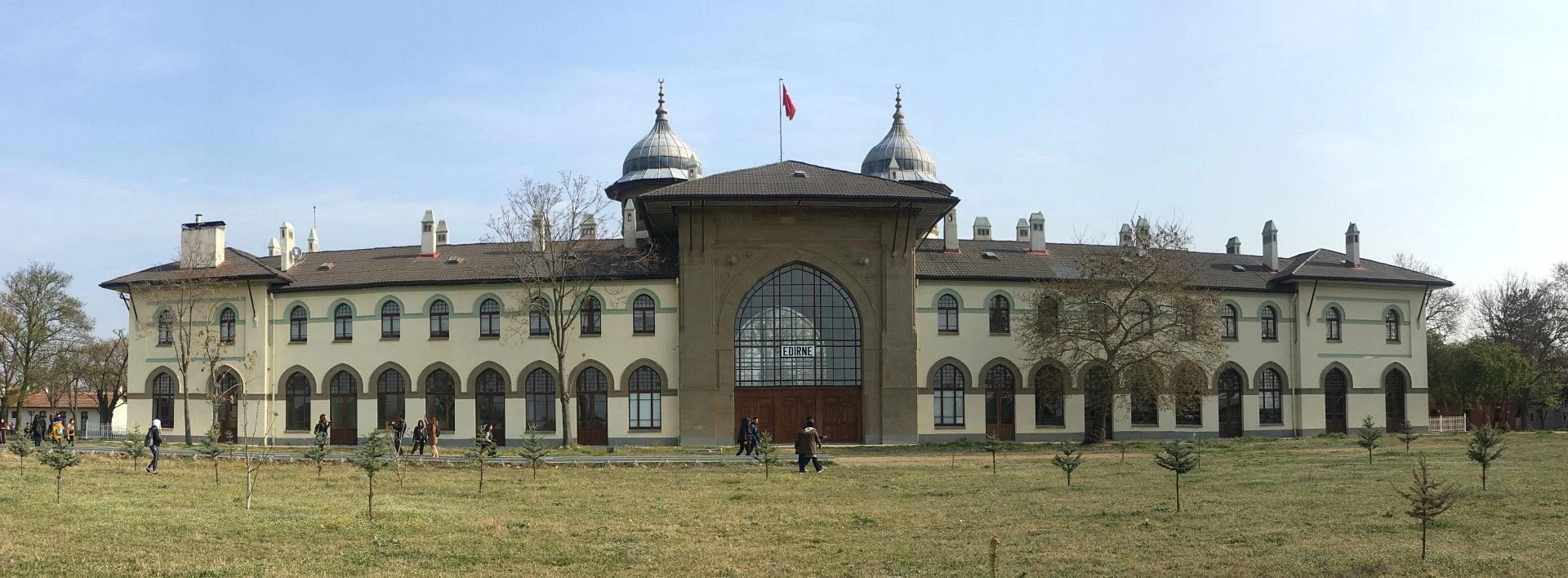
Its architectural centerpiece is the Karaağaç Old Train Station, also known as the Historic Edirne Railway Station, an elegant early 20th-century railway building designed by Mimar Kemalettin Bey.

The station once belonged to the international railway network connecting Istanbul with Europe. Its history, however, became inseparable from the extraordinary political events that transformed the Balkans during the Balkan Wars, First World War and Turkish War of Independence.

Borders shifted around the railway. Administrations changed. Edirne itself was occupied. And eventually, with the Treaty of Lausanne signed on 24 July 1923, Karaağaç became part of the territory of the new Turkish state.

That history is commemorated today by the enormous Lozan Anıtı – Lausanne Monument, standing inside the former railway complex beside the National Struggle and Lausanne Museum.

The railway station itself no longer serves passenger trains. Instead, the historic buildings form part of Trakya University's Karaağaç Campus, where museums, art, historic railway equipment, monumental trees and the preserved station architecture have created one of the most atmospheric cultural areas in Edirne.

Historic Train Station

See one of Mimar Kemalettin's remarkable early 20th-century railway buildings and a landmark of Edirne's connection with Europe.

Treaty of Lausanne

Discover why Karaağaç occupies a special place in the diplomatic history that established Türkiye's modern western frontier.

Lausanne Monument

Explore a monumental symbolic composition representing Anatolia, Thrace, Karaağaç, unity, peace and the Lausanne agreement.

Railway Heritage

Walk around historic station buildings and see the nostalgic locomotive recalling the age of international steam travel.


Know Before You Go

Karaağaç Old Train Station & Lausanne Monument – Quick Facts

Essential information for exploring one of Edirne's most fascinating historical and cultural districts.

📍

Location

Karaağaç neighborhood, southwest of central Edirne, beyond the Tunca and Meriç rivers.

Open on Google Maps
🚂

Historic Function

A major railway station on the international route connecting Istanbul and Edirne with Europe.

🏛️

Architect

The surviving monumental station building was designed by celebrated Ottoman architect Mimar Kemalettin Bey.

📜

Construction

Work began during the early 1910s and the building is generally considered to have been completed around 1914.

🚉

Railway Service

Political upheaval delayed its regular use; the station finally entered service in 1930.

🕊️

Lausanne

Karaağaç became Turkish territory through the settlement associated with the Treaty of Lausanne signed in 1923.

🎓

Today

The historic station forms part of Trakya University's Karaağaç Campus and houses university cultural and educational functions.

⏱️

Suggested Visit

Allow approximately 1½–2½ hours for the station, locomotive, Lausanne Monument, museums and campus grounds.


Railways, Architecture and the Birth of Modern Borders

Why Is Karaağaç Old Train Station Important?

Few places in Edirne bring architecture, transportation, international diplomacy and modern Turkish history together as powerfully as Karaağaç.

At first sight, the attraction appears to be a beautifully preserved historic railway station.

But Karaağaç tells a much larger story.

The railway connected the Ottoman capital with Central and Western Europe, while the station represented the modern infrastructure through which passengers, merchants, officials, soldiers and ideas crossed the Balkans.

The building is also important as a work associated with Mimar Kemalettin, one of the leading architects of the late Ottoman and early Turkish architectural transition.

Yet its greatest historical significance comes from geography.

The railway line around Edirne crossed territory whose political ownership changed repeatedly during the turbulent first decades of the 20th century.

Karaağaç therefore became part of the negotiations that established the frontier between Türkiye and Greece after the Turkish War of Independence.

Today, the station, Lausanne Monument and museum together allow visitors to understand that history within the actual landscape where railways, rivers and international borders meet.

For travelers using our complete Edirne visitor guide, Karaağaç provides an essential contrast to the Ottoman imperial monuments of the historic city center.

The Arrival of the Railway in Karaağaç

The railway reached the Edirne region during the great expansion of Ottoman railway construction in the 19th century.

An earlier station building was already present at Karaağaç by 1872, decades before the monumental structure seen today.

Railways transformed Edirne's relationship with the wider world.

The city, which had historically occupied one of the most important land routes between the Balkans and Istanbul, was now integrated into a modern international railway system.

Passengers could move through Thrace toward Istanbul or continue westward into the expanding European railway network.

Karaağaç became the railway gateway through which this movement passed.

1872

An earlier railway station was already operating at Karaağaç during the first phase of railway development around Edirne.

International Route

The railway formed part of the transport network linking Istanbul with the Balkans and European destinations.

Passengers

Travelers, government officials, merchants and railway employees passed through the Karaağaç station district.

Trade

Rail transport strengthened Edirne's historic position as a commercial gateway between Anatolia and Europe.

The Construction of the Present Karaağaç Train Station

By the beginning of the 20th century, Edirne required a more ambitious station building.

The project was entrusted to Mimar Kemalettin Bey, one of the most influential architects of his generation.

The exact chronology of the design and beginning of construction is not completely certain. Historical research generally places the beginning of construction around 1911–1913.

The station building was largely completed around 1914.

Its completion, however, coincided with one of the most unstable periods in the history of the region.

The Balkan Wars, First World War and repeated changes of political control prevented the building from immediately functioning as the major railway terminal for which it had been designed.

Regular operation at the new station would not begin until 1930.

1872 An earlier railway station exists at Karaağaç.
1911–1913 The monumental new station project begins during the final Ottoman period.
c. 1914 The present station building is generally considered substantially completed.
1914–1920s War, occupation and changing borders prevent normal use of the new terminal.
1930 The station finally enters regular railway service.

Mimar Kemalettin and the Architecture of Karaağaç Station

Ahmed Kemaleddin Bey, better known as Mimar Kemalettin, was one of the most important architects working during the transition from the late Ottoman Empire to the early Turkish Republic.

His architecture combined modern construction requirements with a renewed interest in historical Ottoman forms.

This approach contributed to what became known as the First National Architectural Movement.

At Karaağaç, the station was not designed as a simple utilitarian transport building.

It was conceived as a monumental gateway to the city, with a long symmetrical façade, arched windows, tower-like projections, domed roof elements and carefully organized entrances.

The result communicates both the technological modernity of the railway and an architectural identity rooted in Ottoman visual traditions.

Symmetrical Façade

The long exterior is arranged around a strong central composition and balanced projecting sections.

Arched Windows

Rows of arched openings give the building a distinctive rhythm while bringing generous light into the interior.

Domed Towers

Vertical tower-like elements crowned with domed roofs give the station its instantly recognizable silhouette.

Ottoman References

Historic architectural motifs were reinterpreted within a modern railway building.

Monumental Entrance

The central entrance emphasizes the station's function as an important gateway rather than an ordinary local stop.

Railway Modernity

The architecture reflects an era when railway stations represented progress, movement and international connection.

Architecture of Karaağaç Old Train Station

The station is a long rectangular structure approximately 80 meters in length.

Historical descriptions identify it as a three-storey building, although its strongly horizontal composition makes the structure appear lower and wider when seen from the front.

The central section is emphasized by an enormous arched opening, while tower-like vertical masses create a dramatic central silhouette.

Along the wings, regular sequences of windows and restrained decorative details produce a disciplined architectural rhythm.

The station's appearance is particularly striking because of the contrast between its monumental scale and the quiet, tree-filled landscape of Karaağaç.

Look at the building from a distance first: the long façade is best understood as a complete composition. Afterward, move closer to examine the arched windows, roofline, stone detailing and entrance areas individually.

Inside the Historic Railway Station

The interior of Karaağaç Station has changed considerably during more than a century of use.

Originally, the ground floor contained the practical spaces expected inside an important railway terminal, including waiting rooms, ticket facilities, baggage areas and passenger services.

Railway administration, staff facilities and residential functions occupied other parts of the complex.

A significant renovation in 1959 reorganized sections of the interior to meet changing railway needs.

Later, after the station ceased railway operation, rooms were adapted for university accommodation, classrooms, administrative offices and eventually Fine Arts Faculty functions.

Visitors should therefore understand the building as a historical structure that has continually evolved, rather than an untouched railway interior frozen in 1914.

Karaağaç Railway and the Changing Borders of Thrace

The unusual geography of Karaağaç cannot be understood without looking at the railway.

Unlike most of Edirne, Karaağaç lies west of the Meriç River.

That position became politically important as Ottoman territory in the Balkans contracted during the early 20th century.

A border adjustment agreed between the Ottoman Empire and Bulgaria in 1915 affected railway territory around Edirne and complicated the city's access to its own railway network.

The railway, which had been constructed primarily to connect cities, was now crossing newly created national frontiers.

Karaağaç therefore became an extraordinary example of how transportation infrastructure could influence international boundary negotiations.

Think geographically: when visiting Karaağaç, remember that you have crossed both the Tunca and Meriç rivers and are standing on the western side of the principal Meriç channel, very close to today's Greek frontier.

Karaağaç During the Turkish National Struggle

After the First World War, the future of Thrace became one of the major territorial questions facing the collapsing Ottoman Empire.

Greek forces entered Edirne on 25 July 1920, beginning a period of occupation that transformed political and everyday life across the region.

The military situation changed dramatically after the success of the Turkish National Movement in Anatolia.

The Mudanya Armistice of 1922 opened the way for the return of Eastern Thrace to Turkish administration.

Karaağaç, however, was directly connected with the final diplomatic settlement reached at Lausanne.

The Treaty of Lausanne and Karaağaç

The Treaty of Lausanne was signed in Switzerland on 24 July 1923.

The agreement and its associated protocols settled many of the international questions remaining after the Turkish War of Independence, including territorial, financial, minority and sovereignty issues.

Within this settlement, Karaağaç and the surrounding area were transferred to Türkiye in connection with the reparations settlement between Türkiye and Greece.

The decision gave the district an importance far beyond its modest geographical size.

Karaağaç became a highly visible symbol of the diplomatic negotiations that accompanied international recognition of the new Turkish state and the definition of its western frontier.

Greek forces withdrew from Karaağaç in September 1923, completing the transfer of the district to Turkish administration.

24 July 1923 The Treaty of Lausanne is signed.
Karaağaç The district becomes part of Türkiye within the Lausanne territorial settlement.
Reparations The transfer is associated with the settlement of Turkish claims arising from wartime damage.
September 1923 The transfer on the ground is completed as Greek forces and authorities leave Karaağaç.
Modern Frontier The agreement helped establish the border landscape visitors see around Edirne today.

Why Is Karaağaç Connected So Closely with Lausanne?

Most travelers associate the Treaty of Lausanne with international diplomacy, conference tables and political leaders.

Karaağaç gives that diplomacy a physical landscape.

Here, visitors can stand in the very district whose sovereignty was determined through the Lausanne settlement.

The historic station adds another layer to that story because the railway itself was one of the reasons the geography of the frontier had become so complicated.

The result is unusual: a railway station, international boundary and diplomatic treaty are all connected within the same historical narrative.

Karaağaç Station from 1930 to 1971

Although the building was substantially completed before the First World War, the station did not begin normal service until 1930.

For the following decades, Karaağaç once again functioned as Edirne's major railway gateway.

Passengers arriving from Istanbul or continuing toward Europe passed through the station, while railway workers and associated services gave the surrounding district its distinctive character.

The building underwent an important renovation in 1959, when interior areas were adapted and reorganized.

Eventually, a new railway alignment allowed trains travelling between Istanbul and Edirne to remain entirely within Turkish territory.

With the opening of the replacement Edirne station, railway operations at Karaağaç ended.

The historic station was abandoned for railway purposes on 4 October 1971.

What Happened After Karaağaç Station Closed?

The end of passenger railway service did not mean the end of the station's history.

During the 1974 Cyprus crisis, the strategically located building was temporarily used as a forward military post.

In 1977, the property was acquired for the newly established educational institution in Edirne that would eventually form part of today's Trakya University.

Over the following decades, the former station was used for several university functions, including guest accommodation, classrooms and the university rectorate.

Today, the magnificent station building forms part of Trakya University's Faculty of Fine Arts and the wider Karaağaç cultural campus.

1971

Regular railway use of the historic station ends after the railway route changes.

1974

The strategically placed building serves temporarily as a forward post during the Cyprus crisis.

1977

The former railway property is acquired for higher-education use in Edirne.

University Era

The station subsequently serves as accommodation, teaching space and university administration.

Fine Arts

The historic building is now associated with Trakya University's Faculty of Fine Arts.

Cultural Campus

The surrounding railway complex now combines education, museums, monuments, art and heritage tourism.

The Nostalgic Steam Locomotive at Karaağaç

One of the most photographed objects within the former station grounds is the preserved black steam locomotive.

Standing beside the railway buildings, the locomotive immediately restores the transportation identity of a campus that might otherwise appear to be simply a collection of historic university structures.

Its boilers, driving wheels, rods, cab and railway track provide a powerful visual reminder of the period when steam-powered trains connected Edirne with Istanbul and European destinations.

For children and railway enthusiasts, it is often one of the most memorable features of the visit.

Best photograph: move far enough away to include both the locomotive and the historic station façade. The combination explains the site's railway heritage immediately.

The Lausanne Monument – Lozan Anıtı

The enormous Lausanne Monument is one of the most recognizable modern monuments in Edirne.

It was created within the Karaağaç campus to commemorate the Treaty of Lausanne and the incorporation of Karaağaç into Türkiye.

The foundation stone was laid on 29 March 1998.

The monument and surrounding square were completed in only 110 days and officially opened on 19 July 1998 by President Süleyman Demirel.

Its design is highly symbolic. Three enormous vertical columns represent Anatolia, Thrace and Karaağaç.

36.45 m – Anatolia

The tallest of the three columns represents Anatolia, the principal Asian territory of Türkiye.

31.95 m – Thrace

The second great column symbolizes Thrace, Türkiye's territory on the European continent.

17.45 m – Karaağaç

The smaller central column represents Karaağaç, the district incorporated into Türkiye through the Lausanne settlement.

The Symbolism of the Lausanne Monument

The three columns are only one part of the monument's symbolic composition.

A concrete ring connecting the vertical elements represents unity and solidarity.

In front of it stands a monumental young woman figure approximately 4.2 meters high.

The figure represents aesthetics, grace and law.

In one hand she holds a dove, symbolizing peace and democracy.

In the other she holds a document representing the Treaty of Lausanne.

The monument therefore combines territory, national unity, law, diplomacy and peace within a single visual composition.

Three Columns Anatolia, Thrace and Karaağaç
Concrete Ring Unity and solidarity
Young Woman Aesthetics, grace and law
Dove Peace and democracy
Document The Treaty of Lausanne

National Struggle and Lausanne Museum

The historical story presented by the monument continues inside the National Struggle and Lausanne Museum.

The idea of creating a Lausanne-focused museum at Karaağaç developed during the 1990s.

Collections were assembled around books, documents, photographs and historical material connected with the Turkish National Struggle and the Treaty of Lausanne.

Material associated with İsmet İnönü, who headed the Turkish delegation during the Lausanne negotiations, occupies an important place within the story.

The museum received official museum status from the Ministry of Culture in 2000.

Its location beside the station and monument is particularly meaningful, because visitors can move from historical documents directly into the landscape whose political future was determined by those negotiations.

İsmet İnönü and the Lausanne Conference

A key figure in the story presented at Karaağaç is İsmet İnönü.

Then known internationally as İsmet Pasha, he led the principal Turkish delegation during the Lausanne negotiations.

The conference required months of difficult diplomacy over territorial borders, financial obligations, minorities, international legal questions and the political status of the new Turkish state.

A bust of İsmet İnönü stands within the monument area, while museum material helps explain his role in the negotiations.

Trakya University Karaağaç Campus Today

The former railway complex is now part of Trakya University.

The monumental station building is associated with the Faculty of Fine Arts, creating an especially appropriate new life for one of Edirne's most distinguished architectural landmarks.

Historic auxiliary railway buildings, large gardens and mature trees give the campus a character quite unlike a conventional modern university complex.

Visitors therefore encounter several layers simultaneously: a historic railway station, an educational campus, an open-air heritage environment, art museums, historical exhibitions and a monumental national memorial.

Museums and Collections at Karaağaç Campus

Trakya University's Karaağaç Campus contains several cultural collections, making it possible to spend considerably longer here than visitors often expect.

National Struggle & Lausanne Museum

Documents, books and historical material explain the National Struggle, Lausanne negotiations and the political importance of Karaağaç.

İlhan Koman Sculpture & Painting Museum

Discover works connected with internationally important Edirne-born sculptor İlhan Koman together with additional Turkish artworks.

Natural History Museum

A university collection introducing aspects of the natural world and scientific heritage.

Balkan Universities Association Museum

A collection reflecting Trakya University's educational and cultural connections throughout the Balkans.

Güngör–Rifat Arıbal Collection

Another cultural collection forming part of the diverse museum environment within the campus.

Historic Railway Heritage

The station, locomotive and surviving railway buildings function almost as an additional open-air museum in their own right.

Current access arrangements can change: Trakya University introduced a campus visitor admission system in 2024 covering the historic station, nostalgic train and university museums. Check current prices, museum opening arrangements and temporary closures before relying on older information online.

İlhan Koman Sculpture and Painting Museum

Art lovers should not leave Karaağaç without noticing the connection with İlhan Koman, one of the most important modern sculptors born in Türkiye.

Koman was born in Edirne and later developed an international artistic career.

His work explored geometry, movement, mathematics, material and the relationship between sculpture and space.

The museum at Karaağaç preserves works associated with Koman and presents additional artworks within the unusual architectural setting of the former railway complex.

There is also a personal connection between the Koman family and the station: his father, Dr. Fuat Koman, served as a railway doctor here during the 1940s.

What to See at Karaağaç Old Train Station & Lausanne Monument

Do not treat Karaağaç as a single photo stop. The district contains several different layers that are best explored slowly.

Station Façade

Step back far enough to appreciate the extraordinary length, symmetry and domed towers of Mimar Kemalettin's design.

Central Entrance

Examine the monumental arched entrance that gives the railway station much of its ceremonial character.

Historic Windows

Follow the repeating arched window pattern along the long wings of the station.

Steam Locomotive

See the preserved railway engine that immediately recalls Karaağaç's original transportation function.

Lausanne Monument

Walk around the monument to understand the different heights and relationship between its three symbolic columns.

Dove & Treaty

Look closely at the central female figure carrying the symbols of peace and the Lausanne agreement.

İsmet İnönü Bust

Notice the memorial to the chief Turkish negotiator at the Lausanne Conference.

Lausanne Museum

Use historical documents and photographs to place Karaağaç within the wider National Struggle and diplomatic settlement.

İlhan Koman Museum

Add a completely different artistic dimension to the visit through modern Turkish sculpture and painting.

Historic Railway Buildings

Look beyond the monumental terminal and notice the smaller structures belonging to the former railway complex.

Campus Trees

Mature trees and landscaped grounds contribute significantly to Karaağaç's peaceful atmosphere.

Karaağaç Neighborhood

Continue outside the campus to explore the quiet streets and historic houses of Edirne's unusual riverside district.

How to Understand the Karaağaç Station Complex

Karaağaç becomes much more interesting when visitors stop thinking of it as simply an old train station.

Railway Story An international railway once connected Edirne and Istanbul with the European network.
Architectural Story Mimar Kemalettin transformed a practical station into a monumental early 20th-century landmark.
Border Story Political frontiers shifted around the railway during the Balkan Wars and First World War era.
National Struggle Edirne and Karaağaç experienced occupation before returning to Turkish administration.
Diplomatic Story The Treaty of Lausanne determined Karaağaç's final status within Türkiye.
Modern Story A former railway terminal now functions as a university, museum and cultural heritage campus.

Karaağaç Old Train Station Visitor Information

The historic station grounds form part of an active university campus rather than a conventional standalone archaeological site.

Access arrangements, museum schedules and visitor charges can therefore be updated by Trakya University.

Since October 2024, the university has operated a visitor admission system for the Karaağaç campus. The admission arrangement has included access to the historic station, nostalgic train and several museums, together with museum guidance.

Because these arrangements can change, check current information before visiting rather than relying on older websites that still describe the site as universally free.

Turkish Name Karaağaç Eski Tren Garı / Karaağaç Tren Garı
Location Karaağaç, Edirne
Architect Mimar Kemalettin Bey
Building Period Early 1910s; substantially completed around 1914
Railway Service 1930–1971 in the monumental station building
Current Use Trakya University cultural and Fine Arts campus
Admission Visitor admission is currently managed by Trakya University; check the latest university arrangements
Suggested Time 1½–2½ hours for the station, monument and museums

Best Time to Visit Karaağaç Old Train Station

Morning

A peaceful time to explore the station architecture and campus grounds before visitor numbers increase.

Late Afternoon

Warm directional light can be especially beautiful on the station façade and around the Lausanne Monument.

Spring

One of the most attractive seasons for combining the campus with a walk across the historic river bridges.

Summer

The mature trees provide welcome shade, although midday temperatures can be high.

Autumn

Foliage around the campus creates some of the best atmospheric photography of the historic station.

Winter

A quieter season that emphasizes the railway architecture, although outdoor exploration can be cold and windy.

How Much Time Do You Need at Karaağaç?

30 Minutes

Enough only for photographs of the historic station, locomotive and Lausanne Monument.

60 Minutes

A comfortable quick visit covering the principal outdoor monuments and railway architecture.

1½ Hours

Ideal for the station, locomotive, Lausanne Monument and one or two museum collections.

2–2½ Hours

Recommended for visitors who want to explore the museums and historic campus without rushing.

Half Day

Add the Karaağaç neighborhood, Meriç Bridge, Tunca Bridge and riverside landscapes.

Full Day

Continue into central Edirne for Selimiye, Eski Cami, Üç Şerefeli, bazaars and additional museums.

Photography at Karaağaç Old Train Station

Karaağaç is one of the most varied photographic locations in Edirne.

Full Station Façade

Use a wide composition to emphasize the exceptional length and symmetry of Mimar Kemalettin's design.

Central Towers

A more vertical composition highlights the station's domed central elements and monumental entrance.

Locomotive & Station

Position the steam locomotive in the foreground with the historic station behind it for the clearest railway story.

Lausanne Monument

A low viewpoint exaggerates the height of the three symbolic columns and produces a dramatic composition.

Tree-Lined Campus

Use the mature trees to frame the historic architecture and create a softer, more atmospheric image.

Architectural Details

Arches, window frames, rooflines and masonry provide excellent subjects for closer compositions.

Remember that this is an active university: photograph the architecture freely where permitted, but avoid intruding on students, classes, offices or museum activities. Follow any current restrictions on interior photography.

How to Get to Karaağaç Old Train Station

Karaağaç lies southwest of Edirne's historic center, on the far side of both the Tunca and Meriç rivers.

The journey itself is part of the experience, because the traditional route crosses some of Edirne's most beautiful historic bridges.

From Central Edirne

Travel southwest toward Karaağaç, crossing the Tunca and Meriç river landscapes before entering the neighborhood.

By Taxi

Ask for “Karaağaç Eski Tren Garı” or “Trakya Üniversitesi Karaağaç Yerleşkesi.”

By Local Transport

Municipal transport serves the Karaağaç direction; check the current route most convenient for your starting point.

By Car

Follow the road toward Karaağaç after crossing the historic river corridor west of central Edirne.

By Bicycle

The relatively flat riverside corridor makes Karaağaç an attractive destination for cyclists in suitable weather.

On Foot

Walking from central Edirne is rewarding for active visitors because it allows time for both the Tunca and Meriç bridges.

Tunca Bridge, Meriç Bridge and the Road to Karaağaç

Approaching Karaağaç from central Edirne creates one of the city's most enjoyable heritage routes.

The road first crosses the Tunca River and then the broader Meriç River.

Historic Ottoman bridges, riverbank vegetation, tea gardens and open views make this area feel very different from the monumental mosque district around Selimiye.

After crossing the Meriç, the road continues toward Karaağaç and the old railway station.

This approach also helps explain why the district has such unusual geography: Karaağaç lies beyond the main river that today forms much of the Turkish-Greek frontier around Edirne.

Hacı Adil Bey Fountain

Travelers continuing toward Karaağaç should also notice the historic Hacı Adil Bey Fountain.

The stone fountain was constructed in 1904 and represents another surviving element of the late Ottoman landscape along the road to Karaağaç.

Although much smaller than the railway station, it helps connect the monumental architecture with the everyday urban infrastructure of early 20th-century Edirne.

Places to Visit Near Karaağaç Old Train Station

Karaağaç works especially well as part of a broader Edirne itinerary. Use our complete Edirne visitor guide to continue exploring.

Meriç Bridge

One of Edirne's most beautiful historic bridges and an atmospheric crossing on the traditional road toward Karaağaç.

Tunca Bridge

Cross another historic Ottoman bridge spanning the river landscape between central Edirne and Karaağaç.

Karaağaç Neighborhood

Walk through leafy streets containing historic houses, cafés and reminders of the district's cosmopolitan railway past.

Hacı Adil Bey Fountain

See an attractive 1904 Ottoman fountain standing along the historic approach to Karaağaç.

Selimiye Mosque

Return to central Edirne to experience Mimar Sinan's monumental masterpiece and the city's most celebrated skyline.

Eski Cami

Explore one of Edirne's most important early Ottoman mosques with its nine domes and monumental calligraphy.

Üç Şerefeli Mosque

See a revolutionary 15th-century Ottoman mosque that helped transform the architecture of large congregational spaces.

Macedonia Tower Museum

Discover Roman and Byzantine Hadrianopolis and the surviving remains of Edirne's ancient fortifications.

Suggested Karaağaç Heritage Route

Begin in central Edirne and travel toward the river district.

Cross the Tunca Bridge and continue toward the Meriç Bridge, taking time to enjoy the historic river landscape.

Continue along the traditional road toward Karaağaç, stopping briefly at the Hacı Adil Bey Fountain.

At Karaağaç Old Train Station, explore Mimar Kemalettin's architecture, the preserved locomotive and the surviving railway complex.

Then continue to the Lausanne Monument and the National Struggle and Lausanne Museum to understand why this quiet district became so important to Türkiye's modern diplomatic history.

If time allows, finish with the İlhan Koman Sculpture and Painting Museum and a walk through the leafy streets of Karaağaç.

Start Central Edirne
River Heritage Tunca Bridge
Classic View Meriç Bridge and riverside landscape
Ottoman Detail Hacı Adil Bey Fountain
Main Stop Karaağaç Old Train Station and steam locomotive
Modern History Lausanne Monument and National Struggle & Lausanne Museum
Art İlhan Koman Sculpture & Painting Museum
Allow approximately half a day for the complete route at a relaxed pace, especially if you intend to visit the campus museums.

Karaağaç – Railway, Border and Diplomacy

Karaağaç is particularly unusual because three different kinds of history overlap here.

The railway story belongs to the industrial age, when international train lines connected the Ottoman Empire with Europe.

The border story belongs to the collapse of Ottoman power in the Balkans and the constantly changing political geography of the early 20th century.

The diplomatic story belongs to Lausanne, where negotiations transformed military victory into internationally recognized political borders.

All three stories can still be read within a relatively small area around the historic station.

Frequently Asked Questions About Karaağaç Old Train Station

Where is Karaağaç Old Train Station?

The station is located in the Karaağaç neighborhood of Edirne, southwest of the historic city center and beyond the Tunca and Meriç rivers.

Who designed Karaağaç Train Station?

The monumental surviving station building was designed by Mimar Kemalettin Bey, one of the most important Ottoman architects of the early 20th century.

When was Karaağaç Train Station built?

Construction is generally associated with the period around 1911–1914. The building was substantially complete around 1914, although political events delayed its railway use.

Was there an older station before this building?

Yes. An earlier railway station was already present at Karaağaç by 1872.

When did the present station begin operating?

Although completed much earlier, the monumental building did not enter normal railway service until 1930.

Why did it take so long to open?

The Balkan Wars, First World War, occupation, changing borders and post-war political developments repeatedly disrupted the railway and the status of Karaağaç.

When did Karaağaç Station close?

Railway operations ended after the route was reorganized and a new station served Edirne. The old Karaağaç station ceased railway use in 1971.

What is the station used for today?

The historic station is part of Trakya University's Karaağaç Campus and is associated with the Faculty of Fine Arts and cultural activities.

Why is Karaağaç connected with the Treaty of Lausanne?

Karaağaç became Turkish territory through the territorial settlement associated with the Treaty of Lausanne of 1923.

Was Karaağaç given to Türkiye as war reparations?

The transfer of Karaağaç formed part of the Lausanne settlement connected with the reparations question between Türkiye and Greece following wartime destruction.

When was the Treaty of Lausanne signed?

The treaty was signed on 24 July 1923 in Lausanne, Switzerland.

When did Karaağaç finally become part of Türkiye?

The Lausanne settlement established its status, and the territorial transfer on the ground was completed during September 1923.

What is the Lausanne Monument?

The Lozan Anıtı is a monumental memorial inside Karaağaç Campus commemorating the Treaty of Lausanne and the incorporation of Karaağaç into Türkiye.

When was the Lausanne Monument built?

Its foundation was laid on 29 March 1998 and the completed monument was officially opened on 19 July 1998.

What do the three columns symbolize?

The 36.45-meter column represents Anatolia, the 31.95-meter column represents Thrace, and the 17.45-meter column represents Karaağaç.

What does the woman on the Lausanne Monument represent?

The young woman figure symbolizes aesthetics, grace and law. The dove in her hand represents peace and democracy, while the document represents the Treaty of Lausanne.

Is there a Lausanne Museum?

Yes. The National Struggle and Lausanne Museum contains documents, books, photographs and material related to the National Struggle and Lausanne negotiations.

Who was Türkiye's chief representative at Lausanne?

The principal Turkish delegation was led by İsmet İnönü, then known as İsmet Pasha.

Is there still a train at Karaağaç?

The station is no longer used for regular passenger services, but a preserved historic locomotive and railway equipment remain as part of the site's heritage.

Are there other museums at Karaağaç Campus?

Yes. The campus includes several collections, including the İlhan Koman Sculpture and Painting Museum and other university museums.

Is Karaağaç Old Train Station free to visit?

Older travel information often describes the campus as free, but Trakya University introduced visitor admission charges in 2024. Check the university's latest information for current prices and access arrangements.

How long should I spend at Karaağaç?

Allow around 1½–2½ hours for the station, locomotive, Lausanne Monument and museums. A half day is better if you also explore the neighborhood and historic bridges.

Can I walk to Karaağaç from central Edirne?

Yes. Active visitors can walk, and the route is especially rewarding because it crosses the historic Tunca and Meriç river landscapes.

Is Karaağaç Old Train Station worth visiting?

Absolutely. It is one of Edirne's best places for understanding railway history, early 20th-century architecture, the Turkish National Struggle, the Treaty of Lausanne and the creation of modern borders.

Responsible Visiting at Karaağaç Campus

Respect University Life

Remember that parts of the historic station remain active educational and administrative spaces.

Follow Museum Rules

Observe current photography, touching and access restrictions inside exhibitions.

Protect Railway Heritage

Do not climb on the locomotive, railway equipment or historic architectural elements unless specifically permitted.

Protect the Grounds

Use established paths and help preserve the campus's mature trees and landscaped areas.

Photograph Thoughtfully

Avoid photographing students or university activities at close range without permission.

Allow Time for the Museums

The exhibitions are part of Karaağaç's historical story rather than simply optional additions to the station photograph.

Private Karaağaç & Historic Edirne Experiences

Discover Karaağaç Old Train Station, the Lausanne Monument, historic river bridges, Selimiye, Ottoman bazaars, imperial architecture and Edirne's extraordinary position between Türkiye and the Balkans through a private route shaped around your interests.

Custom Historic Edirne Experience

Combine Ottoman imperial monuments with the fascinating modern history of railways, international borders, the National Struggle and the Treaty of Lausanne.

Historic Edirne Selimiye Mosque Ottoman bridges bazaars Karaağaç and cultural heritage

Explore Edirne

Discover Selimiye, early Ottoman mosques, Roman archaeology, historic bridges, Ottoman medicine, Sufi heritage, traditional bazaars, Karaağaç and the multicultural history of Türkiye's former Ottoman capital.

View Edirne Guide

Continue Exploring Edirne's Historical Layers

Use Karaağaç as the starting point for understanding Edirne not only as an Ottoman capital, but also as a railway gateway, border city and one of the most important locations in the modern history of Turkish-European relations.

Historic Edirne Ottoman mosques bridges rivers and cultural monuments Turkey

Ottoman Edirne

Continue from modern Karaağaç history to Selimiye, Eski Cami, Üç Şerefeli, Ottoman bazaars, palace remains and centuries of imperial architecture.

Discover More