Ten Yufka Layers
The registered Balıkesir Kaymaklısı is made with ten dry yufka sheets arranged as five below and five above the kaymak.






Balıkesir Kaymaklısı is one of the most distinctive traditional desserts of Balıkesir in north-western Türkiye. It is made from layers of specially prepared dry yufka, a generous centre of buffalo kaymak, and a sweet syrup added after the pastry layers have been browned and assembled.
The registered version is unusually precise. It consists of ten yufka layers: five form the base, buffalo kaymak is spread through the middle, and another five complete the top. The yufka dough itself is prepared with wheat flour, egg, wheat starch, sunflower oil and buffalo milk from which the cream has been removed.
Balıkesir Kaymaklısı received Turkish geographical-indication protection in 2022 as a Mahreç İşareti. Its protected geographical boundary covers the central Balıkesir districts of Altıeylül and Karesi, and the official specification emphasises both the buffalo kaymak and the local skill required to prepare and brown the yufka correctly.
Balıkesir Kaymaklısı was registered by TÜRKPATENT in 2022 under registration No. 1264.
The registered dessert is constructed from ten dry yufka sheets, divided into two groups of five.
Rich manda kaymağı is the defining filling and gives the dessert its soft texture and dairy aroma.
The protected geographical area is centred on Balıkesir's Altıeylül and Karesi districts.
Essential information about one of Balıkesir's protected traditional desserts.
Balıkesir, with the protected production area covering Altıeylül and Karesi districts.
Open Balıkesir on Google MapsA layered yufka dessert filled with buffalo kaymak and sweetened with cold syrup.
Buffalo kaymak is the defining filling and a central part of the dessert's texture and aroma.
TÜRKPATENT Mahreç İşareti registration No. 1264, registered in 2022.
Balıkesir Kaymaklısı belongs to an older local tradition in which handmade yufka, butter, buffalo dairy and syrup meet in one carefully assembled dessert.
The official geographical-indication specification describes the history of Balıkesir Kaymaklısı as longstanding and states that the dessert occupies an important place in the culinary culture of its geographical area.
Its identity is closely connected with Balıkesir's strong dairy traditions. Buffalo kaymak is not simply a garnish added at serving time: it forms the central layer of the dessert and is specifically identified as its most important ingredient.
The technique also matters. The yufka must be prepared, dried, moistened again and browned in a way that requires local experience. TÜRKPATENT specifically highlights the preparation and cooking of the yufka as an element linked to regional skill.
Older published recipes show that household methods have varied over time. Some versions use twelve yufka sheets or different ingredient proportions, while the 2022 registered specification defines the protected version as a ten-layer dessert.
Registration in 2022 gave a formal technical definition to a dessert that had long existed in Balıkesir's local food culture and clarified the protected production area as Altıeylül and Karesi.
Ten layers, buffalo kaymak, browned yufka and cold syrup define the registered dessert.
The registered Balıkesir Kaymaklısı is made with ten dry yufka sheets arranged as five below and five above the kaymak.
The yufka dough includes buffalo milk after its cream has been removed, alongside flour, egg, starch and sunflower oil.
Manda kaymağı forms the rich middle layer and gives the dessert its characteristic soft dairy texture.
The moistened dry yufka layers are browned in a round tray before the dessert is assembled.
The assembled pastry is sweetened with cooled syrup rather than being finished with hot syrup.
The official serving specification calls for the finished dessert to be cut into approximately 7 × 7 cm squares.
Skill in preparing and browning the yufka is one of the features connecting the dessert to Balıkesir.
The geographical indication protects a dessert specifically associated with Altıeylül and Karesi.
Balıkesir Kaymaklısı is a traditional syrup dessert made by layering specially prepared dry yufka around a thick centre of buffalo kaymak. The pastry layers are first browned, then arranged so that their paler inner surfaces touch the kaymak while their browned surfaces form the outside of the dessert.
Once assembled, cold syrup is poured over the pastry and the dessert is left to absorb it for at least one hour before being cut into square portions.
Although both are layered syrup desserts, Balıkesir Kaymaklısı uses a different yufka, cooking method and central buffalo-kaymak layer.
Its structure comes from individually prepared yufka rather than a bread-like kadayıf base.
Kaymak is built into the dessert itself rather than served only as a topping or side garnish.
The character comes from the contrast between syrup-soaked pastry and dense, high-fat buffalo cream.
Balıkesir Kaymaklısı is registered by the Turkish Patent and Trademark Office as a Mahreç İşareti, a geographical indication used for products whose reputation, traditional knowledge or other qualities are linked with a defined geographical area.
Balıkesir Kaymaklısı
The geographical-indication registration number is 1264.
The application number is C2022/000108.
The application was filed on 23 March 2022.
Balıkesir Kaymaklısı was registered on 24 November 2022.
The registration holder is Balıkesir Metropolitan Municipality.
The protected geographical boundary is not the whole of Balıkesir Province. The official registration identifies Altıeylül and Karesi, the two central districts of Balıkesir city, as the geographical area associated with the registered product.
The geographical indication defines the production area of Balıkesir Kaymaklısı as the districts of Altıeylül and Karesi. These adjoining districts form the urban heart of Balıkesir and represent the culinary setting with which the protected dessert is officially associated.
Because the registration is based on the dessert's reputation and local production skill, the specification requires all production stages of the geographically indicated Balıkesir Kaymaklısı to take place within this defined area.
One of the two central Balıkesir districts included in the protected geographical boundary.
The second central district specifically named in the geographical-indication registration.
The registered version must be produced within the protected geographical area.
The dessert's longstanding place in local cuisine and the skill involved in its yufka preparation establish its connection with the area.
The official specification calls buffalo kaymak the most important component of Balıkesir Kaymaklısı. Its high fat content contributes both the dessert's soft central texture and its distinctive dairy aroma.
This is what separates the dessert from pastries in which cream is merely an optional accompaniment. In Balıkesir Kaymaklısı, the kaymak is structural: it sits between the two five-layer groups of yufka and becomes the creamy heart of every portion.
The official formula for one approximately 15-person tray uses 1 kilogram of buffalo kaymak.
The fat content of buffalo kaymak is specifically linked with the dessert's aroma and soft texture.
The kaymak is spread evenly between the lower and upper groups of yufka.
Learn more about the regional dairy tradition behind the dessert's defining ingredient.
The registered yufka is not ordinary ready-made phyllo. It is prepared specifically for Balıkesir Kaymaklısı using a short ingredient list that includes dairy from the same buffalo tradition that defines the filling.
The registered formula uses 300 g of wheat flour for ten yufka sheets.
One egg is included in the official dough formula.
Ten grams of wheat starch are added to the dough.
The specification gives 33 ml of sunflower oil for the yufka dough.
Approximately 330 ml of buffalo milk with the cream removed is used to prepare the dough.
The dough is divided into ten pieces so that the finished registered dessert contains ten yufka layers.
The official method gives the yufka an important role in the dessert's identity. Each sheet is prepared before the final dessert is assembled.
The registered dessert has a simple but highly recognisable structure: five yufka layers form the lower section, buffalo kaymak fills the centre, and five more yufka layers form the upper section.
The browned sides are arranged toward the exterior of the finished dessert, while the unbrowned sides face inward toward the kaymak. This creates a browned top and bottom around the soft dairy centre.
The first group of yufka becomes the base of the dessert after browning and cooling.
The kaymak is spread evenly over the inward-facing side of the lower group.
The second browned group is placed over the kaymak with its browned surface facing upward.
The protected recipe defines the dessert as a ten-yufka construction.
Once the dry yufka and syrup are ready, the final dessert is assembled in stages. The official method uses a round tray approximately 42 cm in diameter.
The syrup is a defining part of the registered preparation method. It is cooked separately, cooled and only then poured over the assembled yufka and buffalo kaymak.
The registered tray formula begins with two litres of water for the syrup.
The official specification uses three kilograms of white sugar.
One or two drops of lemon juice are added near the end of cooking.
The syrup is boiled, finished with lemon and then allowed to cool before use.
Unlike many syrup desserts, the registered Balıkesir Kaymaklısı specifically receives cold syrup.
The finished dessert rests so the yufka can absorb the syrup before portioning.
Balıkesir Kaymaklısı combines the sweetness of syrup with the deep dairy richness of buffalo kaymak and the toasted character of browned yufka. The result is richer and more cream-centred than many pastries that rely mainly on nuts or syrup for flavour.
The exact experience depends on freshness and preparation. A well-made version should retain contrast between the soft kaymak centre, syrup-moistened pastry and browned outer surfaces.
Buffalo kaymak supplies the dessert's most distinctive flavour and mouthfeel.
Cold sugar syrup provides the traditional sweetness expected from the finished dessert.
The yufka is browned with butter or margarine, adding a toasted, rounded richness.
Buffalo dairy appears both in the yufka dough and in the central kaymak filling.
Texture is one of the dessert's strongest characteristics. The yufka is cooked twice in different ways: first as dry yufka on the sac, then moistened and browned again in the tray before assembly.
The high-fat buffalo cream creates the dessert's smoothest and richest layer.
Ten yufka sheets give the dessert a clearly layered structure rather than a single dough base.
The outward-facing surfaces are deliberately browned to add flavour and structural contrast.
Resting after the cold syrup is added softens the yufka while preserving the layered identity.
After the cold syrup is poured over the assembled pastry, the registered method requires a resting period of at least one hour. The dessert is then portioned into neat square pieces.
The official serving method specifies approximately seven-centimetre square portions.
Allowing time for absorption helps the sweetness distribute through the layered pastry.
Because the buffalo cream is spread across the central layer, every properly cut portion contains the signature filling.
The dessert is especially expressive when the dairy aroma and contrast between layers remain fresh.
Travellers researching Balıkesir Kaymaklısı may notice an apparent contradiction: some older recipes describe twelve yufka layers, while the TÜRKPATENT registration defines the protected product as having ten layers.
This is not unusual in traditional food culture. Household recipes can evolve in different families and publications, while a geographical-indication specification establishes the technical definition used for the protected commercial product.
Ten yufka sheets, buffalo-kaymak centre, cold syrup and a defined Altıeylül–Karesi production area.
Some cultural and home-recipe sources describe twelve yufka sheets and different ingredient proportions.
Both reflect the broader tradition of pairing layered yufka with generous kaymak and syrup.
When discussing the protected product, the 2022 geographical-indication specification is the clearest reference.
Balıkesir Kaymaklısı contains several common allergens and is a very dairy-rich dessert. Anyone with allergies or dietary restrictions should confirm the exact ingredients with the producer before ordering.
The yufka is made from wheat flour and also contains wheat starch.
Egg is part of the registered yufka dough.
Buffalo milk is used in the yufka, and buffalo kaymak forms the central filling.
Dairy and egg are essential components of the registered dessert.
The registered ingredient list does not require meat or fish, although individual dietary standards may differ.
Buffalo kaymak, butter or margarine and concentrated sugar syrup make this an indulgent traditional sweet.
The easiest way to understand whether a dessert follows the registered Balıkesir Kaymaklısı tradition is to look at its layer structure, central cream filling and geographical-indication presentation.
The registered product uses ten sheets, arranged as two five-layer sections.
The cream should sit as a clear central layer rather than appear only as an external garnish.
The outward-facing pastry surfaces are browned during preparation.
The dessert is sweetened after assembly with cold syrup.
Traditional registered service is in approximately 7 × 7 cm pieces.
Registered commercial use may display the Balıkesir Kaymaklısı name together with the official geographical-indication emblem.
Balıkesir is one of Türkiye's important dairy regions, and its food culture includes cheeses, ayran, butter, kaymak and dairy-based sweets. Balıkesir Kaymaklısı reflects that environment particularly clearly because buffalo dairy appears in both the pastry dough and the filling.
The dessert has also been associated in regional food writing with celebratory tables and special occasions, including holidays, weddings and family gatherings. Its preparation is more involved than an everyday quick sweet, which helps explain its connection with hospitality and special meals.
Explore the regional manda kaymağı that gives the dessert its signature richness.
Compare Balıkesir Kaymaklısı with the province's famous cheese-based sweet.
Continue through Balıkesir's protected dairy traditions with a mature regional cheese.
Discover another Balıkesir speciality shaped by milk, maturation and local craft.
Altıeylül and Karesi are the most meaningful districts in which to seek the registered dessert.
The authentic protected version specifically uses manda kaymağı rather than generic cream.
The registered dessert contains ten yufka sheets with the cream in the middle.
Buffalo cream and syrup make even a modest square a substantial dessert.
Freshness matters because the pleasure comes from the balance of creamy filling and layered pastry.
Tasting both shows two very different expressions of Balıkesir's dairy-based dessert culture.
If geographical-indication authenticity matters to you, ask whether the producer follows the registered Balıkesir Kaymaklısı specification.
Its combination of syrup and buffalo kaymak makes this better treated as a dessert in its own right, not a tiny afterthought.
For travellers interested in regional Turkish food, Balıkesir Kaymaklısı offers something quite different from the better-known pistachio, walnut and semolina sweets encountered elsewhere in Türkiye.
Its interest lies in the combination of hand-prepared yufka, buffalo dairy, controlled browning and cold syrup. It is also a useful window into Balıkesir's wider dairy culture and into the way local culinary techniques become formally protected through geographical indications.
The central cream layer is the ingredient that most clearly defines the dessert.
Layered yufka and soft kaymak create a contrast quite unlike a single-piece cake or pudding.
The protected recipe is tied specifically to the central Balıkesir districts of Altıeylül and Karesi.
A tasting journey becomes more meaningful when compared with höşmerim, local cheeses and Susurluk dairy traditions.
Balıkesir's culinary identity stretches from buffalo dairy and aged cheeses to road-food classics, olive-oil traditions and regional meat dishes.
Continue with Balıkesir's famous cheese-based dessert and compare two very different local sweets.
Explore the manda kaymağı tradition at the heart of Balıkesir Kaymaklısı.
Discover another protected Balıkesir dairy product with a firm, matured character.
Explore a distinctive regional cheese linked with Balıkesir's pastoral heritage.
Taste Balıkesir's exceptionally foamy registered ayran tradition.
Pair the province's dairy culture with one of its best-known road-food classics.
Move from dessert to one of Balıkesir's distinctive savoury meat traditions.
Balıkesir Kaymaklısı and Höşmerim are both strongly associated with Balıkesir, but their structures and flavour profiles are entirely different.
Its structure comes from ten yufka sheets surrounding a central layer of buffalo kaymak.
Höşmerim is built around fresh cheese or curd rather than layered pastry and central cream.
Kaymaklısı combines pastry layers with soft cream, while Höşmerim has a much more unified spoonable or sliceable texture.
Read the complete guide to Balıkesir's other celebrated traditional dessert.
Balıkesir Kaymaklısı is a traditional layered dessert made with dry yufka, buffalo kaymak and cold sugar syrup.
It is associated with Balıkesir in north-western Türkiye, with the protected geographical area covering Altıeylül and Karesi districts.
Yes. It is registered in Türkiye as a Mahreç İşareti geographical indication.
The TÜRKPATENT registration number is 1264.
It was registered on 24 November 2022.
The application was filed on 23 March 2022.
The application number is C2022/000108.
The registration holder is Balıkesir Metropolitan Municipality.
It is registered as a Mahreç İşareti.
The official geographical boundary is Balıkesir Province's Altıeylül and Karesi districts.
Yes. The official specification states that all production stages of the geographically indicated product take place within the defined geographical boundary.
The registered version contains 10 yufka layers.
Older household and cultural recipes sometimes describe twelve layers, but the 2022 geographical-indication specification defines the protected product as ten layers.
Five yufka sheets form the lower section, buffalo kaymak is spread in the middle, and five more yufka sheets form the upper section.
The official specification identifies buffalo kaymak as the dessert's most important component.
Its high fat content gives Balıkesir Kaymaklısı its characteristic soft texture and rich dairy aroma.
The registered formula for one approximately 15-person tray uses 1 kg of buffalo kaymak.
Yes. The registered dough uses buffalo milk after its cream has been removed.
Wheat flour, egg, wheat starch, sunflower oil and skimmed buffalo milk are used in the registered dough.
The rested dough is divided into ten pieces to produce the ten yufka sheets.
The official specification gives a diameter of approximately 30–35 cm.
The registered method rests the dough for approximately one hour.
They are cooked on both sides on a traditional sac before being used as dry yufka in the dessert.
Yes. They are individually moistened with water before being layered and browned in the tray.
The registered preparation describes a round tray approximately 42 cm in diameter.
Each group of five is cooked on an electric hob for approximately 10 minutes.
Yes. The browned yufka groups are cooled at room temperature for approximately 10–15 minutes.
The registered method uses cold syrup on the assembled dessert.
The registered syrup uses water, white sugar and a very small amount of lemon juice.
It is left for at least one hour to absorb the syrup.
The official serving method cuts it into approximately 7 × 7 cm squares.
It is sweet, rich and milky, with a strong buffalo-kaymak character and toasted pastry notes.
No. Its dough, preparation method, central buffalo-cream layer and finishing technique are different from baklava.
No. Balıkesir Kaymaklısı is made from layered yufka rather than a bread-like kadayıf base.
The registered formula contains no meat or fish, although it does contain substantial dairy and egg.
No. Buffalo milk, buffalo kaymak and egg are essential ingredients.
Yes. The yufka is made with wheat flour and wheat starch.
Yes. Egg is included in the registered yufka dough.
Central Balıkesir, particularly Altıeylül and Karesi, offers the strongest connection with the protected geographical tradition.
Höşmerim is another essential Balıkesir speciality and provides an excellent contrast because it is based on fresh cheese rather than layered yufka.
Its identity comes from the combination of locally skilled yufka preparation, ten-layer construction, abundant buffalo kaymak, cold syrup and its protected connection with Altıeylül and Karesi.
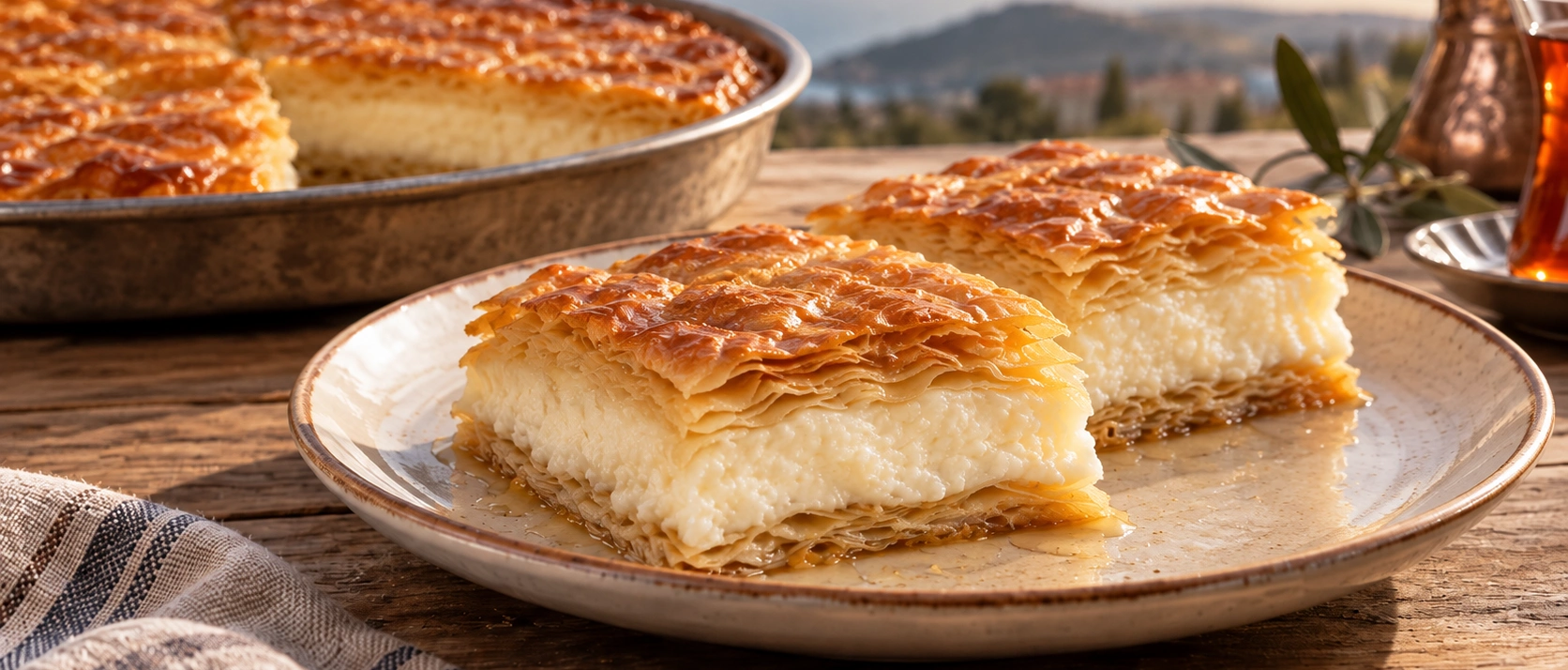
Balıkesir Kaymaklısı is most recognisable when a photograph reveals its browned pastry layers and the thick white band of buffalo kaymak through the centre.
Show the stacked yufka and central kaymak so the dessert's structure is immediately visible.
A round tray before cutting communicates the traditional preparation method and generous scale.
Photograph a clean 7 × 7 cm-style square to highlight the registered serving shape.
Focus closely on the thick buffalo-cream centre, the feature that separates the dessert from most syrup pastries.
A warm angled light helps reveal the golden-brown top and textured yufka surface.
Pair the dessert with a simple local table scene, tea or regional dairy products rather than overly elaborate styling.
Discover Balıkesir Kaymaklısı together with the city's dairy heritage, traditional sweets, protected regional foods and the wider culinary culture of Balıkesir Province.
Custom-designed private programs can combine central Balıkesir's food traditions with local markets, dairy specialities, Höşmerim, regional cheeses and other culinary stops according to your route and travel dates.
Explore Balıkesir through its protected desserts, buffalo dairy traditions, regional cheeses and the culinary stories that connect the city's food with its rural surroundings.
Request This Experience
Compare Balıkesir Kaymaklısı with Höşmerim, buffalo cream and other regional foods while discovering the province's unusually rich dairy and culinary heritage.
Request This Tour