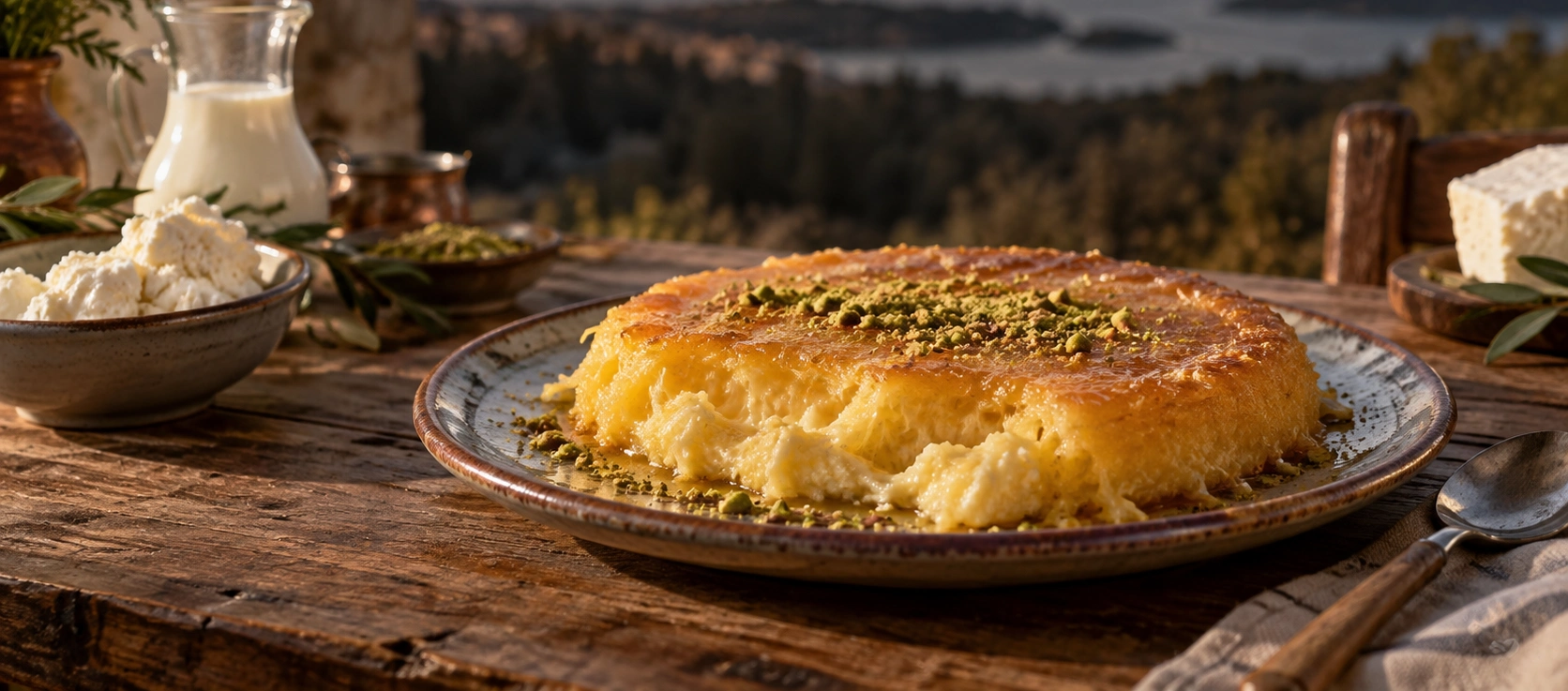
Freshly Curdled Milk
The traditional registered method begins by setting fresh raw milk with rennet to create the young cheese used in the dessert.






Balıkesir Höşmerim Tatlısı is one of the best-known traditional desserts of Balıkesir in western Türkiye. Unlike many Turkish sweets built around syrup, pastry or nuts, höşmerim begins with fresh milk and newly formed unsalted cheese, giving the dessert its distinctive dairy richness and soft, spoonable texture.
The registered Balıkesir version combines fresh curd made from raw milk with sugar, semolina and egg yolk. The mixture is cooked slowly until the cheese, whey, sugar and grain come together into a glossy golden dessert with a flavour somewhere between sweet fresh cheese, semolina pudding and a soft dairy helva.
Balıkesir Höşmerim Tatlısı is officially protected in Türkiye as a Mahreç İşareti geographical indication. TÜRKPATENT registration number 187 recognises the dessert's longstanding reputation, production knowledge and cultural association with Balıkesir.
Its defining character comes from freshly curdled unsalted cheese rather than flour, pastry or syrup alone.
Semolina thickens the dessert while sugar balances the mild dairy flavour of the fresh curd.
Balıkesir Höşmerim Tatlısı is registered in Türkiye as a Mahreç İşareti geographical indication.
Egg yolk and the cooking process help give traditional höşmerim its warm yellow-to-golden appearance.
Essential information about one of Balıkesir's most recognisable traditional desserts.
A traditional dessert strongly associated with Balıkesir Province in western Türkiye.
Open Balıkesir on Google MapsA sweet fresh-cheese dessert prepared with milk, sugar, semolina and egg yolk.
Soft, moist and spoonable, with fine curd and semolina giving the dessert body.
TÜRKPATENT geographical-indication registration number 187, registered as a Mahreç İşareti.
Höşmerim reflects the pastoral traditions, milk production and practical cooking knowledge that have long shaped Balıkesir cuisine.
Balıkesir is one of Türkiye's important livestock and dairy-producing provinces. Its culinary identity has been shaped by sheep, cattle and buffalo husbandry, fresh milk, regional cheeses, yoghurt, kaymak and a wide variety of dishes built around dairy products.
Höşmerim belongs naturally within this landscape. Instead of starting with a finished block of mature cheese, the traditional process begins by curdling fresh milk. The resulting young, unsalted curd remains moist and mild enough to become the foundation of a dessert.
The official geographical-indication registration describes Balıkesir Höşmerim as a product whose local identity comes primarily from human knowledge and tradition rather than from a unique natural ingredient available only in one place. That distinction is important: the dessert's character lies in the way the milk is curdled, the curd is broken, and the ingredients are cooked together.
The registration record also connects the dessert with the Ottoman period and identifies Balıkesir as the place with which this particular style became especially famous.
Today, höşmerim remains one of the foods most closely associated with a visit to Balıkesir. It can be found in local sweet shops, dairy shops, restaurants and packaged-food counters, while home cooks continue to prepare smaller household versions.
Its identity comes from the unusual combination of fresh curd, semolina, sugar and egg yolk cooked into a soft dairy dessert.
The traditional registered method begins by setting fresh raw milk with rennet to create the young cheese used in the dessert.
The cheese is mild and fresh, allowing sweetness and milk flavour to remain central rather than introducing a salty aged-cheese taste.
Semolina absorbs moisture and gives the finished dessert its characteristic thickness and soft granular structure.
Egg yolk contributes richness, colour and a fuller texture during cooking.
Traditional höşmerim is recognisable by its warm yellow or golden tone rather than the white colour of fresh curd.
The finished dessert remains moist and tender rather than becoming dry, brittle or sliceable like a baked helva.
Milk and fresh cheese remain perceptible beneath the generous sweetness, creating the dessert's unusual balance.
Continuous mixing and controlled heating are central to achieving an even texture without large curd pieces.
Höşmerim is a traditional Turkish dessert whose name is used for several regional sweets with very different recipes. In Balıkesir, however, the term most famously refers to a soft cheese-based dessert made from freshly curdled milk, sugar, semolina and egg yolk.
That makes Balıkesir höşmerim quite different from the flour-based, butter-based or syrup-based dishes also called höşmerim in other parts of Türkiye. The geographical-indication registration defines the Balıkesir style through its own ingredients and production sequence.
There is no baked crust and the texture is not created from cream cheese or a cake batter.
There is no rice. Semolina provides the grain element while fresh cheese gives the dessert its defining dairy body.
Although it is sometimes described as a type of cheese helva, its moist curd-based structure differs from classic flour or semolina helva.
The central idea is simple: turn newly formed mild cheese into a rich dessert before the curd develops the character of an aged cheese.
For travellers, the closest useful description is often sweet fresh cheese cooked with semolina—but the flavour and texture make much more sense after tasting it than after comparing it with another dessert.
Balıkesir Höşmerim Tatlısı is registered by the Turkish Patent and Trademark Office as a Mahreç İşareti, a form of Turkish geographical-indication protection used for products whose reputation, characteristics or traditional production knowledge are associated with a geographical place.
Balıkesir Höşmerim Tatlısı
TÜRKPATENT geographical-indication registration number 187.
The original application number is C2011/010.
The protected date recorded in the registration is 21 February 2011.
The current TÜRKPATENT record lists the registration date as 31 July 2015.
The registration holder is the Balıkesir Aşçı Köfteci ve Benzerleri Esnaf Odası.
An especially interesting detail is that the registry identifies Balıkesir as the geographical source area while listing the registered geographical boundary as Türkiye. The protection therefore centres on the recognised Balıkesir method and reputation rather than requiring every ingredient to originate within a narrowly defined Balıkesir production zone.
The official registration describes a remarkably simple formula. What makes the dessert distinctive is not a long list of flavourings but the relationship between fresh milk curd, sugar, semolina and egg yolk.
The registered description expresses the formula as approximately 50% raw milk, which is first transformed into fresh curd.
Approximately 40% of the registered ingredient ratio is sugar, explaining the dessert's unmistakably sweet profile.
Approximately 9% semolina provides thickness and helps bind the milk, curd and sugar.
The registration gives an approximate egg-yolk proportion of 0.98%.
A small amount of cheese rennet is used at the beginning of the registered method to set the fresh milk.
The historical registered specification includes a very small amount of permitted colouring, listed as riboflavin or tartrazine.
Traditional household recipes are not always identical to the large-scale registered formula. Some local recipes begin with ready-made fresh unsalted cheese, while others make the curd directly from milk. Flour, saffron or slightly different quantities may also appear in domestic versions.
The most important difference between Balıkesir höşmerim and many familiar sweets is the use of very fresh, unsalted curd. This is not cheese added as a garnish; the cheese is the structural foundation of the dessert itself.
Young curd has little of the sharpness or salt associated with aged cheeses, allowing it to work naturally with sugar.
Fresh cheese retains enough moisture to blend with semolina rather than producing a dry or crumbly dessert.
Breaking the curd into small particles helps distribute the cheese throughout the mixture instead of leaving large lumps.
Because the cheese is so fresh, the finished sweet retains an unmistakable milk-forward character.
The curd contributes protein, fat and body without requiring the dessert to be based on butter or cream alone.
Knowing when the milk has set sufficiently and how finely to break the curd is an important part of the production method.
The registered production method is described at a large batch scale, but the sequence clearly shows what defines traditional Balıkesir höşmerim: first create fresh curd, then cook that curd with its whey, egg yolk, sugar and semolina until the dessert becomes smooth and cohesive.
The continuous mixing is more than a practical detail. It keeps the curd pieces small, prevents uneven thickening and helps create the smooth yet recognisably dairy texture associated with good höşmerim.
Visitors searching for a Balıkesir höşmerim recipe will quickly notice that household recipes vary. This does not necessarily mean one version is wrong. Traditional foods often exist both as a formal registered product specification and as family recipes adapted to smaller kitchens.
Many home cooks begin with fresh unsalted cheese rather than curdling several litres of milk themselves.
Home recipes may use more or less semolina depending on the moisture of the cheese and the preferred final texture.
Balıkesir cultural sources also record household versions containing a modest quantity of flour alongside semolina.
Some traditional recipes mention saffron for colour, while others rely on egg yolk and cooking alone.
A home saucepan does not require the same heating times as a large commercial production kettle.
Experienced cooks watch the way the curd releases moisture, absorbs sugar and thickens rather than relying on one fixed clock time.
For travellers, the most useful point is that authentic local versions may not look perfectly identical. Fresh cheese, milk composition, semolina quantity and production scale naturally influence colour and consistency.
Balıkesir höşmerim is distinctly sweet, but the flavour is not simply sugary. Fresh curd gives it a soft milkiness and a faint cheese character, while semolina adds warmth and substance. Egg yolk rounds out the mixture and contributes to the dessert's golden appearance.
Sugar is a major part of the registered formula, so the dessert is noticeably sweeter than many milk puddings.
The flavour of fresh dairy remains evident because the cheese is young, mild and unsalted.
The curd gives höşmerim a recognisable cheese note without the sharpness of mature cheese.
Semolina adds a soft cereal flavour and keeps the dessert from tasting like sweetened cheese alone.
The combination of curd and egg gives a satisfying richness while the retained moisture keeps the dessert tender.
Because it is both dairy-rich and sweet, a relatively modest serving is usually enough to appreciate its character.
Good höşmerim should look very different from a dry semolina helva or a firm slice of cheese. Its texture is moist and cohesive, with fine curd and semolina forming a dense but spoonable mass.
The familiar colour ranges from soft yellow to deeper gold depending on the recipe, egg yolk and colouring used.
The dessert often has a slight sheen because it retains substantial moisture and dissolved sugar.
Semolina creates a gentle graininess that distinguishes höşmerim from a completely smooth custard.
The cheese particles should be small and well distributed rather than appearing as large rubbery pieces.
It is firm enough to hold a portion on a plate but soft enough to eat comfortably with a spoon.
The dessert is not whipped or aerated; its texture comes from cooked dairy solids and semolina.
One of Balıkesir's best-loved food stories explains the name through the phrase “Hoş mu, erim?”—roughly, “Is it good, my husband?” According to the popular tale, a woman prepared a quick sweet from fresh cheese, sugar, semolina and egg for her returning husband and repeatedly asked whether he liked it. Over time, the phrase is said to have become “höşmerim.”
It is a charming story and an important part of local culinary folklore, but it should be understood as a legend rather than a proven linguistic origin. Traditional dishes often accumulate memorable origin stories long after they have become part of everyday cooking.
The TÜRKPATENT registration states that the Balıkesir tradition has continued from the Ottoman period to the present. Local historical accounts also connect cheese-based sweets of this type with Türkmen and Yörük pastoral communities whose food culture made intensive use of milk, curd and other dairy products.
References linking höşmerim with early Türkmen settlement traditions and the Havran area are frequently repeated in Balıkesir cultural writing. These accounts fit the broader culinary logic of a mobile or semi-pastoral society: fresh milk was abundant, but it needed to be consumed or transformed quickly into curd, yoghurt, butter, kaymak or cheese.
Whatever the exact point of origin, the modern identity is clear. Höşmerim has become one of Balıkesir's signature foods and is recognised nationally through geographical-indication protection.
The district of Havran, near the Edremit Gulf, is especially closely associated in local tradition with höşmerim. Cultural accounts frequently connect the dessert with Türkmen and Yörük communities in and around Havran and describe it as one of the district's symbolic foods.
Havran's connection is particularly interesting because it sits between Balıkesir's inland pastoral world and the olive-growing culture of the North Aegean coast. In a relatively small geographical area, visitors encounter dairy farming, village agriculture, olive oil, fruit growing and traditional sweets—all of which help explain the diversity of Balıkesir cuisine.
Local narratives often relate höşmerim to the dairy-rich food traditions of Türkmen and Yörük communities.
Milk and fresh cheese provide the practical foundation for a dessert that could emerge naturally from a pastoral kitchen.
Havran lies close to Edremit and the Kazdağları region, placing the dessert tradition within a remarkably varied food landscape.
Höşmerim continues to be promoted as a characteristic local flavour rather than only as a historical recipe.
No. The name höşmerim or closely related forms appear in several parts of Türkiye, but the recipes can be dramatically different. Some versions use cheese, while others are based on flour, butter, milk, kaymak, honey or syrup.
This is precisely why the full name Balıkesir Höşmerim Tatlısı matters. It identifies a specific culinary tradition rather than suggesting that every Turkish dessert called höşmerim follows the same formula.
Fresh-curd, sugar, semolina and egg yolk define the best-known Balıkesir style.
Some regions also prepare cheese-based sweets, but ingredient ratios and cooking methods may differ significantly.
Elsewhere, the same name can describe a pan-cooked sweet based primarily on flour and fat.
Regional traditions may sweeten their höşmerim with honey or syrup rather than building it around fresh curd and granulated sugar.
Balıkesir höşmerim is sometimes described in Turkish as a form of peynir helvası, or cheese helva. The expression is helpful because both belong to a family of sweets in which fresh cheese is cooked with sugar and a grain-based thickener.
However, “peynir helvası” is not one single national recipe. Different regions use different cheeses, grains, proportions and finishing methods. Some cheese helvas are firmer, more browned or baked, while Balıkesir höşmerim is typically softer and more moist.
Höşmerim does not need elaborate presentation. Its attraction lies in the flavour of the dairy base and the unusual soft texture, so simple serving styles usually work best.
Many commercial and local versions are enjoyed after cooling, when the texture has settled and the dairy flavour is clear.
The soft texture makes a dessert spoon more natural than trying to eat it like a firm pastry.
Try the first bites without toppings so you can understand the balance of cheese, semolina and sugar.
Unsweetened black tea provides an excellent counterpoint to the dessert's intense sweetness.
Because the dessert is concentrated and sweet, a modest serving is often more satisfying than a very large plate.
Höşmerim makes a memorable finish after tasting Balıkesir köfte, regional vegetables, local cheeses or olive-oil dishes.
Höşmerim is widely available in Balıkesir, but quality can vary. Look for producers and sellers who treat it as a fresh dairy dessert rather than simply as a generic packaged sweet.
For the protected style, look for the wording Balıkesir Höşmerim Tatlısı.
Fresh milk or cheese, sugar, semolina and egg yolk should make sense within the product's traditional character.
Registered producers may display the appropriate Turkish geographical-indication marking with the protected name.
Because höşmerim is dairy-based, follow the producer's refrigeration and storage instructions carefully.
A fresh local portion and a sealed packaged version can have slightly different textures because they are intended for different serving and transport conditions.
In Balıkesir and Havran, local food shops can often explain which producers specialise in traditional höşmerim.
Höşmerim contains fresh dairy and egg, so it should be treated with the same care as other perishable milk-based desserts. Storage requirements can differ between freshly prepared and commercially packaged products.
The provincial capital is one of the easiest places to compare traditional sweet shops and local food sellers.
Havran has a particularly strong cultural association with the dessert and the region's pastoral food traditions.
Using the full local name helps distinguish it from other Turkish sweets also called höşmerim.
Try it plain first so you can appreciate the characteristic fresh-cheese flavour.
A glass of unsweetened Turkish tea balances the sweetness particularly well.
Texture can range from very soft and creamy to slightly firmer and more semolina-forward.
Packaged versions may be easier to carry, but storage instructions and border rules still matter.
Höşmerim makes more sense when tasted alongside the province's cheeses, buffalo cream, olives and olive oils.
Balıkesir's cuisine is unusually diverse because the province stretches across both Marmara and Aegean cultural landscapes. Inland livestock farming, coastal olive cultivation, fertile agricultural plains and migration traditions all contribute different ingredients and cooking styles.
Höşmerim represents the dairy side of that story. It transforms fresh milk into a dessert through a technique that depends on cheese-making knowledge, careful heat and patient stirring. In that sense, it sits naturally beside Balıkesir's cheeses, yoghurt and buffalo cream while remaining unmistakably a sweet.
The dessert reflects a province where milk and cheese production have long been important parts of rural life.
Curdling milk and working with fresh cheese require practical skills developed through repeated household and artisanal production.
Balıkesir culinary sources describe a wider tradition in which local dishes and sweets are prepared for weddings, communal meals and other gatherings.
Few desserts are as immediately associated with the name Balıkesir as höşmerim.
Geographical-indication registration formally recognises the connection between the dessert's reputation and Balıkesir.
Höşmerim is not only displayed as heritage; it remains a dessert people buy, serve and eat today.
Höşmerim is only one part of Balıkesir's culinary identity. The province combines strong dairy traditions with some of Türkiye's most important olive-growing districts, creating an unusually broad tasting landscape.
Compare sweet höşmerim with protected Balıkesir Manda Kaymağı, another exceptionally rich expression of local dairy culture.
Taste fresh and aged cheeses to understand the dairy traditions from which a cheese-based dessert such as höşmerim could develop.
Explore the completely different food landscape of the North Aegean coast through its protected olive-oil tradition.
Discover another regional speciality shaped by local agriculture, patient preparation and geographical identity.
Do not confuse höşmerim with Balıkesir Kaymaklısı, a different traditional pastry and dessert from the same province.
A generous Balıkesir breakfast can bring together cheese, olives, honey, kaymak, bread and other products that reveal the province's agricultural diversity.
A search for local flavours can easily be combined with the historic centre of Balıkesir, nearby countryside and the wider North Aegean region.
See one of the landmarks of central Balıkesir while exploring the streets, markets and food shops of the provincial capital.
Discover surviving traditional architecture and add cultural context to a day focused on local food.
Combine a city visit with woodland scenery and an easy countryside escape near central Balıkesir.
Explore one of Balıkesir's well-known thermal districts and discover another part of the province's agricultural landscape.
Travel toward the North Aegean coast for mountain scenery, village food traditions and olive-growing landscapes.
If a dedicated Havran page is part of your route, connect the district's local history with the höşmerim tradition so often associated with it.
It is a traditional sweet made from freshly curdled milk or fresh unsalted cheese, sugar, semolina and egg yolk, strongly associated with Balıkesir in western Türkiye.
Yes. Fresh cheese or curd is the defining ingredient and forms the base of the dessert rather than appearing only as a topping or filling.
Yes. Balıkesir Höşmerim Tatlısı is registered by the Turkish Patent and Trademark Office as a Mahreç İşareti geographical indication.
The TÜRKPATENT registration number is 187.
The application number is C2011/010 and the application / protection date recorded in the registration is 21 February 2011.
The current TÜRKPATENT record lists the registration date as 31 July 2015.
The registration holder is Balıkesir Aşçı Köfteci ve Benzerleri Esnaf Odası.
The registered product is based on raw milk transformed into fresh curd, together with sugar, semolina, egg yolk and a very small amount of colouring in the historical specification.
Fresh unsalted cheese. It gives the dessert its dairy flavour, moist body and texture unlike ordinary semolina helva or milk pudding.
Yes. Semolina is part of the registered formula and helps thicken and bind the dessert.
Yes. Egg yolk is included in the registered production method.
Yes. Sugar forms a substantial part of the traditional registered formulation, although the fresh dairy flavour keeps the dessert from tasting like sugar alone.
It is sweet, milky and rich, with a mild fresh-cheese flavour and the warm grain character of semolina.
It is typically moist, dense and spoonable with fine curd and a gentle semolina grain rather than a dry or crumbly texture.
Egg yolk contributes natural colour, and the historical registered specification also allows a tiny amount of permitted colouring. Some household recipes mention saffron.
In the registered method, fresh raw milk is set with rennet for approximately 20–25 minutes and the resulting curd is then broken into small pieces.
The small pieces can disperse throughout the dessert, helping prevent large cheese lumps and creating a more even texture.
The registration describes adding sugar when the mixture reaches approximately 65°C.
The registered large-batch process adds semolina when the mixture reaches approximately 85°C.
The registered large-scale method describes approximately one to one and a half hours of cooking after the semolina is incorporated, with continued mixing.
No. Household versions vary. Some begin with ready-made fresh cheese and some use flour or saffron, while the geographical-indication document defines the formal registered method.
No. Semolina is used, but the fresh cheese base and moist cooking method create a very different dessert.
No. It has no crust and is not baked as a cake. Fresh curd is cooked directly with sugar, semolina and egg yolk.
The terms can overlap and höşmerim is sometimes described as cheese helva, but regional peynir helvası recipes vary. Balıkesir Höşmerim has its own registered formulation and technique.
No. Desserts called höşmerim exist in other Turkish regions, but their ingredients and methods can be very different. The protected Balıkesir style is specifically associated with its fresh-curd method.
A popular local legend says a woman asked her husband “Hoş mu, erim?” after serving him the dessert. It is a beloved story, but it should be treated as folklore rather than proven etymology.
The TÜRKPATENT registration describes the Balıkesir tradition as having reached the present from the Ottoman period.
Havran is strongly associated in local cultural accounts with the dessert and with Türkmen/Yörük dairy traditions in the Balıkesir region.
Look for established sweet shops, dairy shops, local-food stores and restaurants in Balıkesir and surrounding districts, especially places that identify the product specifically as Balıkesir höşmerimi.
It is commonly eaten cool or at room temperature according to the producer's instructions, usually in a small portion with a spoon.
Unsweetened Turkish tea is an excellent pairing because its slight bitterness balances the dessert's richness and sweetness.
Fresh höşmerim is a dairy-and-egg dessert and should be stored according to the producer's refrigeration instructions. Packaged products should always be kept exactly as stated on their labels.
Packaged versions can be practical souvenirs if their storage requirements can be maintained. International travellers should also check dairy-product import rules at their destination.
It brings together the province's dairy heritage, local cooking knowledge and long-established culinary reputation, making it one of Balıkesir's most recognisable food symbols.
Höşmerim is visually simple, so the strongest photographs focus on texture, warm colour and its connection to Balıkesir's dairy culture.
Photograph the fine curd and semolina structure with side lighting so the surface does not appear flat.
A spoon lifting a soft portion communicates the dessert's moist texture more effectively than a distant plate shot.
Simple ceramics and natural surfaces keep attention on the dessert rather than overwhelming it with decoration.
A tulip-shaped glass of Turkish tea beside the yellow dessert creates a recognisable local food scene.
Where permission is available, images of milk, fresh curd or artisanal production can explain what makes the dessert unusual.
Combine höşmerim with local tableware, regional foods or subtle Balıkesir details to give the image a stronger sense of place.
Discover höşmerim alongside Balıkesir's cheeses, buffalo cream, markets, olive traditions, historic streets and beautiful rural landscapes.
Custom-designed private programs can combine regional food tastings, historic neighbourhoods, markets, dairy traditions and selected countryside stops according to season and availability.
Explore Balıkesir through höşmerim, regional cheeses, buffalo kaymak, local markets, protected foods and the culinary traditions connecting the Marmara and Aegean regions.
Request This Experience
Combine Balıkesir's historic centre, traditional houses, local markets and regional food culture on a flexible private journey designed around your interests.
Request This Tour